By Zhang Shuo
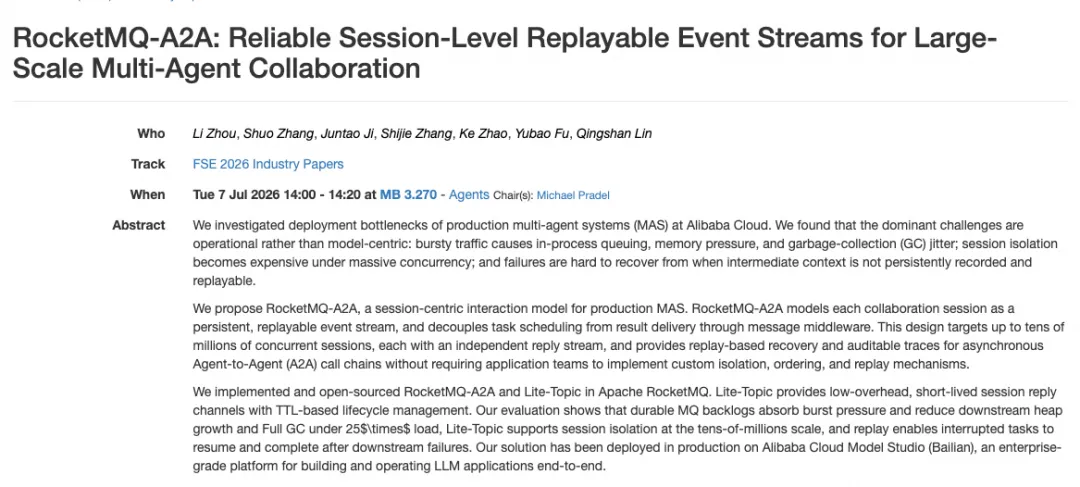
The Alibaba Cloud Messaging team's RocketMQ-A2A paper joins the FSE 2026 Industry Papers Track. Its full title: Reliable Session-Level Replayable Event Streams for Large-Scale Multi-Agent Collaboration.
ACM FSE is a CCF-A top software engineering conference. FSE 2026 ran July 5–9 in Montreal. Its Industry Papers Track highlights software engineering research applied in real industrial settings.
The paper tackles reliable collaboration as multi-agent systems (MAS) move from demo to production. It proposes RocketMQ-A2A, an interaction paradigm built on session-level replayable event streams. It answers one question: in production, who reliably carries messages, state, and session isolation? Production means massive sessions, burst traffic, and constant failures.
MAS is moving from lab demos to real production traffic. A demo needs a few Agents to complete one chain. Production means massive concurrent sessions, unpredictable bursts, and sudden crashes. It also demands full traceability of every collaboration.
Alibaba Cloud serves multiple production MAS deployments. The constraint on scale-out is rarely whether one inference is correct. It is whether the whole chain is reliable, scalable, and recoverable. Four bottlenecks dominate:
• Burst handling: bursts queue inside Worker processes, amplifying memory growth and jitter;
• Session isolation: under massive short sessions, the "one Topic per session" model explodes control-plane cost;
• Recovery: non-persistent calls leave long-chain tasks unable to resume after a crash;
• Auditability: unstructured logs can't supply replayable interaction evidence for debugging and audit.
These aren't solved by tuning prompts or reshuffling Agent roles. Communication and state semantics must be first-class citizens. Production MAS needs more than an Agent framework. It needs recoverable, auditable, session-level async communication. That is the paper's focus.
The contribution spans two layers. First, LiteTopic: a lightweight event-queue model on RocketMQ. Second, RocketMQ-A2A: an interaction paradigm built on it, centered on session-level replayable event streams.
Traditional Topics carry heavy creation and management overhead. They can't support massive short-lived sessions. LiteTopic is a lightweight queue model with four properties:
• Dynamic create/destroy: create by any name (session ID, task ID) on demand; no preconfig; TTL auto-reclaims.
• Low-cost isolation: far cheaper to create and maintain than a normal Topic, supporting massive lightweight session channels.
• Precise subscription: each Consumer freely subscribes to any LiteTopic set, flexibly organizing delivery.
• Ordered messaging: messages within a LiteTopic are delivered in order.
The paradigm shift is this. Turn A2A-style async interaction into a persistent, replayable session-level event stream. The messaging system fully decouples task scheduling from result return. The Supervisor no longer blocks on a Worker's long task. It advances the session state machine by events.
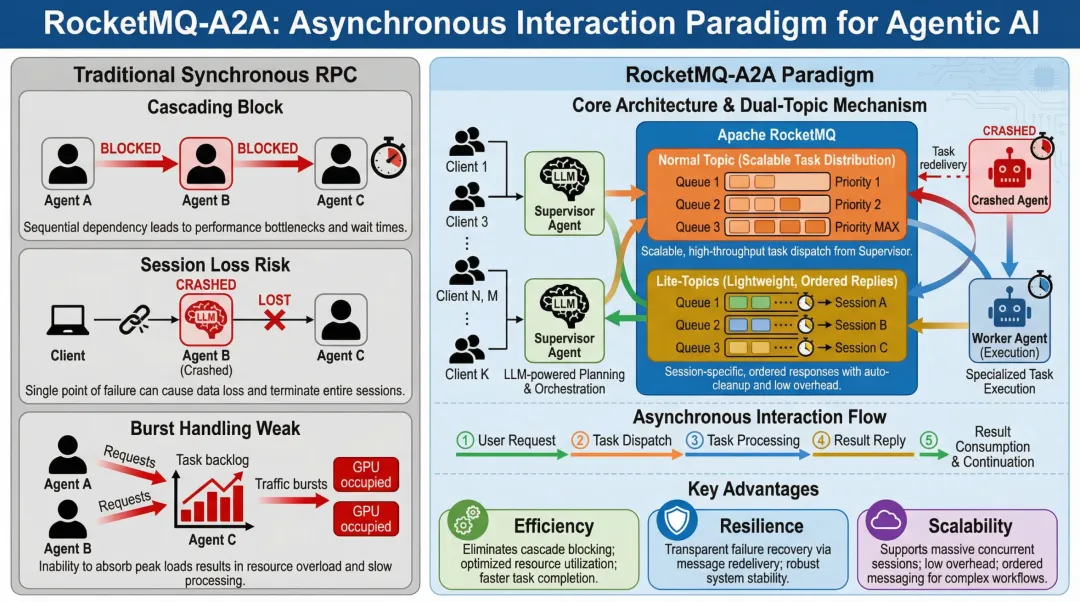
Built on the normal queue plus the lightweight queue, RocketMQ-A2A forms a fully async architecture:
• Topic: high-throughput task dispatch from Supervisor to Workers. Bursts enter the MQ backlog; multiple Workers consume statelessly at their own pace, avoiding in-process buildup.
• LiteTopic: the return channel. Workers write results and state events back to the Supervisor. Lightweight isolation decouples session identity from physical storage, avoiding metadata explosion, while providing an ordered, durable, replayable result stream.
• Session-level replay recovery: after a Supervisor crash, replay the session's LiteTopic from the last interruption. Tasks resume instead of restarting, and structured, searchable, auditable interaction logs accumulate.
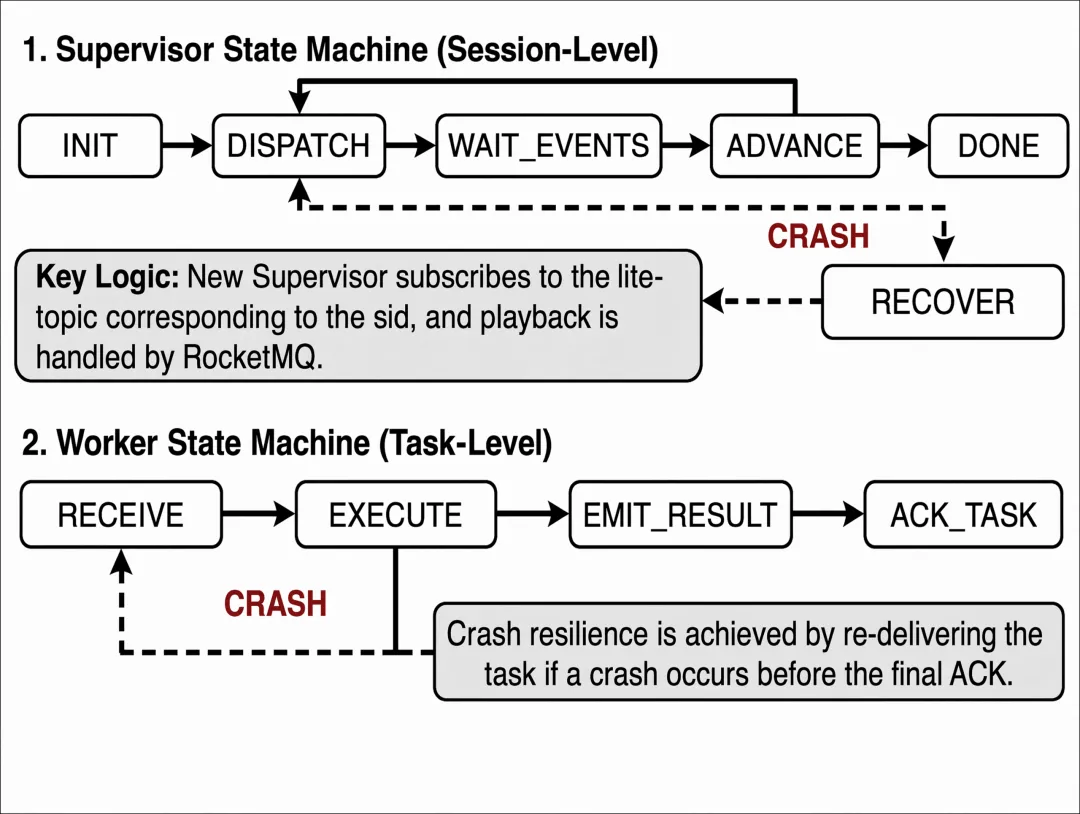
Supervisor and Worker each own an independent state machine. Both transition via MQ messages. The call chain between roles is fully decoupled. With message backlog and durability, RocketMQ-A2A becomes an event-driven, scalable, failure-transparent async A2A architecture.
Results. Under 25× overload, RocketMQ-A2A externalizes burst backlog to the durable queue. Old-gen peak grows just 8.2%. By contrast, HTTP async RPC grows 456.6%, and pure A2A grows 1366.1%. Across 12 fault-injection configs, it hits 100% end-to-end task completion. A 10-Broker cluster sustains 15M concurrent LiteTopics at 50k TPS. The traditional per-session-Topic model fails at 20k channels. LiteTopic at 200k channels holds ~15 ms latency with stable CPU.
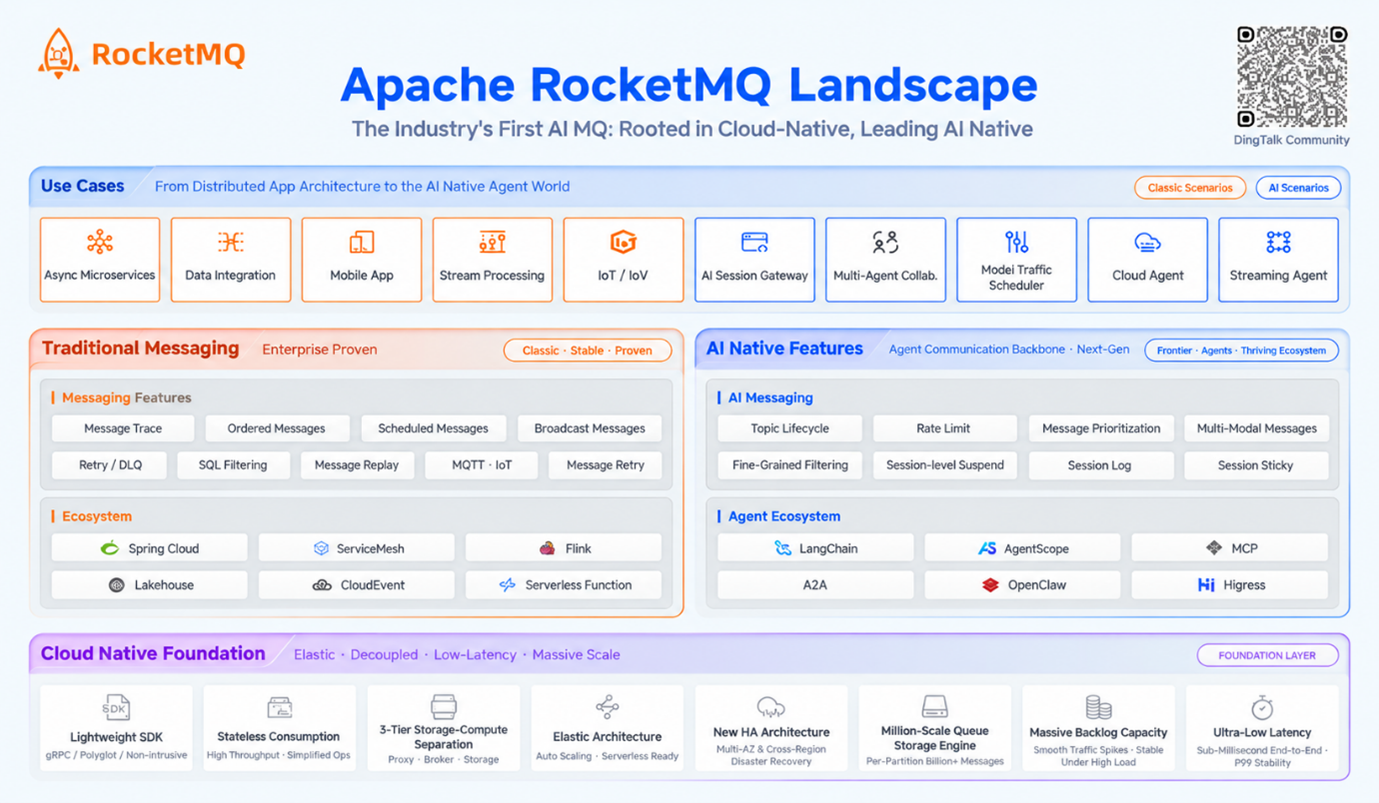
LiteTopic and RocketMQ-A2A are open-sourced to Apache RocketMQ. They run in production on Alibaba Cloud Model Studio (Bailian), powering reliable collaboration for enterprise model services and agent apps.
Bailian serves millions of tenants. They call dozens of LLMs like Qwen concurrently. GPU scarcity plus burst spikes demand precise flow control. Traditional "slice resources per customer" throttling scales cost linearly with customers. One tenant's anomaly bleeds into others.
LiteTopic is lightweight, isolated, and dynamically suspendable. Bailian used it to build a distributed leaky-bucket matrix. Each tenant gets independent, on-demand, fine-grained governance. Flow-control cost dropped 10×. User-perceived throttling anomalies fell sharply.
Qoder Cloud Agents is a Serverless cloud Agent hosting platform. RocketMQ underpins its large-scale agent collaboration. Cloud Agent load has three traits: long-running tasks, massive in-flight sessions, and high-QPS events. A "session-bound Worker" architecture keeps compute occupied during waits. Cost and elasticity are hard to balance.
The team built a "brain-body separated" distributed Agent architecture on RocketMQ. Session is the ordered isolation boundary. It decouples state advancement, async handoff, and on-demand compute. The platform supports 10k-level inference concurrency. It releases compute while waiting. On event arrival, any node resumes within seconds. Cost, performance, and experience stay in balance.
RocketMQ's Agent practice marks its evolution from traditional messaging toward AI-Native. It keeps expanding new ecosystems and capabilities for the AI era.
From classic business middleware to AI-Native MQ, RocketMQ redefines messaging's core value. Not just delivering messages. It carries Agent collaboration, state management, and communication infrastructure.
• Title: RocketMQ-A2A: Reliable Session-Level Replayable Event Streams for Large-Scale Multi-Agent Collaboration
• Authors: Zhou Li, Zhang Shuo, Ji Juntao, Zhang Shijie, Zhao Ke, Fu Yubao, Lin Qingshan (all Alibaba Cloud)
• Abstract: The paper studies deployment bottlenecks in Alibaba Cloud production MAS. The dominant challenges are operational, not model-level: bursts cause in-process queuing, memory pressure, and GC jitter; session isolation is costly at scale; unpersisted context is unrecoverable after failure. It proposes RocketMQ-A2A, a session-level paradigm modeling each collaboration session as a persistent, replayable event stream. It decouples task scheduling from result return via messaging, supporting tens of millions of concurrent sessions with per-session reply streams, replay-based recovery, and auditable tracing.
DingTalk group (RocketMQ for AI): 110085036316

Toward Production-Grade AgenticOps: How STAROps Builds Generalizable Root Cause Analysis

771 posts | 60 followers
FollowAlibaba Cloud Native Community - April 23, 2026
ApsaraDB - May 8, 2026
Alibaba Cloud Native Community - September 29, 2025
Alibaba Cloud Native Community - January 22, 2026
Alibaba Cloud Native Community - December 11, 2025
Alibaba Clouder - April 20, 2020
771 posts | 60 followers
Follow ApsaraMQ for RocketMQ
ApsaraMQ for RocketMQ is a distributed message queue service that supports reliable message-based asynchronous communication among microservices, distributed systems, and serverless applications.
Learn More
ApsaraMQ for MQTT
A message service designed for IoT and mobile Internet (MI).
Learn More
Message Queue for RabbitMQ
A distributed, fully managed, and professional messaging service that features high throughput, low latency, and high scalability.
Learn More Message Queue for Apache Kafka
A fully-managed Apache Kafka service to help you quickly build data pipelines for your big data analytics.
Learn MoreMore Posts by Alibaba Cloud Native Community

