The AI revolution is accelerating, and autonomous agents are becoming essential tools for businesses and developers alike. However, deploying AI agents has traditionally required complex infrastructure setup, security considerations, and ongoing maintenance. Alibaba Cloud's OpenClaw Managed Solution addresses these challenges by offering a streamlined, secure, and cost-effective way to deploy OpenClaw—an open-source AI agent framework—on Simple Application Server (SAS).
Alibaba Cloud is the digital technology and intelligence backbone of Alibaba Group, and one of the world's leading cloud computing providers. Founded in 2009, it has grown to become the largest cloud provider in Asia Pacific and ranks among the top providers globally. Serving millions of customers, Alibaba Cloud operates 92 availability zones in 29 regions worldwide.
The company offers a comprehensive suite of cloud services including computing, storage, networking, security, databases, and cutting-edge AI/ML capabilities. Alibaba Cloud is particularly recognized for its leadership in:
With its deep expertise in handling massive-scale workloads and commitment to open-source technologies, Alibaba Cloud is uniquely positioned to bring enterprise-grade AI agent capabilities to businesses of all sizes.
With the recent surge in OpenClaw interests in China, Alibaba Cloud is poised to capitalize on this momentum by positioning itself as the trusted backbone for scalable AI innovation. Leveraging its deep expertise in cloud-native infrastructure, cross-border data solutions, and enterprise-grade security, Alibaba Cloud can accelerate adoption across industries—empowering businesses to deploy OpenClaw seamlessly while ensuring compliance with local and global standards. This convergence of market demand and technological capability places Alibaba Cloud at the forefront of shaping China’s next wave of AI-driven transformation.
OpenClaw is an open-source autonomous AI agent framework that enables the creation of intelligent agents capable of understanding natural language instructions, planning complex tasks, and executing them using various tools and integrations. Think of it as an operating system for AI agents—providing the infrastructure, memory, tools, and orchestration needed to turn large language models into autonomous workers.
Natural Language Understanding: Agents can comprehend complex instructions in plain English (and other languages)
Task Planning and Execution: Breaks down complex goals into actionable steps and executes them sequentially
Memory Management: Maintains both short-term context and long-term knowledge across conversations
Tool Integration: Connects with external services, APIs, databases, and applications
Multi-Agent Collaboration: Supports multiple agents working together on complex workflows
One of the standout features of OpenClaw is the Work Agent—a cross-application workflow automation tool that acts as your intelligent office assistant. It combines rich skills with the ability to work across multiple applications, making it ideal for both enterprises and individual users looking to automate repetitive tasks.
1. Workflow Automation
-Automating repetitive office tasks across multiple applications
-Data entry and form processing
-Report generation and distribution
-Email management and response drafting
2. Software Development
-Code generation and review
-Automated testing and debugging
-Documentation generation
-Git workflow management
3. Data Analysis and Research
-Web scraping and data collection
-Market research and competitive analysis
-Document summarization and extraction
-Trend analysis and reporting
4. Customer Service
-Intelligent ticket routing and response
-FAQ automation with contextual understanding
-Multi-channel support integration
-Escalation handling
5. Content Creation
-Drafting blog posts, emails, and social media content
-Image and video processing workflows
-Translation and localization
-Content scheduling and publishing
6. DevOps and IT Operations
-Server monitoring and alerting
-Automated deployment pipelines
-Log analysis and troubleshooting
-Infrastructure management
OpenClaw features a sophisticated multi-layer architecture designed for flexibility, security, and extensibility:
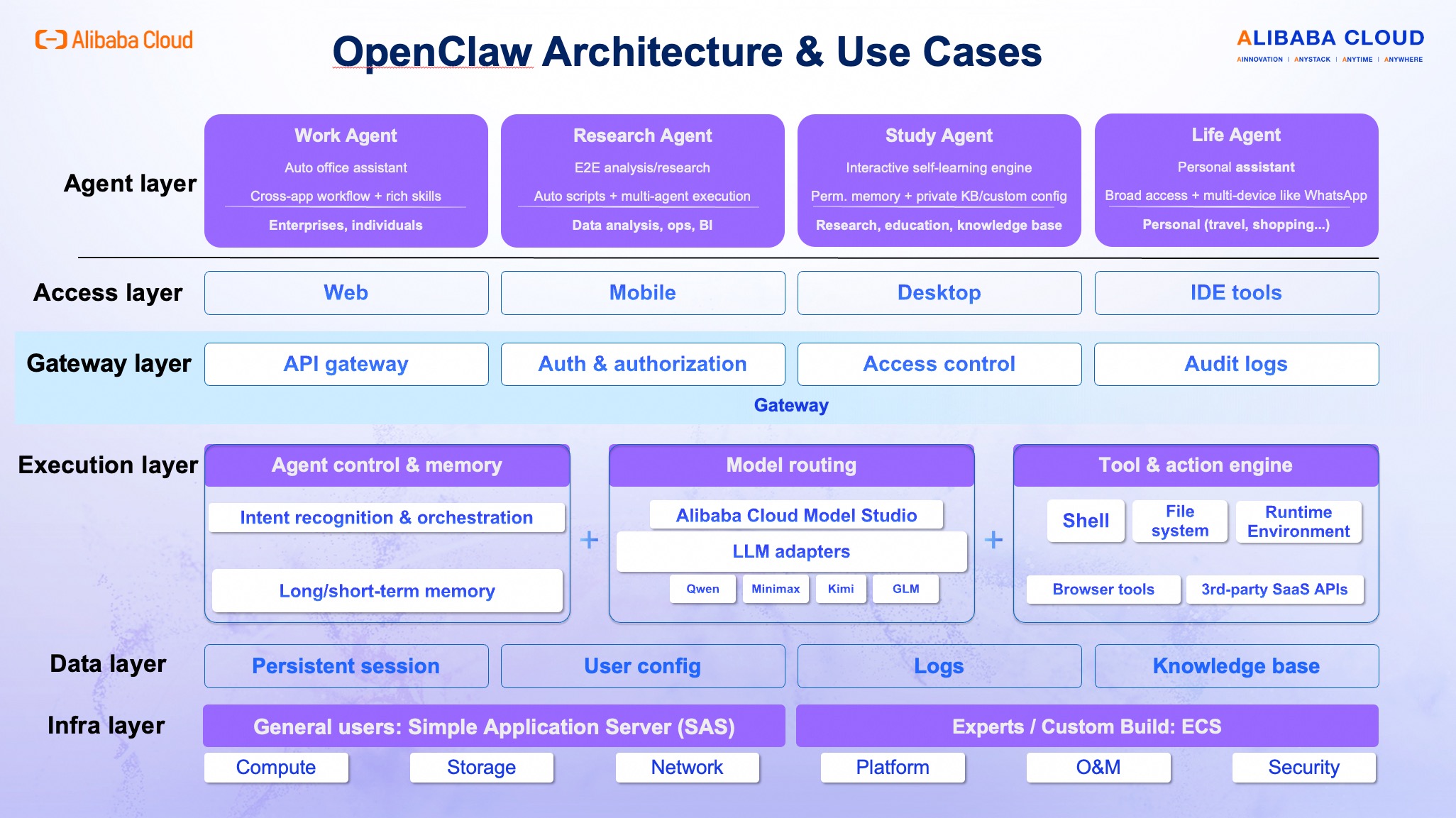
Supports multiple interfaces including web, mobile, desktop, and IDE tools, making it accessible from virtually any environment.
Provides essential enterprise-grade capabilities:
-API gateway for request management
-Authentication and authorization
-Access control policies
-Comprehensive audit logs
The core intelligence of the system:
Intent Recognition & Orchestration: Understands and routes user requests
Agent Control & Memory: Manages both long-term and short-term memory for contextual conversations
Model Routing: Connects to various LLM providers through adapters
Tool & Action Engine: Executes tasks through integrated tools
Ensures persistence and knowledge management:
-Persistent session storage
-User configuration management
-Comprehensive logging
-Knowledge base integration
Flexible deployment options:
General Users: Simple Application Server (SAS) for quick deployment
Experts/Custom Builds: Elastic Compute Service (ECS) for advanced configurations
OpenClaw supports multiple leading LLM providers through Alibaba Cloud Model Studio:
-Qwen (Alibaba Cloud's flagship model)
-Minimax
-GLM
-Kimi
OpenClaw comes with rich built-in tools:
-Shell command execution
-File system operations
-Browser automation (headless Chrome)
-Third-party SaaS API integration
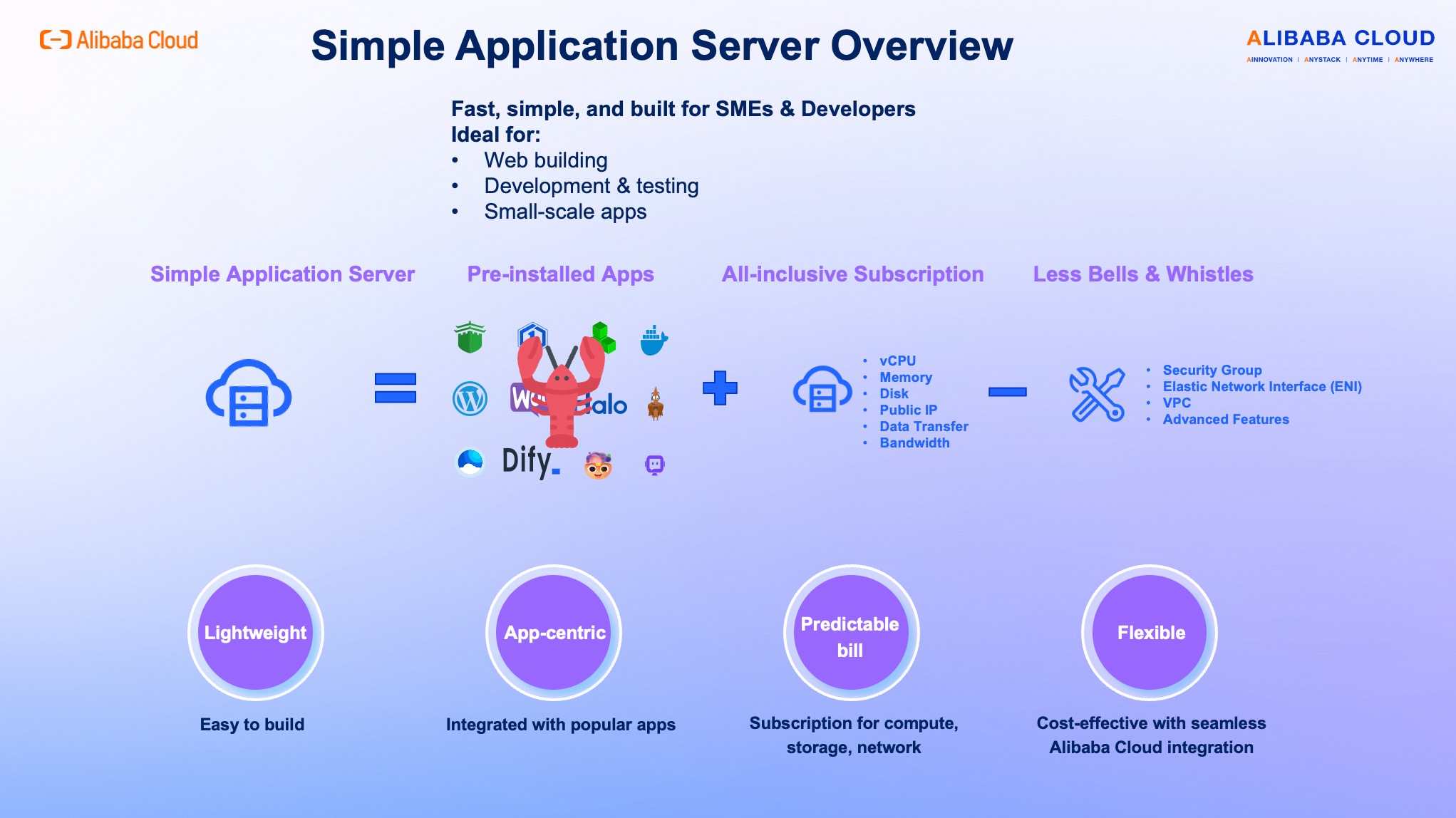
Simple Application Server (SAS) is Alibaba Cloud's lightweight, all-in-one cloud server solution designed specifically for developers, small businesses, and single-application deployments. It is especially suited for OpenClaw deployments. It represents a simplified version to the traditional Elastic Compute Service (ECS) instances.
All-Inclusive Packaging
Unlike traditional cloud servers where you provision and pay for compute, storage, and networking separately, SAS bundles everything into a single subscription:
-vCPU and memory resources
-System disk (eSSD storage)
-Public IP address (IPv4)
-Data transfer & bandwidth allowance
Application-First Design
SAS comes with pre-configured application images including WordPress, LAMP stacks, Node.js environments, and now—OpenClaw. This means you can deploy a working application in minutes rather than hours.
Predictable Pricing
With fixed monthly pricing starting as low as $0.99 (promotional), SAS eliminates the surprise bills often associated with pay-as-you-go cloud services.
Simplified Management
A streamlined console provides essential management capabilities without overwhelming users with hundreds of configuration options. Perfect for those who want to focus on their application, not infrastructure management.
-Building websites and web applications
-Development and testing environments
-Learning and experimentation
-Small-to-medium production workloads
-AI agent deployment with predictable resource needs
As your needs grow, Alibaba Cloud provides a seamless upgrade path to Elastic Compute Service (ECS) for:
-Larger-scale deployments requiring more than 16 vCPUs
-Complex networking requirements
-Custom operating system configurations
-Advanced security and compliance needs
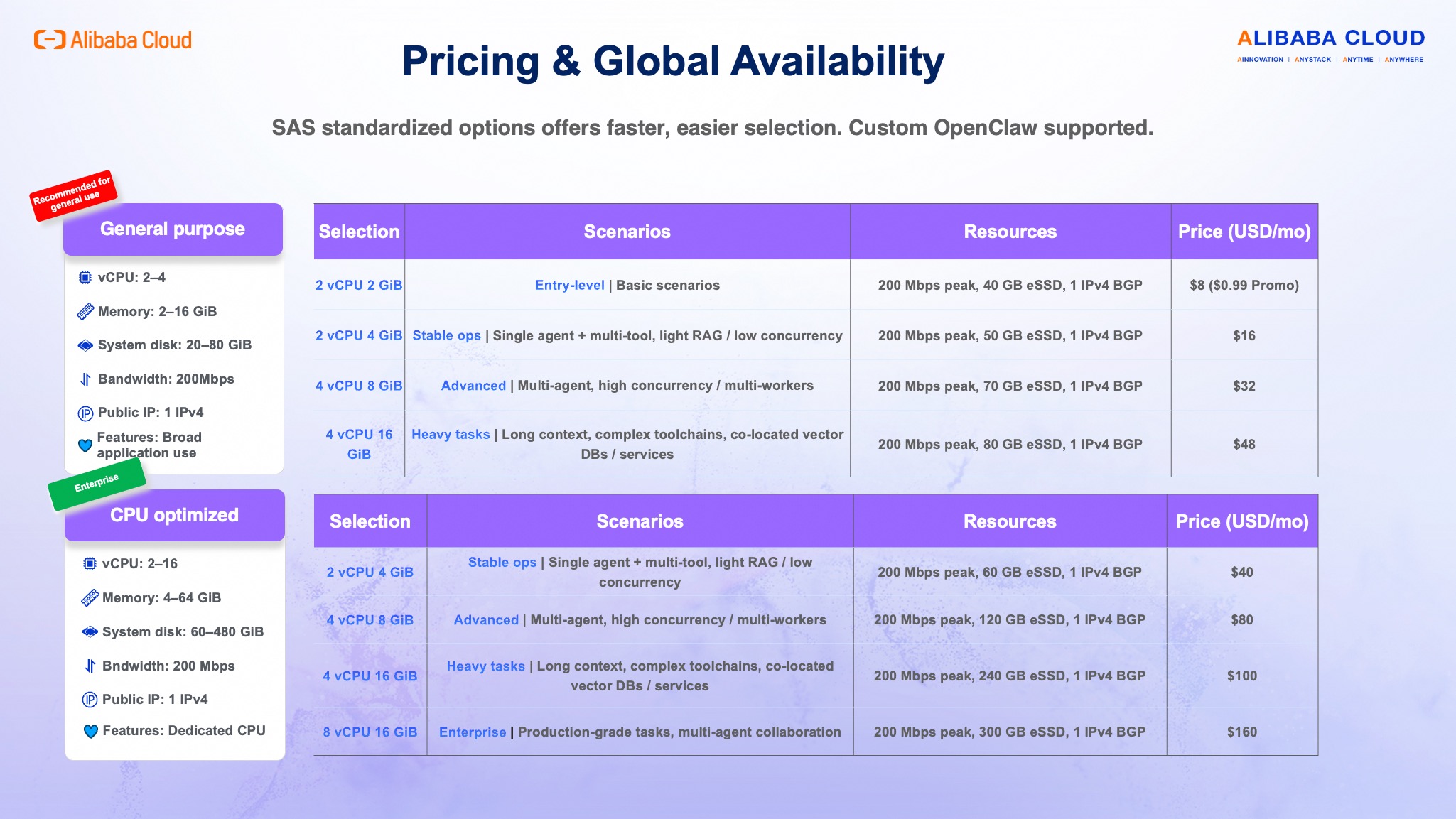
SAS offers two distinct instance families, each optimized for different workload characteristics:
Characteristics:
-Balanced vCPU-to-memory ratio (typically 1:1 or 1:2)
-Shared CPU resources with other tenants
-Cost-effective for most applications
Best For:
-Standard web applications
-Development and testing environments
-Light-to-moderate AI agent workloads
-Applications with variable traffic patterns
-Budget-conscious deployments
Available Configurations:
-2 vCPU / 2 GiB to 4 vCPU / 16 GiB
-System disk: 20–80 GiB eSSD
Characteristics:
-Higher vCPU-to-memory ratio (1:2 to 1:4)
-Dedicated CPU resources (no sharing)
-Consistent, predictable performance
-Higher compute density per dollar
Best For:
-Compute-intensive AI model inference
-High-concurrency agent deployments
-Applications requiring consistent response times
-CPU-bound workloads (data processing, encoding)
-Production environments where performance predictability matters
Available Configurations:
-2 vCPU / 4 GiB to 16 vCPU / 64 GiB
-System disk: 60–480 GiB eSSD
Choose General Purpose when:
-Cost is a primary concern
-Workloads have variable resource needs
-You're experimenting or in development
-Peak performance isn't critical
Choose CPU Optimized when:
-Running multiple agents concurrently
-Processing large documents or datasets
-Response time consistency is important
-Production workloads with predictable traffic
SAS offers flexible pricing tiers to match different needs:
| Configuration | Use Case | Price (USD/month) |
|---|---|---|
| 2 vCPU, 2 GiB | Entry-level, basic scenarios | $8 ($0.99 Promo) |
| 2 vCPU, 4 GiB | Single agent + multi-tool, light RAG | $16 |
| 4 vCPU, 8 GiB | Multi-agent, high concurrency | $32 |
| 4 vCPU, 16 GiB | Long context, complex toolchains | $48 |
All configurations include:
-200 Mbps peak bandwidth
-eSSD storage (40-70+ GB)
-1 IPv4 BGP address
The baseline 2GB memory configuration is designed to handle basic OpenClaw deployments, but understanding memory requirements helps you choose the right specification:
1. Base System Overhead (500MB–1GB)
-Operating system and system services
-OpenClaw core framework
-Gateway and access layer components
2. LLM Context and Token Handling (Variable)
-Conversation history and context windows
-Prompt engineering templates
-Response buffering
3. Tool Execution (256MB–1GB+)
-Browser automation (headless Chrome)
-File system operations
-Code execution environments
-Third-party API integrations
4. Knowledge Base and RAG (Retrieval-Augmented Generation) (512MB–4GB+)
-Vector database for embeddings
-Document storage and indexing
-Search and retrieval operations
5. Multi-Agent Coordination (256MB per agent)
-Additional agents running concurrently
-Inter-agent communication overhead
-Shared memory spaces
| Configuration | Best For | Limitations |
|---|---|---|
| 2 vCPU, 2 GiB | Single user, basic agent, limited tools | No RAG, single concurrent session |
| 2 vCPU, 4 GiB | Single agent with RAG, multiple tools | 2-3 concurrent sessions |
| 4 vCPU, 8 GiB | Multi-agent setups, moderate concurrency | 5-10 concurrent sessions |
| 4 vCPU, 16 GiB | Enterprise workloads, heavy RAG | 15+ concurrent sessions |
-Slow response times from the agent
-"Out of memory" errors in logs
-Browser automation failing or timing out
-Knowledge base queries taking too long
-Unable to run multiple agents simultaneously
As an open-source framework designed to execute arbitrary tasks, OpenClaw presents unique security challenges that require careful consideration before deployment.
OpenClaw is designed to be powerful and flexible—it can execute shell commands, access files, browse websites, and interact with APIs. This power, while enabling rich functionality, also creates potential security risks if not properly contained.
1. Arbitrary Code Execution
By design, OpenClaw can execute shell commands and code. Without proper sandboxing, a compromised agent could:
-Execute malicious commands on the host system
-Access sensitive files and data
-Install malware or backdoors
-Modify system configurations
2. Data Exfiltration
Agents with web access and API integrations could potentially:
-Send sensitive data to external servers
-Leak API keys and credentials
-Transmit confidential documents
3. Prompt Injection Attacks
Maliciously crafted inputs could:
-Override agent instructions
-Trick agents into performing unauthorized actions
-Bypass safety controls
4. Supply Chain Risks
Third-party skills and integrations may:
-Contain malicious code
-Have vulnerable dependencies
-Request excessive permissions
While specific OpenClaw incidents are not well documented, the broader AI agent ecosystem has seen:
Sandbox Escapes: Agents breaking out of intended containment boundaries
Credential Leaks: Accidental exposure of API keys in logs or outputs
Unauthorized Actions: Agents performing actions beyond their intended scope
Data Poisoning: Malicious inputs corrupting agent behavior or knowledge bases
Recognizing these risks, Alibaba Cloud has implemented a comprehensive security hardening framework specifically for OpenClaw deployments:
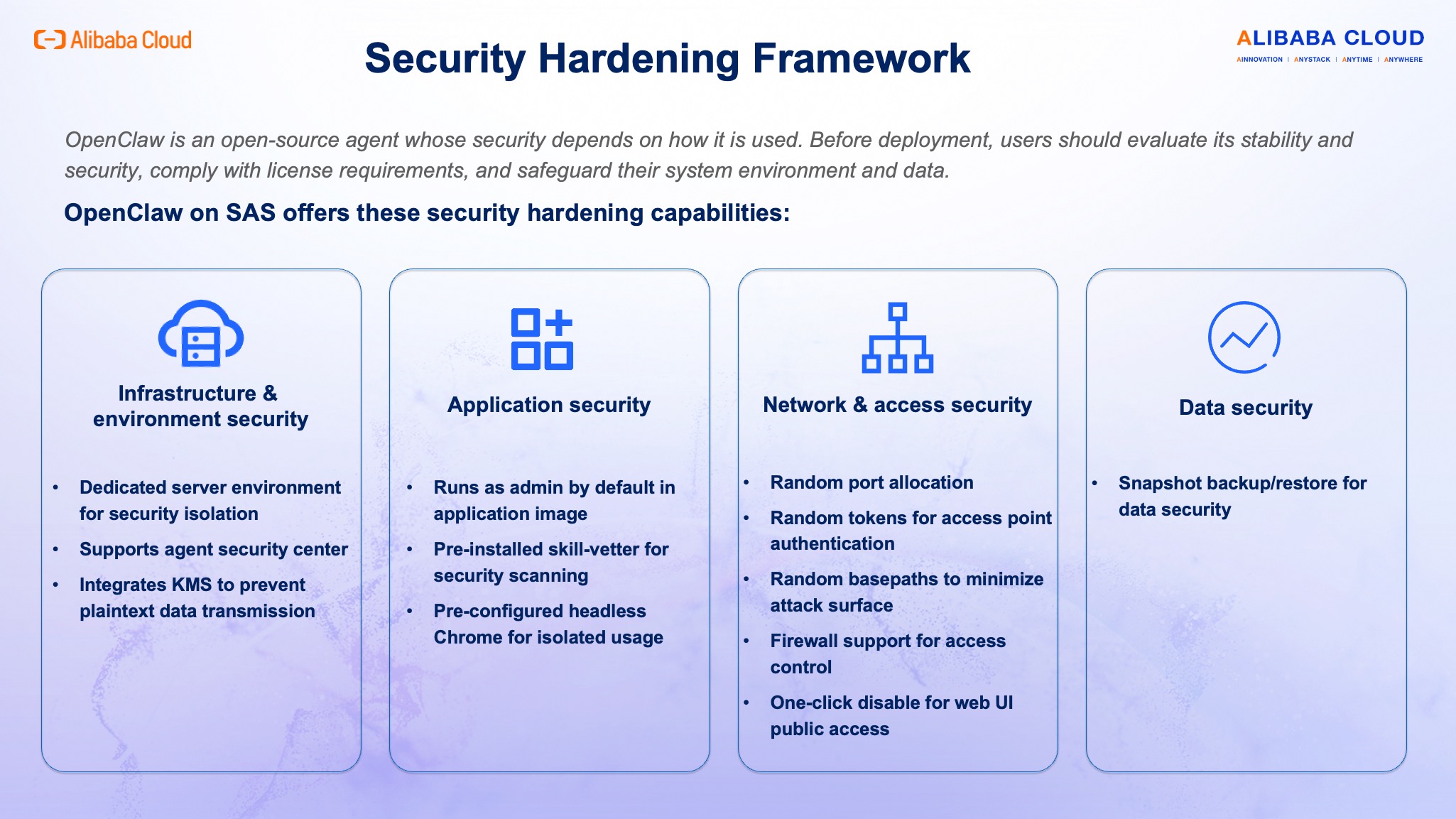
Dedicated Server Environment: Complete security isolation from other tenants
Agent Security Center Integration: Continuous monitoring and threat detection
KMS Integration: All sensitive data encrypted, preventing plaintext transmission
Administrator Privilege Management: Controlled admin access with audit logging
Pre-installed Skill-Vetter: Automated security scanning of all skills before execution
Isolated Headless Chrome: Browser automation runs in sandboxed containers
Random Port Allocation: Unpredictable service ports prevent automated attacks
Random Token Authentication: Each deployment uses unique, cryptographically secure tokens
Random Basepaths: URL randomization minimizes attack surface
Firewall Integration: Granular access control rules
One-Click Public Access Disable: Instantly block web UI from public internet
Snapshot Backup/Restore: Point-in-time recovery capabilities
Encrypted Storage: All data encrypted at rest
Secure Transmission: TLS encryption for all communications
Even with Alibaba Cloud's hardening, users should:
-Regularly review agent logs and audit trails
-Limit tool permissions to only what's necessary
-Use separate instances for different security zones
-Keep skills and integrations updated
-Monitor for unusual resource consumption patterns
-Implement additional authentication layers for sensitive operations
Deploying OpenClaw with SAS is straightforward:
Alibaba Cloud brings several distinct advantages that make it an ideal platform for running OpenClaw:
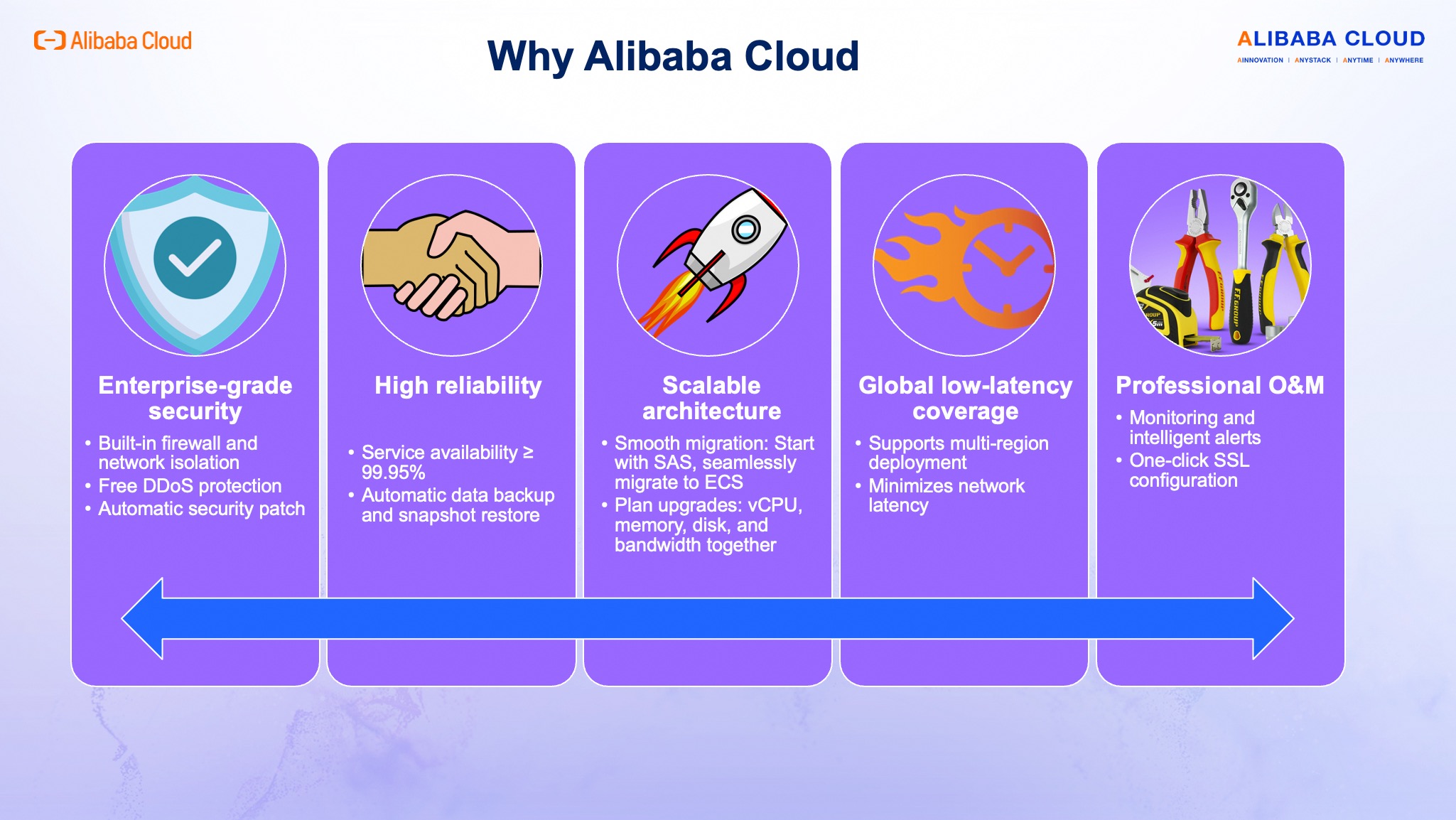
Alibaba Cloud's Model Studio provides seamless access to leading LLMs including Qwen (Alibaba's flagship model), along with integrations for Minimax, GLM, and Kimi. This eliminates the complexity of managing multiple API keys and endpoints.
Years of supporting massive AI training and inference workloads; and supporting China's OpenClaw demands have resulted in infrastructure specifically tuned for AI applications—optimized network throughput, high-performance storage, and compute configurations that match AI agent requirements.
With 99.95% to 99.995% SLA commitments and battle-tested infrastructure that handles billions of transactions during peak events, Alibaba Cloud provides the stability needed for production AI agent deployments.
Alibaba Cloud's security services (KMS, Security Center, WAF) integrate natively with OpenClaw deployments, providing defense-in-depth without complex configuration.
Competitive pricing combined with efficient resource utilization means lower total cost of ownership compared to self-managed deployments or other cloud providers.
Alibaba Cloud offers low-latency deployments, globally with local language support, and compliance with regional data regulations.
OpenClaw represents a significant step forward in democratizing AI agent technology. By combining the power of OpenClaw with the simplicity of Simple Application Server and Alibaba Cloud's enterprise-grade security hardening, businesses of all sizes can now deploy autonomous AI agents with confidence.
Whether you're a developer experimenting with AI agents, an SME seeking to automate workflows, or an enterprise requiring secure, scalable deployment, Alibaba Cloud provides a compelling platform that addresses the key challenges of AI agent deployment: complexity, security, and cost.
With Alibaba Cloud's global infrastructure, integrated AI ecosystem, and commitment to security, OpenClaw on SAS is positioned to become a leading solution for organizations looking to embrace the AI agent revolution.
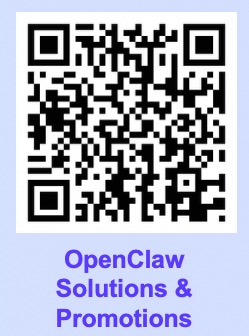
Ready to deploy your first AI agent? Visit www.alibabacloud.com to learn more about OpenClaw and get started with a promotional $0.99 entry-level SAS instance.
OpenClaw AI Agent Memory Loss? Extend Your Agent's Memory Easily with Tablestore Skill Plugin

12 posts | 2 followers
FollowJustin See - March 26, 2026
Alibaba Cloud Native Community - April 22, 2026
Justin See - March 27, 2026
Alibaba Cloud Native Community - March 5, 2026
Alibaba Cloud Native Community - April 16, 2026
Data Geek - September 4, 2026
12 posts | 2 followers
Follow Simple Application Server
Cloud-based and lightweight servers that are easy to set up and manage
Learn More Compute Nest
Cloud Engine for Enterprise Applications
Learn More Container Compute Service (ACS)
A cloud computing service that provides container compute resources that comply with the container specifications of Kubernetes
Learn More Global Application Acceleration Solution
This solution helps you improve and secure network and application access performance.
Learn MoreMore Posts by Justin See

