May 2026 delivers a compelling mix of AI-native innovation and critical platform upgrades across Alibaba Cloud’s database portfolio. A new zero-barrier database provisioning service for AI Agents, two major version milestones (MySQL 8.4 and MongoDB 8.3), and enterprise knowledge base integrations headlined a month that pushed both the developer experience and operational maturity forward.
Below is a quick overview of all ten releases, followed by deep dives into the four most impactful updates.
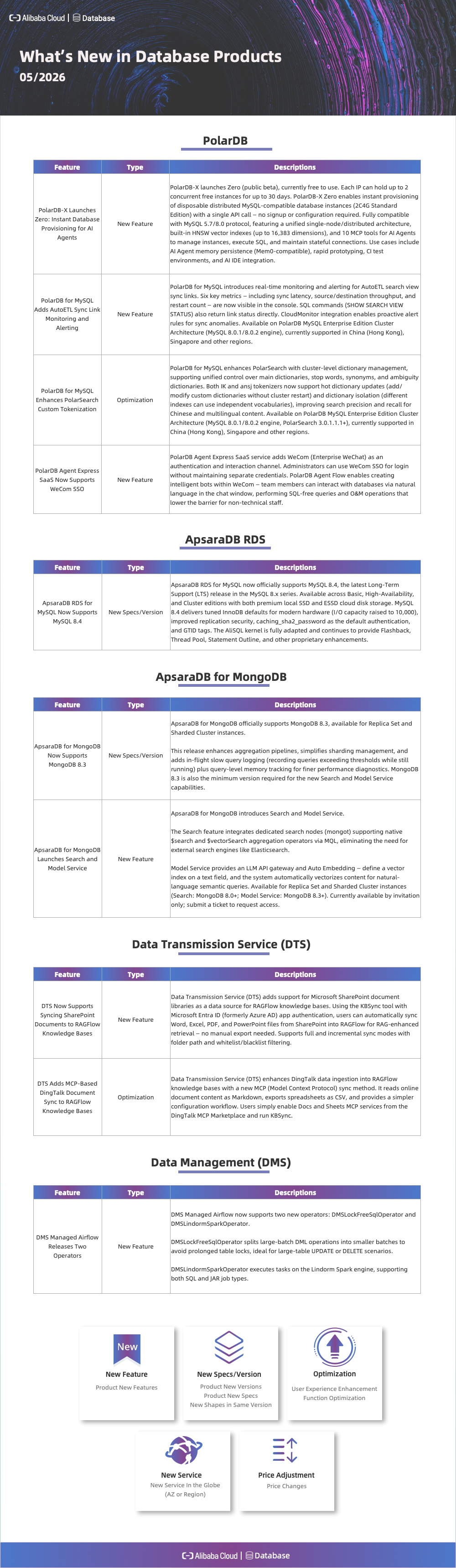
| Product | Feature | Type |
|---|---|---|
| ApsaraDB RDS for MySQL | MySQL 8.4 Version Support | New Version |
| PolarDB for MySQL | AutoETL Sync Link Monitoring & Alerting | New Feature |
| PolarDB for MySQL | PolarSearch Custom Tokenization Enhancement | Enhancement |
| PolarDB for MySQL | PolarDB Agent Express WeCom SSO | New Feature |
| ApsaraDB for MongoDB | MongoDB 8.3 Version Support | New Version |
| ApsaraDB for MongoDB | Search and Model Service | New Feature |
| Data Transmission Service (DTS) | SharePoint-to-RAGFlow Knowledge Base Sync | New Feature |
| Data Transmission Service (DTS) | MCP-Based DingTalk-to-RAGFlow Sync | Enhancement |
| Data Management (DMS) | Managed Airflow Lock-Free SQL & Lindorm Spark Operators | New Feature |
| PolarDB-X | Zero — Instant Database Provisioning for AI Agents | New Feature |
What it is:
PolarDB-X Zero is a free service that provisions disposable, fully functional distributed MySQL-compatible databases with a single API call — no signup, no configuration, no cloud console required.
Description:
AI Agents are increasingly autonomous: they write code, run experiments, store intermediate results, and manage persistent memory. But giving an agent access to a real database has always required manual provisioning — creating cloud accounts, configuring VPCs, managing credentials. PolarDB-X Zero eliminates this entirely.
One HTTP POST to the Zero API returns a running distributed database instance (2C4G Standard Edition) with connection credentials. The instance is 100% compatible with the MySQL 5.7/8.0 protocol, supports distributed transactions and horizontal scaling, and comes with built-in HNSW vector indexes supporting up to 16,383 dimensions — making it immediately usable for both traditional SQL workloads and AI-native use cases like Mem0-compatible memory persistence and vector similarity search.
For agent orchestration, Zero ships with 10 MCP (Model Context Protocol) tools that let AI Agents create instances, execute SQL, and maintain stateful connections programmatically. Each IP can hold up to 2 concurrent instances with a maximum TTL of 30 days, and the service is completely free during public beta.
Why developers and enterprises should pay attention:
What it is:
ApsaraDB RDS for MySQL now supports MySQL 8.4, the latest Long-Term Support (LTS) release in the MySQL 8.x series — and the only MySQL version still receiving official security patches.
Description:
MySQL 8.4 brings meaningful technical improvements. InnoDB defaults are re-tuned for modern SSD hardware (I/O capacity raised from 200 to 10,000), replication security is tightened with GTID tags and reduced retry counts, and the default authentication switches to caching_sha2_password for stronger credential protection. On the Alibaba Cloud side, the AliSQL kernel is fully adapted and continues to deliver proprietary enhancements including Flashback, Thread Pool, Statement Outline, and other capabilities.
MySQL 8.4 is available across Basic, High-Availability, and Cluster editions, supporting both premium local SSD and ESSD cloud disk storage.
Why developers and enterprises should pay attention:
What it is:
ApsaraDB for MongoDB now supports MongoDB 8.3, bringing enhanced observability, simplified sharding management, and serving as the prerequisite version for the new Search and Model Service.
Description:
Performance troubleshooting in MongoDB has traditionally relied on after-the-fact slow query logs — you only see a problem after the query finishes. MongoDB 8.3 changes this with in-flight slow query logging, which captures queries exceeding thresholds while they are still running, giving DBAs real-time visibility into ongoing performance issues.
Additionally, 8.3 introduces query-level memory tracking for granular resource accounting, enhanced aggregation pipeline capabilities, and a redesigned sharding management process that reduces operational complexity for sharded clusters. Available for both Replica Set and Sharded Cluster instances.
Importantly, MongoDB 8.3 is also the minimum version required for the newly launched Search and Model Service — making this upgrade a gateway to native full-text search, vector search, and Auto Embedding capabilities within your MongoDB instance.
Why developers and enterprises should pay attention:
What it is:
DTS now supports syncing Microsoft SharePoint document libraries directly into RAGFlow knowledge bases — turning your enterprise documents into RAG-ready knowledge with zero manual export.
Description:
Enterprise knowledge is often trapped in SharePoint: project plans, product specs, policy documents, and technical guides live in document libraries that are effectively invisible to AI systems. Manually exporting and reformatting these files for knowledge base ingestion is tedious, error-prone, and quickly outdated.
DTS solves this with a dedicated SharePoint connector powered by Microsoft Entra ID (formerly Azure AD) application authentication. Using the KBSync tool, organizations can automatically sync Word, Excel, PDF, and PowerPoint files from SharePoint into RAGFlow for retrieval-augmented generation. The connector supports both full and incremental sync modes, with folder path targeting and whitelist/blacklist filtering to control exactly what enters the knowledge base.
Because authentication uses the client credentials flow (app-level, no interactive login), syncs can run on a schedule without human intervention — keeping your AI knowledge base perpetually up to date with your latest enterprise documents.
Why developers and enterprises should pay attention:
PolarDB for MySQL now provides real-time monitoring for AutoETL search view synchronization links, surfacing six key metrics — sync latency, source/destination throughput, restart count, and more — directly in the console. Users can also query link status via SQL (SHOW SEARCH VIEW STATUS) and set up CloudMonitor alert rules for proactive anomaly detection. Available on PolarDB MySQL Enterprise Edition Cluster Architecture (MySQL 8.0.1/8.0.2 engine), currently in China (Hong Kong), Singapore, and other regions.
PolarSearch adds cluster-level dictionary management with hot-update support for both IK and ansj tokenizers. Custom dictionaries (main, stop word, synonym, ambiguity) can now be modified without restarting the cluster, and dictionary isolation allows different indexes to use independent vocabularies — particularly valuable for Chinese and multilingual search precision. Available on PolarDB MySQL Enterprise Edition (PolarSearch 3.0.1.1.1+), currently in China (Hong Kong), Singapore, and other regions.
PolarDB Agent Express SaaS now supports WeCom (Enterprise WeChat) as both a login method (SSO) and an interaction channel. Through PolarDB Agent Flow, teams can create intelligent bots within WeCom that allow members to query databases using natural language — no SQL required, no tool switching needed.
ApsaraDB for MongoDB introduces Search and Model Service. The Search feature integrates dedicated search nodes (mongot) supporting native $search and $vectorSearch aggregation operators via MQL, eliminating the need for external search engines like Elasticsearch. Model Service provides an LLM API gateway and Auto Embedding — define a vector index on a text field, and the system automatically vectorizes content for natural-language semantic queries. Available for Replica Set and Sharded Cluster instances (Search: MongoDB 8.0+; Model Service: MongoDB 8.3+). Currently available by invitation only; submit a ticket to request access.
DTS enhances DingTalk data ingestion into RAGFlow knowledge bases with a new MCP (Model Context Protocol) sync method. It reads online document content as Markdown, exports spreadsheets as CSV, and provides a simpler configuration workflow. Users simply enable Docs and Sheets MCP services from the DingTalk MCP Marketplace and run KBSync — no DingTalk app creation required.
DMS Managed Airflow introduces two new operators: DMSLockFreeSqlOperator splits large-batch DML into smaller batches to avoid prolonged table locks during large-table UPDATE or DELETE operations; DMSLindormSparkOperator executes tasks on the Lindorm Spark engine with support for both SQL and JAR job types. Both operators integrate natively into Airflow DAGs for streamlined data pipeline orchestration.
May’s releases reflect two converging forces shaping Alibaba Cloud’s database strategy. On one side, AI-native infrastructure is becoming a first-class concern — PolarDB-X Zero reimagines database provisioning as a single API call any agent can make, while DTS’s RAGFlow integrations bridge enterprise knowledge silos to AI retrieval systems. On the other, foundational platform maturity continues: MySQL 8.4 and MongoDB 8.3 ensure that organizations running mission-critical workloads stay current, secure, and ready for the next wave of capabilities built on top of these engines.
Stay tuned for more updates in our next monthly roundup.
Learn more about Alibaba Cloud Database services: ApsaraDB Product Page
PolarDB-X Best Practice Series (12): Best Practices for Data and Traffic Skew Analysis (Part 3)
Introducing AI-Native Database Service (AIDBS): Make Your Database Agent-Ready
ApsaraDB - March 29, 2026
ApsaraDB - May 21, 2026
ApsaraDB - April 20, 2026
ApsaraDB - February 27, 2026
ApsaraDB - July 22, 2026
ApsaraDB - June 27, 2025
 PolarDB for MySQL
Alibaba Cloud PolarDB for MySQL is a cloud-native relational database service 100% compatible with MySQL.
Learn More ApsaraDB for MongoDB
A secure, reliable, and elastically scalable cloud database service for automatic monitoring, backup, and recovery by time point
Learn More
PolarDB for PostgreSQL
Alibaba Cloud PolarDB for PostgreSQL is an in-house relational database service 100% compatible with PostgreSQL and highly compatible with the Oracle syntax.
Learn More
PolarDB for Xscale
Alibaba Cloud PolarDB for Xscale (PolarDB-X) is a cloud-native high-performance distributed database service independently developed by Alibaba Cloud.
Learn MoreMore Posts by ApsaraDB


