CDNs excel at caching static content - images, CSS, JavaScript, videos. But what about dynamic content? API calls, real-time data, user authentication - these requests go back to the origin every time. The traditional approach is to pass them through the public internet directly to your origin server.
The problem is that the public internet doesn't always take the best route. Cross-region and cross-carrier requests may take detours, link quality fluctuates, and packet loss triggers TCP retransmissions that add latency. For static content, this doesn't matter much (it's cached anyway). For dynamic content, it's a real performance penalty.
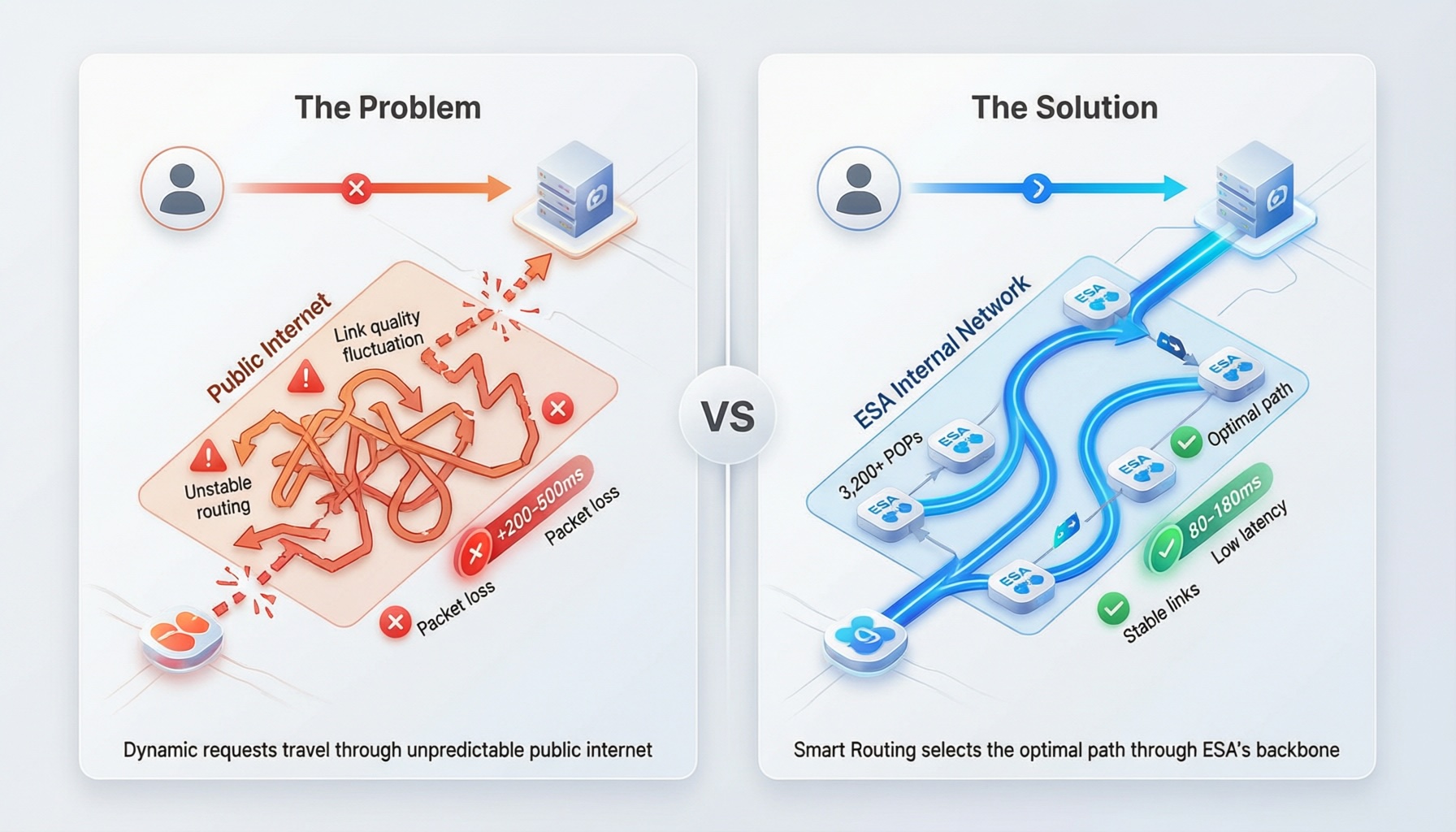
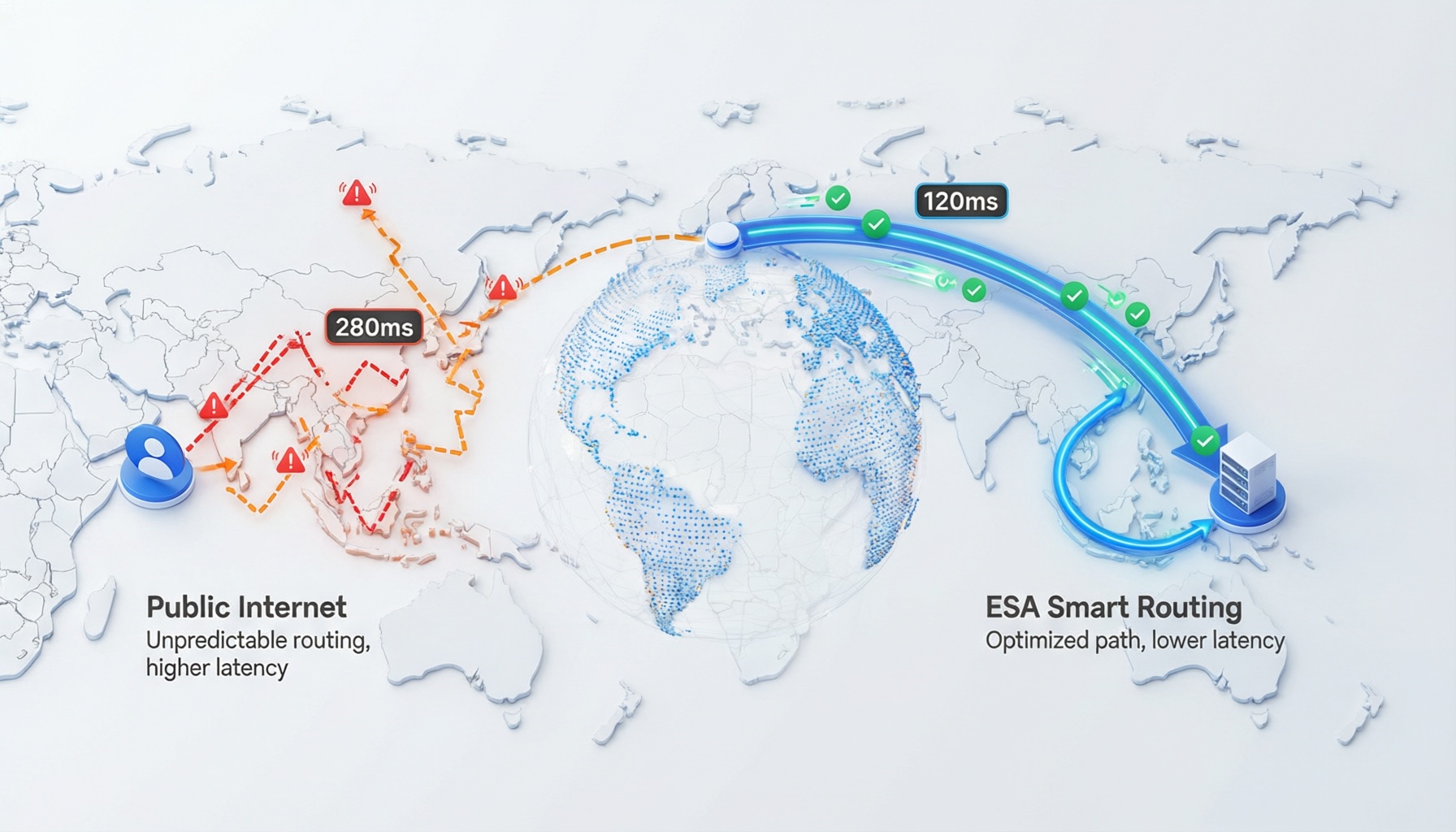
ESA's Smart Routing addresses this by leveraging the internal network across 3,200+ global POPs to find the optimal path for every dynamic request - instead of relying on the public internet.
This article covers Smart Routing's use cases, configuration, and real-world results.
Before diving into Smart Routing, it's worth briefly discussing how ESA (Edge Security Acceleration) differs from traditional CDN.
Traditional CDNs focus on one thing: caching static content at the edge. For dynamic requests, they simply pass traffic through to the origin.
ESA is Alibaba Cloud's next-generation edge platform that combines acceleration, security, and edge computing in a single product. Here's how they compare:
| Dimension | Traditional CDN | ESA |
|---|---|---|
| Dynamic acceleration | Not supported | Smart Routing with intelligent path selection |
| Security | Separate WAF/DDoS purchase required | Built-in WAF, DDoS protection, Bot Management |
| Edge computing | Not available | Edge Functions and Edge Containers |
| DNS hosting | Not available | Built-in DNS with CNAME Flattening |
| Configuration management | Direct production changes | Version Management (Dev/Staging/Prod) |
| Debugging | Limited | Trace request simulation |
| Site management | Per-domain | Whole-site, auto-covers all subdomains |
If your business is primarily static content delivery, a traditional CDN is sufficient and cost-effective. But if your scenarios involve dynamic APIs, security requirements, or need finer configuration control, ESA is the better fit.
Smart Routing is a core part of that difference - it's what turns ESA from a static cache into a full-site acceleration platform.
Static content can be cached. Dynamic content cannot. Here's why the public internet creates problems for dynamic requests:
For static content, these issues are mitigated by caching. For dynamic content, they directly impact user experience.
Smart Routing has a straightforward approach: ESA continuously probes network conditions between its 3,200+ global POPs and selects the optimal path for each request.
Specifically:
For dynamic requests (APIs, database queries, real-time data), Smart Routing receives the request at the edge node and forwards it to the origin through ESA's internal network rather than the public internet.
Smart Routing is particularly helpful in the following scenarios. I'll share some examples from customer engagements I've been involved in.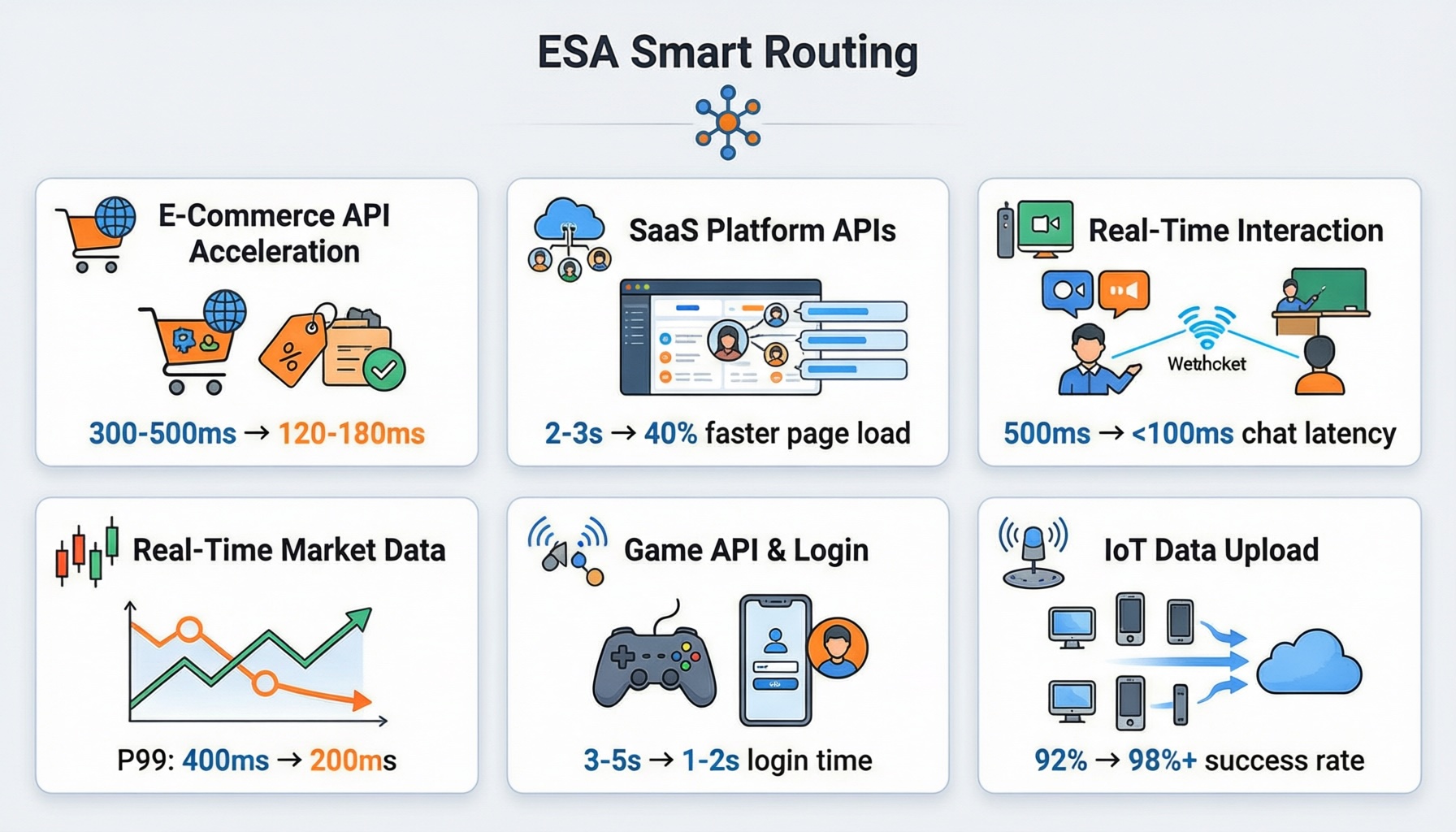
Context: An e-commerce platform with origin servers in the US West region, serving users primarily in China and Southeast Asia. Static resources on product pages (images, CSS) are cached without issues, but price queries, inventory checks, and cart operations require origin fetches every time.
Problem: Chinese users accessing /api/price endpoints experience 300-500ms latency over the public internet, with routes often detouring through Japan or Europe. Users perceive the page as "laggy" - static content loads instantly, but price information takes half a second to appear.
Result: After enabling Smart Routing, API requests travel through ESA's internal network, with latency stabilizing at 120-180ms. Overall page load perception improves noticeably.
Context: A B2B SaaS platform with origin in Singapore, serving customers across APAC (Japan, Korea, Australia, India). The dashboard page makes dozens of API calls (user info, project lists, analytics data).
Problem: Australian users experience 200ms+ latency, Indian users even higher (250ms+). Multiple sequential API calls per page accumulate to 2-3 seconds for full page load.
Result: Smart Routing selects optimal return paths for users in different regions. Australian latency drops to 80-120ms, Indian users to 100-150ms. Overall page load time reduced by approximately 40%.
Context: An online education platform using WebSocket for real-time teacher-student interaction (live chat, hand-raising, quizzes). WebSocket is a long-lived connection - dynamic content that cannot be cached.
Problem: During cross-region classes (e.g., teacher in Beijing, students in Guangzhou), WebSocket connections occasionally drop, and message latency is high due to unstable public internet links causing packet loss and TCP retransmissions.
Result: Smart Routing optimizes the return path for WebSocket connections, significantly reducing packet loss and improving connection stability. Student-side chat latency drops from 500ms+ to under 100ms.
Context: A financial trading platform pushing real-time stock/futures quotes to clients via API polling or WebSocket. Latency directly affects the trading experience.
Problem: Market data API P99 latency exceeds 400ms. Users report slow quote refreshes, affecting trading decisions.
Result: After enabling Smart Routing, P50 latency drops from 150ms to 80ms, P99 from 400ms to 200ms. For financial scenarios, this improvement is meaningful.
Context: A mobile game with login and configuration APIs deployed in East China, serving players across Southeast Asia. Login is a dynamic request (token validation, config fetching) that hits the origin every time.
Problem: Southeast Asian players experience slow logins - 3-5 seconds from tapping "Login" to entering the game, with most time spent on network transmission for API requests.
Result: Smart Routing reduces login API latency from 300ms to around 120ms. Overall login time shortens to 1-2 seconds.
Context: An IoT platform where devices worldwide report data via HTTP API. Devices are distributed across different countries with widely varying network conditions.
Problem: Some regions have low reporting success rates (request timeouts due to unstable networks), leading to data loss.
Result: Smart Routing improves request success rates in weak network conditions, from 92% to 98%+. For IoT scenarios, data completeness matters.
Smart Routing is worth enabling if your scenario matches any of these conditions:
If your website is primarily static content (blogs, documentation sites, image galleries), Smart Routing offers limited value - focus your efforts on cache optimization instead.
Configuration is straightforward - a single toggle:
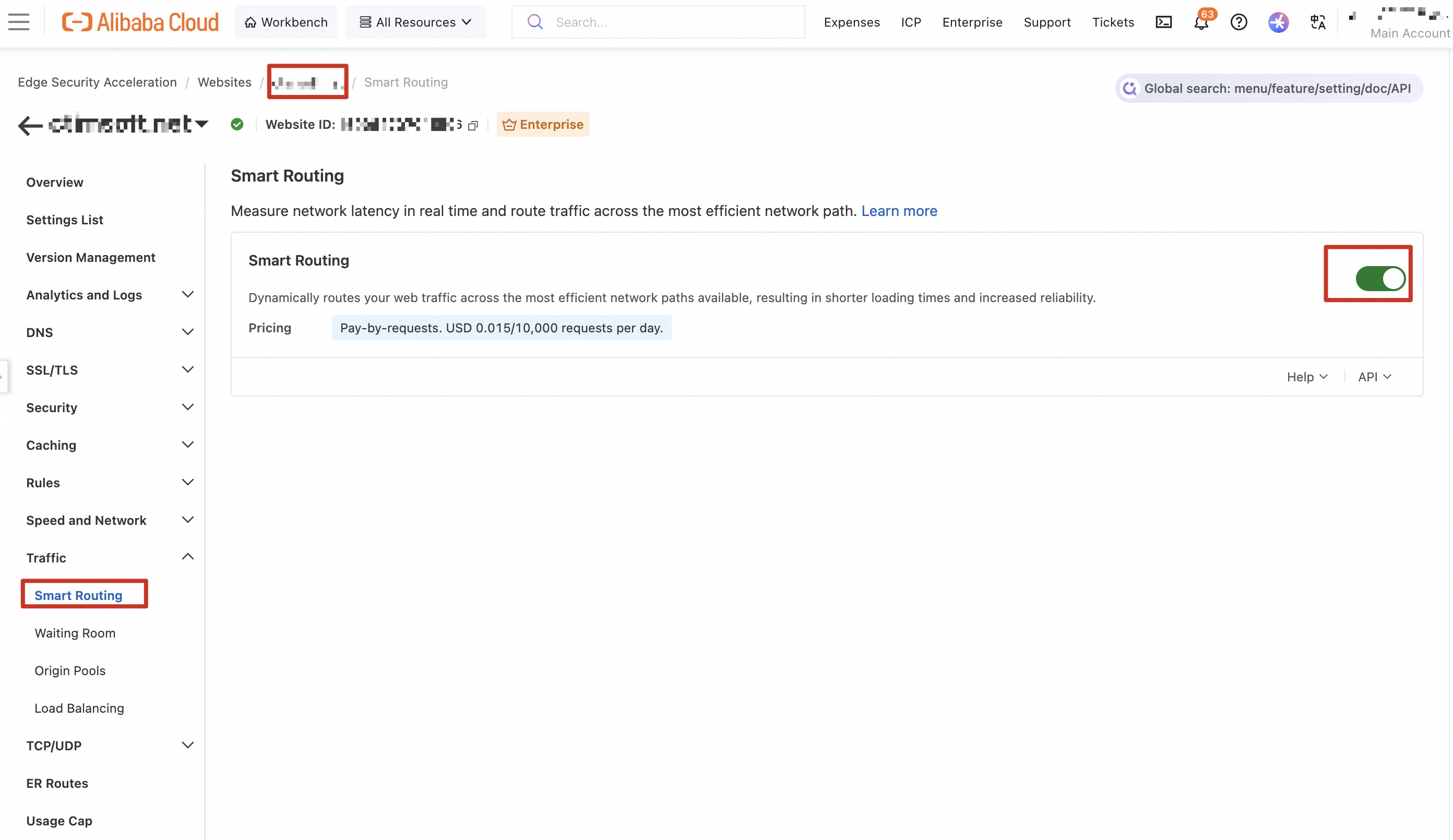
That's it. No origin server changes, no cache rule adjustments, no DNS modifications needed.
Smart Routing is billed as an add-on feature:
For most scenarios, the cost increase is modest. But there's a detail worth noting: Enterprise plan customers receive a generous monthly Smart Routing request allowance as part of their subscription. For many sites, this included quota covers their entire Smart Routing usage - effectively making the feature free.
This is particularly relevant when you consider what comparable dynamic acceleration features cost on other platforms. Major CDN and edge providers typically charge separately for route optimization, often at per-request rates that add up quickly at scale. ESA's bundled approach - especially at the Enterprise tier - can result in meaningful cost savings for sites with significant dynamic traffic.
Quick tip: Smart Routing only applies to origin-bound requests. If your cache hit ratio is high (say 90%), only 10% of requests are billed, making the actual cost much lower than it might initially appear.
After enabling, dynamic request latency typically improves. The exact magnitude depends on:
Based on customer scenarios I've encountered, here are some reference numbers:
| Scenario | Before | After | Improvement |
|---|---|---|---|
| Cross-region API (SEA → US West) | 250-350ms | 120-180ms | ~40% |
| Cross-border (Australia → Singapore) | 180-250ms | 80-120ms | ~50% |
| Cross-carrier (India → Singapore) | 200-300ms | 100-150ms | ~45% |
| Same-region access | 50-80ms | 40-60ms | Minimal |
Note: These numbers are for reference only. Actual results vary by scenario. I'd recommend monitoring the Origin Response Time metric in Analytics after enabling - let the data speak for itself.
Smart Routing and Tiered Cache are complementary:
Ideally, enable both. Tiered Cache intercepts cacheable requests first. Smart Routing optimizes the path for remaining dynamic requests.
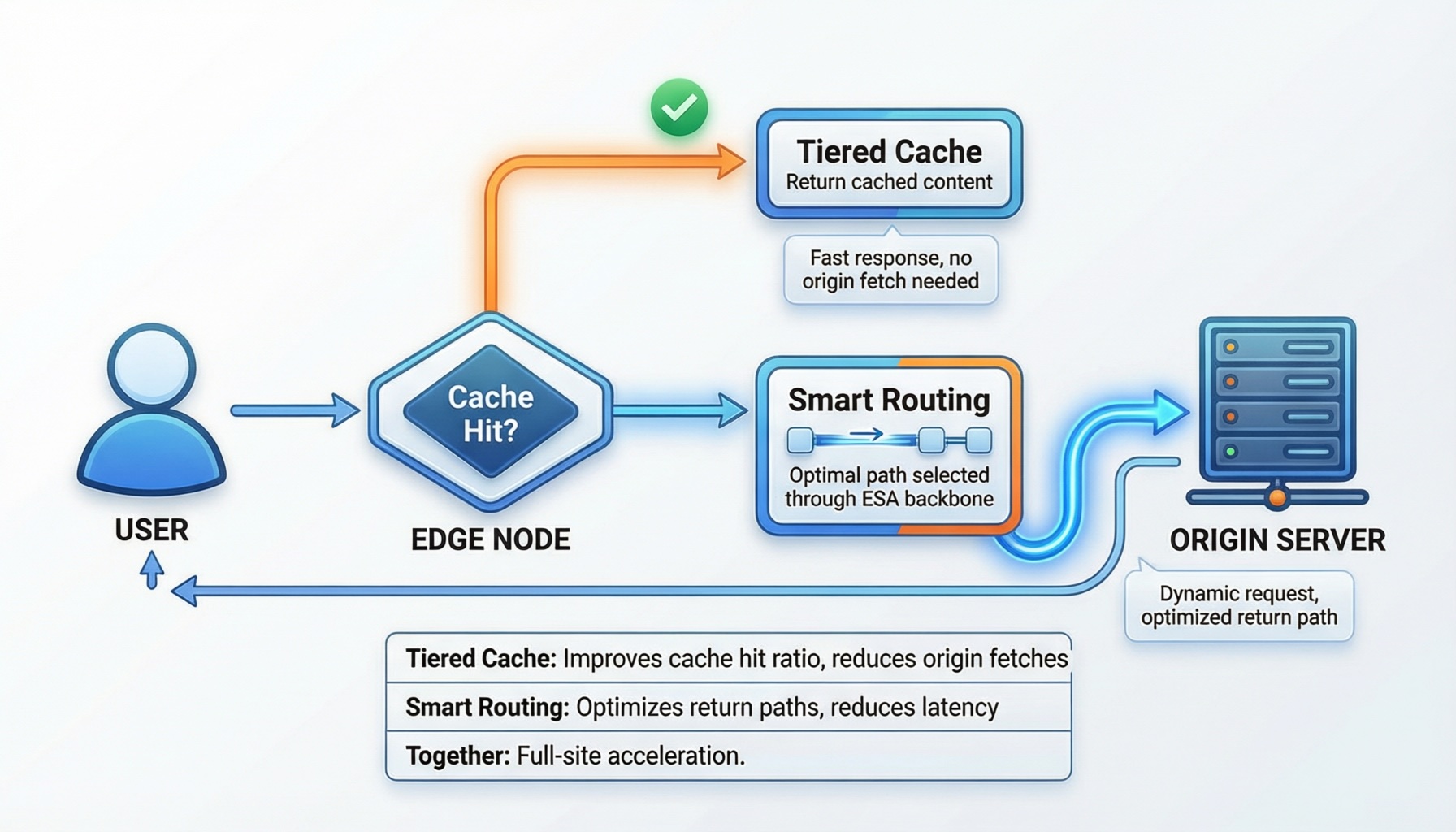
A typical request flow:
User request → Edge node
  → Cache hit? Return directly (Tiered Cache doing its job)
→ Cache miss? Fetch from origin (Smart Routing optimizes the path)Many customers still use Alibaba Cloud's traditional CDN and might wonder: CDN can accelerate too, why switch to ESA?
The core difference: traditional CDN solves one problem - static caching. ESA is a comprehensive edge platform.
| Dimension | Traditional CDN | ESA |
|---|---|---|
| Dynamic acceleration | Not supported | Smart Routing with intelligent path selection |
| Security | Separate purchase required | Built-in WAF + DDoS + Bot Management |
| Edge computing | Not available | Edge Functions / Containers |
| DNS hosting | Not available | Built-in with CNAME Flattening |
| Canary deployment | Not available | Version Management |
| Debugging | None | Trace request simulation |
| Site management | Per-domain | Whole-site, auto-covers subdomains |
Smart Routing is one of the most tangible differences - CDN passes dynamic requests through transparently, while ESA optimizes the return path through its internal network, measurably reducing API latency.
If you're still on traditional CDN and your business involves dynamic APIs, security needs, or global user distribution, it's worth evaluating a migration to ESA.
Smart Routing is one of the key features that differentiates ESA from a traditional CDN - it turns edge delivery from "just static caching" into genuine full-site acceleration.
Simple to configure (one toggle), cost-effective (per-request billing, with included quota on Enterprise plans), and measurable (track latency changes in Analytics). If your site has significant API traffic, real-time data needs, or globally distributed users, it's worth trying.
References:
If you have questions, feel free to leave a comment.
ESA Unlocked: Tiered Cache - Break Through the Cache Hit Ratio Ceiling

6 posts | 1 followers
FollowBryan, Zhang - August 31, 2026
Bryan, Zhang - May 28, 2026
Bryan, Zhang - September 7, 2026
Kidd Ip - September 15, 2025
ESA Big Fan - June 16, 2026
Alibaba Clouder - March 18, 2021
6 posts | 1 followers
Follow Link IoT Edge
Link IoT Edge allows for the management of millions of edge nodes by extending the capabilities of the cloud, thus providing users with services at the nearest location.
Learn More Edge Node Service
An all-in-one service that provides elastic, stable, and widely distributed computing, network, and storage resources to help you deploy businesses on the edge nodes of Internet Service Providers (ISPs).
Learn More Edge Security Acceleration (Original DCDN)
Edge Security Acceleration (ESA) provides capabilities for edge acceleration, edge security, and edge computing. ESA adopts an easy-to-use interactive design and accelerates and protects websites, applications, and APIs to improve the performance and experience of access to web applications.
Learn More Secure Access Service Edge
An office security management platform that integrates zero trust network access, office data protection, and terminal management.
Learn MoreMore Posts by Bryan, Zhang

