
Two critical memory-corruption flaws in PHP's request-parsing path, disclosed on October 21, 2026 and dubbed "PHP2Shell," allow unauthenticated remote code execution on virtually every HTTP-facing PHP deployment. Public exploits exist and in-the-wild attempts were observed even before disclosure. If your workloads sit behind Alibaba Cloud Edge Security Acceleration (ESA), the virtual patches are already in the managed WAF rule set — enabling managed rules is all it takes to block exploitation at the edge.
On October 21, 2026 the PHP project shipped emergency releases fixing two critical memory-corruption vulnerabilities that researchers collectively nickname PHP2Shell:
Both issues are rated Critical — CVSS v4.0 9.2 in third-party advisories and 9.7 in the Alibaba Cloud Vulnerability Database (AVD). Crucially, no authentication is required, and the corruption happens while PHP is still parsing the request, before a single line of application code runs. Application logins, CSRF tokens, or authorization checks in your PHP code provide zero protection: the attacker never reaches them.
Every HTTP-serving PHP runtime is in scope — PHP-FPM, Apache mod_php, php-cgi, FrankenPHP and LiteSpeed — on all branches prior to 8.2.35, 8.3.36, 8.4.27 and 8.5.12. mod_php-style deployments are considered the most exposed because failure handling can occur before application logic starts. Working exploits have been demonstrated, public PoC material is circulating, and cloud providers reported scanning and exploitation attempts around the disclosure window.
In practical terms, the attack traffic has a recognizable shape: oversized multipart/form-data POSTs with binary or empty-name fields, abnormally long and deeply nested form-field names sized to make an allocation fail at a chosen moment, and — for CVE-2026-109619 — follow-up requests probing the same worker, often combined with session upload-progress abuse. That shape is exactly what a web application firewall can be taught to spot.
The only complete remediation is upgrading to the fixed PHP releases (or vendor backports for the 7.4/8.0/8.1 lines). But for most organizations that is a multi-day project: rebuilding container images, regression-testing applications, coordinating with distribution vendors for LTS packages, and rolling out fleets of workers. Meanwhile the exploits are public and scanning is ongoing.
This is the classic virtual-patching window: place a filtering layer in front of PHP that recognizes and drops the exploit traffic at the edge while the patching program runs. The filtering logic is non-trivial — decoded body size limits, multipart part counts, per-part header counts, nesting depth, binary content in form bodies, extremely long field names — which is precisely why you want it delivered as a managed capability rather than hand-written rules.
Alibaba Cloud ESA has released managed-rule coverage for the PHP2Shell family, delivered through the built-in WAF managed rule set of every ESA site. In the ESA console the rules appear under the managed-rule categories; the virtual patch for the session.upload_progress exploitation path (CVE-2026-109618) ships as rule 901222 ("PHP Session.upload_prog…") in the Others category, alongside the companion coverage for CVE-2026-109619, with the action set to Block:
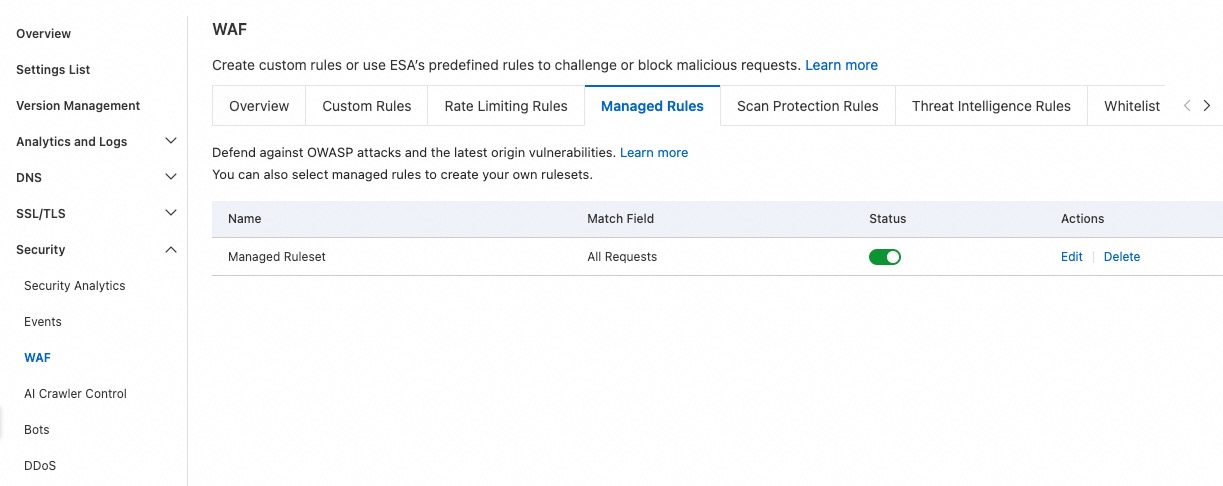
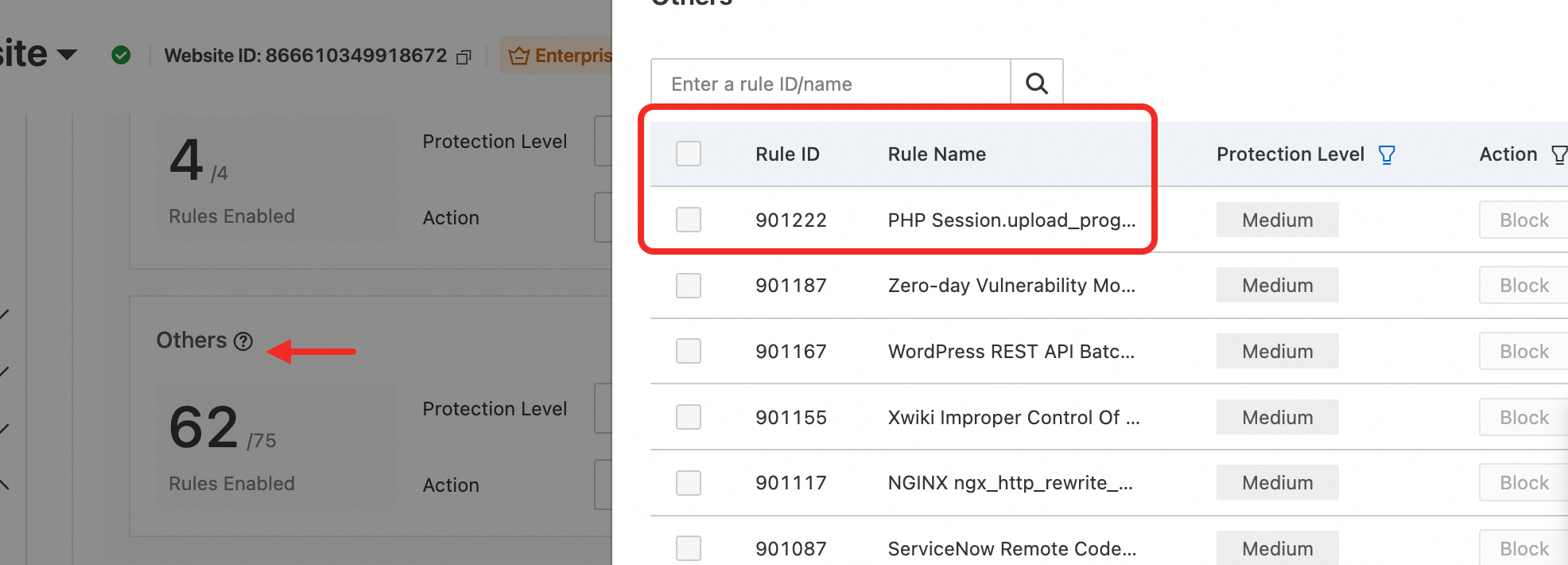
The ESA console showing the managed rule set for a site: the PHP2Shell virtual patch (rule 901222) sits in the "Others" managed-rule category with its action set to Block. There is nothing to write and nothing to tune.
The operational story is deliberately boring, and that is the point:
No custom rules, no regex authoring, no per-application tuning, and no agent to install on your origins. As Alibaba Cloud's security team refines the signatures or new exploit variants appear, the managed rules are updated centrally and every enabled site inherits the improvement automatically. And because enforcement happens at the edge, the malicious payloads are terminated close to their source: your origins never spend a CPU cycle parsing a weaponized multipart body.
The same managed rule set also carries broad coverage for the usual web-attack classes (SQL injection, XSS, command injection, webshells and more), so enabling it raises your baseline well beyond this single incident.
session.upload_progress.enabled = 0, disable fatal_error_backtraces on PHP 8.5, and review memory_limit together with external request-size limits — understanding these are stopgaps, not fixes.PHP's ubiquity is what makes PHP2Shell dangerous, and it is exactly why edge-level, centrally managed protection matters. The vulnerabilities were disclosed yesterday; the defense in ESA has already been delivered. Turn it on, and let the edge absorb the storm while your patching program catches up.
Using ESA as a Front Door for Private OSS: STS Authentication, Cost Optimization, and Security

7 posts | 1 followers
FollowCloudSecurity - October 22, 2026
ESA Big Fan - July 7, 2026
Alibaba Cloud Security - November 6, 2019
Alibaba Cloud Native Community - April 21, 2025
Alibaba Cloud Security - February 17, 2020
Alibaba Cloud Security - July 31, 2018
7 posts | 1 followers
Follow Edge Security Acceleration (Original DCDN)
Edge Security Acceleration (ESA) provides capabilities for edge acceleration, edge security, and edge computing. ESA adopts an easy-to-use interactive design and accelerates and protects websites, applications, and APIs to improve the performance and experience of access to web applications.
Learn More Security Center
A unified security management system that identifies, analyzes, and notifies you of security threats in real time
Learn More WAF(Web Application Firewall)
A cloud firewall service utilizing big data capabilities to protect against web-based attacks
Learn More Security Solution
Alibaba Cloud is committed to safeguarding the cloud security for every business.
Learn MoreMore Posts by ESA Big Fan

