As large language models (LLMs) and Agents move from demos into production, more and more enterprises want the same thing: to run Agents stably in production, not just prove them in a demo. Once an Agent touches real business, two problems surface at once. First, metrics, logs, traces, and events are scattered across systems, and getting from an anomaly to its root cause still depends on a handful of experts. Second, the Agent's own behavior is hard to explain, its effectiveness hard to evaluate, bad cases hard to retain, and successful practices hard to replicate. Together these become the three walls AgenticOps has to cross: data that cannot be collected, context that cannot be understood, and capabilities that cannot be verified.
The root of the change is a changing first user. Operations is moving from manual operations through artificial intelligence for IT operations (AIOps) and Q&A assistants toward goal-driven, autonomous, closed-loop AgenticOps. According to IDC's “Agent Adoption” report, the number of actively deployed AI Agents worldwide is growing roughly 40-fold over four years. The primary consumer of the data is no longer a person, and the responsibility of observability is extending in two directions: supplying trusted facts to Agents, and bringing the Agent's own operational data into observability.
To meet these challenges, Alibaba Cloud is releasing full-stack AgenticOps capabilities. It first extends the observability boundary so that the system is legible to Agents and the Agent itself is legible as well, laying a trusted, understandable foundation of facts. It then lets Agents perceive, judge, act under control, and keep evolving on that foundation, turning “seen” into “solved” as one continuous chain. The capabilities themselves are also being open-sourced for the industry to build and verify together. Concretely, the goal is to move operations and R&D from human-led, tool-assisted work toward goal-driven, Agent-led autonomy.
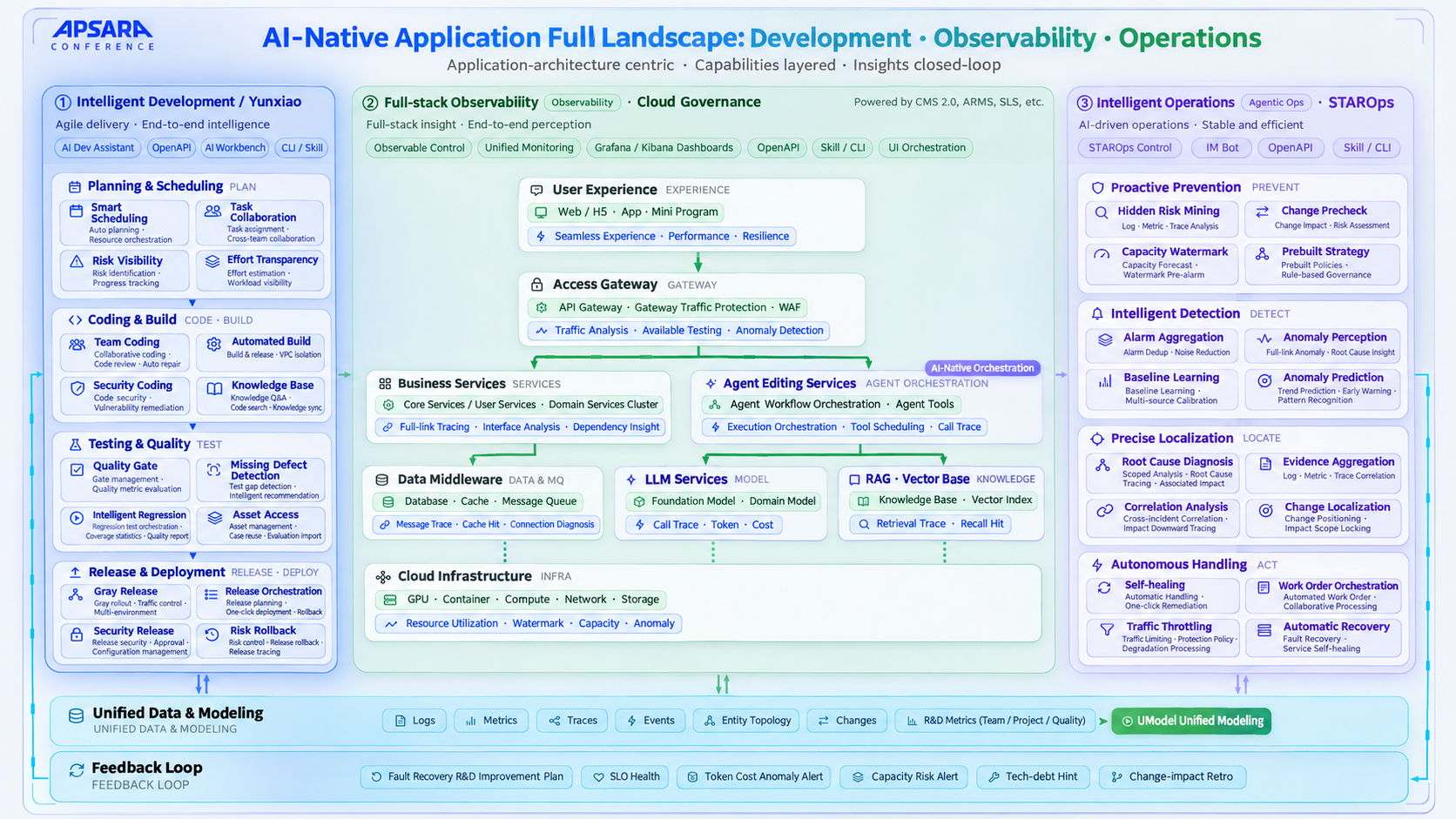
When the Agent becomes the first user, the observability boundary has to expand in two directions at once. Downward, production facts from cross-cloud, cross-stack, and multi-cloud environments must be organized into trusted data an Agent can consume directly. Upward, the Agent's own traces, cost, quality, and risk must come under observability as well. Cloud Monitor 2.0 and AgentLoop carry this layer: the former is a unified, full-domain observability platform built for AgenticOps, and the latter turns the Agent into an object that can be observed, evaluated, and evolved.
The upgraded Cloud Monitor 2.0, now with agentic observability, makes both the system and Agents legible. A complete Agent task breaks into three consecutive phases: trusted facts, evidence-based judgment, and controlled action. For observability by Agents, Cloud Monitor 2.0 hands production facts to the Agent through a single pipeline.
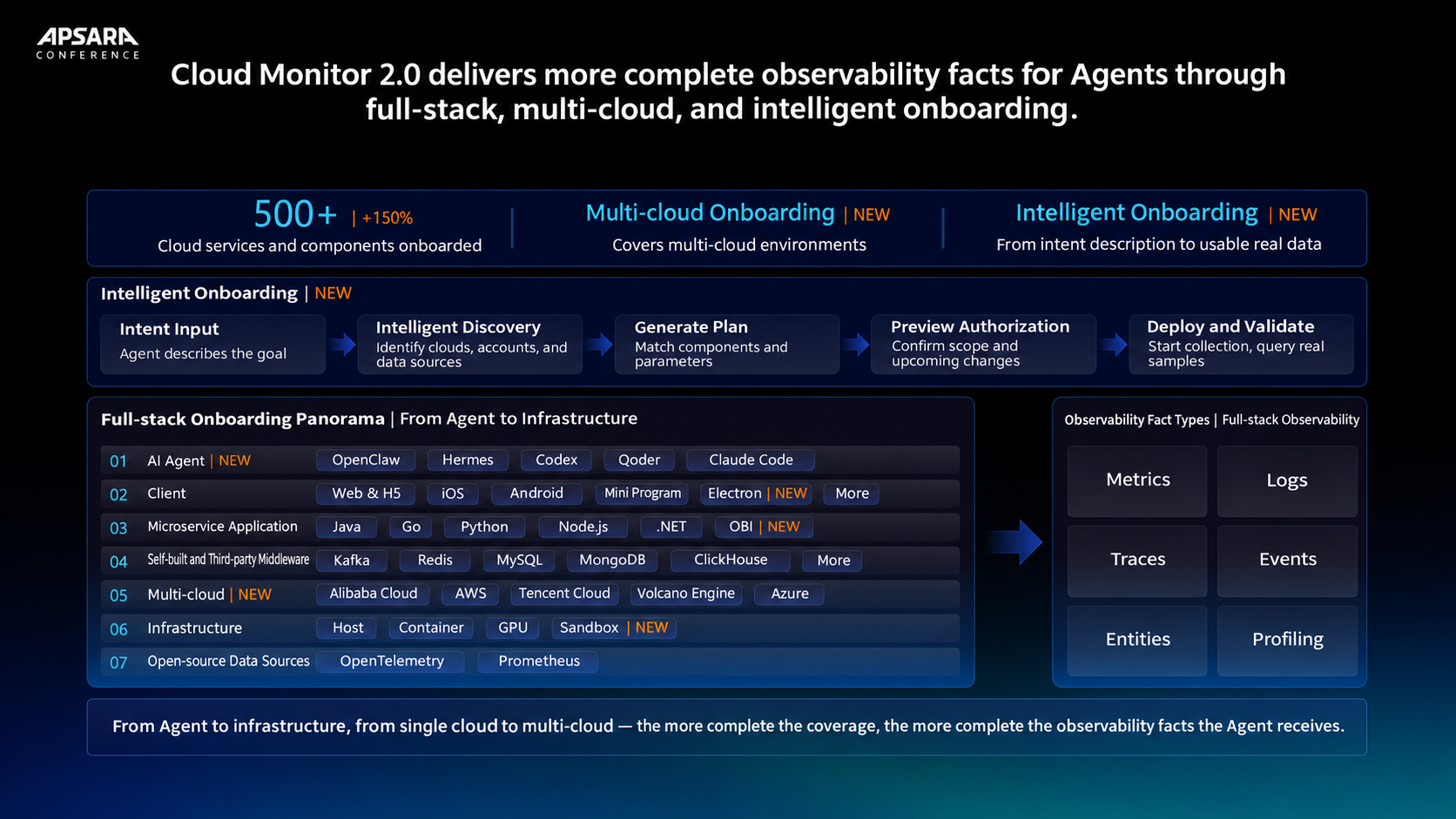
For integration, intelligent onboarding supports more than 500 cloud services and components and works across clouds and accounts. It extends the observability scope from Agents, endpoints, and applications to middleware, infrastructure, multi-cloud environments, and open-source data sources. A five-step loop — intent input, intelligent discovery, solution generation, Preview authorization, and deployment with validation — turns onboarding from form-filling into a goal-driven task, and the finish line is real, usable data rather than a successful configuration.
For governance, the observability pipeline runs through three stages — standardization, organization, and trustworthiness — turning raw observability data such as metrics, logs, traces, events, and metadata into production facts that carry their source, freshness, semantics, quality, and cost boundaries.
For semantics, UModel builds a complete semantic map of production systems. EntitySet describes entities; LogSet, MetricSet, TraceSet, and other sets organize data; relationship links connect dependencies; RunbookSet retains diagnostic and operational knowledge; and SPL provides one unified query language. Its more than 3,200 built-in model definitions cover 10 observability domains and 214 model groups, so an Agent knows exactly which object each piece of data points to. On top of that, Intelligent Inspection covers 117 types of production entities, and built-in expert Skills can be switched on with one click and keep investigating. Root cause analysis (RCA) becomes a verifiable closed loop: investigations driven by a system map, hypotheses and counter-evidence unfolded dynamically, evidence-based evaluation, and online bad cases fed back into regression. When evidence is insufficient, the system keeps investigating rather than forcing a verdict beyond the evidence.
Entry points and security decide whether an Agent can truly enter production. Cloud Monitor 2.0 opens its capabilities through three entry points — Skill at the method layer, the CMS2 command-line interface (CLI) at the execution layer, and the Model Context Protocol (MCP) at the connection layer via the CMS Cloud MCP connector — all sharing one foundation that covers the full data lifecycle of ingestion, computation, storage, and consumption. All three follow the same security contract: queries and investigations are read-only by default and are opened up first; writes and automated execution require separate authorization, with a Preview of the change scope, explicit confirmation, and a read-back check after execution; and Agent permissions never exceed those of the initiating user, with identity, scope, parameters, and results logged throughout. Leave reasoning and judgment to the model; leave the facts to Cloud Monitor 2.0.
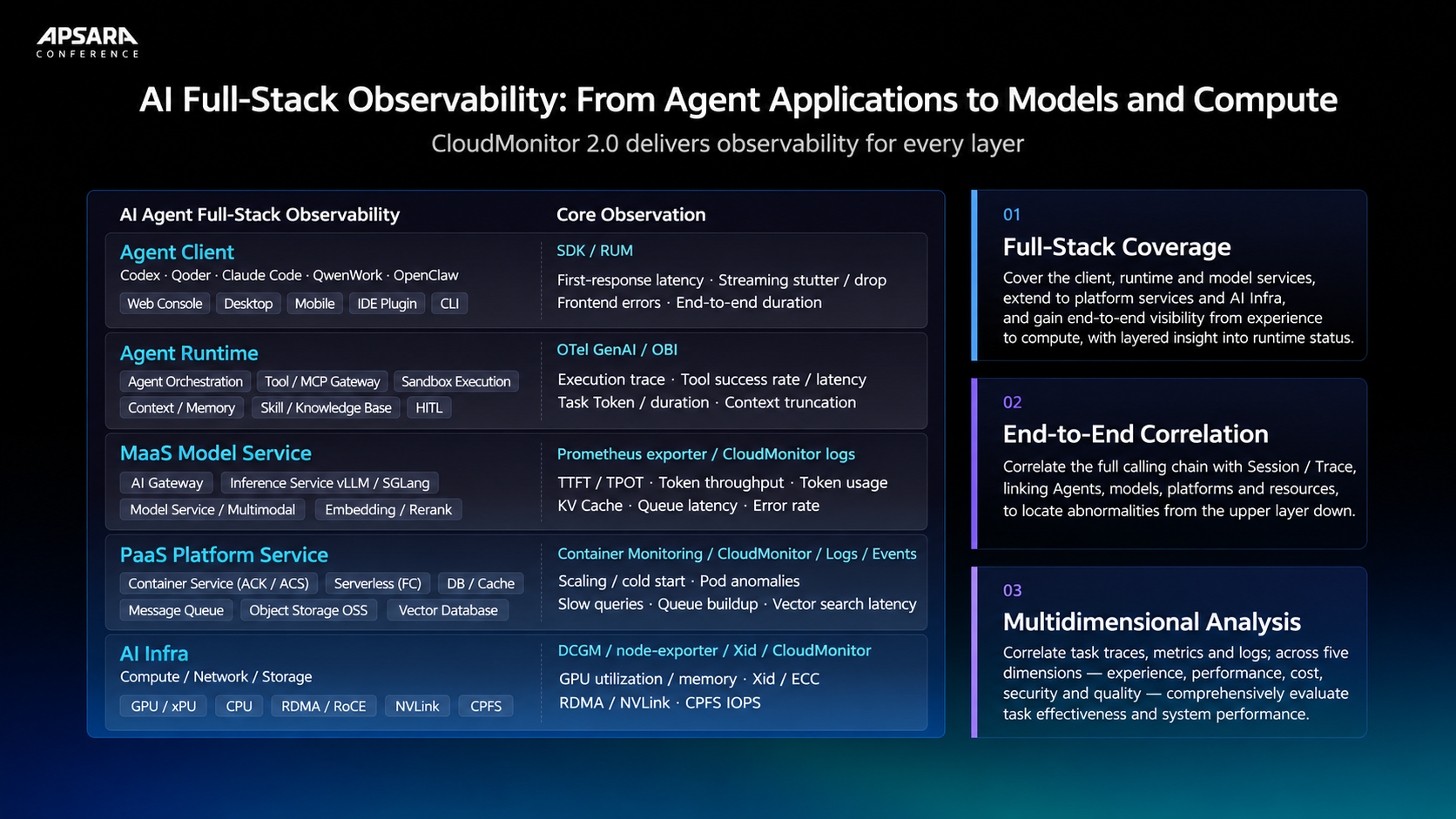
For observability of Agents, Cloud Monitor 2.0 also brings the Agent itself into view. To address three hard problems — stitching full-stack traces together, explaining execution, and drilling down to the root cause of anomalies — it provides full-stack AI observability across the user layer, Agent Runtime, model layer, platform layer, and AI infrastructure, with AI Agent observability, inference service observability, model insights, Sandbox observability, and GPU observability covering each layer. The data produced by observing Agents is the same set of facts that Agents rely on to observe systems; the two capabilities share one foundation.
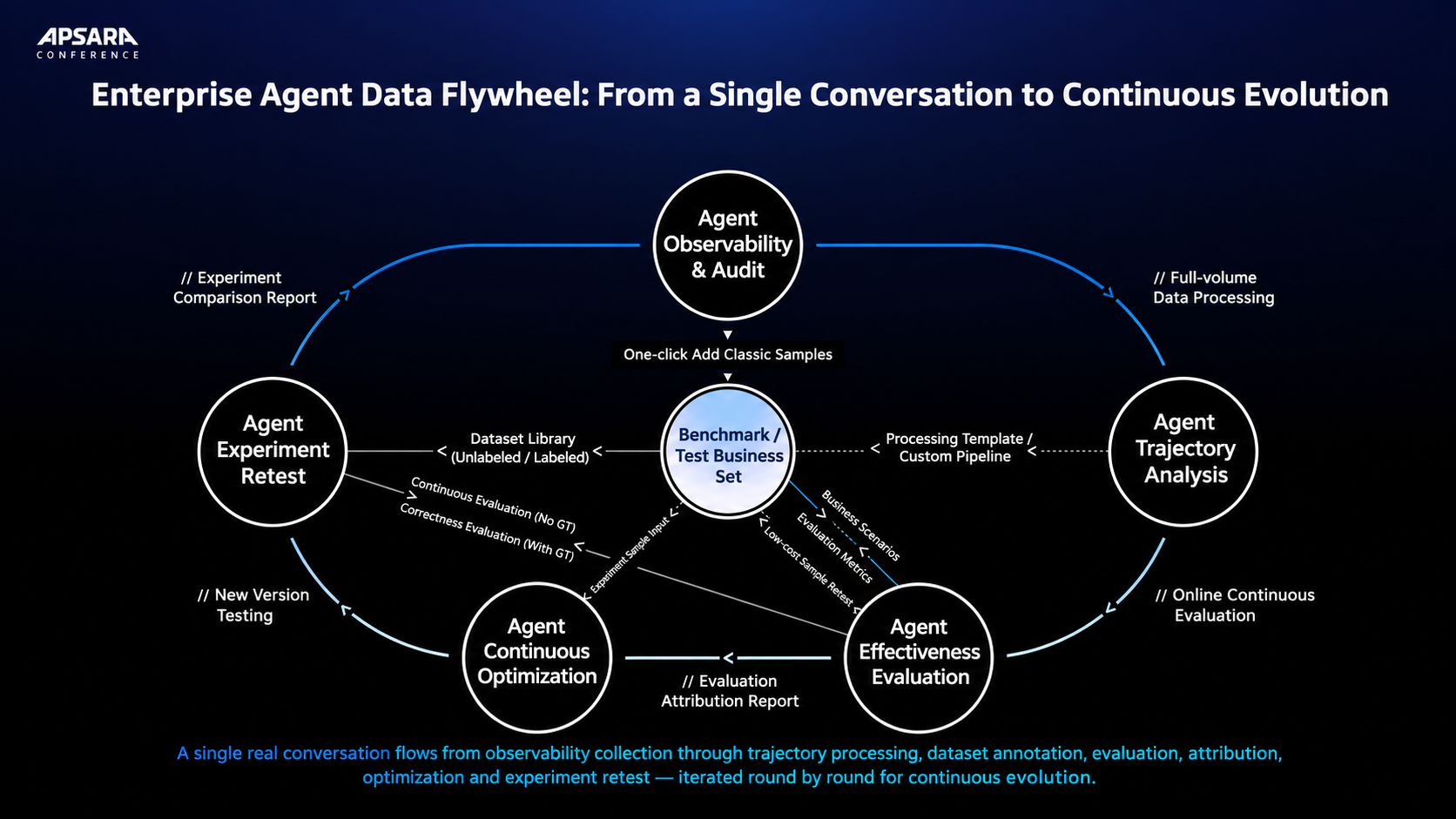
Cloud Monitor 2.0 helps an Agent understand the system; AgentLoop turns the lens on the Agent itself, so every run is visible, accurately evaluated, and open to improvement. Alibaba Cloud's view is that Agent effectiveness is not something you tune; it is something you run, evaluate, improve, and regress. The divide between a demo and a production-grade Agent is whether, when real-world tool failures, cost swings, and quality regressions show up, there is a platform mechanism for observability, evaluation, optimization, and regression that turns Agent observability into a continuously evolving data asset. As an enterprise Agent observability and optimization platform, AgentLoop serves production Agent environments along four lines: full-stack observability, effectiveness evaluation, continuous optimization, and experiment regression.
On the collection side, LoongSuite x AgentSight combines instrumentation agents (probes) for four languages with eBPF zero-code instrumentation, covering more than 40 frameworks without duplication and onboarding everything from LangChain, AgentScope, and Dify to Claude Code, Cursor, and MCP. It turns the Agent's reasoning traces, token cost, and tool calls into analyzable data. Behavioral auditing then upgrades alert lists into explainable, reviewable, actionable risk events, so operations can pick real risk out of the noise.
Above observability, AgentLoop turns data into judgment and improvement. Agent-as-a-Judge uses an Agent as the evaluator: it loads tools and Skills, learns enterprise private knowledge, and returns its reasons along with a traceable record of each run, pushing automated evaluation into a confidence range close to expert judgment. With a second review by human experts, evaluation accuracy reaches over 90%. Attribution analysis turns scores into concrete improvements, locating them across prompt, tool, knowledge, planning, memory, model, and policy. Experiment regression runs five steps — locked baseline, offline regression, small-traffic A/B testing, change gate, and canary release — so every change is a positive optimization; if any core metric misses its threshold, the change is blocked or rolled back.
Once Agents can evolve themselves, the moat in enterprise AI shifts from whose model is better to whose evolution flywheel spins faster.
Once the observability boundary has expanded and the facts are clear, the operations domain has to turn judgment into controlled action. As Alibaba Cloud's unified entry point for AIOps, STAROps unifies operational context and embeds cross-domain analysis, diagnostics, and continuous closed-loop remediation into an enterprise's existing workspaces and Agent ecosystem. Underneath, the STAROps Agentic Ops Engine drives a single chain: intent understanding, dynamic data perception, full-domain context assembly, task decomposition, intent routing, unified conclusion analysis, execution and validation, and self-evolution.
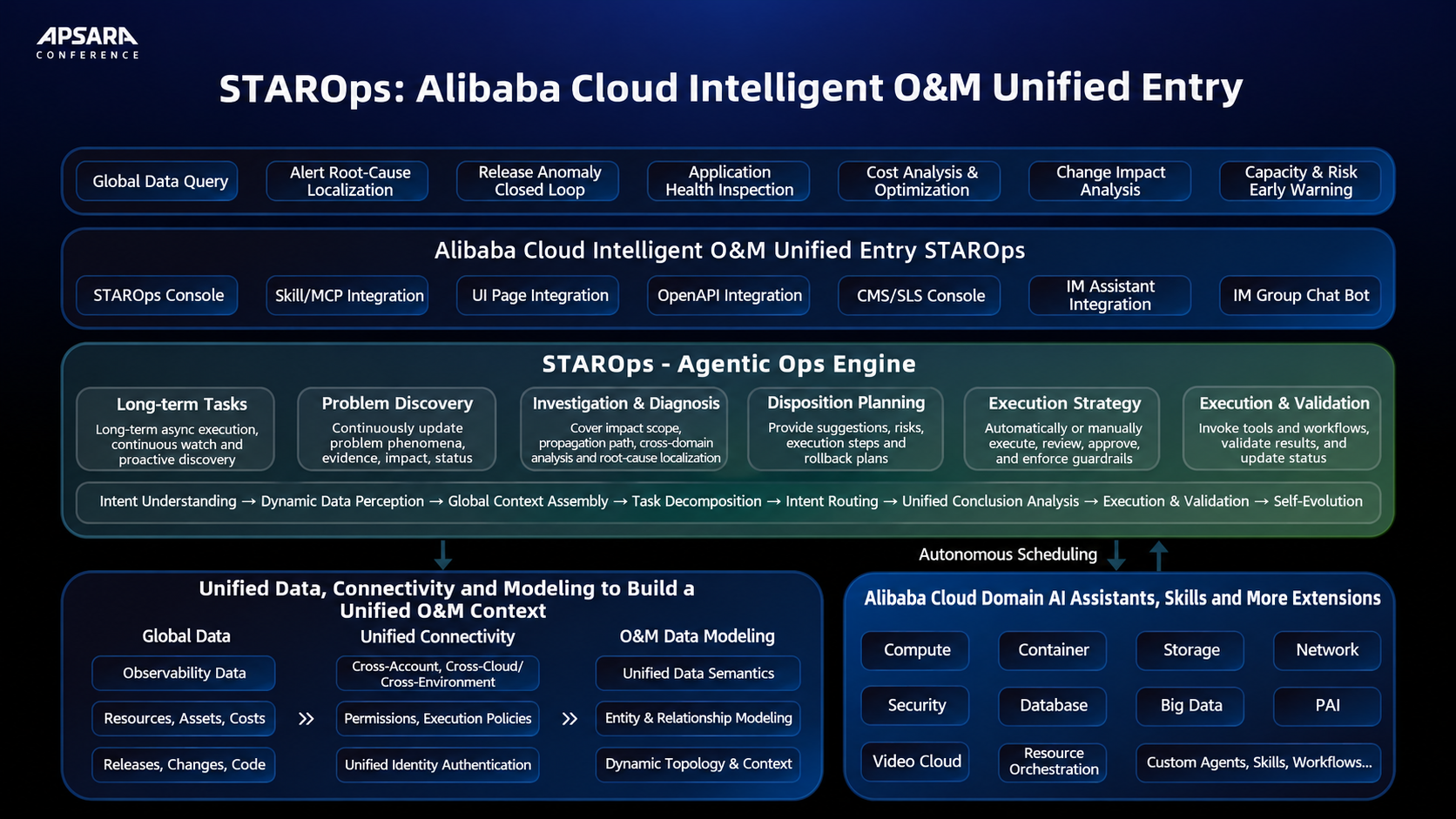
That chain rests on a unified operational context. Unified Connectors reach across Alibaba Cloud accounts, enterprise IDCs, and external systems; unified data modeling then brings metrics, logs, traces, events, changes, and code together with applications, instances, containers, and databases into one context that an Agent can understand and investigate.
In practice, a single question is enough to know and understand operational data. According to the team, a user can simply ask, “Show me the applications with relatively high error rates in the last hour” — an application performance monitoring (APM) question — and the system queries across metrics, logs, traces, resources, and changes, then returns a ranked list and key findings: for example, that the application named “review” has an error rate of 0.367%, about 30 times that of the runner-up, frontend-proxy. For end-to-end diagnostics, STAROps investigates in a hypothesis-driven way, converging through scope locking, full-domain evidence correlation, hypothesis validation, and conclusion output, and covers cross-cloud products, change anomalies, end-to-end application issues, and more.
Continuous loops and controlled execution are key to STAROps. Long-running tasks keep working toward operational goals, find problems proactively, and turn resolution traces and validation results into reusable experience. Remediation follows a tiered strategy: low-risk queries pass automatically; critical changes such as configuration, restarts, and scaling need human confirmation; operations that match a prohibition rule are blocked outright; and every action is checked twice, against execution policy and Resource Access Management (RAM) permissions, so the degree of automation always matches production risk and the whole process stays traceable.
Alibaba Cloud is also extending Agent capabilities from operations into R&D delivery. The Alibaba Cloud DevOps R&D Agent, released at this event, is built on the STAROps digital employee and has three clear goals: intelligent coverage of every scenario, autonomous Agent work, and automatic maintenance of team knowledge. For the user it is a dedicated digital avatar with the same Alibaba Cloud DevOps resource permissions as the person it represents, so there is no separate permission model to maintain; it can commit code, update requirements, and handle other day-to-day R&D work on the user's behalf.
Cloud Monitor 2.0, AgentLoop, STAROps, and Alibaba Cloud DevOps are product capabilities for enterprise production. Beyond them, Alibaba Cloud contributes to three open-source projects — OpenTelemetry (OTel), UModel, and BRiSE — to break, at the foundation, the three walls of data that cannot be collected, context that cannot be understood, and capabilities that cannot be verified, so the whole stack becomes a public asset the industry can reuse, verify, and build together.
As LLMs and Agents accelerate into use, Alibaba Cloud offers enterprises a complete infrastructure that spans observability and evaluation through to decision and action. Cloud Monitor 2.0 and AgentLoop first expand the observability boundary and strengthen the foundation, so the system is legible and the Agent is legible. STAROps closes the AIOps loop on that foundation, moving operations from seeing to understanding and controlled decision-making. The Alibaba Cloud DevOps R&D Agent brings the same autonomous loop into daily R&D. And the open-source foundations of OTel, UModel, and BRiSE hand data collection, semantic unification, and capability evaluation to the industry to build together.
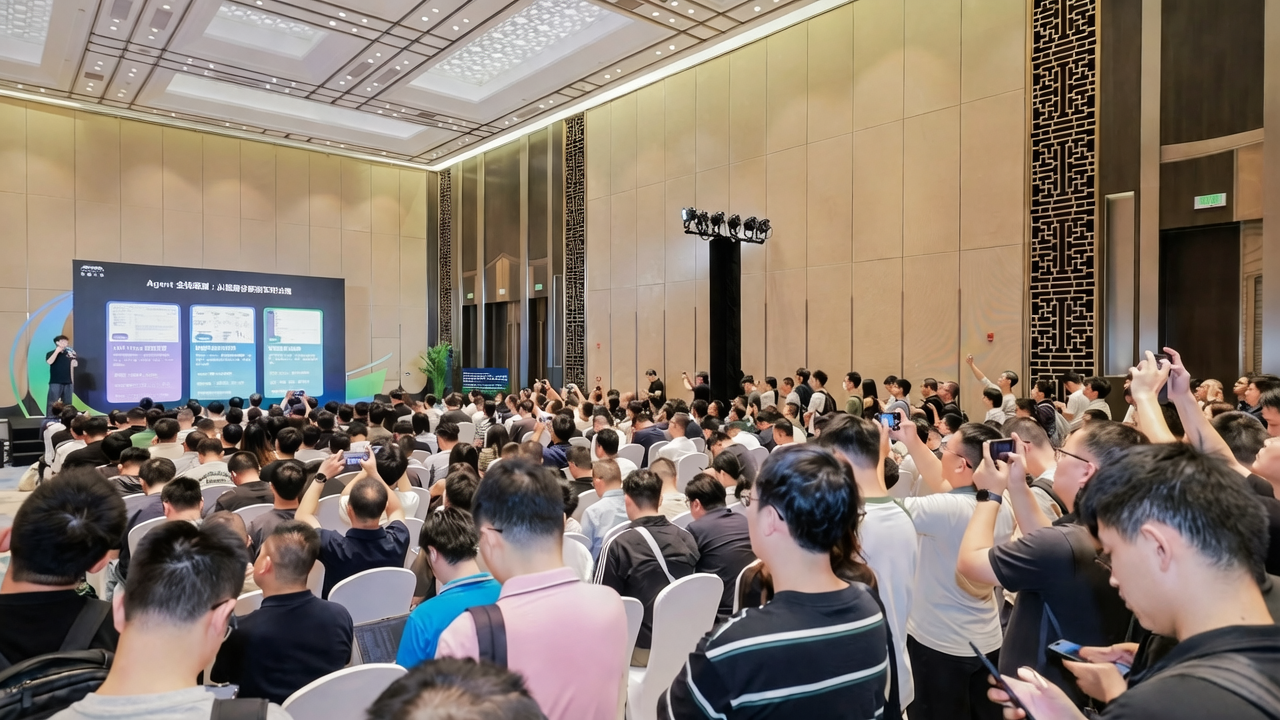
When a system can perceive, decide, and turn every resolution into experience for the next one, the competitive question in enterprise AI becomes simple: who evolves faster.

821 posts | 61 followers
FollowAlibaba Cloud Native Community - September 16, 2026
Alibaba Cloud Community - August 28, 2026
Alibaba Cloud Native Community - April 9, 2026
Alibaba Cloud Native Community - January 19, 2026
Alibaba Cloud Community - May 20, 2026
Alibaba Cloud Community - October 29, 2026
821 posts | 61 followers
Follow CloudMonitor
Automate performance monitoring of all your web resources and applications in real-time
Learn More Bastionhost
A unified, efficient, and secure platform that provides cloud-based O&M, access control, and operation audit.
Learn More AgentCore
 unifies agent construction, governance, and execution capabilities so enterprises can deploy diverse agents with confidence.
Learn More Log Management for AIOps Solution
Log into an artificial intelligence for IT operations (AIOps) environment with an intelligent, all-in-one, and out-of-the-box log management solution
Learn MoreMore Posts by Alibaba Cloud Native Community

