Honorable Mention, Global AI Hackathon Series with Qwen Cloud
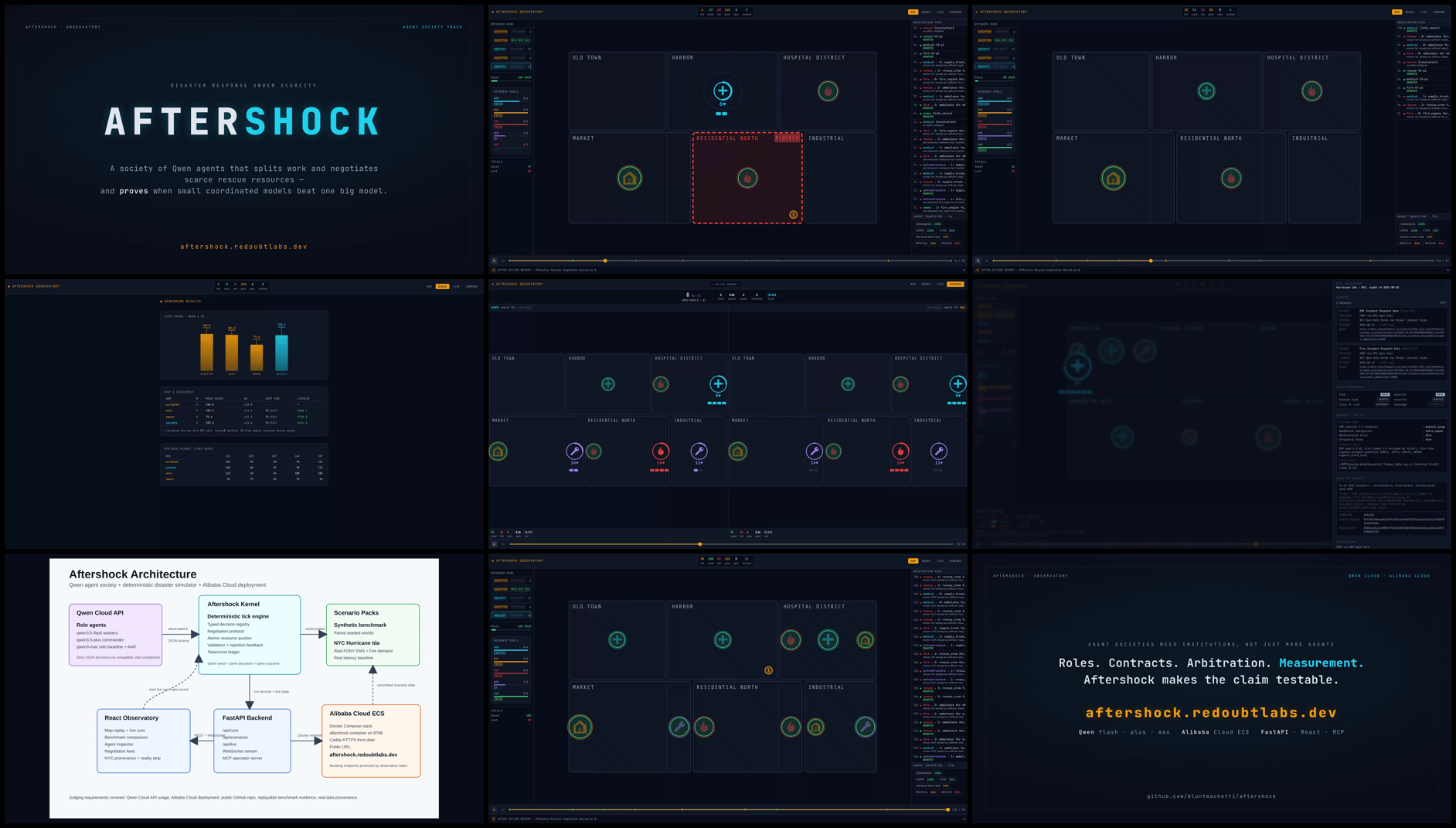
A disaster hits a simulated city. Missions bloom across the map: flooded neighborhoods, a collapsed school with people trapped inside, a hospital running low on generator fuel. A society of Qwen agents in six distinct roles — incident commander, medical, fire, rescue, infrastructure, and public communications — has to respond. This is Aftershock, a deterministic disaster-response simulator and live observatory for Qwen agent societies, and it exists to answer a question the field keeps hand-waving: when you put multiple agents together, does the coordination actually work?
Multi-agent coordination is easy to assert and notoriously hard to prove. Everyone ships a demo where the agents seem to cooperate; almost no one can show you, rigorously, that the cooperation beat a simpler baseline. Aftershock makes coordination auditable and measurable rather than theatrical.
The commander decomposes each mission into typed work and assigns it by role; agents can accept, reject, sub-delegate, or escalate with structured reasons. Scarce resources — ambulances, rescue crews, fire engines, fuel, generators — are contested through a typed proposal protocol of resource requests, task handoffs, escalations, and information shares. The engine resolves conflicts atomically every tick, so coordination is a mechanic, not a chat transcript. And nothing is asserted that you cannot inspect: a Decision Receipt chains any contested call, and a one-page Evidence Pack ties every headline number back to a source file in the repo.
The benchmark is where Aftershock earns its credibility. It runs identical seeded disasters four different ways: scripted bots, one qwen3-max solo agent, a flat swarm of qwen3.5-flash agents without the protocol, and the structured society (qwen3.5-flash workers with a qwen3.5-plus commander). Because the disasters are seeded and deterministic, the four conditions face literally the same emergencies — so any difference in outcome is attributable to the coordination approach, not to luck.
It scores lives saved, response latency, missions failed, wall time, and cost. And it doesn't stop at averages: it shows a bootstrap confidence interval, a paired sign-test, and statistical power beside every delta, flagging weak effects as suggestive rather than proven. A reproducibility badge confirms the scripted engine replays byte for byte. This is a benchmark harness that behaves like a careful scientist, not a marketing page — right down to labeling an agent's own stated rationale as "agent-stated" and never dressing it up as ground truth.
Aftershock's live demo runs on Alibaba Cloud Elastic Compute Service (ECS) as a Docker Compose stack: a FastAPI backend serving the React observatory, fronted by a Caddy HTTPS reverse proxy. All the reasoning across the four benchmark conditions runs on Qwen models — qwen3-max for the solo-agent baseline, qwen3.5-flash for the flat swarm and the structured society's workers, and qwen3.5-plus for the structured society's commander. Running all conditions on the same Qwen models over identical seeded disasters is what lets the harness make a fair, apples-to-apples claim about whether structure beats a swarm — and whether either beats a single strong model.
Aftershock was built by Kenny Ademolu, a cyber architecture and engineering lead focused on building trustworthy AI-native systems for identity, security, resilience, and agent evaluation. The project reflects that lens precisely: an agent society you don't have to take on faith, because every number, ruling, and rationale can be inspected, replayed, and statistically tested.
Explore the project: https://www.youtube.com/watch?v=TTM-iqX33qg
This project was developed as part of the Global AI Hackathon Series with Qwen Cloud.
NaLog Agronomist Agent: An Agronomist With Perfect Memory in Every Farmer's Pocket

148 posts | 29 followers
FollowAlibaba Cloud Community - June 25, 2026
ApsaraDB - May 22, 2026
Alibaba Cloud Project Hub - October 30, 2026
Alibaba Cloud Project Hub - November 4, 2026
Alibaba Cloud Community - September 27, 2025
Richard Kou - February 20, 2021
148 posts | 29 followers
Follow Token Plan
Build more, spend less. One plan, every modality.
Learn More QwenWork
 is dedicated to helping employees strengthen their professional competitiveness in the AI era and to enabling enterprises to improve organizational effectiveness.
Learn More Qwen
Full-range, open-source, multimodal, and multi-functional
Learn More
Alibaba Cloud Model Studio
A one-stop generative AI platform to build intelligent applications that understand your business, based on Qwen model series such as Qwen-Max and other popular models
Learn MoreMore Posts by Alibaba Cloud Project Hub

