Shanghai Zhenhui Information Technology Co., Ltd. (referred to as "HELIOS") runs SaaS systems for enterprise financial management. Their ApsaraDB RDS for MySQL instance used PL1 ESSDs, which cap throughput at 350 MB/s. During 3–4-hour peak windows, read/write load exceeded that limit and caused slow queries. By switching to the general ESSD storage type and enabling I/O burst, HELIOS eliminated the bottleneck without changing their business architecture or paying extra.
Is this use case relevant to you?
The general ESSD + I/O burst solution works well when your database traffic has clear peaks and valleys — meaning I/O demand regularly exceeds your current ESSD's limit for a few hours, then drops back down.
This is the right solution if:
-
Your RDS instance uses a PL1 ESSD and hits the 350 MB/s throughput ceiling during peak hours
-
Peak traffic lasts hours, not continuously — so provisioning a higher-tier ESSD for baseline capacity would waste money during off-peak periods
-
Your hourly I/O operations stay within 500,000 — the free burst quota provided by Alibaba Cloud — so you get higher peak performance at no additional cost
If your peak I/O regularly exceeds 500,000 operations per hour, I/O burst charges apply on a pay-as-you-go basis.
About HELIOS
Founded in August 2016, HELIOS provides enterprise software as a service (SaaS) for financial expense control, corporate spending management, and electronic archives. Its products — HELIOS, HELIOS Selected, e-FILING, and Spendia — serve customers across China, Japan, and global markets.
HELIOS has received investments from Blue Lake Capital, China Renaissance, SB China Capital (SBCVC), Z Capital, and Unicorn Capital, and holds certifications including the national high-tech enterprise certificate, SOC 1, SOC 2, Multi-Level Protection Scheme (MLPS) level 3, ISO 27001, and ISO 27017.
Business challenge: Queries slow down during peak hours
HELIOS's SaaS architecture follows the standard large-scale replication and multi-tenant model. As customer count grew, three problems emerged:
-
Performance bottleneck: During off-peak hours, the read/write load on the core RDS instance stays below 350 MB/s. During peak periods (approximately 3 to 4 hours each day), load exceeds 350 MB/s — the throughput ceiling of a PL1 ESSD — and database queries slow down noticeably.
-
Scaling flexibility: Different customers need different database configurations. HELIOS needed a storage architecture that could handle traffic surges without over-provisioning resources that sit idle most of the time.
-
O&M complexity: Managing large numbers of database instances, supporting data migration and isolation for key accounts, and ensuring zero-downtime migration all add operational overhead.

Typical SaaS architecture
Solution: Upgrade to the general ESSD storage type
Why PL1 ESSD wasn't enough
PL1 ESSDs tie I/O performance to storage capacity. ESSDs use 25 Gigabit Ethernet and RDMA technology to deliver high random read/write IOPS per disk and shorter one-way latency than standard SSDs. The table below shows the limits for PL1:
| Performance level | Description | Capacity range (GiB) | Maximum IOPS | Maximum throughput (MB/s) |
|---|---|---|---|---|
| PL1 | Moderate concurrent I/O, low latency | 20–65,536 | 50,000 | 350 |
HELIOS's monitoring confirmed the pattern: during off-peak hours, throughput stayed comfortably below 350 MB/s. But during peak hours, it hit and held the ceiling — a clear sign of I/O throttling, not a capacity problem.
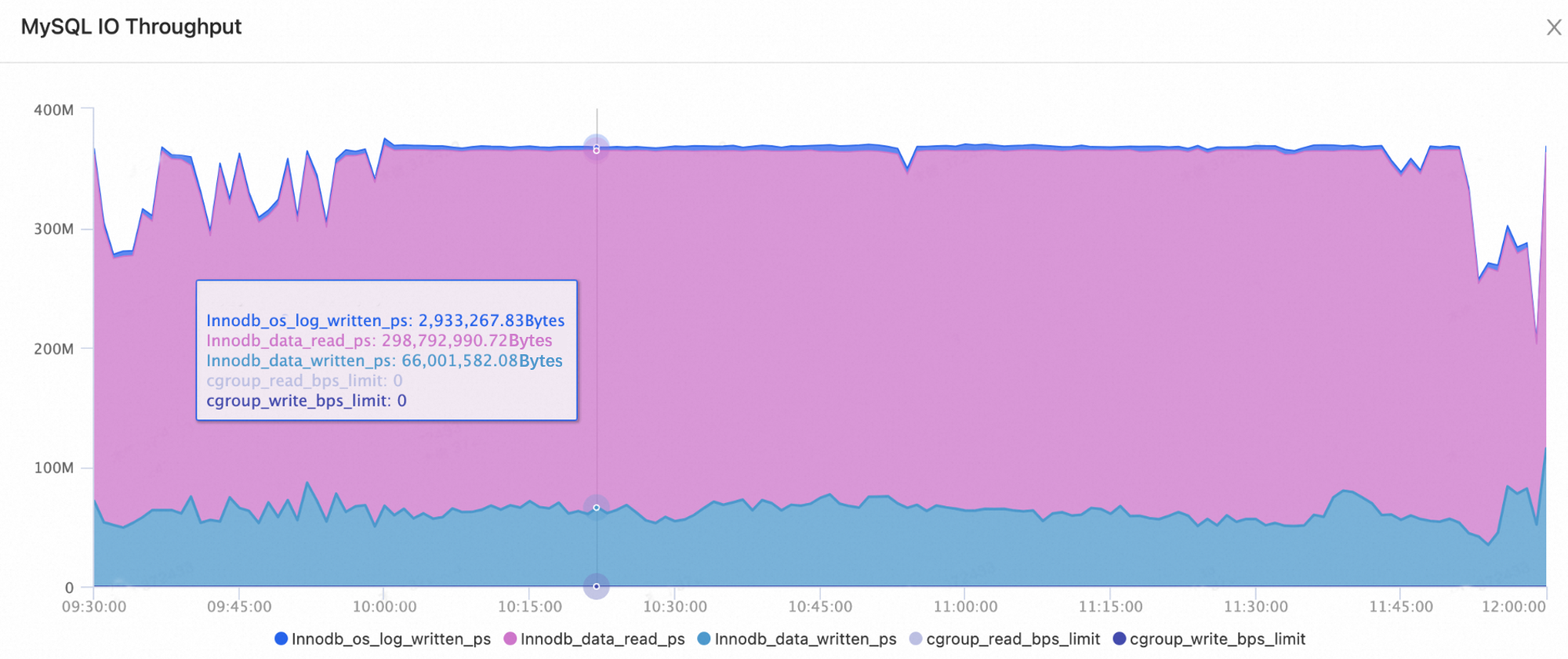
I/O throughput during peak hours (PL1 ESSD)
Expanding storage capacity to raise the PL1 ESSD's IOPS and bandwidth limits was an option, but it would mean paying for resources that go unused outside peak windows.
How general ESSDs work
The general ESSD is a storage type built on a three-layer architecture that integrates PaaS and IaaS:
-
Cache layer: High-performance disk for hot data, maximizing I/O rates
-
Data layer: ESSD for warm data, balancing performance and cost
-
Cold storage layer: Object Storage Service (OSS) buckets for cold data, minimizing storage cost
This architecture decouples I/O performance from storage capacity. The general ESSD uses AliSQL to detect I/O bursts and automatically scales throughput to meet demand, then scales back down once the load subsides.
How I/O burst works
When the I/O burst feature is disabled, maximum IOPS and throughput depend on storage capacity (standard PL1 ESSD behavior). When enabled, the ceiling rises significantly:
| I/O burst | Maximum IOPS | Maximum throughput (MB/s) |
|---|---|---|
| Disabled | min{50,000, max IOPS for instance type, IOPS for max I/O bandwidth, 1,800 + 50 × storage capacity} | min{350, max I/O bandwidth, 120 + 0.5 × storage capacity} |
| Enabled | min{1,000,000, max IOPS for instance type, IOPS for max I/O bandwidth} | min{4,000, max I/O bandwidth} |
When traffic spikes, the system automatically enters burst mode, increases the I/O limit to handle the load, then returns to normal levels once demand drops. No manual intervention is required.
Will I/O burst be enough for your workload? The free quota is 500,000 burstable I/O operations per hour. For most SaaS workloads with clear traffic peaks, this is well above actual demand during bursts — HELIOS's peak usage stays within this free quota. If your workload regularly exhausts the free quota, I/O burst charges apply on a pay-as-you-go basis. To check whether your peak I/O exceeds the free quota, review the hourly I/O operation counts in your RDS monitoring dashboard before upgrading.
Upgrade process
The Alibaba Cloud team worked with HELIOS's R&D team to switch from PL1 ESSD to general ESSD. The upgrade preserved the existing business architecture — no application-side changes were required.
Results after the upgrade
After enabling general ESSDs and I/O burst, peak throughput scales up to 4,000 MB/s. The RDS instance is no longer throttled during peak hours, and slow queries caused by insufficient I/O capacity no longer occur.
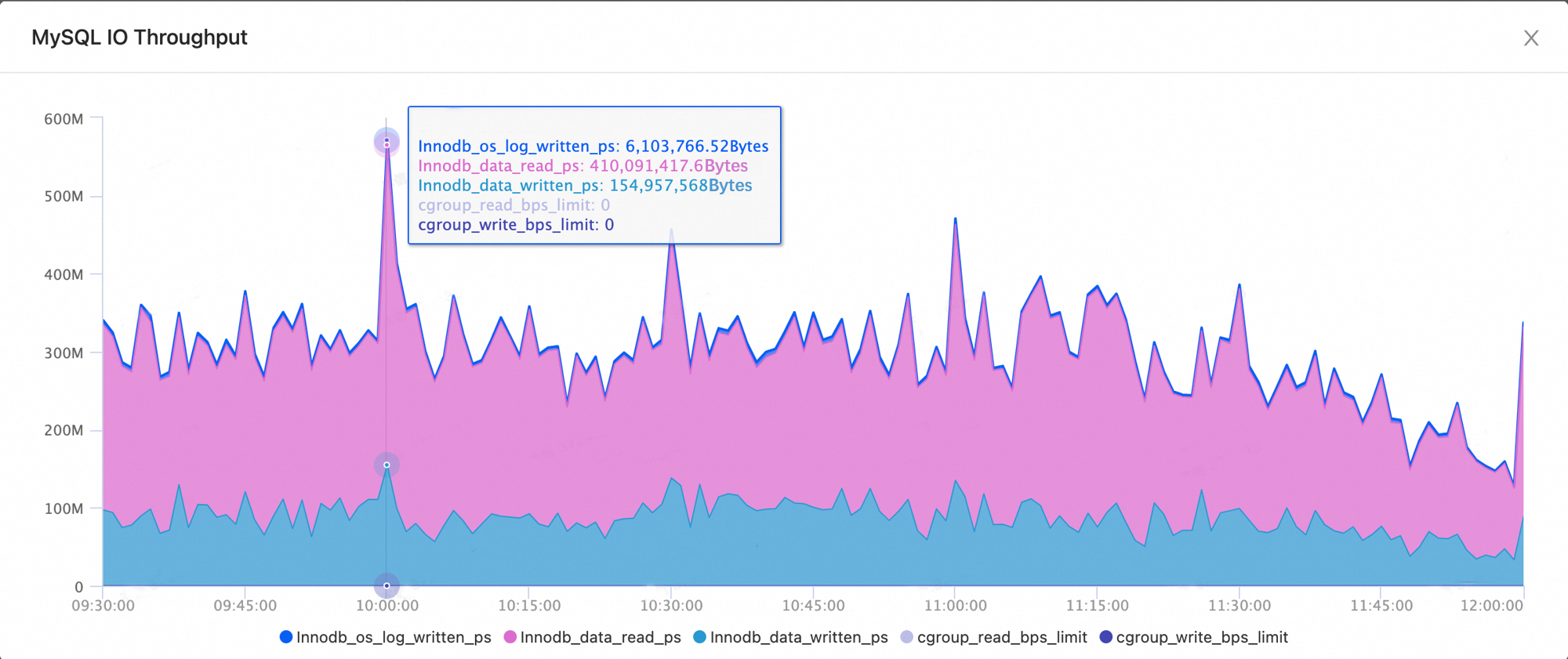
I/O throughput during peak hours (general ESSDs)
Benefits
-
No performance degradation during peaks: I/O burst absorbs traffic spikes automatically. Databases run at full capacity during peak hours without manual intervention.
-
Same price as PL1 ESSD: The base pricing of general ESSDs matches PL1 ESSDs. HELIOS's peak I/O usage falls within Alibaba Cloud's free burst quota of 500,000 operations per hour, so performance improves without additional cost.
-
No architecture changes: The upgrade is a storage-type switch. Existing application code, database schemas, and business workflows stay unchanged.
Customer remarks
"Alibaba Cloud has not only won our trust with its stable environment, first-grade services, and excellent technical capabilities, but also provided effective support when we faced challenges. Alibaba Cloud continuously focused on handling database bottlenecks and disk switching, which ensured the smooth running of databases. I hope that Alibaba Cloud can continue to provide support for us in the future."
— Ma Yunfei, Technical Director, Shanghai Zhenhui Information Technology Co., Ltd.
What's next
-
Storage types — Compare all ApsaraDB RDS storage types, including PL0–PL3 ESSDs and general ESSDs
-
General ESSD — Architecture details, supported instance types, and how to enable I/O burst