Resource Orchestration Service (ROS) lets you define and provision cloud resources using declarative templates. With ROS, you can automate RDS instance deployment and configuration—creating accounts, setting up databases, and querying instance properties—without manual console steps. This topic shows how to use a ROS template to query configuration details of an ApsaraDB RDS instance.
Supported resources
ROS supports two categories of ApsaraDB RDS resources.
Regular resources create or modify RDS infrastructure:
| Resource | Description |
|---|---|
| ALIYUN::RDS::Account | Creates a database management account |
| ALIYUN::RDS::AccountPrivilege | Grants an account access to a database |
| ALIYUN::RDS::ADInfo | Configures an Active Directory (AD) domain |
| ALIYUN::RDS::Connection | Applies for a public endpoint |
| ALIYUN::RDS::Database | Creates a database on an RDS instance |
| ALIYUN::RDS::DBInstance | Creates an RDS instance |
| ALIYUN::RDS::DBInstanceParameterGroup | Modifies instance parameters |
| ALIYUN::RDS::DBInstanceSecurityIps | Modifies the IP address whitelist |
| ALIYUN::RDS::DBInstanceClone | Restores historical data to a new cloned instance |
| ALIYUN::RDS::MigrateTask | Restores a backup file from OSS to an ApsaraDB RDS for SQL Server instance |
| ALIYUN::RDS::PrepayDBInstance | Creates a subscription RDS instance |
| ALIYUN::RDS::ReadOnlyDBInstance | Creates a read-only RDS instance |
Data resources query existing RDS resources and expose their attributes as stack outputs. Use data resources when you need to read instance properties—such as connection strings, storage capacity, or zone IDs—without modifying infrastructure.
| Resource | Description |
|---|---|
| DATASOURCE::RDS::Accounts | Queries account information for an RDS instance |
| DATASOURCE::RDS::DBInstance | Queries information about an RDS instance |
| DATASOURCE::RDS::Databases | Queries database information for an RDS instance |
| DATASOURCE::RDS::DBInstances | Queries all RDS instances |
| DATASOURCE::RDS::Zones | Queries available zones |
For a complete introduction to ROS, see What is ROS?
Prerequisites
To interact with ROS and RDS, you need a RAM user with an AccessKey pair. Avoid using your Alibaba Cloud root account for day-to-day operations.
Before you begin, ensure that you have:
An Alibaba Cloud account
An existing ApsaraDB RDS instance
Set up a RAM user:
Log on to the RAM console, go to the Users page, and click Create User.
Set Logon Name to
rds-test-operatorand Access Method to Using permanent AccessKey to access.Click OK.
Go back to the Users page, find the RAM user you created, and click Add Permissions in the Actions column.
Attach policies based on your use case: For custom permission requirements, see Create custom policies.
Query only: Attach AliyunRDSReadOnlyAccess and AliyunROSFullAccess.
Query and modify: Attach AliyunRDSFullAccess and AliyunROSFullAccess.
Click Grant permissions.
Query RDS instance details using a ROS stack
This example creates a stack using the DATASOURCE::RDS::DBInstance data resource to query configuration details of an existing RDS instance and expose the results as stack outputs.
Create a stack
Log on to the ROS console.
In the top navigation bar, select the region where your RDS instance resides.
In the left-side navigation pane, click Stacks, then choose Create Stack > Use ROS.
In the Specify Template section, select Select an Existing Template.
In the Template Import Method section, select Enter Template Content.
In the Template Content section, click the ROS tab and paste one of the following templates. For full details on the
DATASOURCE::RDS::DBInstanceresource type and all available output attributes, see DATASOURCE::RDS::DBInstance. JSON format{ "ROSTemplateFormatVersion": "2015-09-01", "Parameters": { "DBInstanceId": { "Type": "String", "Description": { "en": "The ID of the instance." }, "Required": false } }, "Resources": { "ExtensionDataSource": { "Type": "DATASOURCE::RDS::DBInstance", "Properties": { "DBInstanceId": { "Ref": "DBInstanceId" } } } }, "Outputs": { "DBInstanceMemory": { "Description": "The memory capacity of the instance. Unit: MB.", "Value": { "Fn::GetAtt": [ "ExtensionDataSource", "DBInstanceMemory" ] } }, "ResourceGroupId": { "Description": "The resource group ID.", "Value": { "Fn::GetAtt": [ "ExtensionDataSource", "ResourceGroupId" ] } }, "IncrementSourceDBInstanceId": { "Description": "The ID of the instance from which incremental data comes. The incremental data of a disaster recovery instance or read-only instance comes from its primary instance. If this parameter is not returned, the instance is a primary instance.", "Value": { "Fn::GetAtt": [ "ExtensionDataSource", "IncrementSourceDBInstanceId" ] } }, "MasterZone": { "Description": "The zone ID of the primary instance.", "Value": { "Fn::GetAtt": [ "ExtensionDataSource", "MasterZone" ] } }, "Port": { "Description": "The port that is used to connect to the instance over an internal network.", "Value": { "Fn::GetAtt": [ "ExtensionDataSource", "Port" ] } }, "LatestKernelVersion": { "Description": "The latest minor engine version that is supported by the instance.", "Value": { "Fn::GetAtt": [ "ExtensionDataSource", "LatestKernelVersion" ] } }, "ConsoleVersion": { "Description": "The type of the proxy that is used by the instance. Valid values:\n1: shared proxy\n2: dedicated proxy", "Value": { "Fn::GetAtt": [ "ExtensionDataSource", "ConsoleVersion" ] } }, "DBInstanceType": { "Description": "The type of the instance. Valid values:\nPrimary: primary instance\nReadonly: read-only instance\nGuard: disaster recovery instance\nTemp: temporary instance", "Value": { "Fn::GetAtt": [ "ExtensionDataSource", "DBInstanceType" ] } }, "GeneralGroupName": { "Description": "The name of the dedicated cluster to which the instance belongs. This parameter is returned only when the instance is created in an ApsaraDB MyBase cluster that runs MySQL on Standard Edition.", "Value": { "Fn::GetAtt": [ "ExtensionDataSource", "GeneralGroupName" ] } }, "InstanceNetworkType": { "Description": "The network type of the instance. Valid values:\nClassic\nVPC", "Value": { "Fn::GetAtt": [ "ExtensionDataSource", "InstanceNetworkType" ] } }, "DBInstanceClassType": { "Description": "The instance family to which the instance belongs. Valid values:\ns: shared instance family\nx: general-purpose instance family\nd: dedicated instance family\nh: dedicated host instance family", "Value": { "Fn::GetAtt": [ "ExtensionDataSource", "DBInstanceClassType" ] } }, "AutoUpgradeMinorVersion": { "Description": "The method that is used to update the minor engine version of the instance. Valid values:\nAuto: automatic update.\nManual: manual update. The minor engine version of the instance is forcefully updated only when the in-use minor engine version is phased out.", "Value": { "Fn::GetAtt": [ "ExtensionDataSource", "AutoUpgradeMinorVersion" ] } }, "DBInstanceId": { "Description": "The instance ID.", "Value": { "Fn::GetAtt": [ "ExtensionDataSource", "DBInstanceId" ] } }, "DBInstanceStorage": { "Description": "The storage capacity of the instance. Unit: GB.", "Value": { "Fn::GetAtt": [ "ExtensionDataSource", "DBInstanceStorage" ] } }, "PGBouncerEnabled": { "Description": "Indicates whether PgBouncer is enabled.", "Value": { "Fn::GetAtt": [ "ExtensionDataSource", "PGBouncerEnabled" ] } }, "InstructionSetArch": { "Description": "The architecture type of the instance. Valid values:\nx86\narm", "Value": { "Fn::GetAtt": [ "ExtensionDataSource", "InstructionSetArch" ] } }, "LockReason": { "Description": "The reason why the instance was locked.", "Value": { "Fn::GetAtt": [ "ExtensionDataSource", "LockReason" ] } }, "AvailabilityValue": { "Description": "The availability status of the instance in percentage.", "Value": { "Fn::GetAtt": [ "ExtensionDataSource", "AvailabilityValue" ] } }, "Engine": { "Description": "The database engine of the instance. Valid values:\nMySQL\nPostgreSQL\nSQLServer\nMariaDB", "Value": { "Fn::GetAtt": [ "ExtensionDataSource", "Engine" ] } }, "DBInstanceDescription": { "Description": "The description of the instance.", "Value": { "Fn::GetAtt": [ "ExtensionDataSource", "DBInstanceDescription" ] } }, "IPType": { "Description": "The type of the IP address. Only IPv4 addresses are supported.", "Value": { "Fn::GetAtt": [ "ExtensionDataSource", "IPType" ] } }, "MaxIOMBPS": { "Description": "The maximum I/O throughput. Unit: MB/s.", "Value": { "Fn::GetAtt": [ "ExtensionDataSource", "MaxIOMBPS" ] } }, "DBInstanceDiskUsed": { "Description": "The disk usage of the instance.", "Value": { "Fn::GetAtt": [ "ExtensionDataSource", "DBInstanceDiskUsed" ] } }, "EngineVersion": { "Description": "The database engine version.", "Value": { "Fn::GetAtt": [ "ExtensionDataSource", "EngineVersion" ] } }, "MaxConnections": { "Description": "The maximum number of concurrent connections.", "Value": { "Fn::GetAtt": [ "ExtensionDataSource", "MaxConnections" ] } }, "DBInstanceStatus": { "Description": "The status of the instance.", "Value": { "Fn::GetAtt": [ "ExtensionDataSource", "DBInstanceStatus" ] } }, "DBInstanceClass": { "Description": "The instance type of the instance.", "Value": { "Fn::GetAtt": [ "ExtensionDataSource", "DBInstanceClass" ] } }, "AccountMaxQuantity": { "Description": "The maximum number of accounts that can be created on the instance.", "Value": { "Fn::GetAtt": [ "ExtensionDataSource", "AccountMaxQuantity" ] } }, "VSwitchId": { "Description": "The vSwitch ID.", "Value": { "Fn::GetAtt": [ "ExtensionDataSource", "VSwitchId" ] } }, "TipsLevel": { "Description": "The severity level of the exception that is detected on the instance. This parameter is returned only when the instance is created in an ApsaraDB MyBase cluster that runs MySQL on Standard Edition. Valid values:\n1: The instance is normal.\n2: The specifications of the read-only instances do not match the specifications of the primary instance. You must adjust the specifications of these instances based on your business requirements.", "Value": { "Fn::GetAtt": [ "ExtensionDataSource", "TipsLevel" ] } }, "LockMode": { "Description": "The lock mode of the instance. Valid values:\nUnlock: The instance is not locked.\nManualLock: The instance is manually locked.\nLockByExpiration: The instance is automatically locked due to instance expiration.\nLockByRestoration: The instance is automatically locked due to instance restoration.\nLockByDiskQuota: The instance is automatically locked due to exhausted storage space.\nLockReadInstanceByDiskQuota: The instance is a read-only instance and is automatically locked due to exhausted storage.", "Value": { "Fn::GetAtt": [ "ExtensionDataSource", "LockMode" ] } }, "DeletionProtection": { "Description": "Indicates whether the release protection feature is enabled. Valid values:\ntrue\nfalse", "Value": { "Fn::GetAtt": [ "ExtensionDataSource", "DeletionProtection" ] } }, "PayType": { "Description": "The billing method of the instance. Valid values:\nPostpaid: pay-as-you-go\nPrepaid: subscription", "Value": { "Fn::GetAtt": [ "ExtensionDataSource", "PayType" ] } }, "GuardDBInstanceId": { "Description": "The ID of the disaster recovery instance that is attached to the instance.", "Value": { "Fn::GetAtt": [ "ExtensionDataSource", "GuardDBInstanceId" ] } }, "DBClusterNodes": { "Description": "The information about the node in the cluster.", "Value": { "Fn::GetAtt": [ "ExtensionDataSource", "DBClusterNodes" ] } }, "TimeZone": { "Description": "The time zone of the instance.", "Value": { "Fn::GetAtt": [ "ExtensionDataSource", "TimeZone" ] } }, "VpcId": { "Description": "The virtual private cloud (VPC) ID of the instance.", "Value": { "Fn::GetAtt": [ "ExtensionDataSource", "VpcId" ] } }, "MasterInstanceId": { "Description": "The ID of the primary instance.\nNote: If this parameter is not returned, the instance is the primary instance.", "Value": { "Fn::GetAtt": [ "ExtensionDataSource", "MasterInstanceId" ] } }, "CurrentKernelVersion": { "Description": "The minor engine version of the instance.", "Value": { "Fn::GetAtt": [ "ExtensionDataSource", "CurrentKernelVersion" ] } }, "CreationTime": { "Description": "The creation time. The time follows the ISO 8601 standard in the yyyy-MM-ddTHH:mm:ssZ format. The time is displayed in UTC.", "Value": { "Fn::GetAtt": [ "ExtensionDataSource", "CreationTime" ] } }, "ConnectionMode": { "Description": "The connection mode of the instance. Valid values:\nStandard: standard mode\nSafe: database proxy mode", "Value": { "Fn::GetAtt": [ "ExtensionDataSource", "ConnectionMode" ] } }, "VpcCloudInstanceId": { "Description": "The VPC ID.", "Value": { "Fn::GetAtt": [ "ExtensionDataSource", "VpcCloudInstanceId" ] } }, "ReadonlyInstanceSQLDelayedTime": { "Description": "The latency at which the system replicates data to read-only instances. The system replicates data from the primary instance to the read-only instances at the latency that is specified by the ReadonlyInstanceSQLDelayedTime parameter. Unit: seconds.", "Value": { "Fn::GetAtt": [ "ExtensionDataSource", "ReadonlyInstanceSQLDelayedTime" ] } }, "ProxyType": { "Description": "The type of the proxy that is supported by the instance. Valid values:\n0: The instance does not support database proxies.\n1: The instance supports shared proxies, with which the instance runs in multi-tenant mode.\n2: The instance supports dedicated proxies, with which the instance runs in single-tenant mode.", "Value": { "Fn::GetAtt": [ "ExtensionDataSource", "ProxyType" ] } }, "ConnectionString": { "Description": "The internal endpoint of the instance.", "Value": { "Fn::GetAtt": [ "ExtensionDataSource", "ConnectionString" ] } }, "ExpireTime": { "Description": "The expiration time. The time follows the ISO 8601 standard in the yyyy-MM-ddTHH:mm:ssZ format. The time is displayed in UTC.\nNote: Pay-as-you-go instances never expire.", "Value": { "Fn::GetAtt": [ "ExtensionDataSource", "ExpireTime" ] } }, "AdvancedFeatures": { "Description": "The advanced features that are enabled for the instance. If multiple advanced features are enabled, the advanced features are separated by commas (,). This parameter is available only to instances that run SQL Server. Valid values:\nLinkedServer\nDistributeTransaction", "Value": { "Fn::GetAtt": [ "ExtensionDataSource", "AdvancedFeatures" ] } }, "DBMaxQuantity": { "Description": "The maximum number of databases that can be created on the instance.", "Value": { "Fn::GetAtt": [ "ExtensionDataSource", "DBMaxQuantity" ] } }, "Category": { "Description": "The RDS edition of the instance. Valid values:\nBasic: RDS Basic Edition\nHighAvailability: RDS High-availability Edition\ncluster: RDS Cluster Edition for ApsaraDB RDS for MySQL\nAlwaysOn: RDS Cluster Edition for ApsaraDB RDS for SQL Server\nFinance: RDS Enterprise Edition\nServerless_basic: RDS Basic Edition for serverless instances", "Value": { "Fn::GetAtt": [ "ExtensionDataSource", "Category" ] } }, "SuperPermissionMode": { "Description": "Indicates whether the instance supports superuser accounts, such as the system administrator (SA) account, the Active Directory (AD) account, and the host account.\nEnable\nDisabled", "Value": { "Fn::GetAtt": [ "ExtensionDataSource", "SuperPermissionMode" ] } }, "DBInstanceNetType": { "Description": "The type of the network over which the instance is connected. Valid values:\nInternet: Internet\nIntranet: internal network", "Value": { "Fn::GetAtt": [ "ExtensionDataSource", "DBInstanceNetType" ] } }, "DedicatedHostGroupId": { "Description": "The ID of the dedicated cluster.", "Value": { "Fn::GetAtt": [ "ExtensionDataSource", "DedicatedHostGroupId" ] } }, "TempDBInstanceId": { "Description": "The ID of the temporary instance that is attached to the instance.", "Value": { "Fn::GetAtt": [ "ExtensionDataSource", "TempDBInstanceId" ] } }, "DBInstanceCPU": { "Description": "The number of CPU cores.", "Value": { "Fn::GetAtt": [ "ExtensionDataSource", "DBInstanceCPU" ] } }, "SecurityIPList": { "Description": "The IP addresses in the IP address whitelist.", "Value": { "Fn::GetAtt": [ "ExtensionDataSource", "SecurityIPList" ] } }, "ReadOnlyDBInstanceIds": { "Description": "The IDs of the read-only instances that are attached to the primary instance.", "Value": { "Fn::GetAtt": [ "ExtensionDataSource", "ReadOnlyDBInstanceIds" ] } }, "SecurityIPMode": { "Description": "The whitelist mode of the instance. Valid values:\nnormal: standard whitelist mode\nsafety: enhanced whitelist mode", "Value": { "Fn::GetAtt": [ "ExtensionDataSource", "SecurityIPMode" ] } }, "MaintainTime": { "Description": "The maintenance window of the instance. The time is displayed in UTC. Take note that the maintenance window displayed in the ApsaraDB RDS console is equal to the value of this parameter plus 8 hours.", "Value": { "Fn::GetAtt": [ "ExtensionDataSource", "MaintainTime" ] } }, "ZoneId": { "Description": "The zone ID.", "Value": { "Fn::GetAtt": [ "ExtensionDataSource", "ZoneId" ] } }, "Collation": { "Description": "The character set collation of the instance.", "Value": { "Fn::GetAtt": [ "ExtensionDataSource", "Collation" ] } }, "DBInstanceStorageType": { "Description": "The storage type of the instance. Valid values:\nlocal_ssd and ephemeral_ssd: local SSD\ncloud_ssd: standard SSD\ncloud_essd: enhanced SSD (ESSD)", "Value": { "Fn::GetAtt": [ "ExtensionDataSource", "DBInstanceStorageType" ] } }, "MaxIOPS": { "Description": "The maximum number of I/O requests per second.", "Value": { "Fn::GetAtt": [ "ExtensionDataSource", "MaxIOPS" ] } }, "SlaveZones": { "Description": "The information about the zone of the secondary instance.", "Value": { "Fn::GetAtt": [ "ExtensionDataSource", "SlaveZones" ] } }, "Extra": { "Description": "The extended information of the instance.", "Value": { "Fn::GetAtt": [ "ExtensionDataSource", "Extra" ] } }, "ServerlessConfig": { "Description": "The settings of the serverless instance.", "Value": { "Fn::GetAtt": [ "ExtensionDataSource", "ServerlessConfig" ] } }, "BabelfishConfig": { "Description": "The configuration of the Babelfish feature for the ApsaraDB RDS for PostgreSQL instance.", "Value": { "Fn::GetAtt": [ "ExtensionDataSource", "BabelfishConfig" ] } }, "Tips": { "Description": "The information about the exception that is detected on the instance. This parameter is returned only when the instance is created in an ApsaraDB MyBase cluster that runs MySQL on Standard Edition.", "Value": { "Fn::GetAtt": [ "ExtensionDataSource", "Tips" ] } } } }YAML format
ROSTemplateFormatVersion: '2015-09-01'
Parameters:
  DBInstanceId:
    Description:
      en: The ID of the instance.
    Required: false
    Type: String
Resources:
  ExtensionDataSource:
    Properties:
      DBInstanceId:
        Ref: DBInstanceId
    Type: DATASOURCE::RDS::DBInstance
Outputs:
  AccountMaxQuantity:
    Description: The maximum number of accounts that can be created on the instance.
    Value:
      Fn::GetAtt:
      - ExtensionDataSource
      - AccountMaxQuantity
  AdvancedFeatures:
    Description: 'The advanced features that are enabled for the instance. If multiple
      advanced features are enabled, the advanced features are separated by commas
      (,). This parameter is available only to instances that run SQL Server. Valid
      values:

      LinkedServer

      DistributeTransaction'
    Value:
      Fn::GetAtt:
      - ExtensionDataSource
      - AdvancedFeatures
  AutoUpgradeMinorVersion:
    Description: 'The method that is used to update the minor engine version of the
      instance. Valid values:

      Auto: automatic update.

      Manual: manual update. The minor engine version of the instance is forcefully
      updated only when the in-use minor engine version is phased out.'
    Value:
      Fn::GetAtt:
      - ExtensionDataSource
      - AutoUpgradeMinorVersion
  AvailabilityValue:
    Description: The availability status of the instance in percentage.
    Value:
      Fn::GetAtt:
      - ExtensionDataSource
      - AvailabilityValue
  BabelfishConfig:
    Description: The configuration of the Babelfish feature for the ApsaraDB RDS for
      PostgreSQL instance.
    Value:
      Fn::GetAtt:
      - ExtensionDataSource
      - BabelfishConfig
  Category:
    Description: 'The RDS edition of the instance. Valid values:

      Basic: RDS Basic Edition

      HighAvailability: RDS High-availability Edition

      cluster: RDS Cluster Edition for ApsaraDB RDS for MySQL

      AlwaysOn: RDS Cluster Edition for ApsaraDB RDS for SQL Server

      Finance: RDS Enterprise Edition

      Serverless_basic: RDS Basic Edition for serverless instances'
    Value:
      Fn::GetAtt:
      - ExtensionDataSource
      - Category
  Collation:
    Description: The character set collation of the instance.
    Value:
      Fn::GetAtt:
      - ExtensionDataSource
      - Collation
  ConnectionMode:
    Description: 'The connection mode of the instance. Valid values:

      Standard: standard mode

      Safe: database proxy mode'
    Value:
      Fn::GetAtt:
      - ExtensionDataSource
      - ConnectionMode
  ConnectionString:
    Description: The internal endpoint of the instance.
    Value:
      Fn::GetAtt:
      - ExtensionDataSource
      - ConnectionString
  ConsoleVersion:
    Description: 'The type of the proxy that is used by the instance. Valid values:

      1: shared proxy

      2: dedicated proxy'
    Value:
      Fn::GetAtt:
      - ExtensionDataSource
      - ConsoleVersion
  CreationTime:
    Description: The creation time. The time follows the ISO 8601 standard in the
      yyyy-MM-ddTHH:mm:ssZ format. The time is displayed in UTC.
    Value:
      Fn::GetAtt:
      - ExtensionDataSource
      - CreationTime
  CurrentKernelVersion:
    Description: The minor engine version of the instance.
    Value:
      Fn::GetAtt:
      - ExtensionDataSource
      - CurrentKernelVersion
  DBClusterNodes:
    Description: The information about the node in the cluster.
    Value:
      Fn::GetAtt:
      - ExtensionDataSource
      - DBClusterNodes
  DBInstanceCPU:
    Description: The number of CPU cores.
    Value:
      Fn::GetAtt:
      - ExtensionDataSource
      - DBInstanceCPU
  DBInstanceClass:
    Description: The instance type of the instance.
    Value:
      Fn::GetAtt:
      - ExtensionDataSource
      - DBInstanceClass
  DBInstanceClassType:
    Description: 'The instance family to which the instance belongs. Valid values:

      s: shared instance family

      x: general-purpose instance family

      d: dedicated instance family

      h: dedicated host instance family'
    Value:
      Fn::GetAtt:
      - ExtensionDataSource
      - DBInstanceClassType
  DBInstanceDescription:
    Description: The description of the instance.
    Value:
      Fn::GetAtt:
      - ExtensionDataSource
      - DBInstanceDescription
  DBInstanceDiskUsed:
    Description: The disk usage of the instance.
    Value:
      Fn::GetAtt:
      - ExtensionDataSource
      - DBInstanceDiskUsed
  DBInstanceId:
    Description: The instance ID.
    Value:
      Fn::GetAtt:
      - ExtensionDataSource
      - DBInstanceId
  DBInstanceMemory:
    Description: 'The memory capacity of the instance. Unit: MB.'
    Value:
      Fn::GetAtt:
      - ExtensionDataSource
      - DBInstanceMemory
  DBInstanceNetType:
    Description: 'The type of the network over which the instance is connected. Valid
      values:

      Internet: Internet

      Intranet: internal network'
    Value:
      Fn::GetAtt:
      - ExtensionDataSource
      - DBInstanceNetType
  DBInstanceStatus:
    Description: The status of the instance.
    Value:
      Fn::GetAtt:
      - ExtensionDataSource
      - DBInstanceStatus
  DBInstanceStorage:
    Description: 'The storage capacity of the instance. Unit: GB.'
    Value:
      Fn::GetAtt:
      - ExtensionDataSource
      - DBInstanceStorage
  DBInstanceStorageType:
    Description: 'The storage type of the instance. Valid values:

      local_ssd and ephemeral_ssd: local SSD

      cloud_ssd: standard SSD

      cloud_essd: enhanced SSD (ESSD)'
    Value:
      Fn::GetAtt:
      - ExtensionDataSource
      - DBInstanceStorageType
  DBInstanceType:
    Description: 'The type of the instance. Valid values:

      Primary: primary instance

      Readonly: read-only instance

      Guard: disaster recovery instance

      Temp: temporary instance'
    Value:
      Fn::GetAtt:
      - ExtensionDataSource
      - DBInstanceType
  DBMaxQuantity:
    Description: The maximum number of databases that can be created on the instance.
    Value:
      Fn::GetAtt:
      - ExtensionDataSource
      - DBMaxQuantity
  DedicatedHostGroupId:
    Description: The ID of the dedicated cluster.
    Value:
      Fn::GetAtt:
      - ExtensionDataSource
      - DedicatedHostGroupId
  DeletionProtection:
    Description: 'Indicates whether the release protection feature is enabled. Valid
      values:

      true

      false'
    Value:
      Fn::GetAtt:
      - ExtensionDataSource
      - DeletionProtection
  Engine:
    Description: 'The database engine of the instance. Valid values:

      MySQL

      PostgreSQL

      SQLServer

      MariaDB'
    Value:
      Fn::GetAtt:
      - ExtensionDataSource
      - Engine
  EngineVersion:
    Description: The database engine version.
    Value:
      Fn::GetAtt:
      - ExtensionDataSource
      - EngineVersion
  ExpireTime:
    Description: 'The expiration time. The time follows the ISO 8601 standard in the
      yyyy-MM-ddTHH:mm:ssZ format. The time is displayed in UTC.

      Note: Pay-as-you-go instances never expire.'
    Value:
      Fn::GetAtt:
      - ExtensionDataSource
      - ExpireTime
  Extra:
    Description: The extended information of the instance.
    Value:
      Fn::GetAtt:
      - ExtensionDataSource
      - Extra
  GeneralGroupName:
    Description: The name of the dedicated cluster to which the instance belongs.
      This parameter is returned only when the instance is created in an ApsaraDB
      MyBase cluster that runs MySQL on Standard Edition.
    Value:
      Fn::GetAtt:
      - ExtensionDataSource
      - GeneralGroupName
  GuardDBInstanceId:
    Description: The ID of the disaster recovery instance that is attached to the
      instance.
    Value:
      Fn::GetAtt:
      - ExtensionDataSource
      - GuardDBInstanceId
  IPType:
    Description: The type of the IP address. Only IPv4 addresses are supported.
    Value:
      Fn::GetAtt:
      - ExtensionDataSource
      - IPType
  IncrementSourceDBInstanceId:
    Description: The ID of the instance from which incremental data comes. The incremental
      data of a disaster recovery instance or read-only instance comes from its primary
      instance. If this parameter is not returned, the instance is a primary instance.
    Value:
      Fn::GetAtt:
      - ExtensionDataSource
      - IncrementSourceDBInstanceId
  InstanceNetworkType:
    Description: 'The network type of the instance. Valid values:

      Classic

      VPC'
    Value:
      Fn::GetAtt:
      - ExtensionDataSource
      - InstanceNetworkType
  InstructionSetArch:
    Description: 'The architecture type of the instance. Valid values:

      x86

      arm'
    Value:
      Fn::GetAtt:
      - ExtensionDataSource
      - InstructionSetArch
  LatestKernelVersion:
    Description: The latest minor engine version that is supported by the instance.
    Value:
      Fn::GetAtt:
      - ExtensionDataSource
      - LatestKernelVersion
  LockMode:
    Description: 'The lock mode of the instance. Valid values:

      Unlock: The instance is not locked.

      ManualLock: The instance is manually locked.

      LockByExpiration: The instance is automatically locked due to instance expiration.

      LockByRestoration: The instance is automatically locked due to instance restoration.

      LockByDiskQuota: The instance is automatically locked due to exhausted storage
      space.

      LockReadInstanceByDiskQuota: The instance is a read-only instance and is automatically
      locked due to exhausted storage.'
    Value:
      Fn::GetAtt:
      - ExtensionDataSource
      - LockMode
  LockReason:
    Description: The reason why the instance was locked.
    Value:
      Fn::GetAtt:
      - ExtensionDataSource
      - LockReason
  MaintainTime:
    Description: The maintenance window of the instance. The time is displayed in
      UTC. Take note that the maintenance window displayed in the ApsaraDB RDS console
      is equal to the value of this parameter plus 8 hours.
    Value:
      Fn::GetAtt:
      - ExtensionDataSource
      - MaintainTime
  MasterInstanceId:
    Description: 'The ID of the primary instance.

      Note: If this parameter is not returned, the instance is the primary instance.'
    Value:
      Fn::GetAtt:
      - ExtensionDataSource
      - MasterInstanceId
  MasterZone:
    Description: The zone ID of the primary instance.
    Value:
      Fn::GetAtt:
      - ExtensionDataSource
      - MasterZone
  MaxConnections:
    Description: The maximum number of concurrent connections.
    Value:
      Fn::GetAtt:
      - ExtensionDataSource
      - MaxConnections
  MaxIOMBPS:
    Description: 'The maximum I/O throughput. Unit: MB/s.'
    Value:
      Fn::GetAtt:
      - ExtensionDataSource
      - MaxIOMBPS
  MaxIOPS:
    Description: The maximum number of I/O requests per second.
    Value:
      Fn::GetAtt:
      - ExtensionDataSource
      - MaxIOPS
  PGBouncerEnabled:
    Description: Indicates whether PgBouncer is enabled.
    Value:
      Fn::GetAtt:
      - ExtensionDataSource
      - PGBouncerEnabled
  PayType:
    Description: 'The billing method of the instance. Valid values:

      Postpaid: pay-as-you-go

      Prepaid: subscription'
    Value:
      Fn::GetAtt:
      - ExtensionDataSource
      - PayType
  Port:
    Description: The port that is used to connect to the instance over an internal
      network.
    Value:
      Fn::GetAtt:
      - ExtensionDataSource
      - Port
  ProxyType:
    Description: 'The type of the proxy that is supported by the instance. Valid values:

      0: The instance does not support database proxies.

      1: The instance supports shared proxies, with which the instance runs in multi-tenant
      mode.

      2: The instance supports dedicated proxies, with which the instance runs in
      single-tenant mode.'
    Value:
      Fn::GetAtt:
      - ExtensionDataSource
      - ProxyType
  ReadOnlyDBInstanceIds:
    Description: The IDs of the read-only instances that are attached to the primary
      instance.
    Value:
      Fn::GetAtt:
      - ExtensionDataSource
      - ReadOnlyDBInstanceIds
  ReadonlyInstanceSQLDelayedTime:
    Description: 'The latency at which the system replicates data to read-only instances.
      The system replicates data from the primary instance to the read-only instances
      at the latency that is specified by the ReadonlyInstanceSQLDelayedTime parameter.
      Unit: seconds.'
    Value:
      Fn::GetAtt:
      - ExtensionDataSource
      - ReadonlyInstanceSQLDelayedTime
  ResourceGroupId:
    Description: The resource group ID.
    Value:
      Fn::GetAtt:
      - ExtensionDataSource
      - ResourceGroupId
  SecurityIPList:
    Description: The IP addresses in the IP address whitelist.
    Value:
      Fn::GetAtt:
      - ExtensionDataSource
      - SecurityIPList
  SecurityIPMode:
    Description: 'The whitelist mode of the instance. Valid values:

      normal: standard whitelist mode

      safety: enhanced whitelist mode'
    Value:
      Fn::GetAtt:
      - ExtensionDataSource
      - SecurityIPMode
  ServerlessConfig:
    Description: The settings of the serverless instance.
    Value:
      Fn::GetAtt:
      - ExtensionDataSource
      - ServerlessConfig
  SlaveZones:
    Description: The information about the zone of the secondary instance.
    Value:
      Fn::GetAtt:
      - ExtensionDataSource
      - SlaveZones
  SuperPermissionMode:
    Description: 'Indicates whether the instance supports superuser accounts, such
      as the system administrator (SA) account, the Active Directory (AD) account,
      and the host account.

      Enable

      Disabled'
    Value:
      Fn::GetAtt:
      - ExtensionDataSource
      - SuperPermissionMode
  TempDBInstanceId:
    Description: The ID of the temporary instance that is attached to the instance.
    Value:
      Fn::GetAtt:
      - ExtensionDataSource
      - TempDBInstanceId
  TimeZone:
    Description: The time zone of the instance.
    Value:
      Fn::GetAtt:
      - ExtensionDataSource
      - TimeZone
  Tips:
    Description: The information about the exception that is detected on the instance.
      This parameter is returned only when the instance is created in an ApsaraDB
      MyBase cluster that runs MySQL on Standard Edition.
    Value:
      Fn::GetAtt:
      - ExtensionDataSource
      - Tips
  TipsLevel:
    Description: 'The severity level of the exception that is detected on the instance.
      This parameter is returned only when the instance is created in an ApsaraDB
      MyBase cluster that runs MySQL on Standard Edition. Valid values:

      1: The instance is normal.

      2: The specifications of the read-only instances do not match the specifications
      of the primary instance. You must adjust the specifications of these instances
      based on your business requirements.'
    Value:
      Fn::GetAtt:
      - ExtensionDataSource
      - TipsLevel
  VSwitchId:
    Description: The vSwitch ID.
    Value:
      Fn::GetAtt:
      - ExtensionDataSource
      - VSwitchId
  VpcCloudInstanceId:
    Description: The VPC ID.
    Value:
      Fn::GetAtt:
      - ExtensionDataSource
      - VpcCloudInstanceId
  VpcId:
    Description: The virtual private cloud (VPC) ID of the instance.
    Value:
      Fn::GetAtt:
      - ExtensionDataSource
      - VpcId
  ZoneId:
    Description: The zone ID.
    Value:
      Fn::GetAtt:
      - ExtensionDataSource
      - ZoneId
Click Next and configure the stack parameters:
Parameter Required Description Example Stack Name Yes The name of the stack Rds_TestDBInstanceId Yes The ID of the RDS instance rm-bp1tuz16pa5x8****Configure Stack Settings No Additional stack parameters. See Create a stack — Click Create.
Verify the results
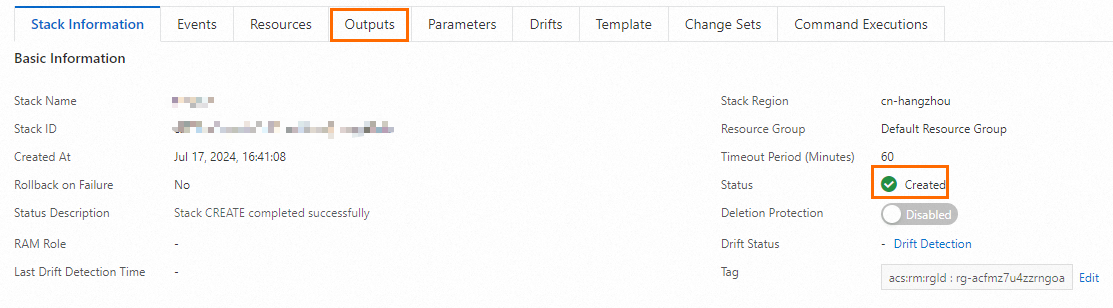
After the stack is created, click the Outputs tab to view the instance details.
What's next
To learn about all available stack operations, see Create a stack.
To use ROS with other RDS resource types, see the ROS developer reference for the full list of
ALIYUN::RDS::*andDATASOURCE::RDS::*resources.