CloudOps Orchestration Service provides a visual console and supports multiple integration methods: OpenAPI, Alibaba Cloud SDK, CLI, and Resource Orchestration Service (ROS). Choose the method that fits your needs when integrating with CloudOps Orchestration Service.
OpenAPI
The OpenAPI Portal provides intelligent search, documentation, online debugging, SDK downloads, code samples, error diagnosis, and call statistics. Call any Alibaba Cloud product's OpenAPI, view requests and responses, and auto-generate SDK call samples. What is OpenAPI?.
Version guide
OpenAPI uses version numbers to manage API lists. For example, CloudOps Orchestration Service supports API version 2019-06-01. 2019-06-01 is a version identifier, not a date. It represents the latest public API set, which may be updated over time.
|
Version number |
Description |
|
Recommended |
Online debugging
CloudOps Orchestration Service provides API debugging in the OpenAPI Portal. Before calling an API, understand the versions, endpoints, and integration methods that CloudOps Orchestration Service supports.
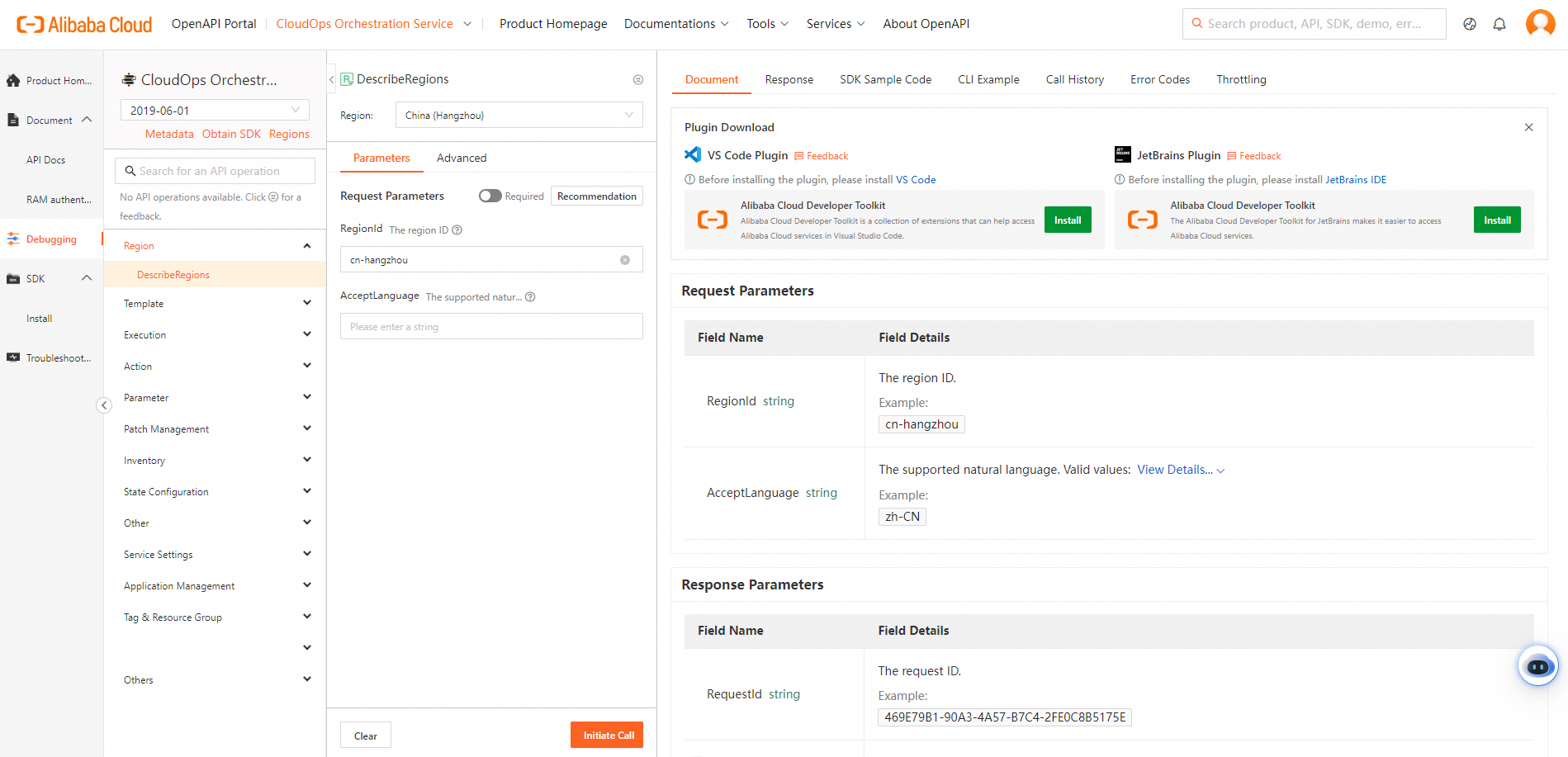
Debug portal
API debugging portal: CloudOps Orchestration Service API Debugging List
Endpoints
Select the endpoint for the region where your resources reside. For example, the public endpoint for CloudOps Orchestration Service in the China (Zhangjiakou) region is oos.cn-zhangjiakou.aliyuncs.com, and the VPC endpoint is oos-vpc.cn-zhangjiakou.aliyuncs.com.
-
Public endpoints are accessible globally.
-
VPC endpoints are accessible only from within the corresponding Alibaba Cloud region and VPC, and offer these advantages:
-
Higher security and privacy through VPC-only access.
-
Lower latency by avoiding public network overhead.
-
Reduced data transfer costs through internal network communication.
-
User identity
The OpenAPI Portal uses your Alibaba Cloud account by default for API debugging. Because this grants access to all APIs, we recommend using a Resource Access Management (RAM) user with least-privilege permissions. The RAM user must have permissions to manage CloudOps Orchestration Service resources. Use RAM for access control.
|
User identity |
Support |
|
Support |
|
|
RAM user (Recommended) |
Support |
|
RAM role (Recommended) |
Supported |
More information
Integration methods
SDKs are the recommended method for calling OpenAPI.
Integration method overview
|
Method |
Support |
|
Support |
|
|
Support |
|
|
Support |
|
|
Support |
-
Alibaba Cloud SDK
-
Alibaba Cloud provides SDKs for Java, C#, Go, Python, Node.js/TypeScript, PHP, and C++. SDKs handle signature logic, timeouts, and retries, and return structured response objects. Alibaba Cloud SDK.
-
You can call CloudOps Orchestration Service using the Alibaba Cloud SDK. Supported languages and installation: CloudOps Orchestration Service SDK.
-
-
Alibaba Cloud CLI
-
Alibaba Cloud CLI is a command-line tool built on OpenAPI for managing Alibaba Cloud products. What is Alibaba Cloud CLI?.
-
You can call CloudOps Orchestration Service using the Alibaba Cloud CLI. CLI integration example.
-
-
Resource Orchestration Service (ROS)
-
Resource Orchestration Service (ROS) automates cloud resource provisioning through templates. Define resources such as ECS instances and ApsaraDB RDS instances with their dependencies, and the ROS engine creates and configures them automatically. What is Resource Orchestration Service?.
-
You can use ROS to call CloudOps Orchestration Service. ROS integration example.
-
-
Custom API call encapsulation
For native HTTP calls, implement the signature algorithm and build the request. CloudOps Orchestration Service API overview and V3 request body & signature mechanism.
Notes
If a CloudOps Orchestration Service API call returns an error, verify the error code and request parameters.
You can also record the RequestID returned in the response or SDK error messages, and use the Alibaba Cloud OpenAPI Diagnostic Platform to perform a self-diagnosis.
FAQ
-
CloudOps Orchestration Service is an Alibaba Cloud automated O&M service. Define tasks, execution order, inputs, and outputs in templates, then run them to automate operations. What is CloudOps Orchestration Service?.
-
For supported SDK languages for CloudOps Orchestration Service: CloudOps Orchestration Service SDK Reference.