IoT Platform provides a console for visual operations and multiple methods for calling API operations, including OpenAPI Explorer, Alibaba Cloud SDKs, Terraform, and Resource Orchestration Service (ROS). This facilitates your development and deployment.
API overview
Alibaba Cloud API is a series of APIs that allow developers to access and manage Alibaba Cloud services by programming and provide automated and custom solutions. Alibaba Cloud provides OpenAPI Explorer for developers to efficiently understand and use the API operations of various Alibaba Cloud services. OpenAPI Explorer integrates multiple features related to API operations, including intelligent search, documentation, online debugging, SDK download, sample code, error diagnosis, and call statistics. In OpenAPI Explorer, you can call API operations of all Alibaba Cloud services and view API requests and responses. For more information, see What is an API?
Versions
OpenAPI Explorer supports online debugging for APIs of the 2018-01-20 version. 2018-01-20 is an API version number instead of a date. 2018-01-20 is not the last update date of APIs. OpenAPI Explorer allows you to call all the latest public APIs. For more information about how to view the version of an API, see API version.
Version number | Description |
The recommended version. |
Online debugging
You can call the API operations of IoT Platform in OpenAPI Explorer. Before you call the API operations of IoT Platform, you must understand the information about the API, including the API version, endpoints, and request parameters.
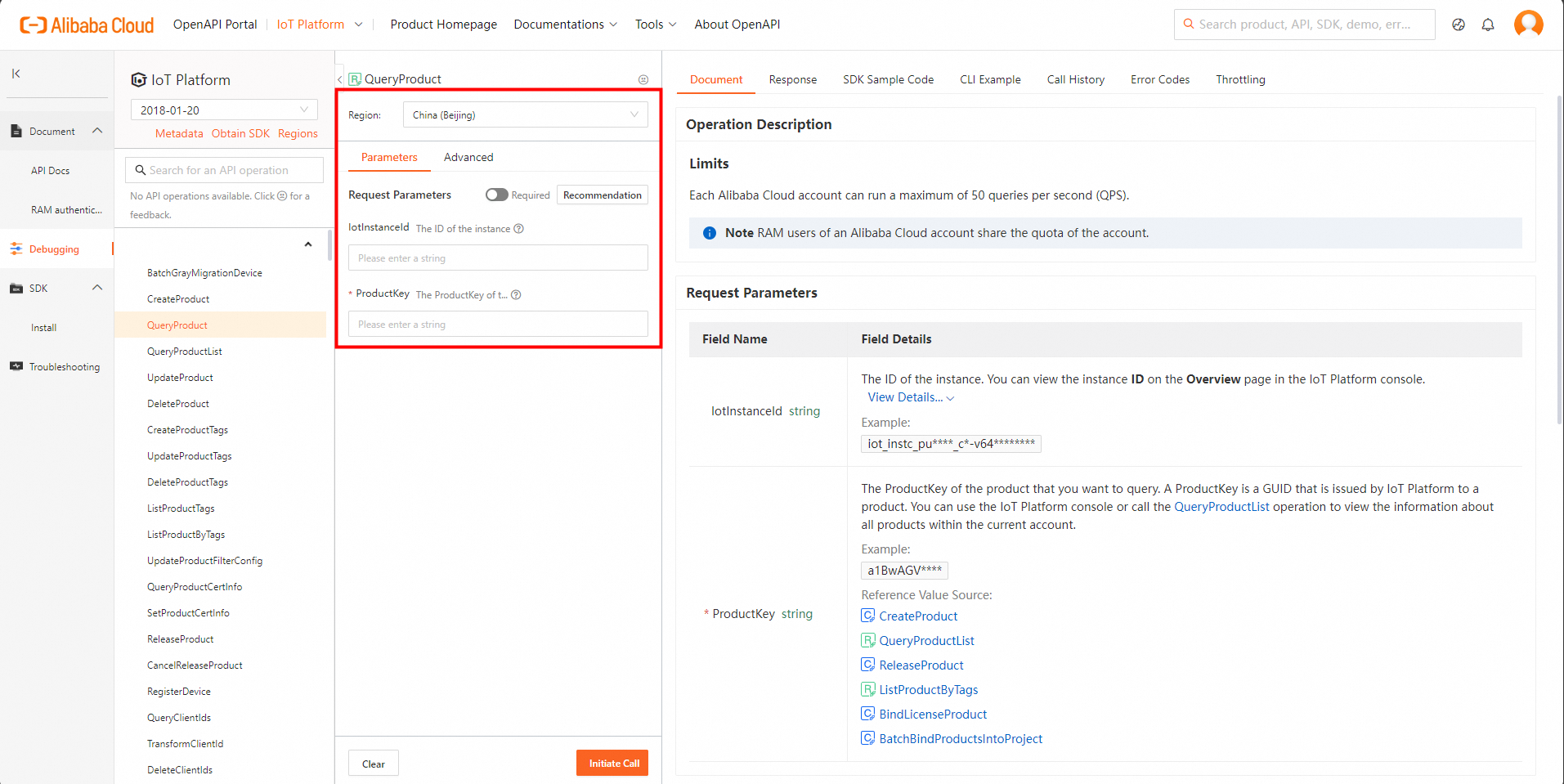
Online debugging page
You can call the API operations of IoT Platform on the .
Endpoints
An endpoint is used to access an Alibaba Cloud service. The endpoints of an Alibaba Cloud service consist of public endpoints and Virtual Private Cloud (VPC) endpoints.
Public endpoints can be globally accessed.
VPC endpoints are accessible only from within a VPC in a specific Alibaba Cloud region. VPC endpoints provide the following benefits:
Higher security: VPC endpoints can be accessed only from within a VPC. This provides higher security and privacy.
Faster response: VPC endpoints use the internal network environment to deliver faster responses than those of public endpoints. In addition, by using VPC endpoints, you are free from issues such as network latency and bandwidth limits.
Lower cost: VPC endpoints are accessed over an internal network. This reduces the dependencies on external traffic and the cost of using public bandwidth.
In most cases, you can select the endpoint nearest to the region in which your users or business resides to reduce network latency and application response time and accelerate data transmission. For example, if most of your users are located in Hangzhou, we recommend that you select the endpoint in the China (Hangzhou) region.
For more information about the endpoints of IoT Platform, see IoT Platform Regions.
User identities
After you log on to OpenAPI Explorer by using your Alibaba Cloud account, OpenAPI uses your Alibaba Cloud account to perform online debugging by default. An Alibaba Cloud account has the permissions on all API operations. Security risks may arise if you use an Alibaba Cloud account to call API operations. We recommend that you call API operations or perform routine O&M as a Resource Access Management (RAM) user. Before you call API operations as a RAM user, grant the required permissions to the RAM user based on your business requirements. The RAM user must have the permissions on IoT Platform. For more information, see Mapping between IoT Platform API operations and RAM policies.
Identity | Supported |
Yes | |
RAM user (recommended) | Yes |
RAM role (recommended) | Yes |
References
Integration methods
SDKs can be easily integrated with your applications and cover the widest range of operations. We recommend that you use SDKs to call API operations.
Integration method | Supported |
Yes | |
Yes | |
Partially supported | |
Partially supported | |
Yes |
Alibaba Cloud SDKs
Alibaba Cloud provides SDKs in multiple programming languages, including Java, C#, Go, Python, Node.js, TypeScript, PHP, and C++. You can integrate the SDKs with your applications to directly call API operations. SDKs encapsulate the signature logic, timeout mechanism, and retry mechanism and provide the request and response objects that facilitate development. For more information, see Alibaba Cloud SDKs.
You can use IoT Platform SDKs to call API operations. For more information about the supported programming languages and how to install dependencies, see IoT Platform SDKs.
Alibaba Cloud CLI
Alibaba Cloud CLI allows you to run the
aliyuncommand to interact with Alibaba Cloud services and manage cloud service resources. For more information, see What is Alibaba Cloud CLI?You can use Alibaba Cloud CLI to call the API operations of IoT Platform. For more information about how to obtain and use Alibaba Cloud CLI, see User guide of Alibaba Cloud CLI.
Terraform
Terraform is an open source tool that is used to preview, configure, and manage cloud infrastructure and resources in a secure and efficient manner. Terraform works in a similar way as ROS. Terraform calls API operations by interpreting templates. For more information, see What is Terraform?
You can use Terraform to call the API operations of IoT Platform. The following table describes the resources and data sources that are supported by Terraform.
Type
List
Description
Resource
Provides a device group resource.
Data source
This data source provides all device groups within the current Alibaba Cloud account.
You can use this data source to automatically activate the IoT service. If the IoT service is activated, the On state is returned.
ROS
ROS is an Alibaba Cloud service that can simplify the management of cloud computing resources. You can create a template to describe the cloud computing resources that you need, such as Elastic Compute Service (ECS) and ApsaraDB RDS instances, and the relationship between the resources. ROS automatically creates and configures all the resources based on the template to implement automated deployment and O&M. For more information, see What is ROS?.
You can use ROS to call the API operations of IoT Platform. The following table describes the resource types that are supported by ROS.
Resource type
Description
Registers a device.
Creates a device group.
Creates a product.
Creates a topic for a specific product.
Creates a rule for a specific topic.
Creates a rule action for a specific rule.
Custom API encapsulation
To make native HTTP calls, you must construct custom requests and sign the requests. For more information about the signature method, see List of operations by function and Request syntax and signature method V3.
Usage notes
The number of queries per second (QPS) that an Alibaba Cloud account can initiate varies based on the API operations. For more information, see the QPS limits section in the API reference of each operation.
NoteAll RAM users that belong to an Alibaba Cloud account share the QPS quota of the Alibaba Cloud account.
If an error is returned after you call an API operation, you can check whether the request parameters and the parameter values are valid based on the error code. For more information, see Error codes.
You can also perform self-service diagnostics based on the returned request ID or SDK error information on the OpenAPI problem diagnosis page.