Create, set default, or delete launch template versions to manage instance parameters across deployments.
Create a launch template version
Launch templates are immutable after creation. Create a new version to change parameters.
Prerequisites
A launch template is created. See Create a launch template.
Considerations
-
The first version number of a new launch template is 1.
ImportantVersion numbers auto-increment and cannot be customized.
-
Each launch template supports up to 30 versions.
-
All parameters are optional when creating a version. If required parameters such as instance type or image are missing, you must specify them when creating instances.
-
Launch template versions cannot be modified after creation.
Procedure
In the upper-left corner of the page, select a region and resource group.
-
Find the target launch template and create a version by using one of the following methods:
-
On the Launch Templates page, click New Version in the Actions column.

-
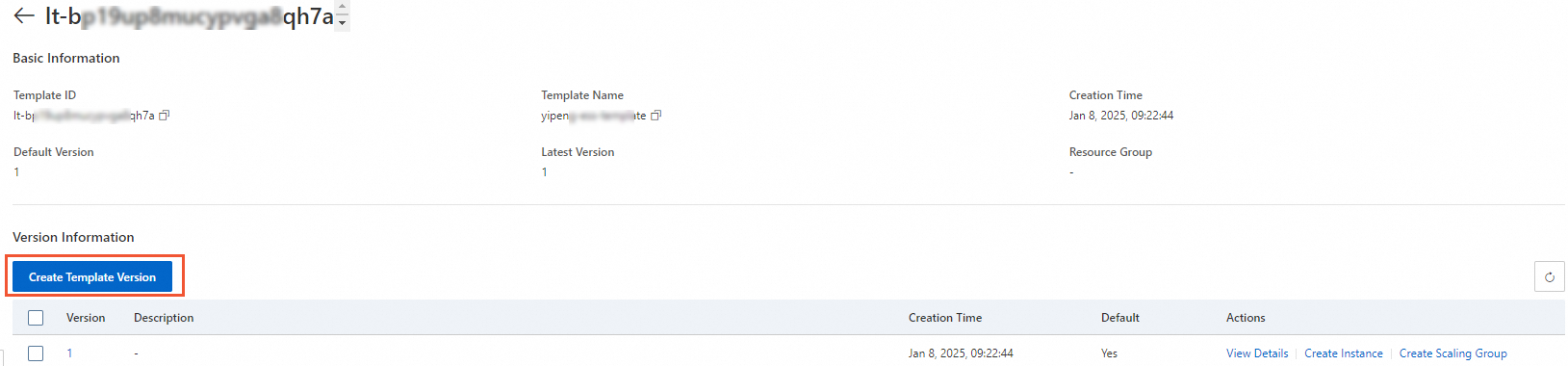
Click the template ID to open the details page. In the Version Information section, click New Version.
-
-
On the Template Name page, configure the parameters.
In the Clone Template section, select an existing template and version as the baseline. For parameter descriptions, see Create an instance with Custom Launch.
-
In the Confirm Configurations step, select Create Version in the Save As section and select the target launch template.
-
Click Create Launch Template.
-
In the message that appears, click View New Version to view the created version in the ECS console.
NoteYou can also view all launch templates on the Template Name page.
Change the default version of a launch template
When no version is specified during instance creation, ECS uses the default version. Set your most commonly used version as the default.
In the upper-left corner of the page, select a region and resource group.
-
Click the template ID to open the details page.
-
In the Version Information section, find the target version and click Set as Default in the Actions column.

Delete a launch template version
Delete non-default launch template versions that are no longer needed.
-
The default version cannot be deleted. Change the default version first, then delete it.
-
To remove all versions, delete the launch template instead.
In the upper-left corner of the page, select a region and resource group.
-
On the Launch Templates page, click the template ID to open the details page.
-
In the Version Information section, delete one or more versions:
-
Single version: Click Delete in the Actions column.
-
Multiple versions: Select the versions and click Delete at the bottom of the page.
-
-
In the confirmation dialog, click OK.
References
-
Manage launch template versions by calling the following API operations:
-
CreateLaunchTemplateVersion: Creates a launch template version.
-
ModifyLaunchTemplateDefaultVersion: Sets the default version of a launch template.
-
DeleteLaunchTemplateVersion: Deletes a launch template version.
-
-
After creating a version, you can select it when performing the operations listed in the following table.
Operation
Description
References
Create an ECS instance
Use a launch template to quickly create an ECS instance without repeatedly configuring parameters.
Create multiple ECS instances at a time
Use a launch template with the RunInstances operation to create multiple ECS instances at a time.
Specify the LaunchTemplateId and LaunchTemplateVersion parameters when you call the RunInstances operation.
Create a scaling group
Use a launch template to create a scaling group based on ECS instances. The system uses configurations from the template. You can modify specific configurations during creation, such as the VPC and vSwitch.
Create an auto provisioning group
Auto provisioning groups use specific versions of launch templates as instance configuration sources. Attributes such as images, security groups, and logon credentials from the templates are used to create ECS instances. After an auto provisioning group is created, an instance cluster is provisioned at the specified time.