This topic describes the metadata that custom message channels support.
Prerequisites
A message channel must be configured. For more information, see Message channels.
Background information
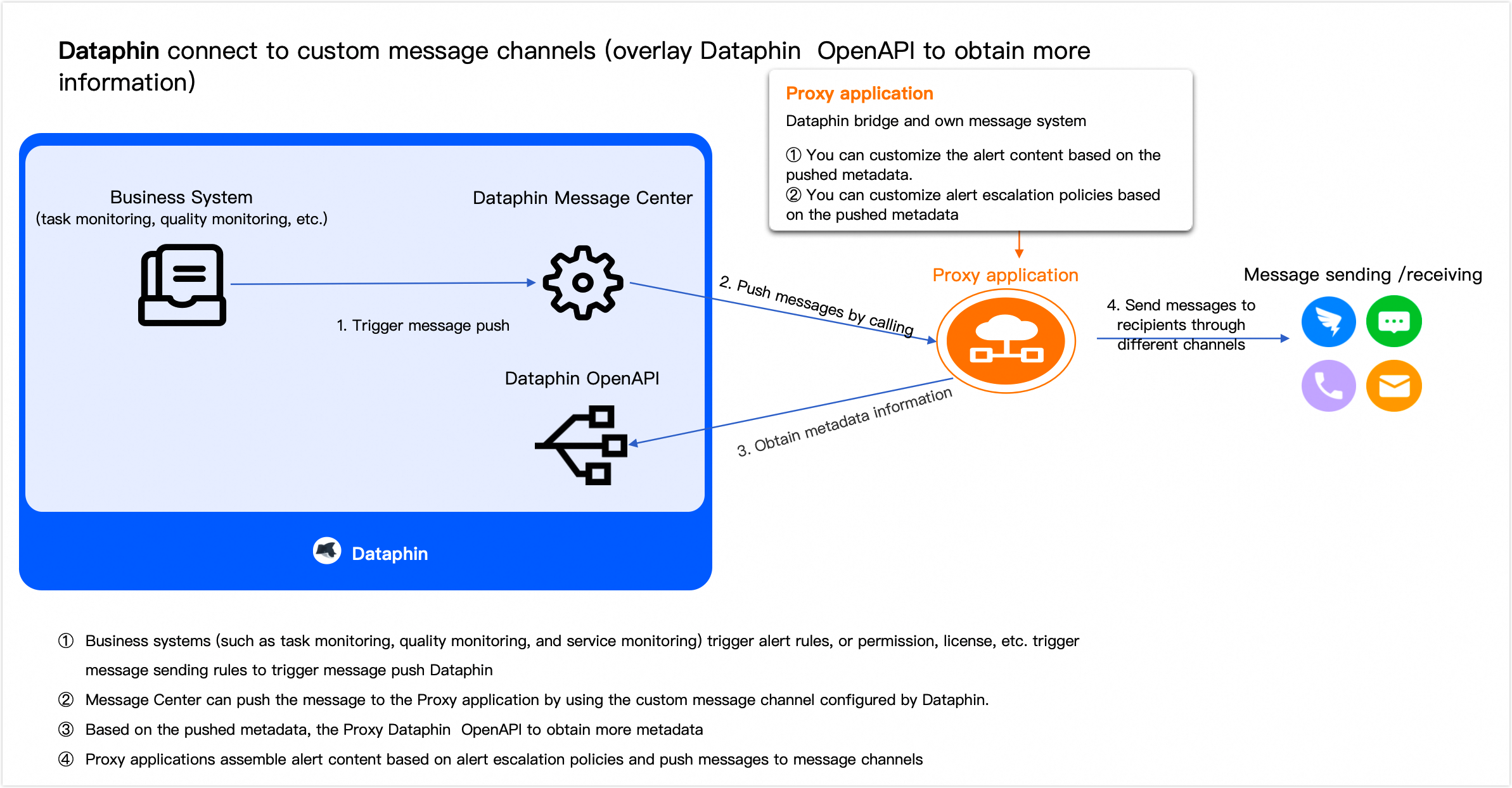
The custom message channel API provides basic metadata. The Proxy application uses this information to upgrade alert messages and assemble alert content.

If the metadata in the API does not meet your requirements, you can use OpenAPI to obtain more information.
Common metadata
Parameter name | Data type | Description |
receiver_phone | String | The phone number of the message recipient. Example: 1361234****. |
receiver_name | String | The username of the message recipient. Example: SuperAdmin. |
receiver_userid | String | The internal user ID of the message recipient in the Dataphin system. This is the unique ID within the Dataphin system. Example: 1234567. |
receiver_sourceuserid | String | The ID of the message recipient from the source system. This ID is related to the integrated authentication system, such as the source user ID from RAM, ASCM, or a customer's own authentication system that is based on the single sign-on (SSO) software development kit (SDK). Example: username@dataphin. |
receiver_email | String | The email address of the recipient. Example: username@***.com. |
receiver_message | String | The predefined message that the recipient receives from the Dataphin system. Example: The node ods_order triggered an alert because the node failed. The node belongs to the ods_dataphin project. |
message_type | String | The supported message types. Valid values:
|
message_metadata | JSON | You can view the data using a JSON Resolver. |
Alert for an ungenerated instance (LOGICAL_INSTANCE_ALARM)
Parameter name | Data type | Description |
event_id | String | The event ID of the alert. |
reason | String | The reason for the alert: LOGICAL_INSTANCE_GENERATION: Monitoring for logical instance generation. |
Alert for an offline task (BATCH_PROCESS_ALARM)
Parameter name | Data type | Description |
event_id | String | The event ID of the alert. |
reason | String | The reason for the alert:
|
instance_id | String | The ID of the task instance that triggered the alert. |
instance_url | String | The URL of the alert instance. |
bizdate | String | The data timestamp of the task instance. This applies to daily, weekly, and monthly scheduling. Hourly nodes also support only data timestamps. |
node_id | String | Task ID |
node_name | String | Task name. |
project_id | String | The ID of the project to which the node belongs. |
project_name | String | The name of the project to which the node belongs. |
node_owner | String | Task owner |
notify_time | String | The time when the alert was triggered. |
monitor_owner | String | The user who created the monitoring rule. |
cur_value | Number | The runtime of the node. This parameter is used only for the timeout monitoring type. |
threshold | List<String> |
|
receivers | String | The information about the alert recipients. Format: Recipient Display Name 1 (Recipient Logon Account Associated ID 1), Recipient Display Name 2 (Recipient Logon Account Associated ID 2). |
due_time | String | The scheduled runtime of the instance. This parameter is supported only for auto triggered tasks. |
execute_start_time | String | The time when the instance started to run. For an instance that is automatically retried after a failure, this parameter indicates the start time of the most recent retry. |
instance_log_url | String | The URL of the runtime log for the alert instance. |
folder | String | The folder to which the node belongs. The format is |
description | String | Task description. |
Alert for a real-time task (REALTIME_PROCESS_ALARM)
Parameter name | Data type | Description |
event_id | String | The event ID of the alert. |
reason | String | The reason for the alert:
|
alert_period | String | The detection frequency of the metric, in seconds. |
threshold | List<Number> | The threshold that is configured for the alert. The value varies based on the reason for the alert:
|
condition | String | The judgment condition. Valid values:
|
cur_value | String | The current value. |
instance_url | String | The URL of the alert instance. |
node_name | String | Job name |
project_id | String | The ID of the project to which the node belongs. |
project_name | String | The name of the project to which the node belongs. |
node_owner | String | Task owner. |
notify_time | String | The time when the alert was triggered. |
monitor_owner | String | The user who created the monitoring rule. |
receivers | String | The information about the alert recipients. Format: Recipient Display Name 1 (Recipient Logon Account Associated ID 1), Recipient Display Name 2 (Recipient Logon Account Associated ID 2). |
Alert for a real-time integration task (STREAM_PIPELINE_ALARM)
Parameter name | Data type | Description |
event_id | String | The event ID of the alert. |
reason | String | The reason for the alert:
|
alert_period | String | The detection frequency of the metric, in seconds. |
threshold | List<Number> | The threshold that is configured for the alert. The value varies based on the reason for the alert:
|
condition | String | The judgment condition. gt: greater than. |
cur_value | String | The current value. |
instance_url | String | The URL of the alert instance. |
node_name | String | Job name. |
project_id | String | The ID of the project to which the node belongs. |
project_name | String | The name of the project to which the node belongs. |
node_owner | String | Task Owner |
receivers | String | The information about the alert recipients. Format: Recipient Display Name 1 (Recipient Logon Account Associated ID 1), Recipient Display Name 2 (Recipient Logon Account Associated ID 2). |
Alert for a baseline (BASELINE_ALARM)
Parameter name | Data type | Description |
events | List(Event) | The alert events for the baseline alert. |
receivers | String | The information about the alert recipients. Format: Recipient Display Name 1 (Recipient Logon Account Associated ID 1), Recipient Display Name 2 (Recipient Logon Account Associated ID 2). |
Event
If alerts are merged, each alert message is a separate event. Otherwise, the message contains only a single event.
Parameter name | Data type | Description |
event_id | String | The event ID of the alert. |
reason | String | The reason for the alert:
|
baseline_instance_id | String | The ID of the baseline instance that triggered the alert. |
baseline_instance_url | String | The URL of the baseline instance that triggered the alert. |
baseline_bizdate | String | The data timestamp (for daily or weekly scheduling) or business time (for hourly or minute-based scheduling) of the baseline instance. |
baseline_id | String | The baseline ID. |
baseline_name | String | The baseline name. |
baseline_owner | String | The owner of the baseline. |
node_instance_id | String | The ID of the task instance that triggered the alert. This parameter is provided only for baseline event alerts (when a baseline node fails or a baseline node slows down). |
node_instance_url | String | The URL of the task instance that triggered the alert. This parameter is provided only for baseline event alerts (when a baseline node fails or a baseline node slows down). |
node_id | String | The ID of the node that triggered the alert. This parameter is provided only for baseline event alerts (when a baseline node fails or a baseline node slows down). |
node_name | String | The name of the node that triggered the alert. This parameter is provided only for baseline event alerts (when a baseline node fails or a baseline node slows down). |
project_id | String | The ID of the project to which the node that triggered the alert belongs. This parameter is provided only for baseline event alerts (when a baseline node fails or a baseline node slows down). |
project_name | String | The name of the project to which the node that triggered the alert belongs. This parameter is provided only for baseline event alerts (when a baseline node fails or a baseline node slows down). |
node_owner | String | The owner of the node that triggered the alert. This parameter is provided only for baseline event alerts (when a baseline node fails or a baseline node slows down). |
baseline_priority | String | The priority of the baseline. |
baseline_allowance | String | The margin of the baseline. |
current_key_node_instance_id | String | The ID of the task instance that is currently causing the baseline alert. This parameter is provided only for baseline alerts (baseline early warning or broken baseline). |
current_key_node_name | String | The name of the node that is currently causing the baseline alert. This parameter is provided only for baseline alerts (baseline early warning or broken baseline). |
current_key_node_id | String | The ID of the node that is currently causing the baseline alert. This parameter is provided only for baseline alerts (baseline early warning or broken baseline). |
current_key_node_owner | String | The owner of the node that is currently causing the baseline alert. This parameter is provided only for baseline alerts (baseline early warning or broken baseline). |
current_key_node_project_name | String | The name of the project to which the node that is currently causing the baseline alert belongs. This parameter is provided only for baseline alerts (baseline early warning or broken baseline). |
current_key_node_instance_url | String | The URL of the task instance that is currently causing the baseline alert. This parameter is provided only for baseline alerts (baseline early warning or broken baseline). |
baseline_num | Number | The number of affected baselines. |
Alert for Data Quality (DATA_QUALITY_ALARM)
Parameter name | Data type | Description |
event_id | String | The event ID of the alert. |
reason | String | The reason for the alert:
|
object_id | String | The object that triggered the alert. Format:
|
rule_name | String | The name of the rule. |
rule_level | String | The strength of the rule. |
rule_type | String | The name of the template. |
notify_time | String | The time when the alert was triggered. |
project_name | String | The name of the project. |
detail_object_id | String | The detailed object of the monitored object:
|
receivers | String | The information about the alert recipients. Format: Recipient Display Name 1 (Recipient Logon Account Associated ID 1), Recipient Display Name 2 (Recipient Logon Account Associated ID 2). |
quality_index | String | The configured and actual values of a quality check. For example, the check configuration is 'Normal rows >= 100 and Exception rate < 10%', and the actual metrics are 'Normal rows = 100 and Exception rows = 11%'. Example: Check configuration: 'Normal rows >= 100 and Exception rate < 10%'. Actual metrics: 'Normal rows = 100 and Exception rows = 11%'. |
quality_index_kv | String | The key metrics for the rule check. Example: Total rows: 100, Normal rows: 80, Abnormal rows: 20, Normal rate: 80%, Abnormal rate: 20%. Example: Total rows: 100; Normal rows: 80; Abnormal rows: 20; Normal rate: 80%; Abnormal rate: 20%. Other types are displayed as a check value and a comparison value. Example: Number of partitions: 100; Number of partitions 7 days ago: 100. Note Only the configured key metrics are displayed. Intermediate data is not displayed. |
Alert for DataService Studio (DATA_SERVICE_ALARM)
Parameter name | Data type | Description |
event_id | String | The event ID of the alert. |
reason | String | The reason for the alert:
|
api_id | String | The API ID. |
api_name | String | The API name. |
statistical_period | String | The statistical period of the monitoring metric, in seconds. |
alert_period | String | The detection frequency of the metric, in seconds. |
threshold | List<Number> | The threshold that is configured for the alert. The value varies based on the reason for the alert:
|
condition | String | The judgment condition. Valid values:
|
cur_value | String | The current value. |
receivers | String | The information about the alert recipients. Format: Recipient Display Name 1 (Recipient Logon Account Associated ID 1), Recipient Display Name 2 (Recipient Logon Account Associated ID 2). |