Container Compute Service (ACS) provides ACK KEDA for event-driven autoscaling, applicable to scenarios such as offline audio and video transcoding, event-driven jobs, and stream data processing.
Overview
Horizontal Pod Autoscaler (HPA) is the most common Kubernetes scaling solution. HPA scales pods based on the gap between resource usage and predefined thresholds. While HPA supports various resource metrics, it cannot react to external events in real time.
How ACK KEDA works
ACS delivers event-driven autoscaling through an enhanced version of ACK KEDA.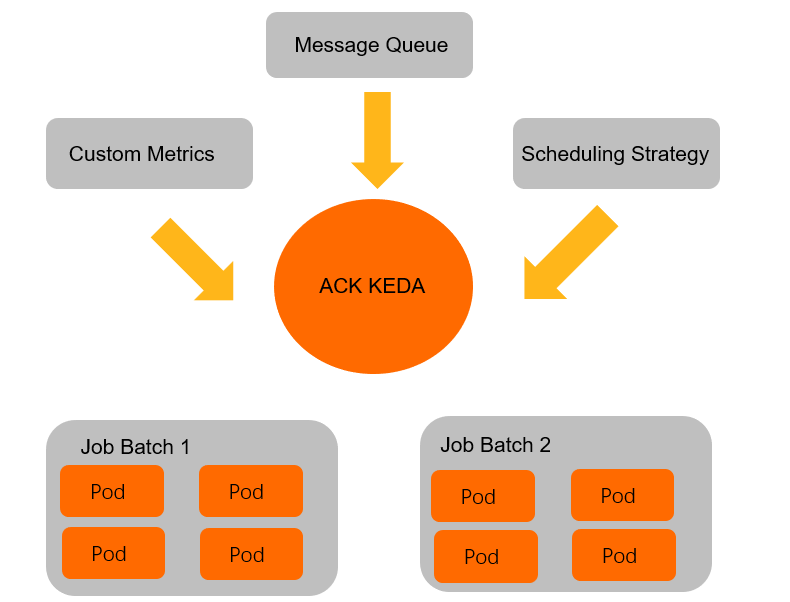
ACK KEDA periodically polls event sources. When pending messages increase, it scales a batch of jobs within seconds and asynchronously scales subsequent batches in the next polling cycle. Key features:
-
Multiple event sources
Supports data sources such as Kafka, MySQL, PostgreSQL, RabbitMQ, and MongoDB.
-
Job concurrency control
Submitting too many jobs at once strains the control plane's resource, quota, and API management. ACK KEDA throttles job concurrency across batches to maintain system stability.
-
Automatic metadata cleanup
Accumulated job metadata degrades API Server performance, reduces cluster stability, and can impact other services. ACK KEDA automatically clears metadata after jobs complete.