Agent Sandbox is a next-generation compute service for AI agents, enabling large-scale, production-grade deployment and operation.
Introduction
Agent Sandbox offers MicroVM-level isolated runtime environments, memory-level hibernation and wake-up, checkpoint and cloning capabilities, and massive elastic scaling of up to 15,000 sandboxes per minute. Agent Sandbox is fully compatible with the native Kubernetes ecosystem and seamlessly integrates with mainstream AI agent frameworks and tools, such as E2B SDK and AgentScope.
Agent Sandbox is currently in public preview. If you encounter issues, have feature requests, or want to provide other feedback, submit a ticket or contact us through other support channels.
Key features
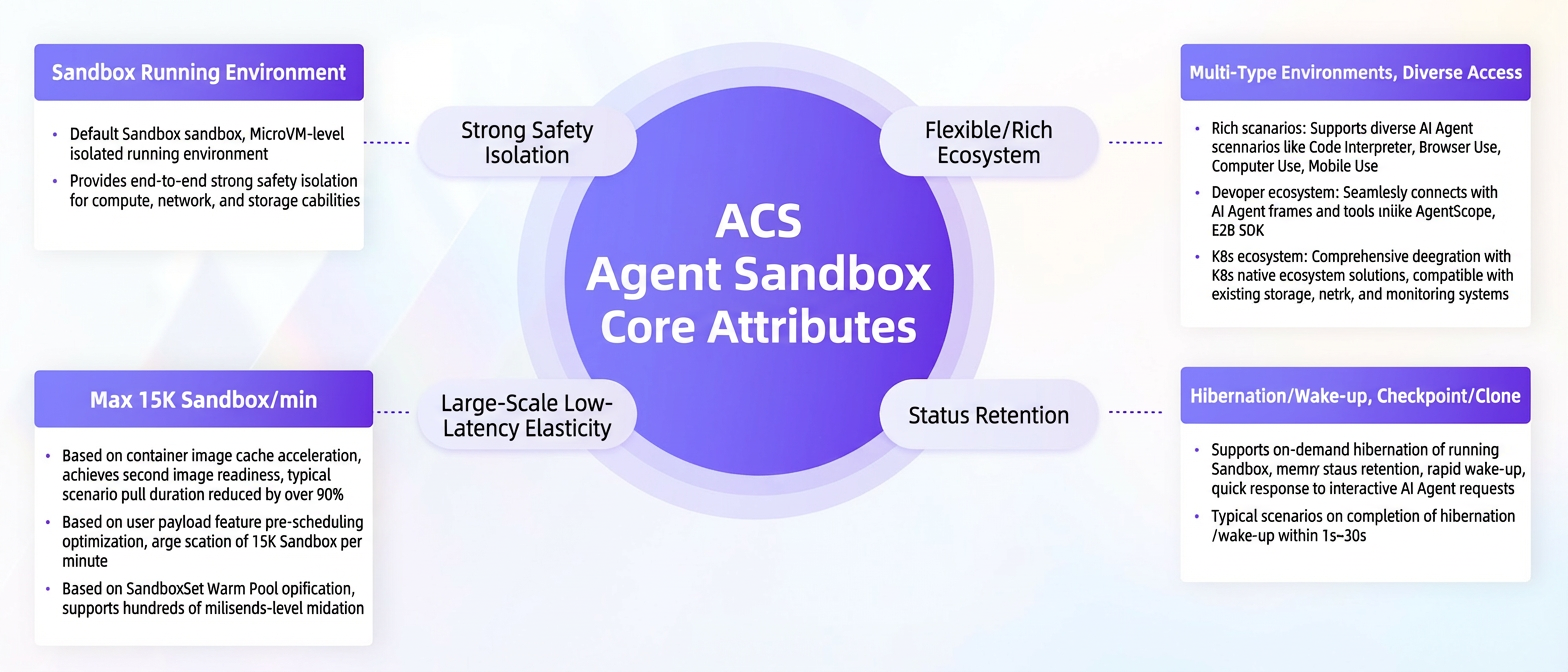
Strong security isolation
Each sandbox runs in a dedicated, secure execution environment based on a MicroVM-level isolated runtime.
The service provides end-to-end isolation for compute, network, and storage and supports sandbox-level logging and monitoring to simplify audits and troubleshooting.
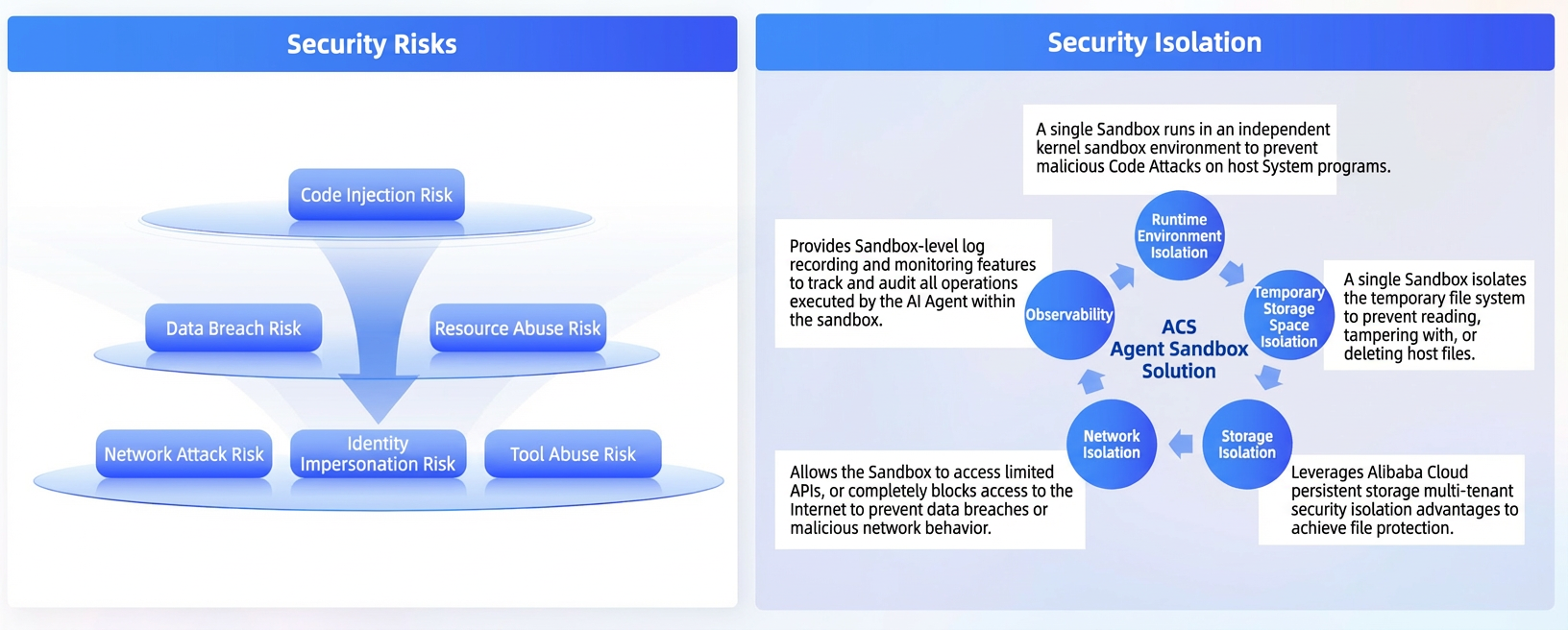
Massive-scale, low-latency elasticity
Image cache acceleration makes images ready in seconds, reducing pull times by over 90% in typical scenarios and significantly shortening image preparation time for sandbox creation.
Pre-scheduling optimizations based on workload characteristics improve creation efficiency in high-concurrency scenarios. The service supports creating up to 15,000 sandboxes per minute at scale, accelerating the iteration speed of agent reinforcement learning (AgentRL).
Warm Pool optimizations enable rapid sandbox creation, often within hundreds of milliseconds.
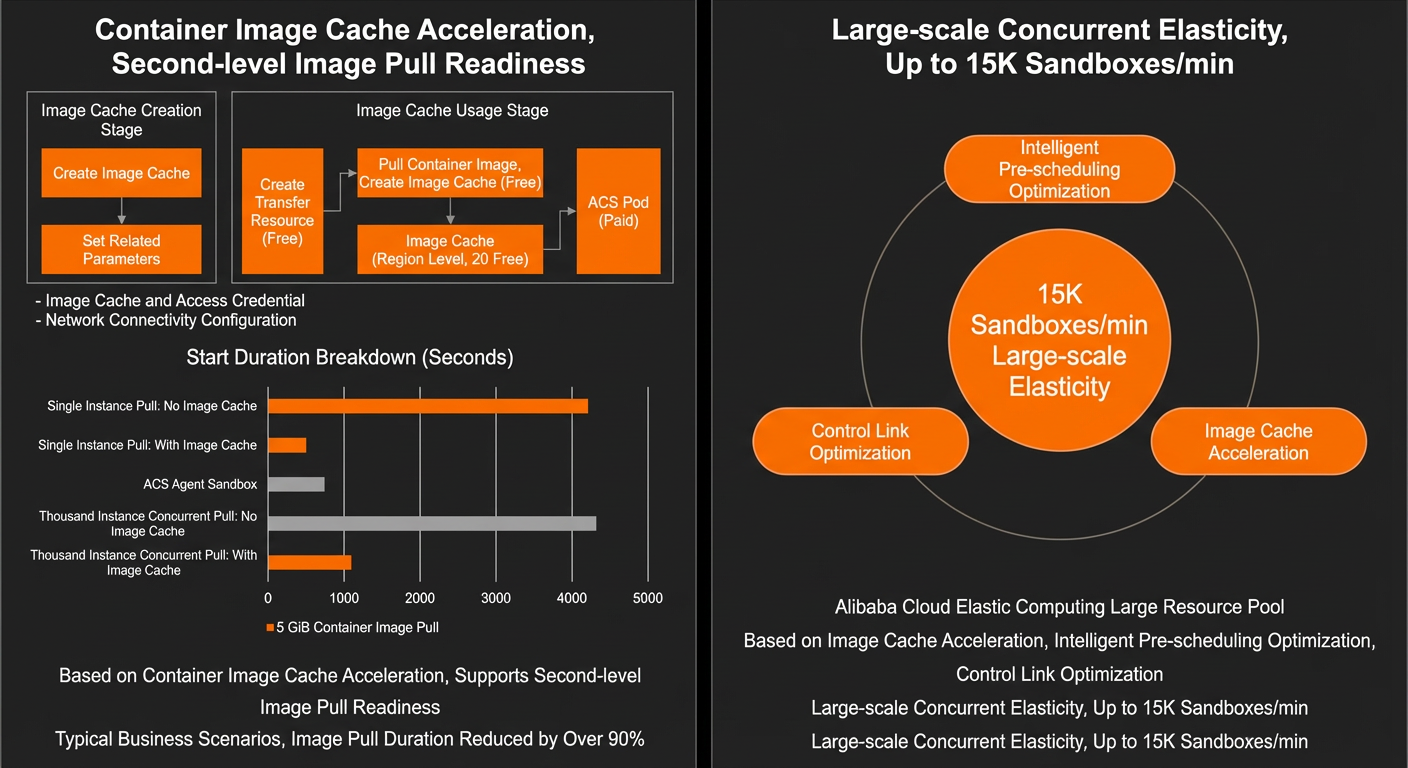
State persistence
You can hibernate running sandboxes on-demand, which preserves their memory state for a fast wake-up. This feature ensures quick responses to interactive AI agent requests. In typical scenarios, a sandbox wakes up and restores its memory state in 1 to 10 seconds.
You can perform checkpoint and restore operations on a sandbox's memory state. This capability makes AI agent states storable and portable, accelerating scenarios that require parallel branch exploration.
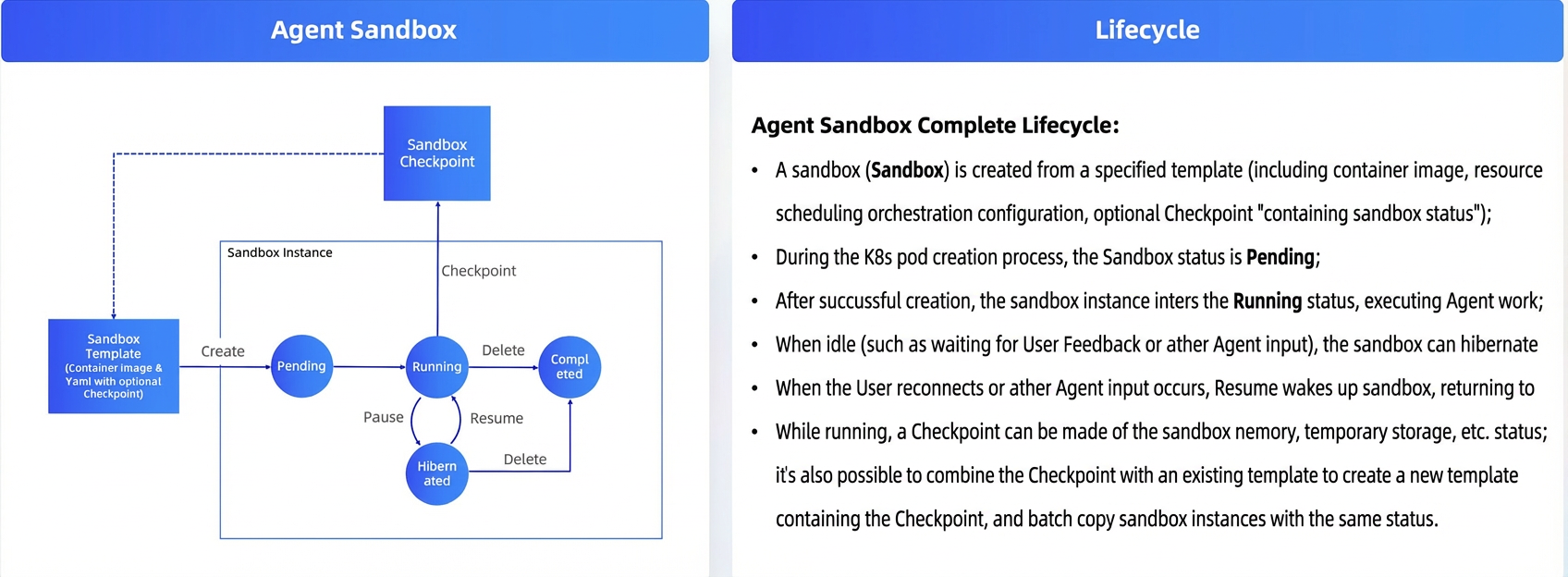
Flexible and rich ecosystem
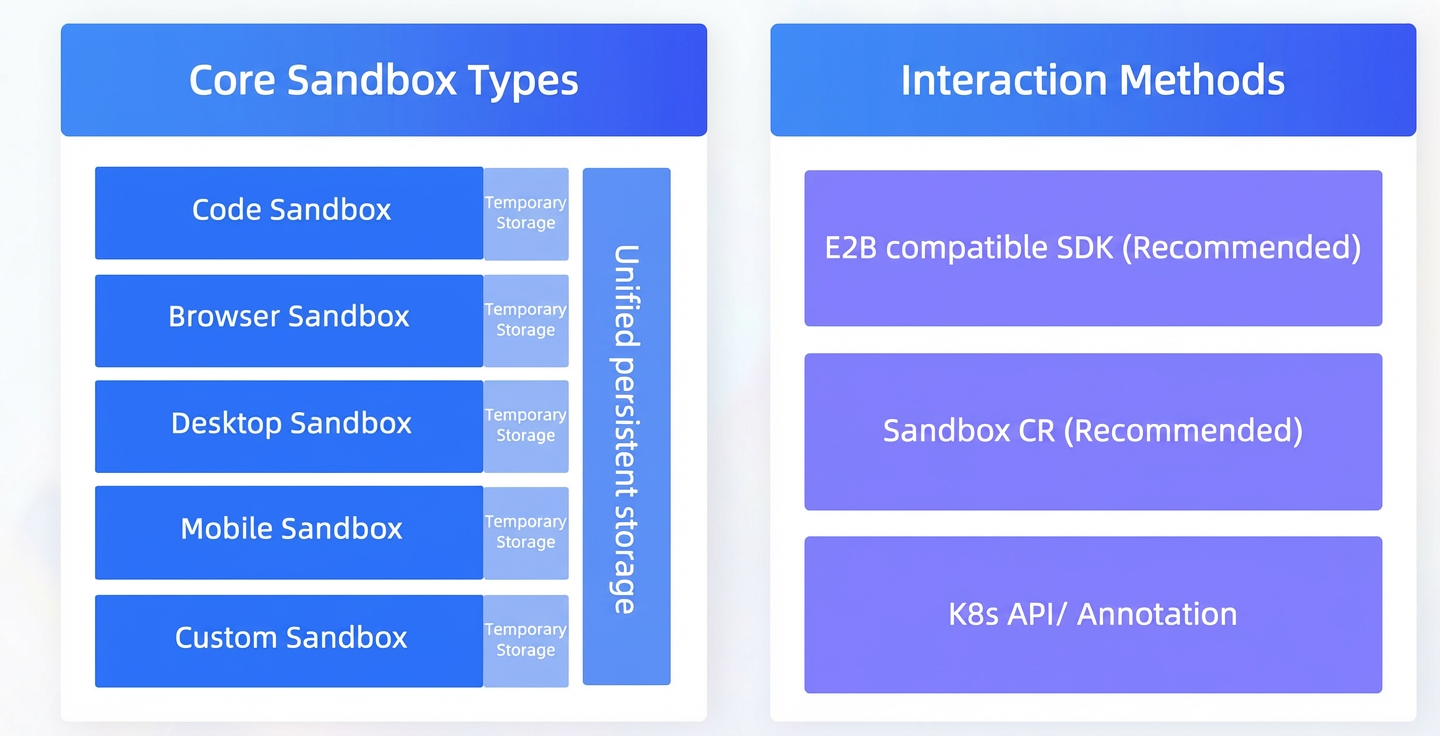
Rich scenarios: Agent Sandbox supports diverse AI agent sandbox scenarios, such as Code Interpreter and Browser Use.
Integration methods:
E2B-compatible SDK (Recommended): This method provides an SDK compatible with the E2B ecosystem. You can use familiar E2B SDK call patterns to create, connect to, execute, and release sandboxes, reducing migration and refactoring costs.
Sandbox CR (Recommended): This method provides a declarative integration. You can manage sandbox templates, runtime parameters, and lifecycle with custom resource (CR) objects.
Kubernetes ecosystem: Agent Sandbox deeply integrates with the native Kubernetes ecosystem, ensuring compatibility with your existing storage, network, and operational monitoring systems.
Use cases
Agent reinforcement learning (AgentRL) scenarios: Ideal for scenarios such as reinforcement learning training, trajectory sampling, environment interaction, and multi-path exploration. Agent Sandbox supports large-scale concurrent sandbox creation, fast teardown, and state reuse to improve training throughput and resource utilization.
AgentServing scenarios: Ideal for online agent services that involve in-depth research, tool calls, or multi-turn conversations. Agent Sandbox provides strongly isolated execution environments, elastic scale-out, and hibernation/wake-up features, balancing a responsive user experience with low running costs.
Building personal assistants with OpenClaw: Agent Sandbox helps you rapidly build and launch applications like personal assistants and digital employees. It supports various tool environments, such as code, browser, and desktop interfaces, to facilitate a smooth transition from prototype to production deployment.
Billing
You are billed based on the vCPUs and memory specified when you create a sandbox. If you select an unsupported vCPU and memory configuration, the cluster automatically adjusts it to the nearest supported specification, and you are billed accordingly. Sandboxes support hibernation, and the billing varies by state:
Running state: The first 30 GiB of ephemeral storage is free. Storage that exceeds this amount is billed at the cloud disk price.
Hibernation state: You are not charged for vCPU or memory. There is no free tier for ephemeral storage; you are billed for all storage used, including the initial 30 GiB.
GPU computing power is not supported. Only CPU and memory configurations are available.
Billing formula
Cost per sandbox = (Number of vCPUs × vCPU unit price + Memory size × memory unit price) × billed duration.
Billing method
Sandbox instances are billed on a pay-as-you-go basis, charged by the second and invoiced hourly.
Region | Compute type | Compute quality | Billing item | |
vCPU | Memory (GiB) | |||
Chinese mainland | Agent Sandbox | default | CNY 0.0000217/second (CNY 0.078/hour) | CNY 0.00001083/second (CNY 0.039/hour) |
Hong Kong (China) and other regions | Agent Sandbox | default | CNY 0.0000342/second (CNY 0.1232/hour) | CNY 0.00001711/second (CNY 0.0616/hour) |