CDN resource plans offset specific types of resource fees, not all fees. If you're still seeing charges after purchasing a resource plan, use this guide to identify and resolve the cause.
What resource plans cover
Resource plans offset fees only for specific billable items and regions. Use the following table to check whether your charges fall within the coverage of your current plan.
| Resource plan type | Covered billable items | Covered region |
|---|---|---|
| Outbound data transfer plan | Outbound data transfer fees | The acceleration region you selected at purchase |
| Value-added service plan | Specific value-added service fees (e.g., HTTPS requests for static content) | The acceleration region you selected at purchase |
Any usage outside this coverage is billed at pay-as-you-go rates and deducted from your account balance.
Troubleshooting
The following figure shows the troubleshooting procedure. If the problem persists after addressing one possible cause, move to the next.

Possible causes and solutions
Cause 1: The billable item isn't covered by your resource plan
Each resource plan covers only specific billable items. CDN charges for two categories:
Basic services — for example, outbound data transfer and requests
Value-added services — for example, HTTPS requests for static content
An outbound data transfer plan cannot offset HTTP requests for static content fees. Uncovered fees are deducted from your account balance. If the balance is insufficient, overdue payments are generated.
The following table lists common scenarios where resource plans don't apply and your options:
| Scenario | Why the plan doesn't apply | What to do |
|---|---|---|
| Outbound data transfer plan used against HTTPS request fees | Different billable item categories | Accept pay-as-you-go billing, or purchase a value-added service resource plan |
| Value-added service is enabled but no value-added service plan exists | Value-added service fees aren't covered by basic service plans | Purchase a resource plan for value-added services |
What to do
Check your bills and identify which billable items your resource plans don't cover. For uncovered items, either accept pay-as-you-go billing (fees are deducted from your balance) or purchase a resource plan that covers those items.
For value-added services such as HTTPS requests for static content, pay-as-you-go billing applies automatically. To offset these fees, purchase a resource plan specifically for value-added services. See HTTPS featureBilling of value-added services.
For the full list of billable items, see Billing overview. For guidance on selecting the right resource plans, see Guidelines for choosing resource plans.
Cause 2: Your resource plan covers a different acceleration region
When you purchase a resource plan, you specify an acceleration region. The plan offsets fees only in that region.
For example: an outbound data transfer plan for the Chinese mainland covers only Chinese mainland fees. It does not offset fees generated in China (Hong Kong), China (Macao), China (Taiwan), or other regions outside the Chinese mainland.
What to do
If your accelerated domain names use multiple acceleration regions, purchase a separate resource plan for each region. Go to the resource plan buy page to purchase.
Cause 3: Your metering method isn't compatible with outbound data transfer plans
Outbound data transfer plans work only with the pay-by-data-transfer metering method. If CDN is configured for pay-by-bandwidth or pay-by-95th-percentile, the plan cannot offset outbound data transfer fees — those fees are deducted from your account balance instead.
What to do
Switch to pay-by-data-transfer in the CDN console. See Change the metering method.
Cause 4: Your usage exceeded the resource plan quota
Once you exhaust a resource plan's quota, additional usage is billed at pay-as-you-go rates automatically.
For example: if you purchased a 100 GB outbound data transfer plan and consumed 110 GB in a month, the extra 10 GB is billed at pay-as-you-go rates. If your account balance is insufficient, an overdue payment is generated.
Resource plans cannot offset fees for usage that occurred before the plan was purchased.
What to do
Configure low capacity alerts to get notified before your plan runs out, giving you time to top up before overages occur.
Purchase additional resource plans to cover excess usage. See Query details about resource plans to review your current usage.
Cause 5: The bill reflects usage from before you purchased the plan
CDN bills in arrears: a bill covers usage from a past billing cycle, not the current one. Resource plans take effect immediately after payment, but CDN issues bills 3 to 4 hours after each billing cycle ends — so a bill may arrive after your purchase but still cover usage from before you bought the plan.
For example: a bill issued at 10:00 (UTC+8) covers usage from 06:00 to 07:00 (UTC+8) the same day. If you purchased a resource plan at 09:00, the 06:00–07:00 usage is still charged at pay-as-you-go rates.
What to do
When you receive a bill, check both the issue time and the billing cycle it covers. If the billing cycle predates your resource plan purchase, the charges are expected.
Check your billing details
You can view the billing details of cloud services on the Billing Details tab. Select a statistical dimension and a statistical period to view reports based on different dimensions. For more information, see Billing details.
View itemized charges on the Billing Details page. Select a statistical dimension and period to filter by service, instance, or time range. See Billing details for details.
Manage resource plans
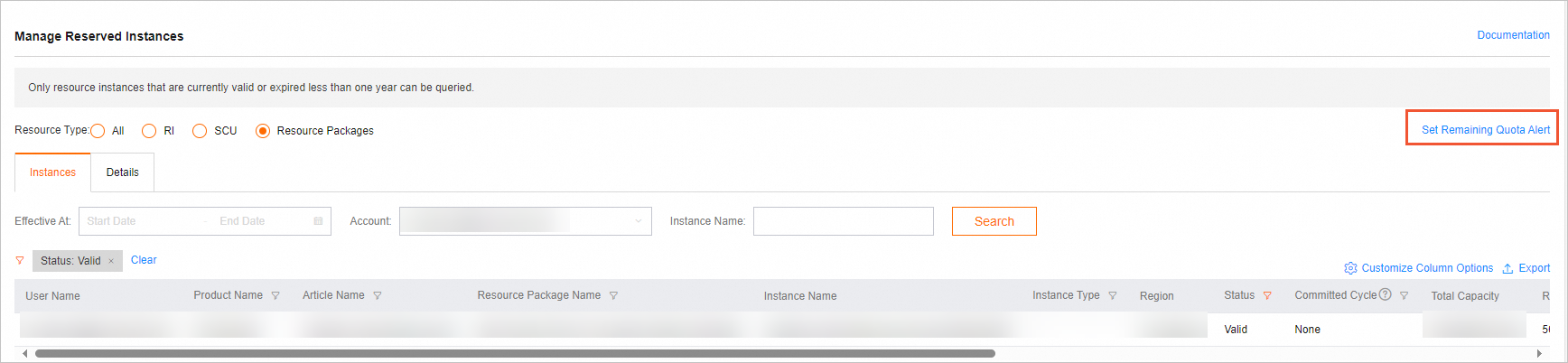
View plans and usage: Go to the Manage Reserved Instances page to see all purchased plans and their remaining quotas.
Set quota alerts: Click Set Remaining Quota Alert to configure thresholds. When the remaining quota drops below the threshold, the system sends an alert via text message or other notification methods.