Simple network interconnection scenarios
Template ID
AppID: CUMEUBXUD20D4IQ3
Supported regions
Beijing, Shenzhen, Shanghai
Template architecture
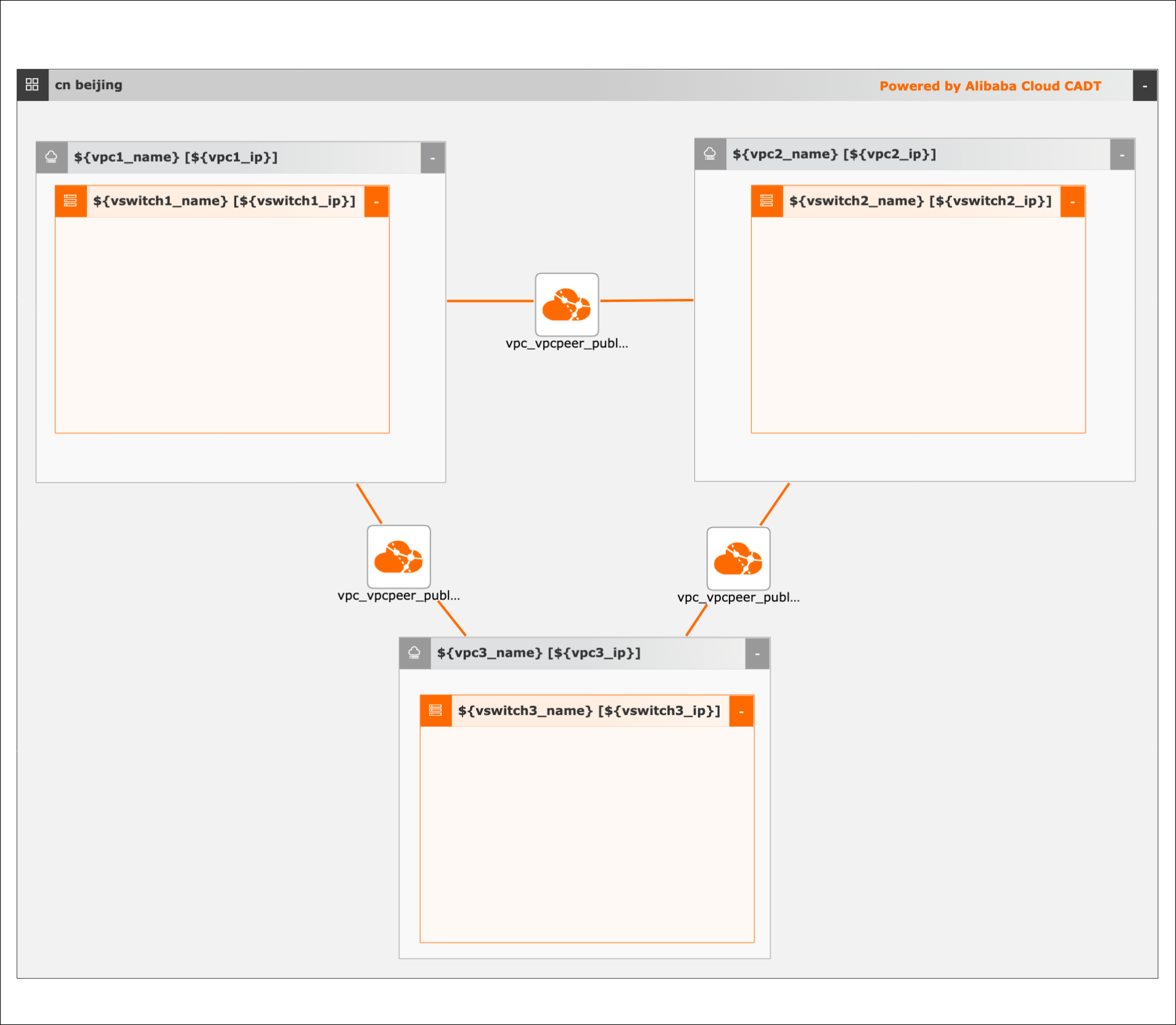
Parameter variables
Parameter variable types include String, etc., and relevant parameter values are passed through variables.
If not passed, the default value is used. For modifying the template variable configuration, see: Template Variable Configuration
Ordinal number | Variable name | Variable type | Default value | Description |
1 | Region | String | cn-beijing | Beijing region |
2 | ${vpc1_name} | String | vpc1 | Name of vpc1 |
3 | ${vpc1_ip} | String | 192.168.0.0/16 | CIDR block of vpc1 |
4 | ${vswitch1_name} | String | vswitch1 | Name of vswitch1 |
5 | ${vswitch1_ip} | String | 192.168.0.0/24 | CIDR block of vswitch1 |
6 | ${vpc2_name} | String | vpc1 | Name of vpc2 |
7 | ${vpc2_ip} | String | 172.16.0.0/12 | CIDR block of vpc2 |
8 | ${vswitch2_name} | String | vswitch2 | Name of vswitch2 |
9 | ${vswitch2_ip} | String | 192.168.0.0/24 | CIDR block of vswitch2 |
10 | ${vpc3_name} | String | vpc3 | Name of vpc3 |
11 | ${vpc3_ip} | String | 10.0.0.0/8 | CIDR block of vpc3 |
12 | ${vswitch3_name} | String | vswitch3 | Name of vswitch3 |
13 | ${vswitch3_ip} | String | 10.0.0.0/24 | CIDR block of vswitch3 |
Command line debugging
YAML file parameter configuration example (default VPC, switch, security group, IPv4, route table are newly created):
template_id: CUMEUBXUD20D4IQ3
area_id: "cn-beijing"

variables:
            ${vpc1_name}: "vpc1"
            ${vpc1_ip}: "192.168.0.0/16"
            ${vswitch1_name}: "vswitch1"
            ${vswitch1_ip}: "192.168.0.0/24"
            ${vpc2_name}: "vpc2"
            ${vpc2_ip}: "172.16.0.0/12"
            ${vswitch2_name}: "vswitch2"
            ${vswitch2_ip}: "172.16.0.0/24"
            ${vpc3_name}: "vpc3"
            ${vpc3_ip}: "10.0.0.0/8"
            ${vswitch3_name}: "vswitch3"
            ${vswitch3_ip}: "10.0.0.0/24"

configuration:
  enableMonitor: "0"
  enableReport: "0"
Note:
1. If you change the region, replace the area_id field, such as Beijing "cn-beijing", with Shanghai "cn-shanghai"
ID can be referenced: Region and Zone
2. The peering connection has been configured with route entries. After the application deployment is completed, network interconnection between the three VPCs is automatically established
Template Library Address:
https://bpstudio.console.alibabacloud.com/bpStudio/topo?TemplateId=51N54AV10ZTRRTRW
Code Example Address:
WA-Single VPC Network Template in the Same Region
Visualization Method
Batch create related Alibaba Cloud services, including 3 VPCs, 3 switches, 3 peering connections.
Create a new application based on the template. The default region is Beijing, and all cloud products are newly created.
Complete application saving, perform verification and pricing respectively. The related cloud products in this example are all billed on a pay-as-you-go basis.
After verification is completed, confirm the protocol to start batch deployment, and automatically complete the routing configuration.
Integrated API Invocation Method
Use a set of openAPI interfaces to quickly complete usage through integrated API.
Refer to the document to initialize using the command line tool.
Refer to the model YAML file for direct deployment and output.
If you change the region, replace the area_id field, such as Beijing "cn-beijing", with Shanghai "cn-shanghai".
Complex network interconnection scenarios
Template ID
AppID: S5JCNNWUFQMSZFQ9
Supported regions
Beijing, Hangzhou, Shanghai
Template architecture
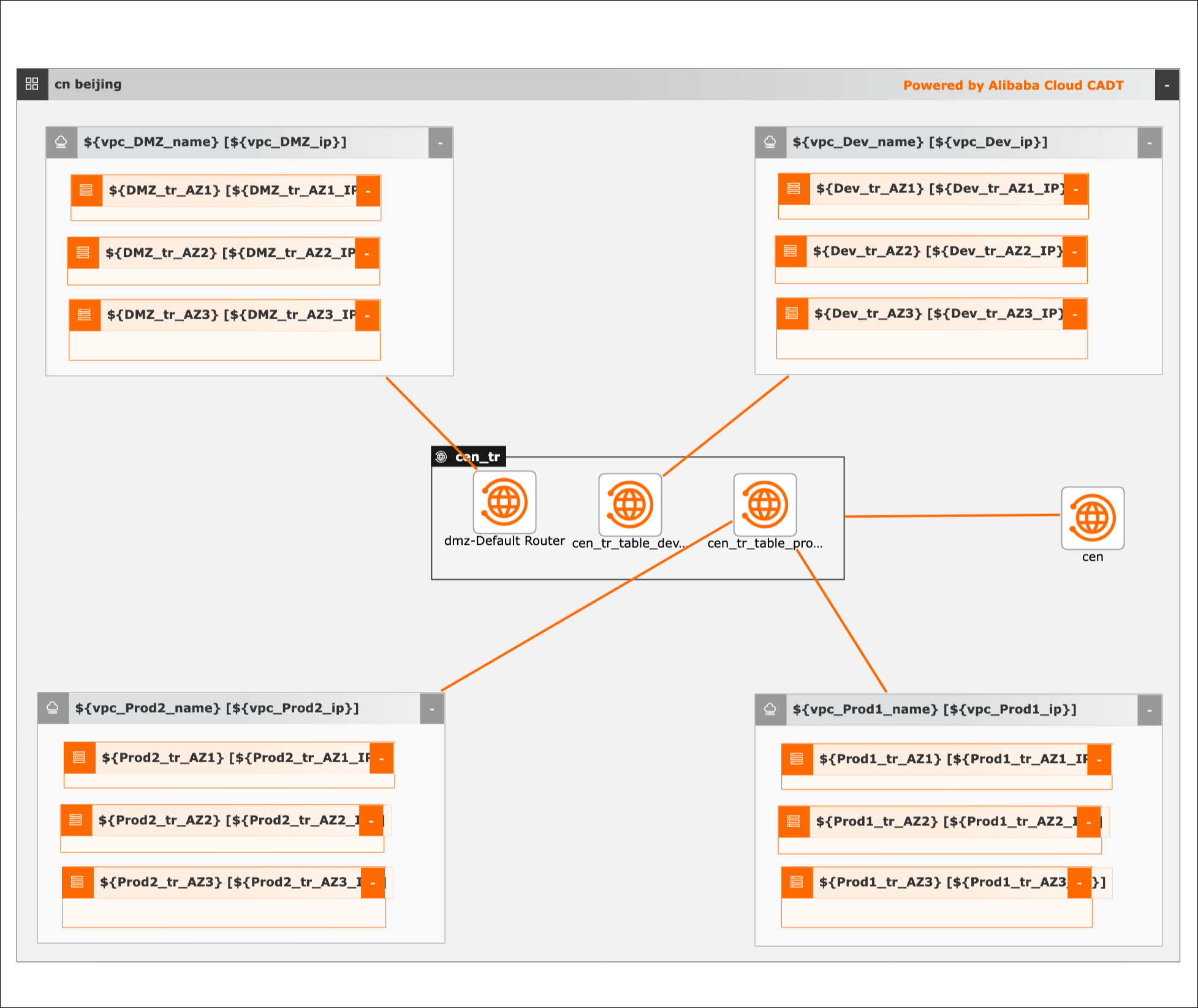
Parameter variables
Parameter variable types include String, etc., and relevant parameter values are passed through variables.
If not passed, the default value is used. For modifying the template variable configuration, see: Template Variable Configuration
Ordinal number | Variable name | Variable type | Default value | Description |
1 | Region | String | cn-beijing | Beijing region |
2 | ${vpc_DMZ_name} | String | vpc-DMZ | Name of VPC in DMZ area |
3 | ${vpc_DMZ_ip} | String | 10.1.0.0/16 | CIDR block of VPC in DMZ area |
4 | ${DMZ_tr_AZ1} | String | DMZ-tr-H | Name of tr switch 1 in DMZ area |
5 | ${DMZ_tr_AZ1_IP} | String | 10.1.0.0/24 | CIDR block of tr switch 1 in DMZ area |
6 | ${DMZ_tr_AZ2} | String | DMZ-tr-I | Name of tr switch 2 in DMZ area |
7 | ${DMZ_tr_AZ2_IP} | String | 10.1.1.0/24 | CIDR block of tr switch 2 in DMZ area |
8 | ${DMZ_tr_AZ3} | String | DMZ-tr-J | Name of tr switch 3 in DMZ area |
9 | ${DMZ_tr_AZ3_IP} | String | 10.1.2.0/24 | CIDR block of tr switch 3 in DMZ area |
10 | ${vpc_Dev_name} | String | vpc-DMZ | Name of VPC in Dev area |
11 | ${vpc_Dev_ip} | String | 10.2.0.0/16 | CIDR block of VPC in Dev area |
12 | ${Dev_tr_AZ1} | String | DMZ-tr-H | Name of tr switch 1 in Dev area |
13 | ${Dev_tr_AZ1_IP} | String | 10.2.0.0/24 | CIDR block of tr switch 1 in Dev area |
14 | ${Dev_tr_AZ2} | String | DMZ-tr-I | Name of tr switch 2 in Dev area |
15 | ${Dev_tr_AZ2_IP} | String | 10.2.1.0/24 | CIDR block of tr switch 2 in Dev area |
16 | ${Dev_tr_AZ3} | String | DMZ-tr-J | Name of tr switch 3 in Dev area |
17 | ${Dev_tr_AZ3_IP} | String | 10.2.2.0/24 | CIDR block of tr switch 3 in Dev area |
18 | ${vpc_Prod1_name} | String | vpc-Prod1 | Name of VPC in Prod1 area |
19 | ${vpc_Prod1_ip} | String | 10.3.0.0/16 | CIDR block of VPC in Prod1 area |
20 | ${Prod1_tr_AZ1} | String | Prod1-tr-H | Name of tr switch 1 in Prod1 area |
21 | ${Prod1_tr_AZ1_IP} | String | 10.3.0.0/24 | CIDR block of tr switch 1 in Prod1 area |
22 | ${Prod1_tr_AZ2} | String | Prod1-tr-I | Name of tr switch 2 in Prod1 area |
23 | ${Prod1_tr_AZ2_IP} | String | 10.3.1.0/24 | CIDR block of tr switch 2 in Prod1 area |
24 | ${Prod1_tr_AZ3} | String | Prod1-tr-J | Name of tr switch 3 in Prod1 area |
25 | ${Prod1_tr_AZ3_IP} | String | 10.3.2.0/24 | CIDR block of tr switch 3 in Prod1 area |
26 | ${vpc_Prod2_name} | String | vpc-Prod2 | Name of VPC in Prod2 area |
27 | ${vpc_Prod2_ip} | String | 10.4.0.0/16 | CIDR block of VPC in Prod2 area |
28 | ${Prod2_tr_AZ1} | String | Prod2-tr-H | Name of tr switch 1 in Prod2 area |
29 | ${Prod2_tr_AZ1_IP} | String | 10.4.0.0/24 | CIDR block of tr switch 1 in Prod2 area |
30 | ${Prod2_tr_AZ2} | String | Prod2-tr-I | Name of tr switch 2 in Prod2 area |
31 | ${Prod2_tr_AZ2_IP} | String | 10.4.1.0/24 | CIDR block of tr switch 2 in Prod2 area |
32 | ${Prod2_tr_AZ3} | String | Prod2-tr-J | Name of tr switch 3 in Prod2 area |
33 | ${Prod2_tr_AZ3_IP} | String | 10.4.2.0/24 | CIDR block of tr switch 3 in Prod2 area |
Command line debugging
YAML file parameter configuration example (default VPC, switch, security group, IPv4, route table are newly created):
template_id: S5JCNNWUFQMSZFQ9
area_id: "cn-beijing"

variables:
            ${vpc_DMZ_name}: "vpc-DMZ"
            ${vpc_DMZ_ip}: "10.1.0.0/16"
            ${DMZ_tr_AZ1}: "DMZ-tr-H"
            ${DMZ_tr_AZ1_IP}: "10.1.0.0/24"
            ${DMZ_tr_AZ2}: "DMZ-tr-I"
            ${DMZ_tr_AZ2_IP}: "10.1.1.0/24"
            ${DMZ_tr_AZ3}: "DMZ-tr-J"
            ${DMZ_tr_AZ3_IP}: "10.1.2.0/24"
            ${vpc_Dev_name}: "vpc-Dev"
            ${vpc_Dev_ip}: "10.2.0.0/16"
            ${Dev_tr_AZ1}: "Dev-tr-H"
            ${Dev_tr_AZ1_IP}: "10.2.0.0/24"
            ${Dev_tr_AZ2}: "Dev-tr-I"
            ${Dev_tr_AZ2_IP}: "10.2.1.0/24"
            ${Dev_tr_AZ3}: "Dev-tr-J"
            ${Dev_tr_AZ3_IP}: "10.2.2.0/24"
            ${vpc_Prod2_name}: "vpc-Prod2"
            ${vpc_Prod2_ip}: "10.3.0.0/16"
            ${Prod2_tr_AZ1}: "Prod2-tr-H"
            ${Prod2_tr_AZ1_IP}: "10.3.0.0/24"
            ${Prod2_tr_AZ2}: "Prod2-tr-I"
            ${Prod2_tr_AZ2_IP}: "10.3.1.0/24"
            ${Prod2_tr_AZ3}: "Prod2-tr-J"
            ${Prod2_tr_AZ3_IP}: "10.3.2.0/24"
            ${vpc_Prod1_name}: "vpc-Prod1"
            ${vpc_Prod1_ip}: "10.4.0.0/16"
            ${Prod1_tr_AZ1}: "Prod1-tr-H"
            ${Prod1_tr_AZ1_IP}: "10.4.0.0/24"
            ${Prod1_tr_AZ2}: "Prod1-tr-I"
            ${Prod1_tr_AZ2_IP}: "10.4.1.0/24"
            ${Prod1_tr_AZ3}: "Prod1-tr-J"
            ${Prod1_tr_AZ3_IP}: "10.4.2.0/24"

configuration:
  enableMonitor: "0"
  enableReport: "0"
Note:
1. If you change the region, replace the area_id field, such as Beijing "cn-beijing", with Shanghai "cn-shanghai"
ID can be referenced: Region and Zone
2. The peering connection has been configured with route entries. After the application deployment is completed, network interconnection between the three VPCs is automatically established
Template Library Address:
https://bpstudio.console.alibabacloud.com/#/bpStudio/topo?TemplateId=51N54AV10ZTRRTRW
Code Example Address:
WA-Single VPC Network Template in the Same Region
Visualization Method
Batch create related Alibaba Cloud services, including 4 VPCs, 12 switches, 1 CEN.
Create a new application based on the template. The default region is Beijing, and all cloud products are newly created.
Complete application saving, perform verification and pricing respectively. The related cloud products in this example are all billed on a pay-as-you-go basis.
After verification is completed, confirm the protocol to start batch deployment, and automatically complete the routing configuration.
Integrated API Invocation Method
Use a set of openAPI interfaces to quickly complete usage through integrated API.
Refer to the document to initialize using the command line tool.
Refer to the model YAML file for direct deployment and output.
If you change the region, replace the area_id field, such as Beijing "cn-beijing", with Shanghai "cn-shanghai".