The host monitoring feature monitors metrics for CPU, memory, disk, load, network traffic, and network packets. This topic explains how to view these metrics.
ARMS console
Log on to the ARMS console. In the left-side navigation pane, choose .
On the Application List page, select the region in the top navigation bar and then click the name of the application.
NoteIcons in the Language column have the following meanings:
 : a Java application connected to Application Monitoring.
 : a Golang application connected to Application Monitoring.
 : a Python application connected to Application Monitoring.
-: an application connected to Managed Service for OpenTelemetry.
In the left navigation pane, click Application Details.
On the Application Details page, click the Host Monitoring tab.
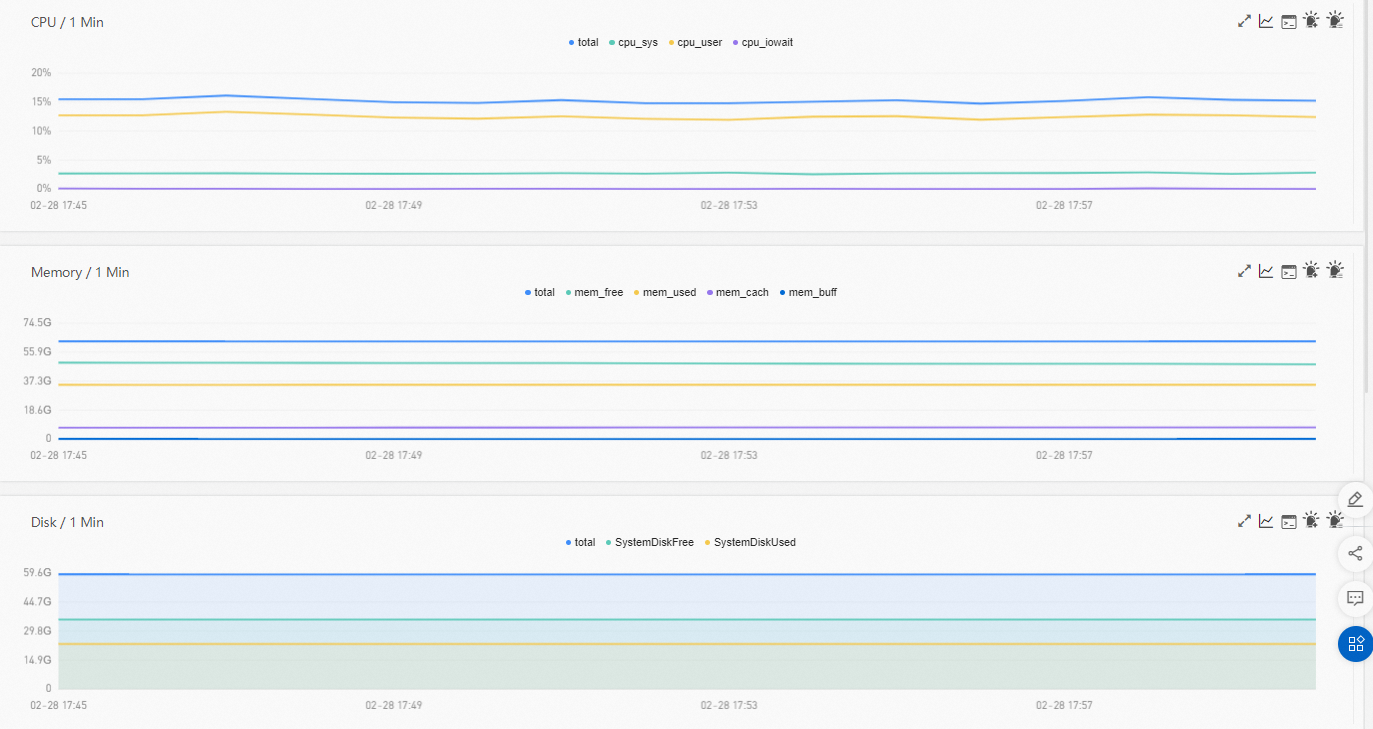
View host monitoring metrics
The Host Monitoring tab displays time-series charts for CPU, memory, disk, load, network traffic, and network packets.
Click a metric's name on a monitoring panel, such as system CPU utilization, to toggle its visibility in the chart.
NoteYou cannot hide a metric if it is the only one shown in the chart.
Click the line chart icon in the upper-right corner to view data for a specific time range or compare data across two time ranges.
Click the View API button in the upper-right corner to view the API details for the metric.
In the upper-right corner of a monitoring panel, click the
 icon to view existing alerts and the
  icon to create an alert rule. For more information, see Application Monitoring alert rules.
Metrics
The host monitoring feature includes the following metrics:
CPU
total CPU utilization
system CPU utilization
user CPU utilization
CPU utilization for I/O wait
Physical memory
total memory
free memory
used memory
memory in PageCache
memory in BufferCache
Disk
total system disk space (bytes)
free system disk space (bytes)
used system disk space (bytes)
Load
system load
Network traffic
received network traffic (bytes)
sent network traffic (bytes)
Network packets
received network packets per minute
sent network packets per minute
received network errors per minute
discarded network packets per minute