The ARMS SDK lets you retrieve the trace ID and related trace properties from your code.
Usage notes
For agents v4.x or later, use the OpenTelemetry Java SDK for custom instrumentation and to retrieve trace context:
Use the OpenTelemetry Java SDK to propagate context in intra-process asynchronous scenarios
Use the OpenTelemetry Java SDK to propagate context across processes
Only use the ARMS SDK if you cannot upgrade to a 4.x agent. For all other scenarios, use the OpenTelemetry Java SDK for custom instrumentation and to retrieve trace context.
Prerequisites
In the ARMS console, enable Application Monitoring for your application, and install and start the agent in your Java application. For more information, see Install an agent manually.
Include the
arms-sdk-1.7.3.jardependency in your application.<dependency> <groupId>com.alibaba.arms.apm</groupId> <artifactId>arms-sdk</artifactId> <version>1.7.3</version> </dependency>NoteIf you cannot obtain the dependency from pom.xml, download arms-sdk-1.7.3.jar.
Retrieve trace and RPC IDs
Use the following code to retrieve a trace ID and an RPC ID.
Span span = Tracer.builder().getSpan();   // This does not create a new Span.
String traceId = span.getTraceId();
String rpcId = span.getRpcId();
Propagate custom baggage
In Spring Cloud Gateway scenarios, baggage propagation fails if you use an agent of v4.2.x or later and enable the spring-bean plug-in in custom configurations. To resolve this, either disable the plug-in or downgrade the agent to v4.1.x or earlier.
To propagate custom baggage, add code to set and retrieve it as shown in the following steps:
Set custom baggage.
Map<String, String> baggage = new HashMap<String, String>();
baggage.put("key-01", "value-01");
baggage.put("key-02", "value-02");
baggage.put("key-03", "value-03");
Span span = Tracer.builder().getSpan();
span.withBaggage(baggage);
Retrieve the custom baggage.
Span span = Tracer.builder().getSpan();
Map<String, String> baggage = span.baggageItems();
In agents of version 4.x and later, baggage is used only for propagation. Its content is not automatically added to the tags of each Span. If required, you must manually set a custom tag for a Span.
Set custom span tags
A custom tag is valid only for the Span on which it is set and is not propagated. Add and retrieve custom tags as follows:
In your application code, add one or more custom tags to a Span.
Span span = Tracer.builder().getSpan();
// Add a tag to the Span.
span.setTag("tag-key1", "tag-value1");
span.setTag("tag-key2", "tag-value2");
In your application code, retrieve the custom tags of a Span.
Span span = Tracer.builder().getSpan();
// Inspect the Span's tags.
Map<String, String> tags = span.tags();
Query by custom baggage and tags
You can query traces using the custom baggage and tags set on a Span.
Baggage is propagated to downstream services and is typically used for business context propagation. Avoid adding an excessive number of baggage items.
A tag is valid only within the current Span. You can add multiple business-related items as tags.
Log in to the ARMS console. In the navigation pane on the left, choose .
On the Trace Query page, select a region at the top of the page. Then, select a Parameter type, enter the custom tag in the Parameter value field, and click Add to query criteria.
In the list of traces, click the trace ID of the desired trace.
On the Trace details page, hover over a service name to view the tags for that Span.
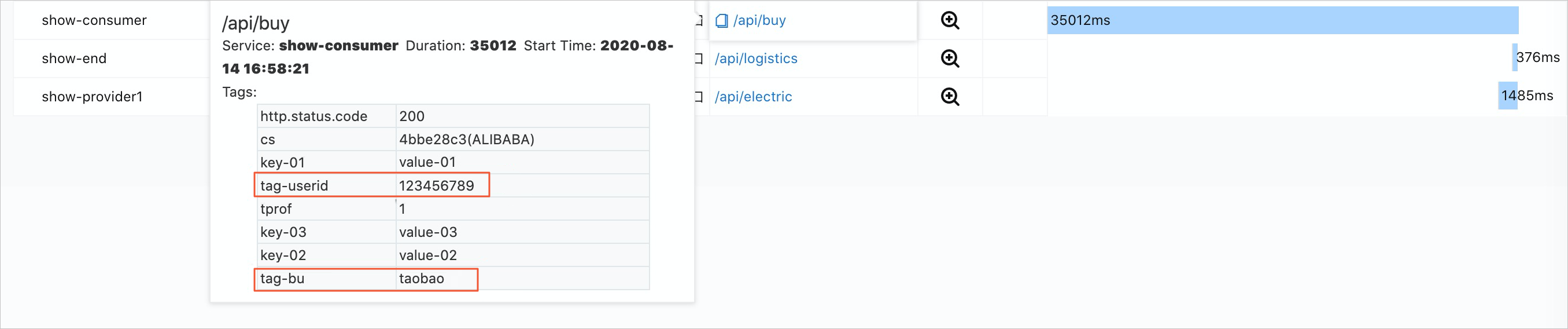
For agent v4.x and later, to include baggage in a Span, retrieve the baggage and then set it as a custom tag. See Propagate custom baggage and Set a custom tag for a Span.
More information
Can I modify the trace ID?
The ARMS SDK for Java does not allow you to programmatically modify the trace ID of the current trace.
This SDK is deprecated. You should replace this SDK with the OpenTelemetry SDK for Java as soon as possible: https://www.alibabacloud.com/help/en/arms/application-monitoring/use-cases/use-opentelemetry-sdk-for-java-to-manually-instrument-applications