ApsaraMQ for RocketMQ provides a distributed transaction processing feature similar to eXtended Architecture (X/Open XA) to ensure transaction consistency in ApsaraMQ for RocketMQ. This topic provides sample code on how to send and receive transactional messages by using the HTTP client SDK for PHP.
Background information
The following figure shows the interaction process of transactional messages.
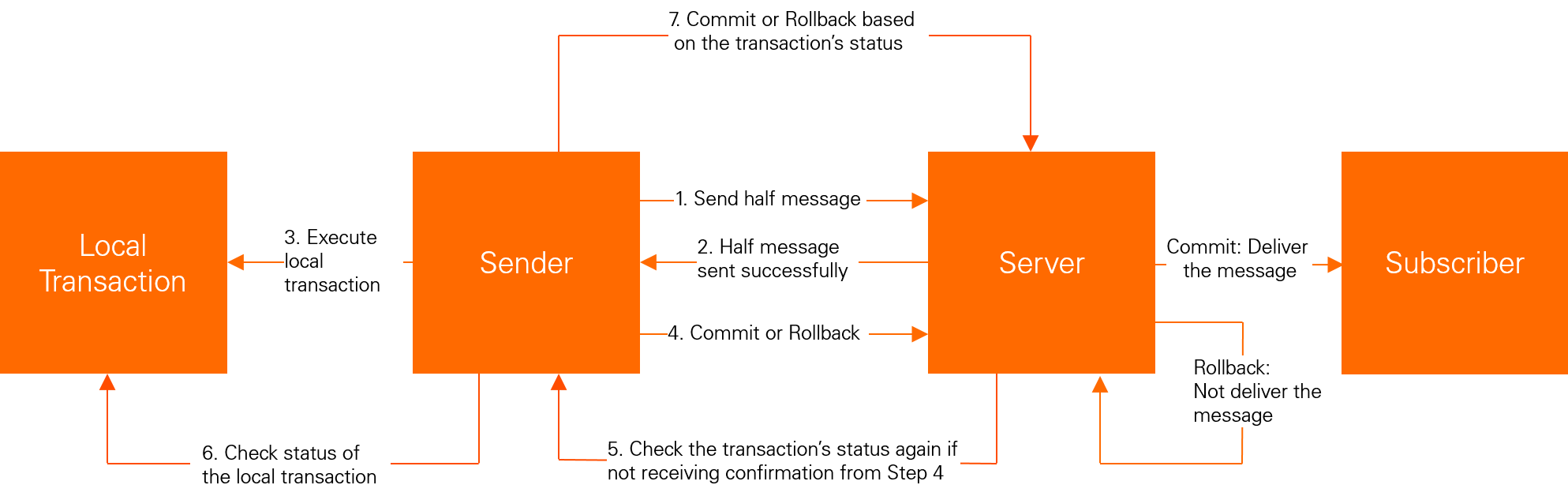
For more information, see Transactional messages.
Prerequisites
Before you start, make sure that the following operations are performed:
Install the SDK for PHP. For more information, see Prepare the environment for the PHP SDK.
Create the resources that you want to specify in the code in the ApsaraMQ for RocketMQ console. The resources include instances, topics, and consumer groups. For more information, see Create resources.
Obtain the AccessKey pair of your Alibaba Cloud account. For more information, see Create an AccessKey.
Send transactional messages
The following sample code provides an example on how to send transactional messages by using the HTTP client SDK for PHP:
<?php

require "vendor/autoload.php";

use MQ\Model\TopicMessage;
use MQ\MQClient;

class ProducerTest
{
    private $client;
    private $transProducer;
    private $count;
    private $popMsgCount;

    public function __construct()
    {
        $this->client = new MQClient(
            // The HTTP endpoint. You can obtain the endpoint in the HTTP Endpoint section of the Instance Details page in the ApsaraMQ for RocketMQ console.
            "${HTTP_ENDPOINT}",
            // Make sure that the environment variables ALIBABA_CLOUD_ACCESS_KEY_ID and ALIBABA_CLOUD_ACCESS_KEY_SECRET are configured.
	          // The AccessKey ID that is used for authentication.
	          getenv("ALIBABA_CLOUD_ACCESS_KEY_ID"),
	          // The AccessKey secret that is used for authentication.
	          getenv('ALIBABA_CLOUD_ACCESS_KEY_SECRET')
        );

        // The topic in which the message is produced. You must create the topic in the ApsaraMQ for RocketMQ console.
        $topic = "${TOPIC}";
        // The ID of the consumer group that you created in the ApsaraMQ for RocketMQ console.
        $groupId = "${GROUP_ID}";
        // The ID of the instance to which the topic belongs. You must create the instance in the ApsaraMQ for RocketMQ console.
        // If the instance has a namespace, specify the ID of the instance. If the instance does not have a namespace, set the instanceID parameter to null or an empty string. You can obtain the namespace of the instance on the Instance Details page in the ApsaraMQ for RocketMQ console.
        $instanceId = "${INSTANCE_ID}";

        $this->transProducer = $this->client->getTransProducer($instanceId,$topic, $groupId);
        $this->count = 0;
        $this->popMsgCount = 0;
    }

    function processAckError($e) {
        if ($e instanceof MQ\Exception\AckMessageException) {
            // If the transactional message is committed or rolled back after the time specified by the TransCheckImmunityTime parameter for the handle of the transactional message elapses or the time specified by the NextConsumeTime parameter for the handle of consumeHalfMessage elapses, the commit or rollback fails.
            printf("Commit/Rollback Error, RequestId:%s\n", $e->getRequestId());
            foreach ($e->getAckMessageErrorItems() as $errorItem) {
                printf("\tReceiptHandle:%s, ErrorCode:%s, ErrorMsg:%s\n", $errorItem->getReceiptHandle(), $errorItem->getErrorCode(), $errorItem->getErrorCode());
            }
        } else {
            print_r($e);
        }
    }

    function consumeHalfMsg() {
        while($this->count < 3 && $this->popMsgCount < 15) {
            $this->popMsgCount++;

            try {
                $messages = $this->transProducer->consumeHalfMessage(4, 3);
            } catch (\Exception $e) {
                if ($e instanceof MQ\Exception\MessageNotExistException) {
                    print "no half transaction message\n";
                    continue;
                }
                print_r($e->getMessage() . "\n");
                sleep(3);
                continue;
            }

            foreach ($messages as $message) {
                printf("ID:%s TAG:%s BODY:%s \nPublishTime:%d, FirstConsumeTime:%d\nConsumedTimes:%d, NextConsumeTime:%d\nPropA:%s\n",
                    $message->getMessageId(), $message->getMessageTag(), $message->getMessageBody(),
                    $message->getPublishTime(), $message->getFirstConsumeTime(), $message->getConsumedTimes(), $message->getNextConsumeTime(),
                    $message->getProperty("a"));
                print_r($message->getProperties());
                $propA = $message->getProperty("a");
                $consumeTimes = $message->getConsumedTimes();
                try {
                    if ($propA == "1") {
                        print "\n commit transaction msg: " . $message->getMessageId() . "\n";
                        $this->transProducer->commit($message->getReceiptHandle());
                        $this->count++;
                    } else if ($propA == "2" && $consumeTimes > 1) {
                        print "\n commit transaction msg: " . $message->getMessageId() . "\n";
                        $this->transProducer->commit($message->getReceiptHandle());
                        $this->count++;
                    } else if ($propA == "3") {
                        print "\n rollback transaction msg: " . $message->getMessageId() . "\n";
                        $this->transProducer->rollback($message->getReceiptHandle());
                        $this->count++;
                    } else {
                        print "\n unknown transaction msg: " . $message->getMessageId() . "\n";
                    }
                } catch (\Exception $e) {
                    $this->processAckError($e);
                }
            }
        }
    }

    public function run()
    {
        // Cyclically send four transactional messages.
        for ($i = 0; $i < 4; $i++) {
            $pubMsg = new TopicMessage("hello,mq");
            // The custom attributes of the message.
            $pubMsg->putProperty("a", $i);
            // The message key.
            $pubMsg->setMessageKey("MessageKey");
            // The time interval between the sending time of the transactional message and the start time of the first check for the status of the local transaction. This time interval specifies the relative time when the status is first checked. Unit: seconds. Valid values: 10 to 300.
            // If the message is not committed or rolled back after the first transaction status check is performed, the broker initiates a request to check the status of the local transaction at an interval of 10 seconds within the next 24 hours.
            $pubMsg->setTransCheckImmunityTime(10);
            $topicMessage = $this->transProducer->publishMessage($pubMsg);

            print "\npublish -> \n\t" . $topicMessage->getMessageId() . " " . $topicMessage->getReceiptHandle() . "\n";

            if ($i == 0) {
                try {
                    // After the producer sends the transactional message, the broker obtains the handle of the half message that corresponds to the transactional message and commits or rolls back the transactional message based on the status of the handle.
                    $this->transProducer->commit($topicMessage->getReceiptHandle());
                    print "\n commit transaction msg when publish: " . $topicMessage->getMessageId() . "\n";
                } catch (\Exception $e) {
                    // If the transactional message is committed or rolled back after the time specified by the TransCheckImmunityTime parameter elapses, the commit or rollback fails.
                    $this->processAckError($e);
                }
            }
        }

        // The client needs a thread or a process to process unacknowledged transactional messages.
        // Process unacknowledged transactional messages.
        $this->consumeHalfMsg();
    }
}


$instance = new ProducerTest();
$instance->run();

?>
Subscribe to transactional messages
The following sample code provides an example on how to subscribe to transactional messages by using the HTTP client SDK for PHP:
<?php

use MQ\MQClient;

require "vendor/autoload.php";

class ConsumerTest
{
    private $client;
    private $consumer;

    public function __construct()
    {
        $this->client = new MQClient(
            // The HTTP endpoint. You can obtain the endpoint in the HTTP Endpoint section of the Instance Details page in the ApsaraMQ for RocketMQ console.
            "${HTTP_ENDPOINT}",
            // Make sure that the environment variables ALIBABA_CLOUD_ACCESS_KEY_ID and ALIBABA_CLOUD_ACCESS_KEY_SECRET are configured.
	          // The AccessKey ID that is used for authentication.
	          getenv("ALIBABA_CLOUD_ACCESS_KEY_ID"),
	          // The AccessKey secret that is used for authentication.
	          getenv('ALIBABA_CLOUD_ACCESS_KEY_SECRET')
        );

        // The topic in which the message is produced. You must create the topic in the ApsaraMQ for RocketMQ console.
        $topic = "${TOPIC}";
        // The ID of the consumer group that you created in the ApsaraMQ for RocketMQ console.
        $groupId = "${GROUP_ID}";
        // The ID of the instance to which the topic belongs. You must create the instance in the ApsaraMQ for RocketMQ console.
        // If the instance has a namespace, specify the ID of the instance. If the instance does not have a namespace, set the instanceID parameter to null or an empty string. You can obtain the namespace of the instance on the Instance Details page in the ApsaraMQ for RocketMQ console.
        $instanceId = "${INSTANCE_ID}";

        $this->consumer = $this->client->getConsumer($instanceId, $topic, $groupId);
    }

    public function ackMessages($receiptHandles)
    {
        try {
            $this->consumer->ackMessage($receiptHandles);
        } catch (\Exception $e) {
            if ($e instanceof MQ\Exception\AckMessageException) {
                // If the handle of a message times out, the broker cannot receive an acknowledgment (ACK) for the message from the consumer.
                printf("Ack Error, RequestId:%s\n", $e->getRequestId());
                foreach ($e->getAckMessageErrorItems() as $errorItem) {
                    printf("\tReceiptHandle:%s, ErrorCode:%s, ErrorMsg:%s\n", $errorItem->getReceiptHandle(), $errorItem->getErrorCode(), $errorItem->getErrorCode());
                }
            }
        }
    }

    public function run()
    {
        // Cyclically consume messages in the current thread. We recommend that you use multiple threads to concurrently consume messages.
        while (True) {
            try {
                // Consume messages in long polling mode.
                // If no message in the topic is available for consumption, the request is suspended on the broker for a period of time. This period of time is known as long polling period. If a message becomes available for consumption within the period of time, the broker immediately sends a response to the consumer.
                $messages = $this->consumer->consumeMessage(
                    3, // The maximum number of messages that can be consumed at a time. In this example, the value is specified as 3. The maximum value that you can specify is 16.
                    3 // The duration of a long polling period. Unit: seconds. In this example, the value is specified as 3. The maximum value that you can specify is 30.
                );
            } catch (\MQ\Exception\MessageResolveException $e) {
                // If messages cannot be parsed due to invalid characters in the message body, this exception is thrown.
                // The messages that can be parsed as expected.
                $messages = $e->getPartialResult()->getMessages();
                // The messages that cannot be parsed as expected.
                $failMessages = $e->getPartialResult()->getFailResolveMessages();

                $receiptHandles = array();
                foreach ($messages as $message) {
                    // The message consumption logic.
                    $receiptHandles[] = $message->getReceiptHandle();
                    printf("MsgID %s\n", $message->getMessageId());
                }
                foreach ($failMessages as $failMessage) {
                    // Handle the message that cannot be parsed due to invalid characters in the message body.
                    $receiptHandles[] = $failMessage->getReceiptHandle();
                    printf("Fail To Resolve Message. MsgID %s\n", $failMessage->getMessageId());
                }
                $this->ackMessages($receiptHandles);
                continue;
            } catch (\Exception $e) {
                if ($e instanceof MQ\Exception\MessageNotExistException) {
                    // If no message is available for consumption, and the long polling mode continues to take effect.
                    printf("No message, contine long polling!RequestId:%s\n", $e->getRequestId());
                    continue;
                }

                print_r($e->getMessage() . "\n");

                sleep(3);
                continue;
            }

            print "consume finish, messages:\n";

            // The message consumption logic.
            $receiptHandles = array();
            foreach ($messages as $message) {
                $receiptHandles[] = $message->getReceiptHandle();

                printf("MessageID:%s TAG:%s BODY:%s \nPublishTime:%d, FirstConsumeTime:%d, \nConsumedTimes:%d, NextConsumeTime:%d,MessageKey:%s\n",
                    $message->getMessageId(), $message->getMessageTag(), $message->getMessageBody(),
                    $message->getPublishTime(), $message->getFirstConsumeTime(), $message->getConsumedTimes(), $message->getNextConsumeTime(),
                    $message->getMessageKey());
                print_r($message->getProperties());
            }

            // If the broker does not receive an ACK for a message from the consumer before the period of time specified in $message->getNextConsumeTime() elapses, the broker delivers the message to the consumer again.
            // A unique timestamp is specified for the handle of a message each time the message is consumed.
            print_r($receiptHandles);
            $this->ackMessages($receiptHandles);
            print "ack finish\n";
        }

    }
}

$instance = new ConsumerTest();
$instance->run();


?>