When messages accumulate in a Kafka topic or disk usage spikes, you need partition-level visibility to pinpoint which partitions are affected and whether consumers are keeping up. Partition status exposes the message count and offset range for each partition in a topic, so you can quickly identify imbalances, stale partitions, and growing consumer lag.
Concepts
| Concept | Description |
|---|---|
| Partition | An ordered, append-only log within a topic. Each partition stores messages independently and supports parallel consumption. |
| Offset | A unique, incremental number assigned to each message in a partition, indicating its position. |
| Minimum offset | The earliest available offset in a partition. Messages before this offset have been cleaned up by the retention policy. |
| Maximum offset | The latest offset in a partition, representing the most recently written message. |
| Consumer lag | The difference between the maximum offset and a consumer group's last committed offset. A large or growing lag means consumers cannot keep up with incoming messages. |
Prerequisites
Before you begin, make sure that you have:
A topic in your ApsaraMQ for Kafka instance. For more information, see Step 3: Create resources
View partition status in the console
Log on to the ApsaraMQ for Kafka console.
In the Resource Distribution section of the Overview page, select the region where the ApsaraMQ for Kafka instance that you want to manage resides.
On the Instances page, click the name of the instance that you want to manage.
In the left-side navigation pane, click Topics.
On the Topics page, click the name of the topic that you want to manage. On the Topic Details page, click the Partition Status tab.Name
Table 1. Parameters included in partition status
Parameter
Description
Partition ID
The partition ID.
Minimum Offset
The minimum offset in the partition.
Maximum Offset
The maximum offset in the partition.
Messages
The number of messages in the partition.
Last Updated At
The time when the last message in the partition is stored.
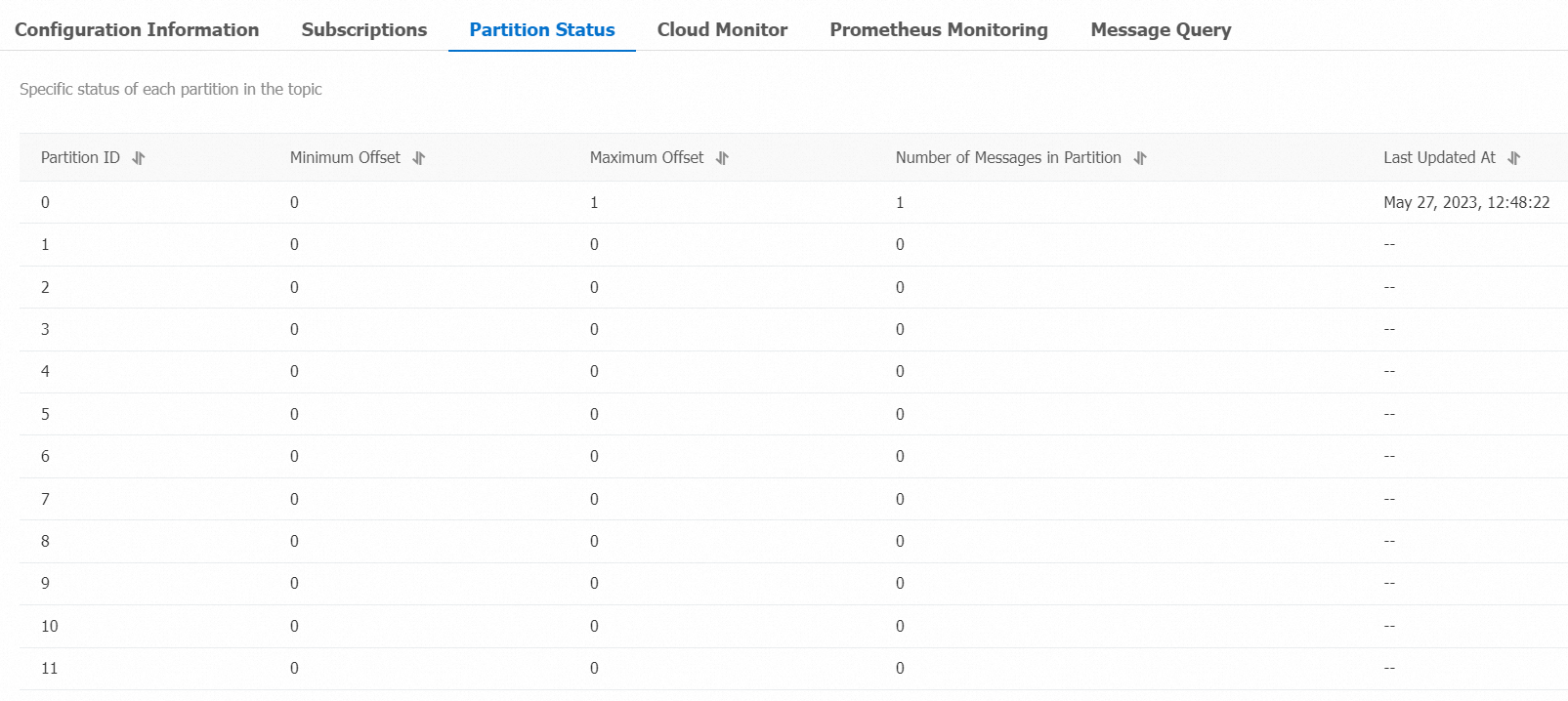
On the Topic Details page, click the Partition Status tab.
The tab displays the following parameters for each partition:
Parameter Description Partition ID The unique identifier of the partition within the topic. Minimum Offset The earliest available offset in the partition. Maximum Offset The latest offset in the partition. Messages The number of messages currently stored in the partition. Calculated as Maximum Offset minus Minimum Offset. Last Updated At The timestamp of the most recent message written to the partition.
Diagnose common issues
Use partition status metrics to identify root causes for message accumulation, uneven load, and stale topics.
Uneven message distribution
Compare the Messages count across partitions. If some partitions hold significantly more messages than others, producers may be using a partition key that causes skewed distribution. To confirm, check whether your producer code specifies a key and whether the key values are well-distributed.
For more details, see Why are messages unevenly distributed among partitions?
Consumer lag
Consumer lag is the gap between a consumer group's committed offset and the partition's Maximum Offset. To calculate lag:
Consumer lag = Maximum Offset - Consumer's committed offsetA large and growing lag means consumers cannot process messages as fast as producers send them. Common causes include:
Terminated consumers: One or more consumers in the group have stopped, shifting load to remaining consumers.
Insufficient throughput: Consumer processing logic is too slow or the consumer group has too few members for the partition count.
To view the committed offset for each consumer group, check the Consumer Groups page in the console.
High disk usage
Look for partitions with a high Messages count. Large volumes across multiple partitions increase disk pressure on the broker. To reduce usage:
Shorten the message retention period for the topic.
Scale your instance to add storage capacity.
Stale partitions
If the Last Updated At timestamp is significantly older than expected, the partition is no longer receiving messages. Verify that your producers are active and targeting the correct topic.
If the Last Updated At column displays 1970 or --, see Why is 1970 or "--" displayed in the Last Updated At column for the partitions of a topic?
Related operations
To redistribute unevenly allocated partitions among topics that use cloud storage, see Partition balancing and traffic redirection.