This topic details the AI Agent intelligent memory storage (MemStore) solution, built on the cloud-native data warehouse AnalyticDB for MySQL. This solution provides AI Agents with a scalable, highly reliable, and unified storage system for long-term, working, and episodic memory.
Solution overview
Cognitive model of AI agent memory
Based on cognitive science theories (such as the Atkinson–Shiffrin memory model) and the characteristics of AI systems, the AI Agent memory framework consists of the following three core modules:
Long-term memory: Persistently stored information, such as user preferences and domain knowledge, available for use across sessions.
Working memory: Temporary states and intermediate results during the execution of the current task.
Episodic memory: Contextual records from specific interactions, supporting experience recall and reuse.
This classification integrates the core features of mainstream frameworks such as Mem0, ReMe, and LangMem, and aligns with the current trend toward standardization in AI cognitive modeling.
Representation and storage of AI agent memory
AI Agent memory is represented in two forms: implicit memory and explicit memory.
Implicit Memory
Technical implementation: Implemented through the parameter space of deep neural networks. The model weights reflect the degree of knowledge internalization.
Explicit Memory
Long-term memory: Stored in a columnar data warehouse, such as the OLAP engine of AnalyticDB for MySQL, to support complex queries and statistical analysis.
Working memory: Implemented as a collaboration of an in-memory key-value (KV) store (such as Redis Cluster) and a real-time computing engine (such as Flink), supporting high-speed reads/writes and real-time processing.
To meet these cognitive architecture requirements, AnalyticDB for MySQL provides a scalable and highly reliable storage foundation for AI Agent memory systems.
Solution architecture
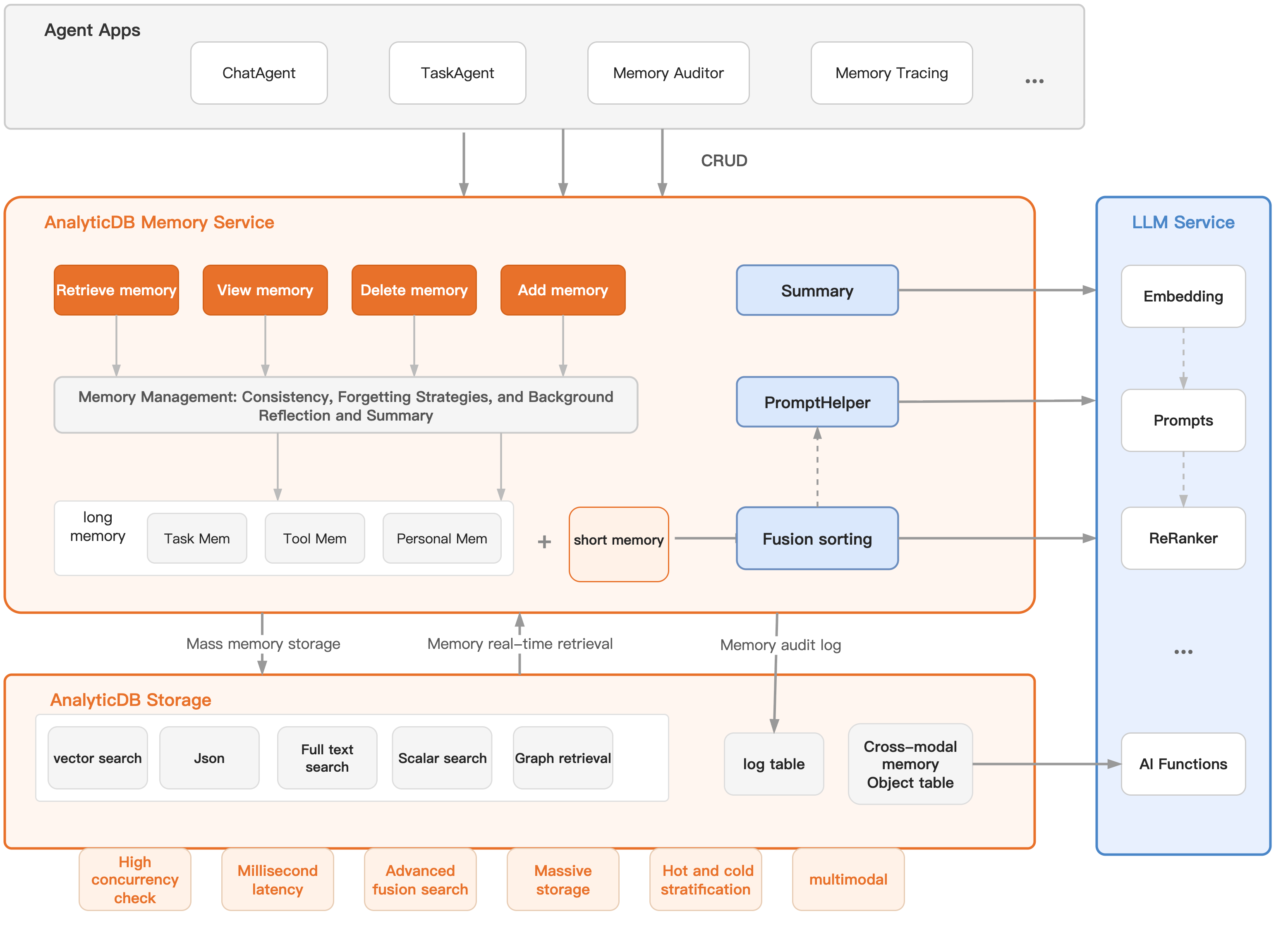
The overall architecture of the AnalyticDB for MySQL AI Agent MemStore solution, shown below, consists of the following three core components.

AnalyticDB Memory Service
As the core service layer for memory management, it natively supports Mem0 and ReMe, and provides a unified, standardized interface for AI Agents to use.
API
Description
Retrieve memory
Searches for relevant memories based on semantic similarity.
View memory
Retrieves a list of memories for a specified user or AI Agent.
Delete memory
Manually or automatically deletes specified memories.
Add memory
Extracts and stores new memories from conversations or tasks.
The service also includes built-in advanced features such as tiered memory management, periodic reflection, consistency maintenance, and intelligent forgetting strategies. These features enable the AI Agent to continuously learn and optimize. Additionally, the solution provides an embedded SDK to facilitate local AI Agent development and debugging.
LLM Service
Integrates multiple large language models (LLMs) to provide the following core AI capabilities for memory generation, processing, and retrieval:
Capability
Description
Embeddings
Generates text embeddings (vectors) from text to support semantic search.
Prompts
Manages and optimizes prompts.
ReRanker
Reranks search results to improve relevance.
AI Functions
Provides intelligent function-calling capabilities.
AnalyticDB Storage
Serves as the unified storage foundation for long-term memory. It leverages the three core capabilities of AnalyticDB for MySQL—vector search, JSON search, and full-text search—to provide comprehensive and efficient hybrid search support for upper-layer services.
Memory generation and retrieval flow
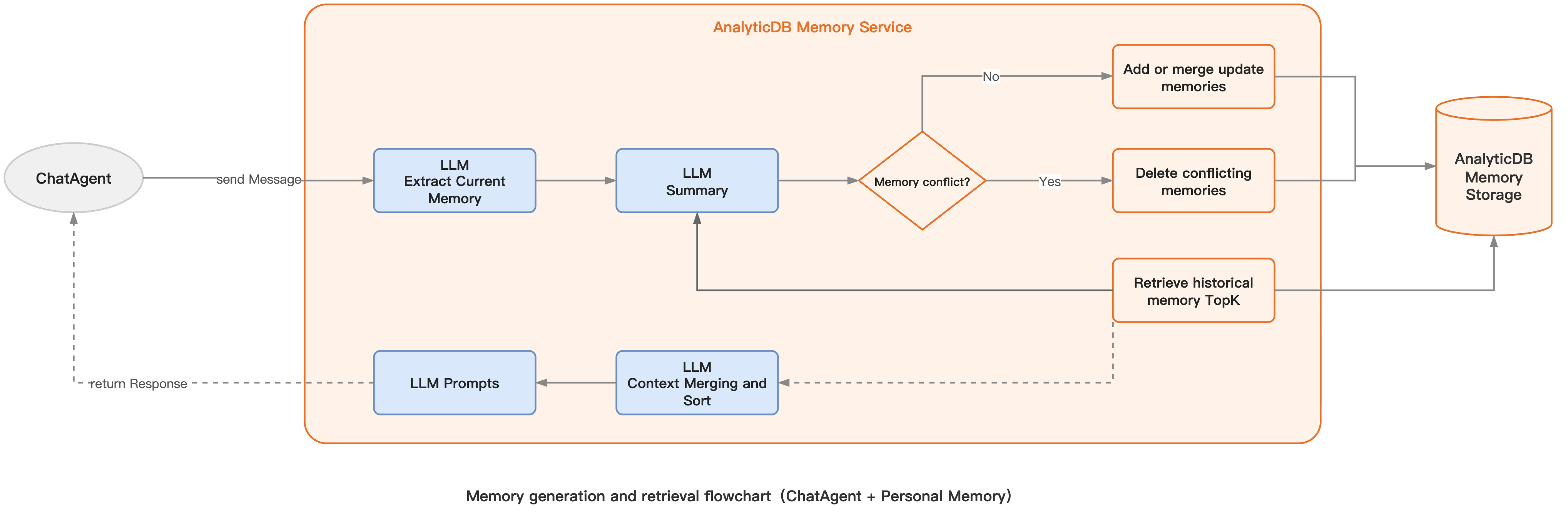
The following figure illustrates the end-to-end data flow, from initial information input to memory generation and final retrieval.

Key technology comparison: ReMe vs. Mem0
Although ReMe and Mem0 both aim to enhance AI Agent capabilities through memory mechanisms, they differ significantly in design philosophy, capability boundaries, and use cases.
Dimension | ReMe | Mem0 |
Positioning | An agent-enhancing behavioral memory system that supports reflection, self-correction, and knowledge sharing across agents. | A context-enhancing memory system that improves the efficiency of context engineering. |
Use cases | ChatAgent, TaskAgent, and multi-agent collaboration. | ChatAgent, personalized assistants, and long-term context applications. |
Memory classification |
|
|
Memory reuse | TaskMemory supports reuse across different agents, which facilitates policy sharing and promotes collective intelligence and behavioral improvement.
| Shared organizational memory maintains consistent domain knowledge and global configurations. |
Long-term memory optimization | Asynchronously merges and refines memories in the background to ensure program correctness and long-term quality. | Asynchronously merges and refines memories in the background to ensure program correctness and long-term quality. |
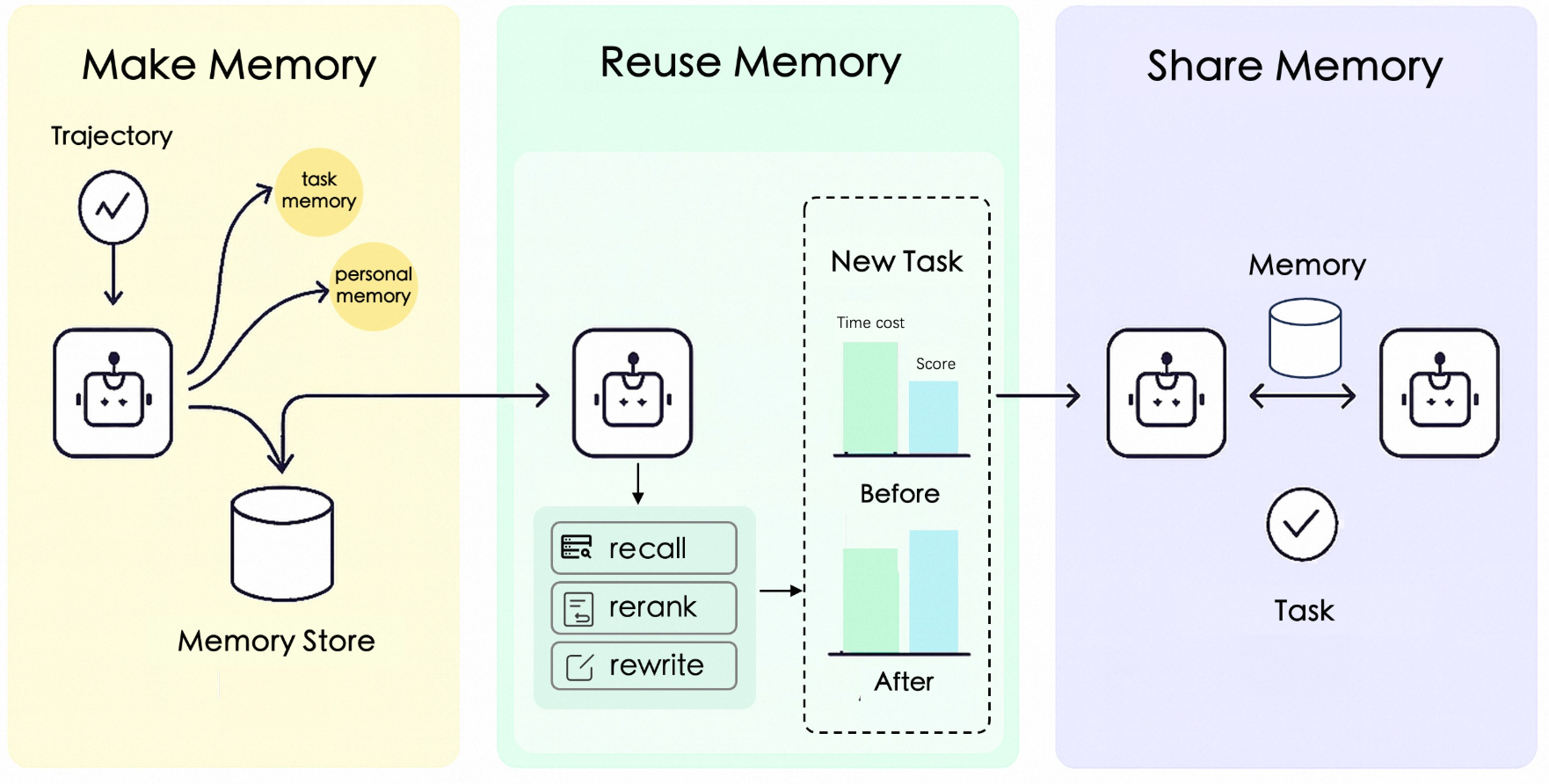
ReMe and Mem0 are both excellent memory frameworks, but they have different design priorities:
The strengths of Mem0 lie in its mature ecosystem, integration capabilities, production-grade scalability, and efficient context management mechanisms.
ReMe focuses on fine-grained, behavioral-level memory. It is specifically optimized for agent actions and uses a progressive, agentic memory architecture, which makes it better suited for dynamic and continuously evolving agent scenarios.
Core capabilities of AnalyticDB for MySQL
AnalyticDB for MySQL provides the following three core retrieval capabilities to support AI Agent memory management:
Supports the
HNSW_PQalgorithm for approximate nearest neighbor search in high-dimensional vectors.Supports Euclidean distance and cosine similarity as distance functions.
Supports create, read, update, and delete (CRUD) operations (
json_set,json_replace,json_remove) on JSON columns.Supports indexing on JSON attribute keys and JSON arrays.
Supports a variety of JSON functions.
Uses the standard
MATCH(column) AGAINST('keyword')syntax, which is compatible with MySQL.Supports fuzzy matching (
match() fuzzy()) and phrase matching (match() phrase()).Supports keyword highlighting with
fulltext_highlightand allows custom highlighting.Supports multiple tokenizers:
AliNLP,IK,Standard,Ngram,Edge_ngram, andPattern.Supports custom dictionaries, stop words, and expansion words.
Supports index creation on Varchar and JSON column types.
Supports BM25 scoring and ranking.
By combining these three capabilities, AnalyticDB for MySQL provides powerful hybrid search capabilities, enabling AI Agents to efficiently and accurately locate the information they need from large memory stores.