This topic describes how to add multiple domains and domain aliases to your Alibaba Mail service.
Domains
A domain is the part of an email address after the @ symbol. Alibaba Mail allows you to add multiple domains. For example, if your company owns both example.net and example1.net, you can add both as domains. When you create a new email account, you can choose to use either @example.net or @example1.net. By creating an alias account, emails sent to both user@example.net and user@example1.net will arrive in the same mailbox.
The maximum number of multiple domains and subdomains you can add depends on the number of paid accounts you have:
If you have 10 or more paid accounts, you can add up to 10 multiple domains and subdomains.
If you have 50 or more paid accounts, you can add up to 30 multiple domains and subdomains.
If you have 500 or more paid accounts, you can add up to 100 multiple domains and subdomains.
Paid accounts are sub-accounts and do not include the postmaster account.
Note: The AI Premium Edition is not subject to these paid account limits and supports up to 100 multiple domains and subdomains by default. For more information about feature differences, see Product Editions.
Add domains
To use the multiple domains feature, you must have at least 10 paid accounts.
The screenshots in this section use an account with 10 paid accounts as an example.
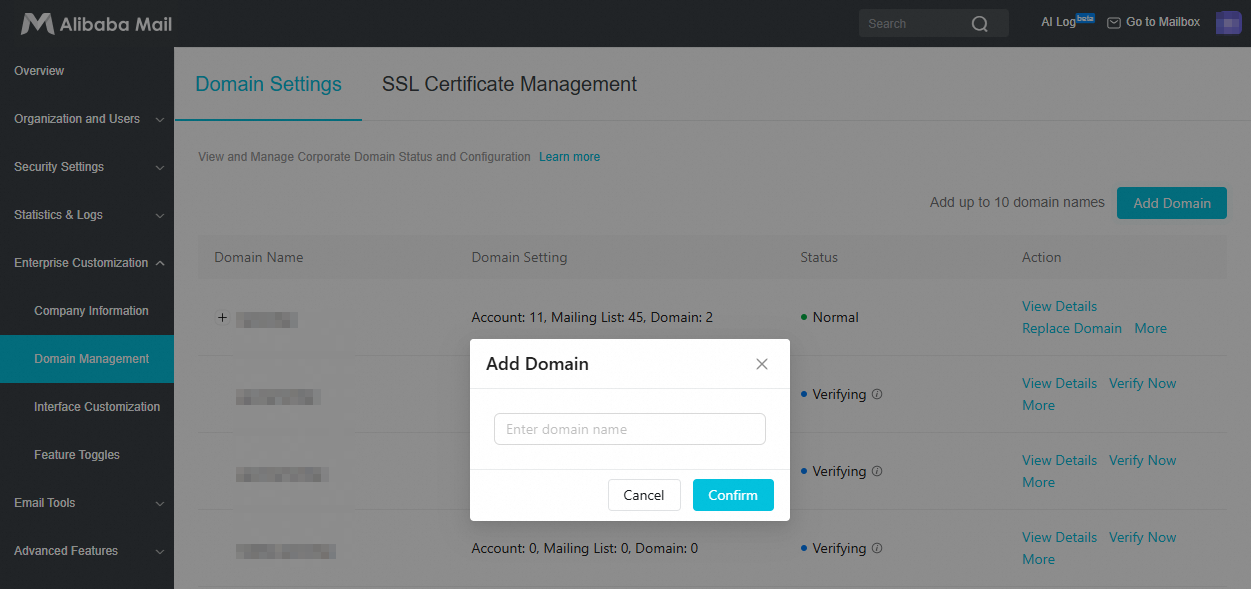
Sign in to the mail management console with the postmaster account. Navigate to Enterprise Customization > Domain Management > Domain Settings. Click Add Domain, enter the domain that you want to add, and then click OK.
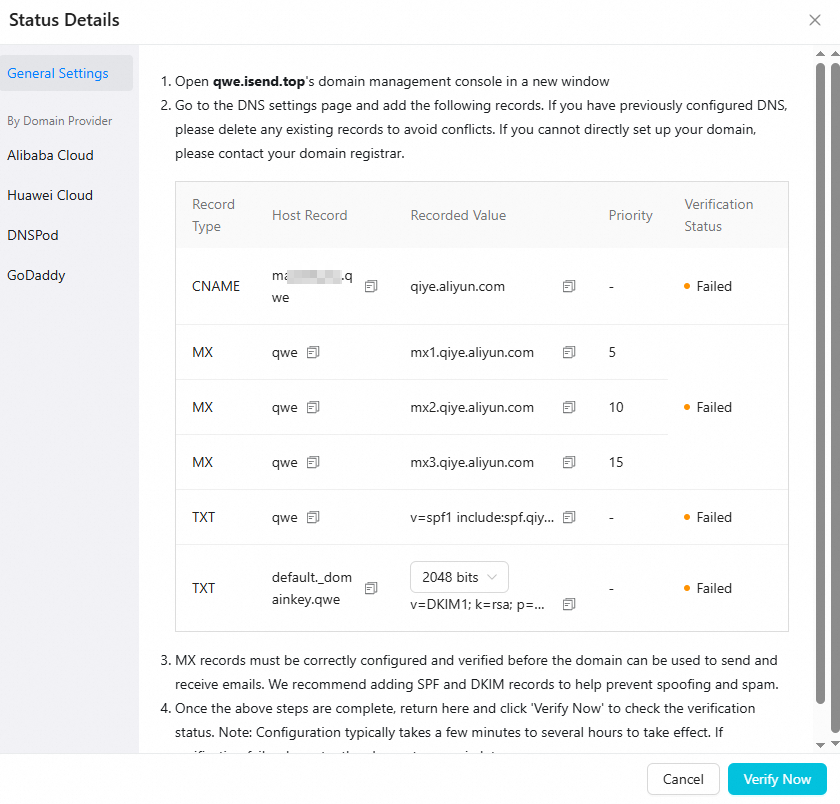
After adding the domain, you must configure its DNS records. Click View Details, and add the CNAME, MX, and TXT records as instructed.
NoteYou must configure the domain name resolution with your DNS provider. For an example using the Alibaba Cloud DNS console, see How to set up DNS resolution for an Alibaba Cloud domain to use with Alibaba Mail.
 Note
NoteWhen you add DNS records for the domain, note the following:
If you use the quick DNS resolution feature (Quick Add Alibaba Mail Records) in the Alibaba Cloud DNS console, the CNAME record required for domain verification may be missing from the automatically added records. Check the resolution records and add the missing CNAME record manually if needed.
If some verification records (such as the DKIM record) fail verification, this does not affect sending or receiving emails. The MX record must pass verification for email delivery to work.
After you add the DNS records and they propagate, the status changes to Normal, and the domain is ready to use.
 Note
NoteDNS record propagation depends on your DNS provider. DNS record propagation can take from a few minutes to 48 hours to complete globally. During this time, the status shows as Verifying.
Delete domains
Warning: Deleting a domain is an irreversible action. All accounts and emails associated with that domain will be permanently deleted. Before proceeding, check for active accounts under the domain. If you need to preserve account data, change the domain for those accounts first. To learn how, see How to edit employee account information.
Each domain you add is unique. If you delete a domain and then add it again, you cannot restore the previously deleted accounts from the Account Recycle Bin. You can, however, back up emails by transferring them before deletion. For more information, see What is the Account Recycle Bin.
Find the domain you want to delete, click More > Delete, and then click Confirm.
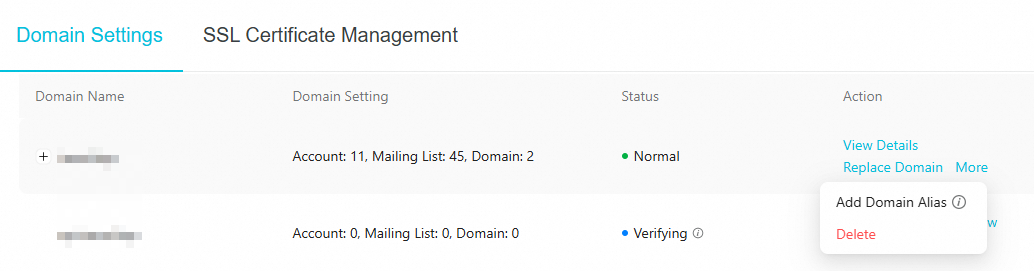
After you delete the domain, all associated accounts and emails will be permanently removed.
Add domain aliases
You can add up to 6 domain aliases for each primary domain. This feature is not available for the free email service.
Sign in to the mail management console with the postmaster account. Navigate to Enterprise Customization > Domain Management > Domain Settings. Find the primary domain to which you want to add an alias, and click More > Add domain alias.
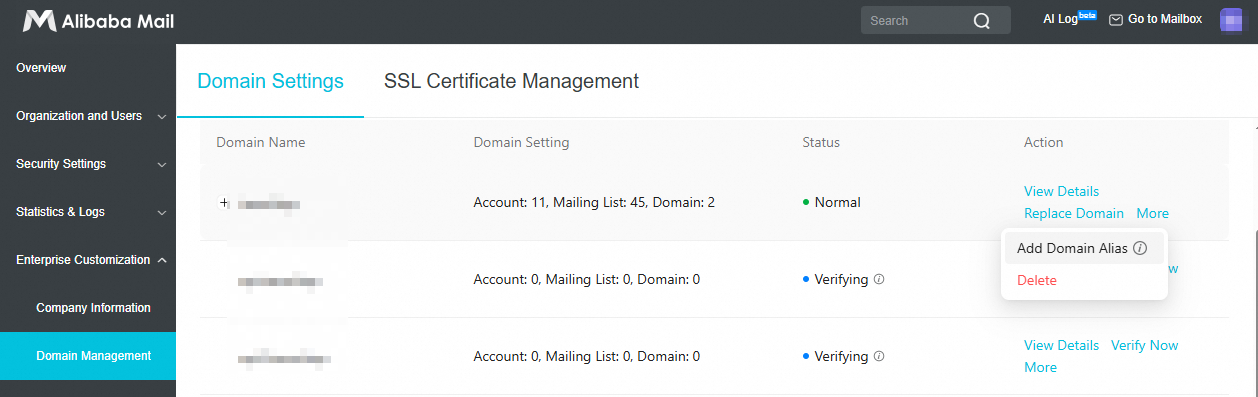
Enter the domain alias you want to add and click OK.
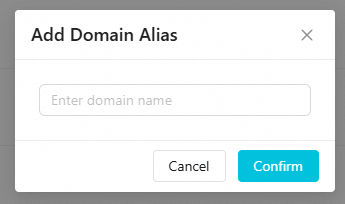
After adding the domain alias, you must configure its DNS records. Click View Details and add the DNS records as instructed. The DNS record types are described as follows:
MX record: Required. Mail exchange record, used to send and receive emails.
CNAME record: Required. Alias record that points to qiye.aliyun.com.
TXT (SPF) record: Required. Sender Policy Framework, which prevents email spoofing.
TXT (DKIM) record: Optional. DomainKeys Identified Mail, which enhances email security.
The DKIM record is an optional enhancement. Not adding it does not affect the normal sending and receiving of emails for the domain alias. Adding it enhances email security and trustworthiness. After the DNS records propagate, the status changes to Normal, and the domain alias is ready to use.
NoteYou must configure the domain name resolution with your DNS provider. For an example using the Alibaba Cloud DNS console, see How to set up DNS resolution for an Alibaba Cloud domain to use with Alibaba Mail.
If DNS verification fails, check for DNS record conflicts. A CNAME record with the host record set to @ conflicts with MX records. Delete the CNAME record and any non-Alibaba Mail MX records. For more information, see Troubleshoot email domain DNS resolution conflicts.
If the domain alias status remains Verifying or verification still fails after the records propagate, troubleshoot as follows:
Check whether your DNS records still contain MX or CNAME records left over from a previous email provider (for example, a record pointing to
mxbiz1.qq.cominstead of Alibaba Mail). If so, delete these conflicting records.Click View Details again and add every record in the list exactly as shown, including the CNAME record, all three MX records, and the TXT (SPF and DKIM) records. Use the record values shown in the console, since they are unique to your domain.
After you finish adding the records, return to the mail management console and click Verify Now.
The MX record must pass verification before the domain alias can send or receive emails. If verification still fails after you have added all the required records, wait a few minutes and click Verify Now again, since DNS record propagation can take time.
Delete domain aliases
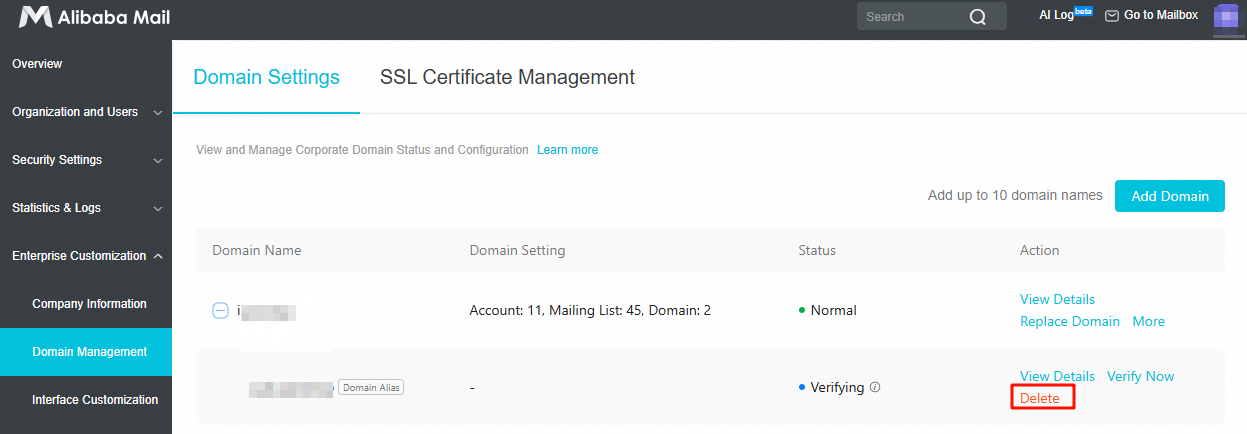
Find the domain alias you want to delete, click Delete next to it, and then click Confirm.
Display domain alias addresses in DingTalk
By default, DingTalk displays an employee's primary domain in their mailbox address. To display a domain alias address instead, swap the primary domain with the domain alias.
Sign in to the mail management console (qiye.aliyun.com) with the postmaster account, and navigate to Enterprise Customization > Domain Management > Domain Settings.
Delete the target domain alias: in the row of the domain, click More > Delete.
Replace the primary domain: in the row of the primary domain, click More > Replace Domain, enter the original domain alias as the new primary domain, and click OK.
On the DNS verification page, add the following records. For detailed configuration steps, see How to set up DNS resolution for an Alibaba Cloud domain to use with Alibaba Mail.
CNAME: The host record is mail+random ID.domain prefix, and the record value is qiye.aliyun.com.
MX: Points to mx1/mx2/mx3.qiye.aliyun.com, with priorities 5/10/15 respectively.
TXT (SPF): v=spf1 include:spf.qiye.aliyun.com -all
After the DNS records take effect (usually within 10 minutes to 2 hours), return to the domain management page and click Verify Now.
After verification succeeds, in the row of the primary domain, click More > Add domain alias, and bind the original primary domain as a domain alias.
During the primary domain replacement, the original mailbox address cannot send or receive emails. Notify users in advance. The domain holder is unrelated to the mailbox account owner; you only need to cooperate with DNS resolution verification. If the domain you enter when replacing the primary domain already exists as a domain alias, the system returns "The domain name already exists or is occupied (error code: rpc:domain.isExist)". In this case, delete that domain alias as described in step 2, and then replace the primary domain.
FAQ
The primary difference is how alias accounts are handled.
With multiple domains, you must manually create an alias account for each user. With a domain alias, the system automatically creates an alias account for every user.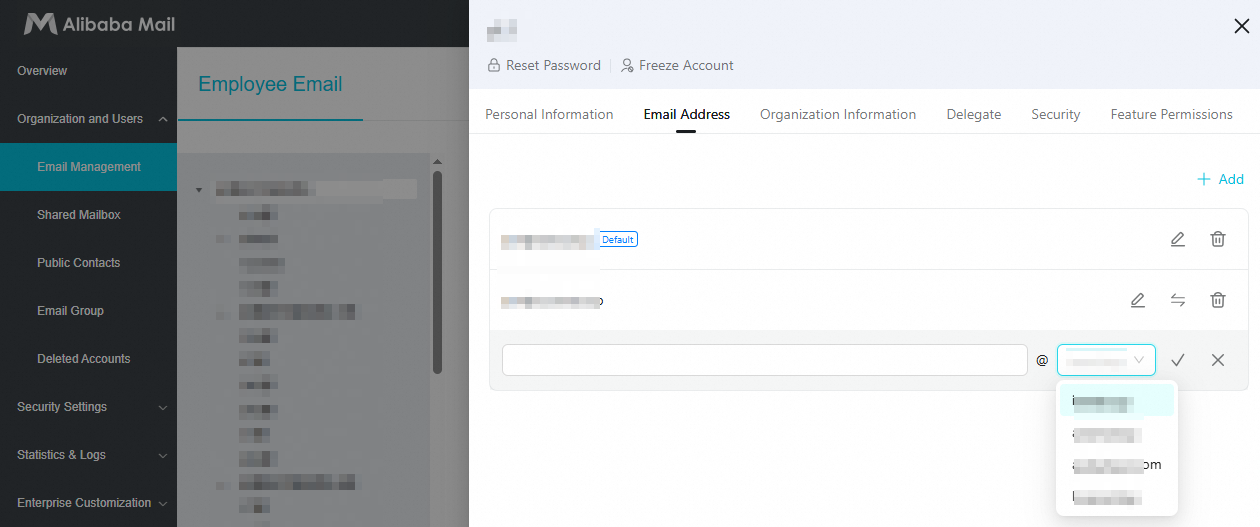
If the primary domain expires but the domain alias is still active, can I use the domain alias mailbox to send and receive emails?
No. When the primary domain expires, the sending and receiving functions of the associated domain alias mailboxes are affected, because domain alias delivery depends on the DNS (MX) resolution of the primary domain. We recommend that you renew the primary domain as soon as possible and confirm that the DNS records take effect, or replace the primary domain by following the steps for swapping the primary domain described earlier in this topic.
How do I configure a domain alias in a third-party email client (such as Foxmail)?
A domain alias must pass DNS verification (CNAME, MX, and TXT records) before you can use it to sign in to a third-party client for sending and receiving emails. Until verification passes, you cannot sign in to IMAP or SMTP using the domain alias address.
The IMAP and SMTP server addresses are the same as those for the primary domain:
Incoming server:
imap.qiye.aliyun.com, SSL port 993Outgoing server:
smtp.qiye.aliyun.com, SSL port 465
The SMTP sending address must match the authenticated account. If you authenticate using the primary domain address, you cannot set the sending address to a domain alias address.
Multiple domains
Definition: Multiple domains are distinct primary domains (the part after the @ symbol) that you can choose from when creating an email account. To link accounts across these domains to the same mailbox, you must manually create an alias account for each employee.
Use case: An enterprise owns both
example.netandexample1.net. An administrator can add both as separate domains. When creating new email accounts, the administrator can choose to use either@example.netor@example1.net.Key characteristics:
When configured with an alias account,
user@example.netanduser@example1.netcan access the same mailbox.The maximum number of domains you can add is based on the number of paid accounts. This feature is not available for the free email service.
Domain alias
Definition: A domain alias is an alternate name mapped to a primary domain. Every user under the primary domain automatically receives a corresponding alias with the new domain name.
Use case: The primary domain is
example.net, and you addexample1.netas a domain alias. Signing in touser@example.netanduser@example1.netwill access the same mailbox.Key characteristics:
All users under the primary domain can send and receive emails using the domain alias.
You can add up to 6 domain aliases for each primary domain. This feature is not available for the free email service.