By Ken Meng
AI Agents now touch production—service, ops, risk, O&M. Yet models that reason still can't see the business as it happens.
Orders, payments, behavior, alerts, telemetry—all change by the second, scattered across queues, databases, and object storage with mismatched schemas. An Agent stuck on a static knowledge base can't answer "what just happened," "who's affected," "what next."
Turning live events into data Agents can understand, query, and invoke is now table stakes. EventHouse is built for this: EventBridge's cloud-native event lakehouse, unifying ingestion, governance, analysis, and Agent invocation in one Serverless service—closing the loop from Data-to-Data to Data-to-Agent.
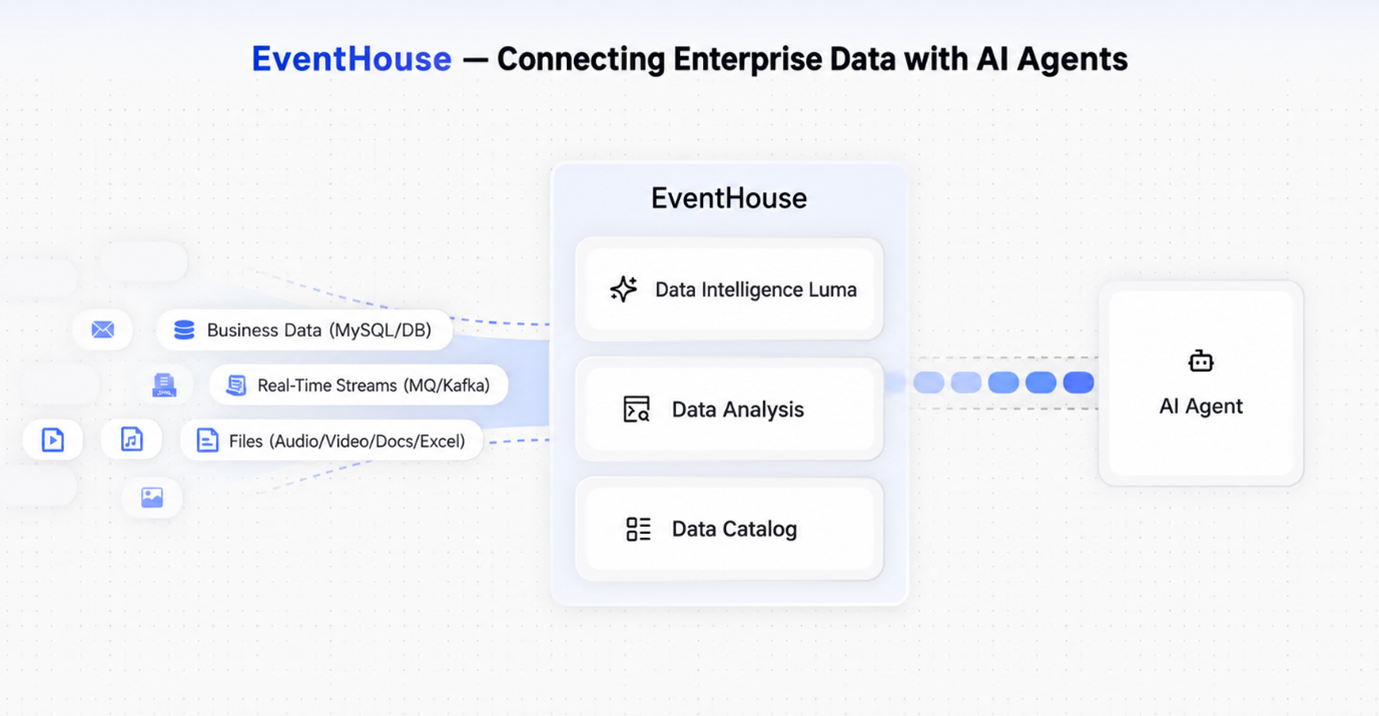
It abstracts structured, semi-structured, and unstructured data from Kafka, RocketMQ, MySQL, and OSS into a standard event model, then puts it to work through three layers: Catalog, Analysis, Luma.
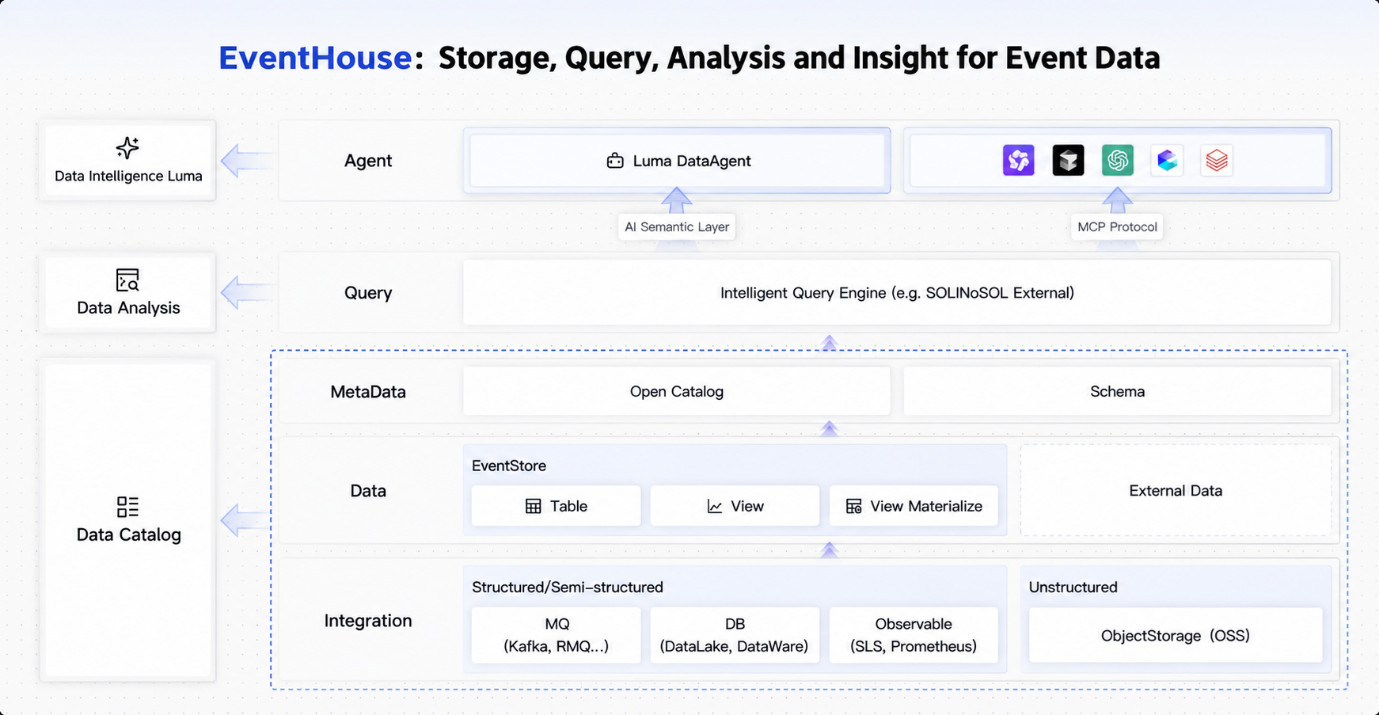
Most enterprises don't lack data—they lack a map of where it lives, what it means, and how it connects.
Catalog auto-discovers metadata across sources and manages schemas, permissions, and lineage in one place. Upstream schema changes are versioned automatically; when anomalies hit, engineers trace an event along its lineage through production, storage, and analysis.
It speaks open table formats—Iceberg, Hudi, Delta Lake—with access control down to the column. Keep your storage and compute; no rip-and-replace.
Once governed, Analysis queries live events and history in one place—Kafka and RocketMQ streams, plus federated queries over MySQL, PostgreSQL, and Elasticsearch.
One SQL serves live streams and archived data alike. Federated joins span RDS dimension tables and OSS logs—no copying, filters pushed to the source.
Materialized views precompute hot queries for millisecond answers. Columnar compression cuts JSON and CloudEvents storage over 50% versus traditional databases. Storage and compute scale independently.
The old contradiction ends: events arrive in milliseconds; analysis no longer waits on batch sync.
Luma is the AI-native analysis layer. Ask in plain language; it finds the right tables and fields, generates and validates the SQL, runs it, returns the answer.
General models can write SQL but don't know your fields. Is status_code = 4 a failed payment, a closed order, or a manual cancellation? No way to know.
The semantic layer lets you attach business descriptions, synonyms, and computed logic to fields. The Data Agent uses them to explore, generate, self-repair, and execute. Missing a time range or metric? Luma asks before it guesses.
An operator asks, "Any order-brushing in the last 30 minutes?" Luma finds the transaction tables and behavior logs, builds a correlated query across time, IP, and device, and returns suspect accounts with evidence.
Luma also exposes data over MCP, so your own Agents can query live business data within scope.
Picture e-commerce monitoring: orders in RocketMQ, profiles in MySQL, gateway logs in OSS. The old way queries each separately and joins by hand—ad-hoc questions queue behind the data team.
With EventHouse, Catalog registers all three. Analysis computes success rate and latency over live windows; the rule engine alerts when failed orders spike. Analysts correlate orders, users, and logs to pin the cause to a channel, a region, or a bad deploy.
A business user asks, "Which channel's payment failures grew fastest in the last ten minutes?" No tables or joins to memorize.
EventHouse goes generally available on July 23, 2026, pay-as-you-go.
Preview users: review your regions, data volume, query frequency, and budget now. See the EventBridge billing docs for pricing and rules.
Sound familiar? EventHouse is the real-time, unified, governable data foundation your Agents need:
• Dormant data: piled up at scale, still hard to analyze;
• Lagging pipelines: cross-source queries on brittle ETL; answers trail the business;
• Intelligence gap: Agents that need direct access to business data;
• High adoption barrier: unified, real-time, governed context—without the heavy lift.
Model Studio Gateway in Practice: Using RocketMQ LiteTopic to Cut the Throttling Ratio by 10×

776 posts | 60 followers
FollowAlibaba Cloud Native Community - May 9, 2026
Alibaba Cloud Native Community - June 4, 2026
Alibaba Cloud Native Community - May 18, 2026
Justin See - March 13, 2026
Alibaba Cloud Native Community - July 4, 2025
Alibaba Cloud Native Community - March 19, 2026
776 posts | 60 followers
Follow EventBridge
EventBridge is a serverless event bus service that connects to Alibaba Cloud services, custom applications, and SaaS applications as a centralized hub.
Learn More ApsaraMQ for RocketMQ
ApsaraMQ for RocketMQ is a distributed message queue service that supports reliable message-based asynchronous communication among microservices, distributed systems, and serverless applications.
Learn More Function Compute
Alibaba Cloud Function Compute is a fully-managed event-driven compute service. It allows you to focus on writing and uploading code without the need to manage infrastructure such as servers.
Learn More Serverless Workflow
Visualization, O&M-free orchestration, and Coordination of Stateful Application Scenarios
Learn MoreMore Posts by Alibaba Cloud Native Community

