In the rapidly evolving landscape of enterprise technology, particularly with the explosion of Generative AI, a significant gap often exists between a cloud provider’s cutting-edge capabilities and a customer’s ability to actually implement them. Enterprises do not just need architecture diagrams; they need working, deployed solutions tailored to their unique, messy, real-world environments.
Here comes the Forward Deployed Engineer (FDE).
Need for Forward Deployment Engineer
For a hyperscalar cloud provider like Alibaba Cloud, the Forward Deployment Engineering team represents a critical evolution in how cloud and AI services are delivered. An FDE is a technical engineer who works directly with customers to solve their real-world problems, adapting, integrating, and building software specifically for the customer's environment. Sitting at the intersection of Software Engineering, Solutions Architecture, Consulting, and Customer Success, the Alibaba Cloud FDE ensures that the immense power of the Alibaba Cloud AI stack is not just theoretically available, but practically operationalized.
What an Alibaba Cloud FDE Typically Does
The role of an FDE at Alibaba Cloud goes far beyond traditional technical support or sales engineering. They are embedded in the customer’s journey, executing five core responsibilities:
1. Understand the Customer's Problem
FDEs work directly with customer business and technical stakeholders. They do not just listen to technical requests; they dig into the underlying business objectives. Whether a logistics company wants to optimize routing using AI or a financial institution needs automated compliance checking, the FDE translates these complex business requirements into actionable technical solutions using Alibaba Cloud services.
2. Build and Customize
Unlike traditional support engineers who only troubleshoot, FDEs write production-quality code. They build custom integrations, APIs, AI agents, and data workflows. They adapt Alibaba Cloud’s foundational models and platforms to fit seamlessly into the customer's existing infrastructure, writing the "glue code" that makes disparate systems communicate.
3. Deploy in the Customer's Environment
Enterprise environments are rarely greenfield. They are complex hybrid ecosystems. The FDE works directly inside the customer's AWS, Azure, on-premises, or hybrid environments (often connected via Alibaba Cloud’s Cloud Enterprise Network). They handle the gritty details: configuring Virtual Private Clouds (VPC), setting up Resource Access Management (RAM) for security, building data pipelines, and ensuring observability.
4. Rapidly Prototype to Production
Speed is critical in AI adoption. An FDE will build an initial proof of concept (PoC) in days, not months. They iterate rapidly with the customer, refining the prompts, adjusting the retrieval-augmented generation (RAG) pipelines, and once validated, they harden the prototype into a reliable, scalable production system on Alibaba Cloud.
5. Solve Problems That Don't Fit the Standard Product
No cloud platform covers 100% of edge cases. When a customer's requirement falls outside the standard Alibaba Cloud console capabilities, the FDE develops custom workarounds or builds bespoke components. Crucially, they act as the voice of the customer, feeding these recurring requirements and product gaps back to Alibaba Cloud’s core engineering and product teams to influence the platform's roadmap.
The Alibaba Cloud AI Stack: The FDE’s Arsenal
To execute this mandate, an Alibaba Cloud FDE leverages one of the most comprehensive AI and cloud stacks in the industry. The FDE does not just recommend these tools; they configure, code against, and deploy them.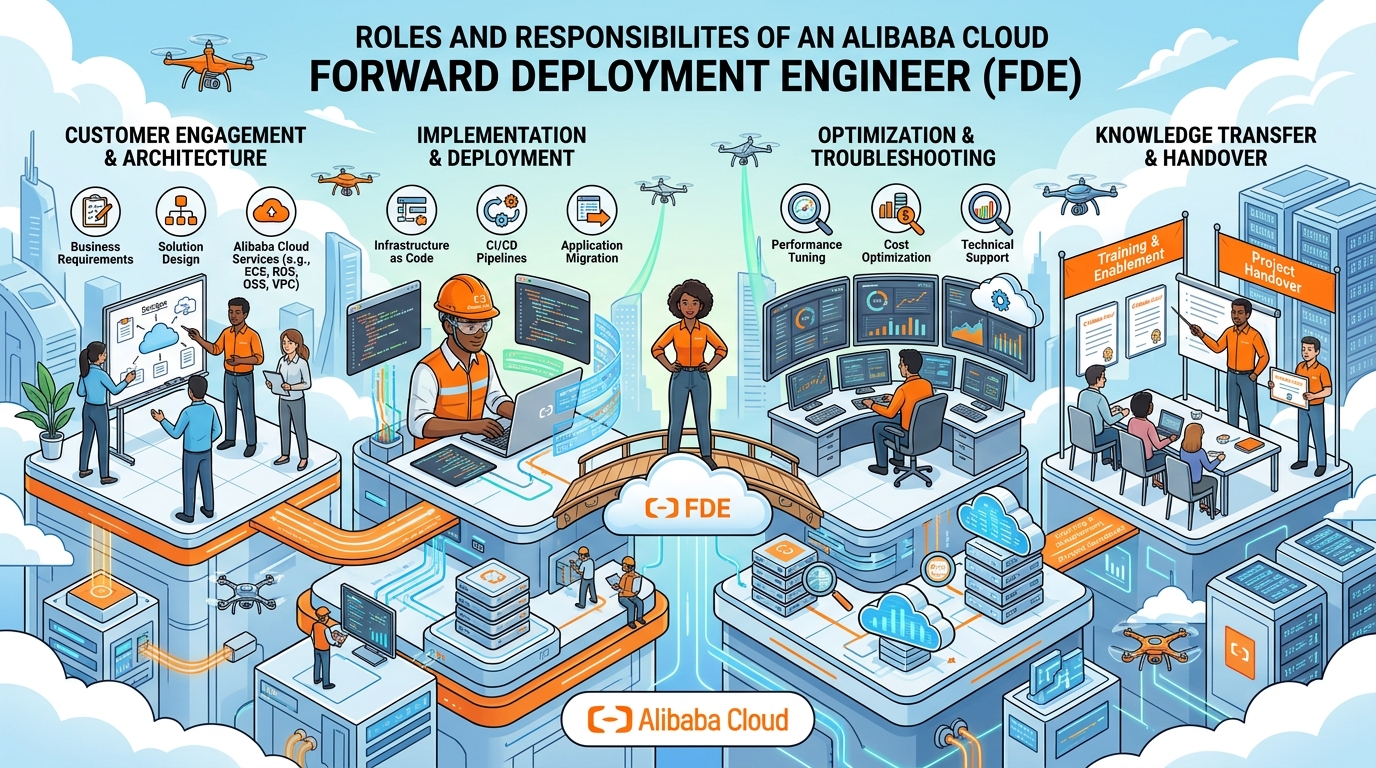
**Foundation Models and Orchestration:
Model Studio (Bailian) & Qwen**
At the heart of the AI stack is Alibaba Cloud Model Studio (Bailian) and the proprietary Qwen (Tongyi Qianwen) large language models. The FDE uses Model Studio to manage prompt engineering, orchestrate complex AI agents, and manage enterprise knowledge bases. They write the code to interact with the Qwen API, fine-tuning system prompts to ensure the AI adheres to the customer's specific corporate tone and compliance rules.
Machine Learning Operations: Platform for AI (PAI)
When off-the-shelf LLMs aren't enough, the FDE utilizes PAI. If a customer needs to fine-tune a model on proprietary data or deploy a custom computer vision model for manufacturing defect detection, the FDE uses PAI-Designer for visual workflow building, PAI-DSW for interactive coding, and PAI-EAS (Elastic Algorithm Service) to deploy the models as highly available, auto-scaling online services.
Data and Vector Infrastructure
AI is only as good as its data. For RAG applications, the FDE deploys AnalyticDB for PostgreSQL or PolarDB with their advanced vector search engines. They write the Python scripts to chunk customer documents, generate embeddings using Alibaba Cloud’s text embedding models, and ingest them into the vector database. For massive data processing, they build pipelines using MaxCompute and DataWorks.
Compute and Deployment
To host the custom applications, APIs, and agent orchestration layers, the FDE relies on Container Service for Kubernetes (ACK) for scalable microservices, Function Compute (FC) for event-driven serverless architectures, and Elastic Compute Service (ECS) for traditional workloads.
In Action: Solving a Real-World Customer Problem
To understand the true value of an Alibaba Cloud FDE, let’s look at a practical scenario.
The Customer: A massive global retail enterprise.
The Problem: "We want an internal AI agent that can search our thousands of supplier contracts, access our real-time inventory databases, and automatically draft responses to vendor support tickets. But our data is highly sensitive, spread across on-premises servers and multiple clouds, and we have zero internal AI engineering talent."
A traditional vendor might hand over a 50-page architecture document. An Alibaba Cloud FDE rolls up their sleeves and executes the following:
1. Requirements & Architecture:
The FDE workshops with the retail CIO and supply chain VPs. They determine that a hybrid-cloud approach is necessary to keep sensitive financial data on-premises while leveraging Alibaba Cloud's public AI compute.
2. Rapid Prototyping:
Within 48 hours, the FDE uses Model Studio to spin up a basic RAG prototype using the Qwen-Max model. They upload a sample of 50 supplier contracts, test the retrieval accuracy, and demonstrate a working chat interface to the stakeholders to prove the concept's viability.
3. Building and Customizing:
The FDE writes custom Python code using the Alibaba Cloud SDK. They build a secure API gateway to bridge the customer's on-premises inventory database with Alibaba Cloud. They write the orchestration logic that allows the AI agent to "call" the inventory database as a tool to check stock levels before drafting a vendor email.
4. Deploying in the Customer Environment:
This is where the FDE shines. They don't just deploy to a simple public cloud VPC. They configure Cloud Enterprise Network (CEN) to securely connect the customer's on-prem data center to Alibaba Cloud. They set up strict RAM policies so the AI agent only has read-access to specific inventory tables. They containerize the custom orchestration code and deploy it to the customer's dedicated ACK cluster. Finally, they integrate Simple Log Service (SLS) and CloudMonitor to track API latency, token usage, and hallucination rates.
5. Production and Feedback:
The system goes live. The FDE monitors the evaluation metrics, tweaking the chunking strategy in the vector database to improve retrieval accuracy. They notice that the customer frequently asks for a specific document parsing feature that Model Studio doesn't natively support yet. The FDE builds a temporary workaround using Function Compute and submits a detailed feature request to the Alibaba Cloud Model Studio product team.
FDE vs. Solutions Architect in the Alibaba Cloud Ecosystem
It is crucial to distinguish the Forward Deployed Engineer from the traditional Solutions Architect (SA) within the Alibaba Cloud organization. While both are highly technical and customer-facing, their outputs and daily realities are distinctly different.
| Area | Solutions Architect (SA) | Forward Deployed Engineer (FDE) |
|---|---|---|
| Customer Interaction | High (Pre-sales, design workshops) | Very High (Post-sales, embedded implementation) |
| Architecture | High (Designing the cloud topology) | High (Implementing the architecture in code) |
| Coding | Moderate (Scripts, diagrams, IaC) | High (Production Python/Java/Go, API integration) |
| Production Implementation | Sometimes (Handoff to customer/SI) | Core responsibility (Hands-on keyboard deployment) |
| Prototyping | Often (High-level PoCs) | Very frequent (Working, end-to-end functional PoCs) |
| Customer Environment | Advises from the outside | Works directly inside it (Hybrid, on-prem, multi-cloud) |
| Product Feedback | Some (Feature requests) | Strong feedback loop (Code-level insights to product teams) |
| Typical Output | Architecture design, Bill of Materials | Working, deployed, and monitored solution |
A simple distinction in the context of Alibaba Cloud:
Solutions Architect: "Here is how you should structure your VPC, configure your PAI clusters, and design your RAG pipeline using Qwen and AnalyticDB."
Forward Deployed Engineer: "Let's build it together. I'm writing the Terraform for your VPC, coding the RAG pipeline in Python, and deploying the Qwen agent to your ACK cluster right now."
Why the Role is Called "Forward Deployed"
The terminology "Forward Deployed" is borrowed from military and enterprise consulting lexicons. It signifies deploying engineers close to the customer and the problem, rather than keeping engineering entirely isolated inside Alibaba Cloud’s headquarters in Hangzhou or Beijing.
In the context of Alibaba Cloud, this is particularly vital. Alibaba Cloud serves a vast array of industries—from government and finance to manufacturing and retail. These enterprises are undergoing massive digital transformations and are eager to adopt AI, but they are hindered by legacy systems, strict compliance regimes, and a shortage of specialized AI talent.
By placing FDEs "forward" in these environments, Alibaba Cloud ensures that its sophisticated technology stack is not just sold, but successfully adopted. The FDE acts as a force multiplier, absorbing the complexity of the Alibaba Cloud AI stack so the customer can focus on their core business outcomes.
Conclusion
The advent of Generative AI has shifted the enterprise technology paradigm. It is no longer enough to provide powerful APIs and scalable compute; customers need guided, hands-on implementation to turn those capabilities into business value.
Forward Deployment Engineering using Alibaba Cloud represents the pinnacle of this customer-centric approach. By combining deep expertise in the Alibaba Cloud AI stack—from Qwen and Model Studio to PAI and AnalyticDB—with the grit and coding prowess of a seasoned software engineer, FDEs bridge the final mile of cloud adoption. They do not just design the future; they write the code, deploy the infrastructure, and build it directly inside the customer's world, ensuring that the promise of AI becomes a tangible, production-ready reality.
For consultation and queries, the author can be reached via email: ferdinjoe@gmail.com and via Linkedin.
Alibaba Developer - March 3, 2022
Alibaba Cloud Community - September 9, 2026
Alibaba Cloud Native Community - September 25, 2023
Community Builder - June 16, 2026
Alibaba Cloud Native - July 14, 2023
Alibaba F(x) Team - September 2, 2021
 Token Plan
Build more, spend less. One plan, every modality.
Learn More
Alibaba Cloud Model Studio
A one-stop generative AI platform to build intelligent applications that understand your business, based on Qwen model series such as Qwen-Max and other popular models
Learn More QwenWork
QwenWork is dedicated to helping employees strengthen their professional competitiveness in the AI era and to enabling enterprises to improve organizational effectiveness.
Learn More Architecture and Structure Design
Customized infrastructure to ensure high availability, scalability and high-performance
Learn MoreMore Posts by ferdinjoe


