In programming, there's a fundamental principle: declare what you need before using it. However, in Flink's early state management, you could "use as you go" - meaning states could be dynamically declared and used at any time. While this flexibility was convenient, it brought several challenges. FLIP-22 addresses these issues by proposing a more structured state declaration approach.
The current state declaration method is like "building a house as you walk." Programs can declare and use states anytime during runtime through getRuntimeContext().getState(descriptor). While this approach seems flexible, it introduces three major problems:
Imagine trying to upgrade a system without knowing the layout of all rooms - it would be a nightmare. Similarly, Flink only knows whether state migration or version upgrades are needed when states are declared. If states are declared dynamically, the entire process needs to pause for migration, which is far from elegant.
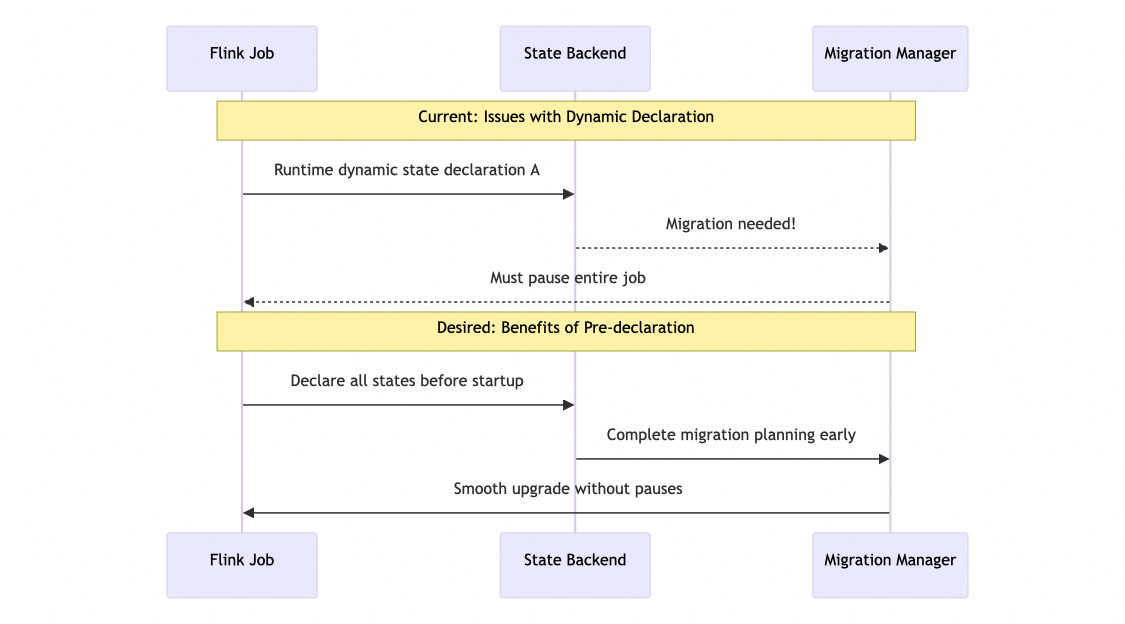
In the current design, a state can only be queried after it's registered in the keyed state registry. This means states restored from checkpoints cannot be queried until they are redeclared. It's like having a file but being unable to locate it until it's re-registered.
JobManager currently can't access complete state information, such as serialization methods or operator state distribution schemes. It's like headquarters being unclear about how branch offices operate, making it difficult to plan effectively.
FLIP-22 proposes a new state declaration approach with three main components:
This new approach requires declaring all states before job submission. Here's how it works:

This mechanism is implemented through:
To make code more concise and readable, FLIP-22 introduces annotations for state declaration:
// Keyed state declaration example
@KeyedState(
    stateId = "myPojoListStateId",
    queryableStateName = "myPojoListStateQueryHandle",
    typeSerializerFactory = MyPojoSerializerFactory.class
)
private ListState<MyPojo> pojoListState;

// Operator state declaration example
@OperatorState(
    stateId = "myPojoListStateId",
    redistributeMode = OperatorStateHandle.Mode.BROADCAST
)
private ListState<MyPojo> pojoOperatorState;
This approach not only makes the code clearer but also automates state initialization.
To ensure a smooth transition, existing dynamic declaration interfaces will be marked as deprecated but not immediately removed. It's like finding a better solution but providing a transition period rather than immediately demolishing the old structure.
The pre-declaration mechanism brings clear benefits, illustrated in this comparison:
| Feature | Old Approach | New Approach |
|---|---|---|
| State Migration | Requires job pause | Early planning, smooth execution |
| State Queries | Await redeclaration | Immediately available |
| State Management | Incomplete JobManager info | Global view, easier management |
| Code Organization | Scattered | Centralized, clear |
| Operations Efficiency | Reactive | Proactive |
This FLIP is still under community discussion. From the mailing list discussions, several concerns have emerged:
FLIP-22's state pre-declaration proposal is like drawing up blueprints before building a house. While it might seem less flexible than building at will, it makes the entire system more robust and maintainable.
Although the proposal is still under discussion and faces some technical challenges, its core principles - early planning and centralized management - are commendable. This improvement will enable new possibilities in Flink's state management, such as more powerful migration capabilities and enhanced query functionality.
Like all significant technical improvements, implementing this change requires finding the right balance between flexibility and maintainability. The ongoing discussions show that the community is carefully considering how to maintain Flink's powerful features while making the system more robust.
FLIP-23: Unified Model Serving Platform - An Interesting but Abandoned Attempt

213 posts | 60 followers
FollowApache Flink Community - May 26, 2025
Apache Flink Community - January 7, 2025
Apache Flink Community - September 18, 2026
Apache Flink Community - January 31, 2024
Apache Flink Community - October 15, 2025
Apache Flink Community - August 21, 2025
213 posts | 60 followers
Follow Realtime Compute for Apache Flink
Realtime Compute for Apache Flink offers a highly integrated platform for real-time data processing, which optimizes the computing of Apache Flink.
Learn More Big Data Consulting for Data Technology Solution
Alibaba Cloud provides big data consulting services to help enterprises leverage advanced data technology.
Learn More Big Data Consulting Services for Retail Solution
Alibaba Cloud experts provide retailers with a lightweight and customized big data consulting service to help you assess your big data maturity and plan your big data journey.
Learn More .COM Domain
Limited Offer! Only $4.90/1st Year for New Users.
Learn MoreMore Posts by Apache Flink Community

