This is Technical Insights Series by Perry Ma | Product Lead, Real-time Compute for Apache Flink at Alibaba Cloud.
Imagine an alarm system: sometimes you want to wake up at a fixed time (like 7 AM), sometimes after a specific duration (like 8 hours), and sometimes when there's enough sunlight. In daily life, these wake-up conditions can be freely combined - like "ring at 7 AM or after 8 hours of sleep, whichever comes first."
Triggers in Flink are like such an alarm system, determining when to process data. Unfortunately, the triggers at that time weren't as flexible - they couldn't combine multiple conditions like an alarm clock. FLIP-9 aimed to solve this problem, making trigger rule writing as simple and intuitive as setting an alarm. However, this proposal was ultimately shelved - why?

These triggers were usable but had two obvious limitations:
Like an alarm clock that can only set either "fixed time" or "timer" alarms, but not "ring at fixed time or when timer expires, whichever comes first." In Flink, you couldn't combine conditions like "data accumulates to a certain amount" and "reaches a certain time point."
Suppose the alarm rang but you didn't wake up - should it keep ringing or wait for the next time? Similarly with delayed data. While the system allowed setting a wait time, you couldn't specify special handling rules for these "late" arrivals. It's like not being able to set a rule like "if I don't wake up the first time, ring every 5 minutes until I do."
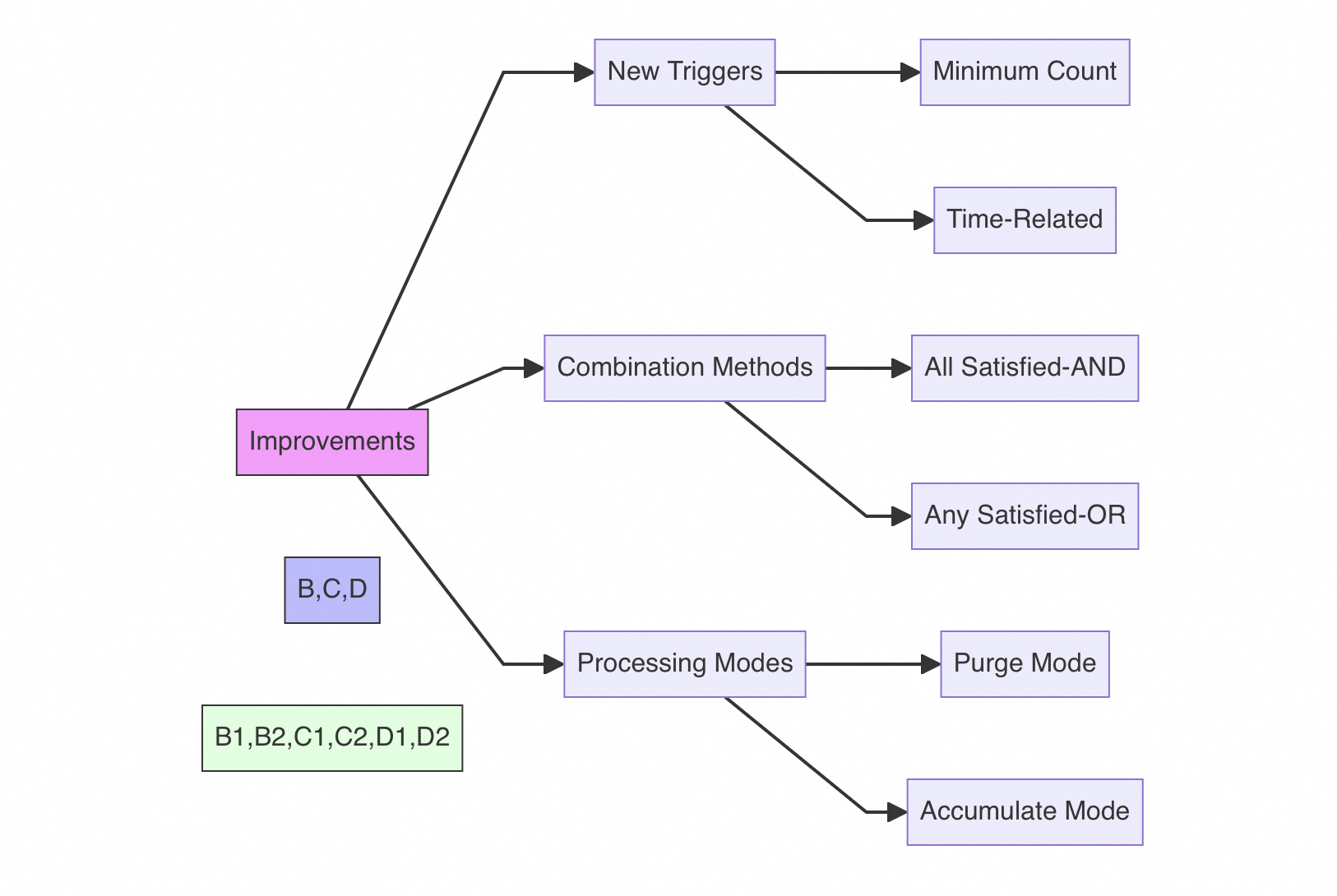
FLIP-9 proposed a more flexible approach:
New Basic Triggers:
Combination Methods:
Two Processing Modes:
This proposal was ultimately shelved for several main reasons:
The case of FLIP-9 shows that some ideas, while looking good on paper, might face unexpected difficulties in implementation. Sometimes, keeping things simple is the wiser choice. Although this proposal wasn't adopted, the problems it discussed and the decision-making process provided good references for subsequent improvements.
If you're using Flink now, you can implement special trigger requirements through custom triggers. While this might require writing more code, it's actually more flexible and easier to understand and maintain.
Mastering Flink State Scaling: FLIP-8 Non-Partitioned State Management for Distributed Systems
Apache Flink FLIP-10: Complete Guide to Unified Checkpoints and Savepoints

213 posts | 60 followers
FollowApache Flink Community - August 4, 2021
Apache Flink Community - September 1, 2025
Apache Flink Community China - February 19, 2021
Apache Flink Community - April 17, 2024
Apache Flink Community - April 18, 2024
Apache Flink Community - April 10, 2025
213 posts | 60 followers
Follow Realtime Compute for Apache Flink
Realtime Compute for Apache Flink offers a highly integrated platform for real-time data processing, which optimizes the computing of Apache Flink.
Learn More Big Data Consulting for Data Technology Solution
Alibaba Cloud provides big data consulting services to help enterprises leverage advanced data technology.
Learn More Big Data Consulting Services for Retail Solution
Alibaba Cloud experts provide retailers with a lightweight and customized big data consulting service to help you assess your big data maturity and plan your big data journey.
Learn More MaxCompute
Conduct large-scale data warehousing with MaxCompute
Learn MoreMore Posts by Apache Flink Community

