Enterprises Have AI Assistants Now. Why Are Office Workers Still So Drained?
By Alibaba Cloud AIDBS
1. AI takes part in the analysis, but humans still carry the work forward
"Why did this metric drop recently? Break it down by region and category, and let's see how we should adjust next."
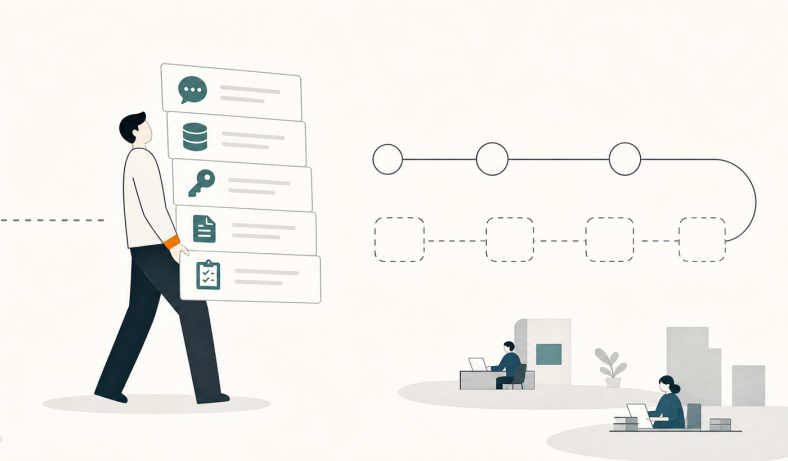
This line comes from a real task we handled recently. Taken on its own, AI can already write SQL, run the spreadsheet, and summarize the data. In practice, though, humans still do the heavy lifting. We scroll back through group chats to confirm the metric, dig through documents to check the rules, and ask the data team which table to query and how to request access. We then format what we find into inputs the AI can understand, wait for the analysis, and check every output line by line. Even then the job is only half done — we still have to write it up, communicate it, and follow up.
Enterprises have no shortage of AI assistants, yet the work still gets sliced into fragments — messages, rules, data, permissions, and AI each sit in their own silo, and humans end up carrying context back and forth between systems. First we turn group chats, documents, and data into tasks the Agent can execute, then push its conclusions back out into documents, resources, and follow-up tasks. This is exactly the blind spot in many AI projects: we tend to judge AI by its accuracy and tool count, but those only measure whether it can "solve a problem" — not whether it can "carry a piece of work forward." The boundary between the two is not the same.
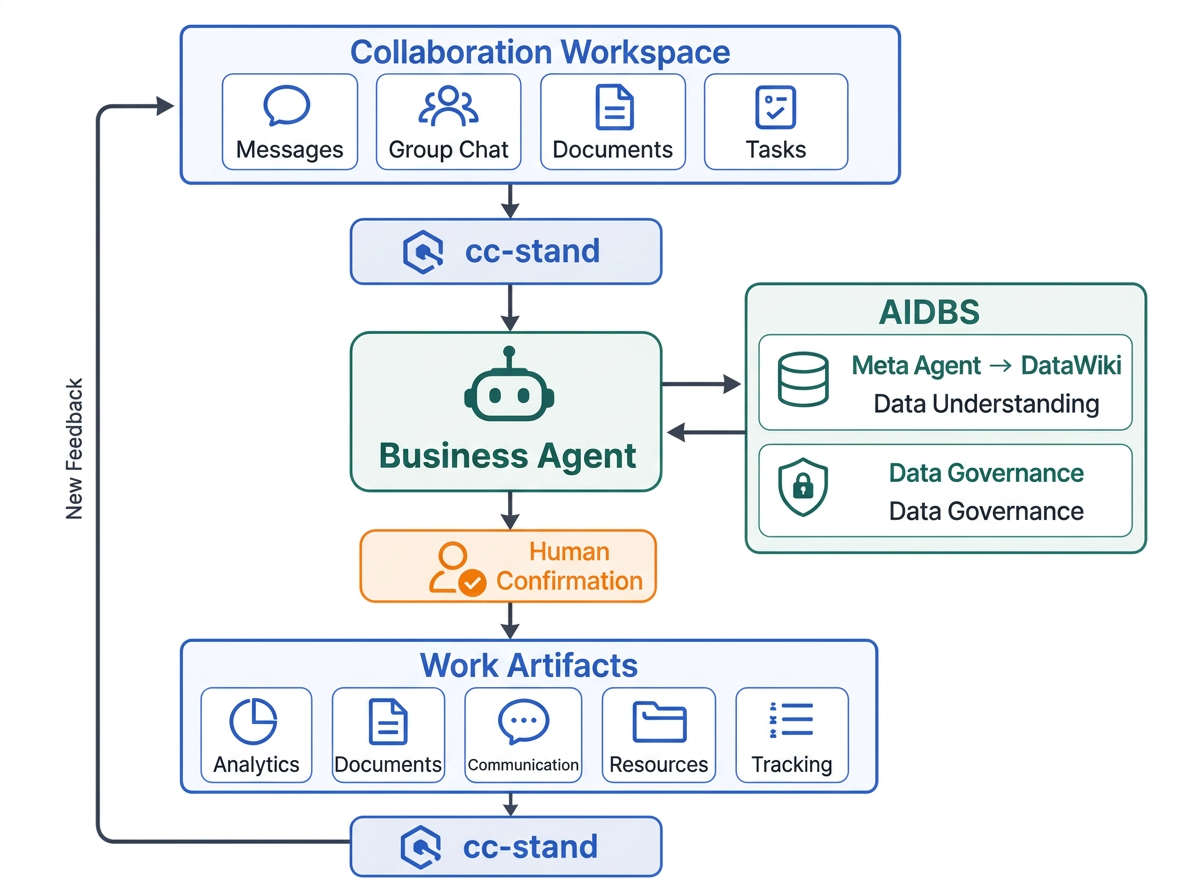
Alibaba Cloud AI-Native Database Service (AIDBS) is designed to answer the latter. It lets the Agent: 1. Truly understand enterprise data. 2. Use that data safely within the boundaries of identity, permissions, and audit. The former is handled by Meta Agent, which maintains the enterprise's semantic knowledge. The latter relies on the Agent Data Gateway to govern access. Combined with collaboration tools that handle message and task flow, only then can the agent carry a piece of work all the way through.
2. Solving a problem ≠ carrying work forward
A conversation usually starts with a question and ends with an answer, but a piece of work has a much longer life cycle:
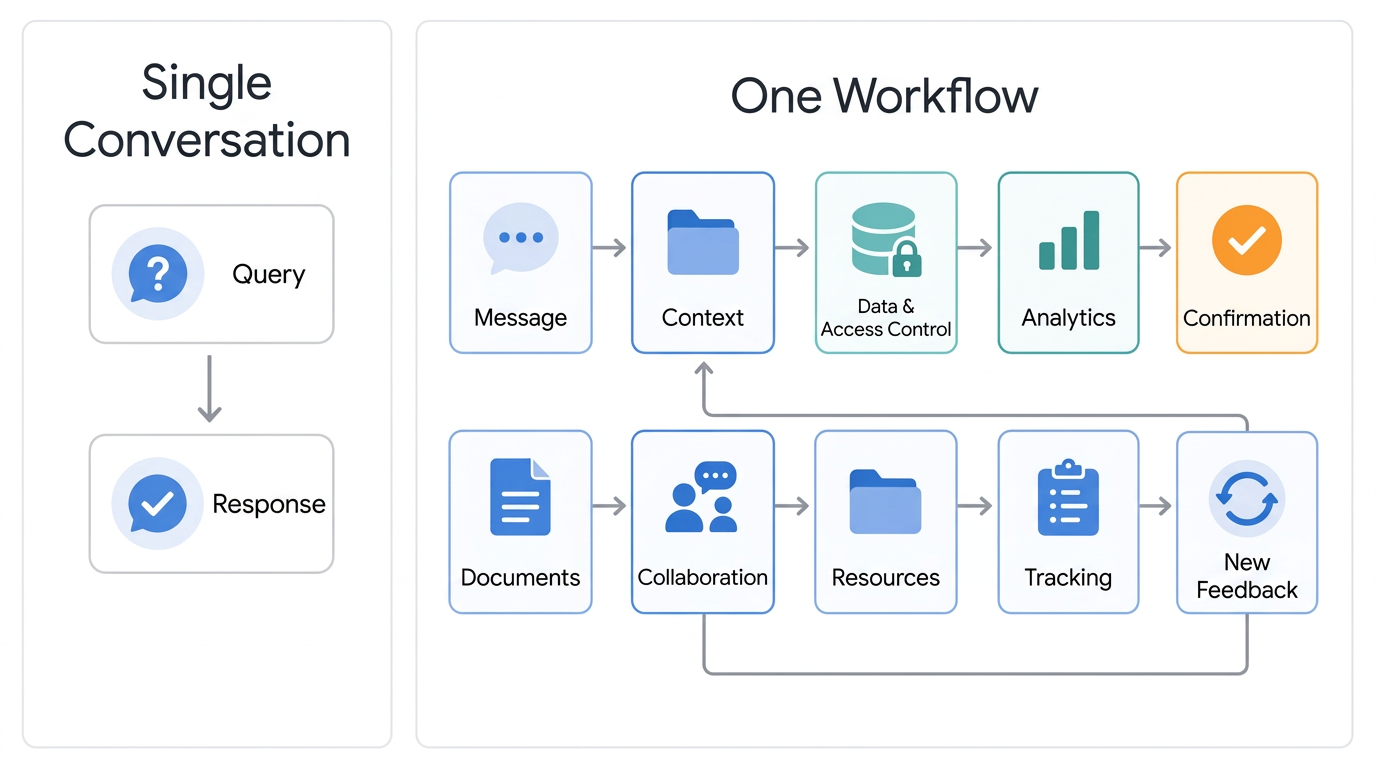
If any one of these steps needs a human to reorganize the information, the work falls back to a manual handoff. The Agent can read the group messages, but it can't tell whether a given sentence counts as a task. It can generate SQL, but it doesn't understand the company's internal metric definitions. Even when it finds the right data, it may not have the identity or permissions the task requires. And once it produces a recommendation, it still has to decide who should receive it, what's safe to send, and what must be confirmed by a human.
Models can already complete the analysis. What's missing is a mechanism to keep the work running. The enterprise AI Native approach that AIDBS represents reorganizes the work's context, data, permissions, and collaboration into a single task: the Agent keeps executing based on confirmed conclusions, while business judgment, authorization, and accountability stay with people. Where a task starts determines who is left carrying the work forward.
3. Letting the Agent directly involves in the workplace
Much of the work inside an enterprise doesn't begin as a structured task. It begins as a group chat message: the background sits in earlier discussion, the materials are scattered across documents and message history, and the follow-up conversation loops back to DingTalk.
Since DingTalk is already the first place where the work happens, we let the Agent start from the group message. That's different from adding a group bot or bringing in a new "role-based agent": a bot is a new communication node, and a role-based agent is a new execution entity. We call this third form a "digital stand-in": the Agent reads the person's own work context and acts on their behalf within an authorized scope, while the final wording, commitment, and responsibility still belong to that person.
Around this approach we built cc-stand and open-sourced it: a collaboration tool connecting DingTalk, Lark, and the Agent. In this task, cc-stand reads the group messages, citations, and context according to preset strategies, and decides whether this is an ordinary discussion or a task that needs handling. Once confirmed, it organizes the relevant information into inputs the Agent can execute, and records four things: who asked, what materials are needed, where the result should go, and who signs off on it. Task identification and context filtering no longer live only in the assignee's head.
After reading the message, the Agent will confirm the metric definitions, query the data, break down the changes, determine the root cause, and form adjustment recommendations based on the existing rules.
4. First understand how the enterprise uses data
There's no natural correspondence between the table and field names in a database and a sentence in natural language. The same "deal" might be counted as an order placed, a payment made, or an order completed. The same "region" might be defined by user location, merchant affiliation, or organizational zone. Even a word as clear as "recent" might mean calendar days, business days, or a particular campaign period. Throw these straight at a large model, and the Agent easily produces an analysis that is logically complete but unusable in business terms — it may not have done the math wrong, it simply misunderstood the question from the very first step.
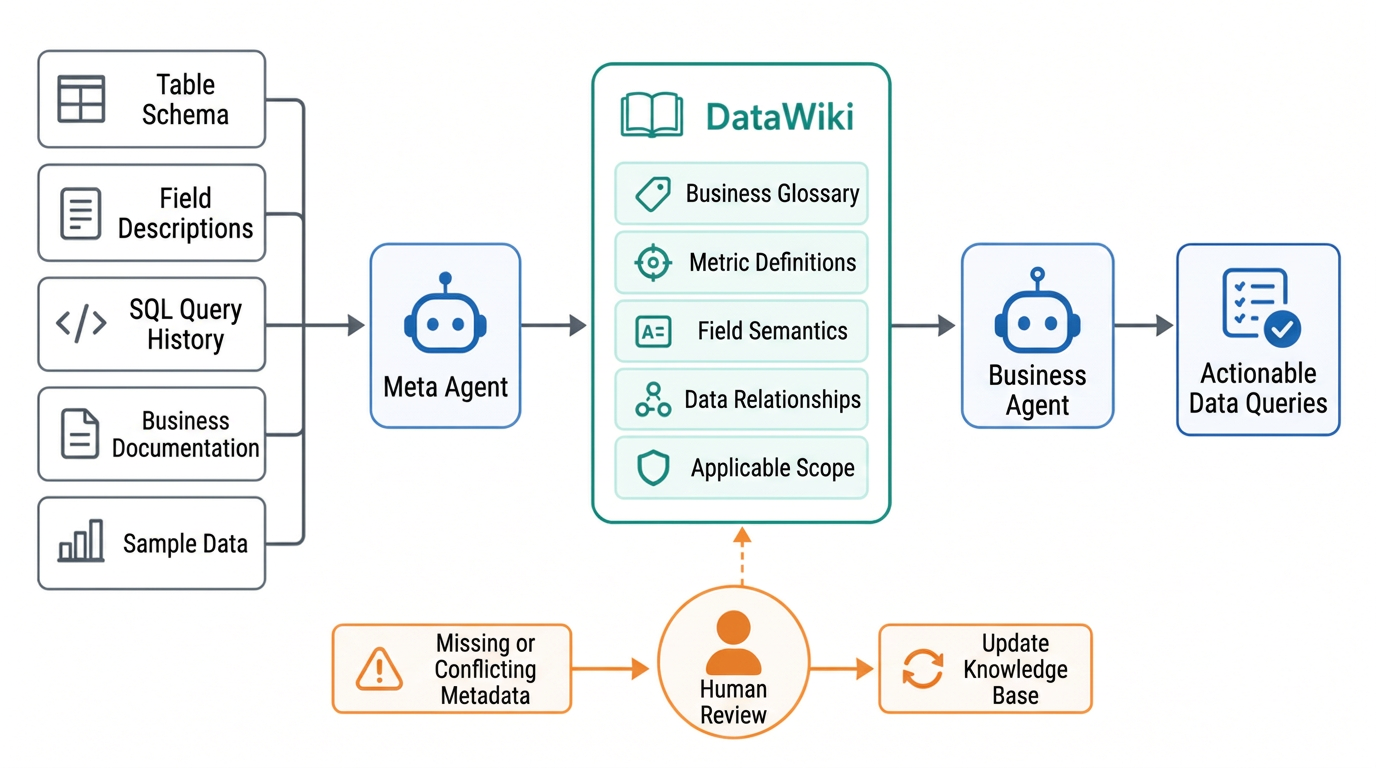
AIDBS solves this problem with the Meta Agent. Built for data asset management, the Meta Agent extracts data knowledge from table schemas, field descriptions, historical SQL, business documents, and sample data, and it continuously maintains the DataWiki — recording the business glossary, metric algorithms, field mappings, and data relationships, along with the applicable time windows and rule versions. Before any analysis, the business Agent queries this knowledge first, then maps a natural-language question into executable data objects.
Back to this task: the Agent first aligned the metric definitions, the aggregation period, the relationship between region and category, and the anomalies to exclude, before it started generating the query and analysis steps. There's an important boundary here: the DataWiki does not invent metric definitions on behalf of the business users. Confirmed knowledge is cited directly. When something is missing or conflicting, a person confirms it and adds it into the DataWiki, keeping the source and the scope of application. The Agent shouldn't have to re-guess the enterprise's definitions from scratch every time it runs an analysis.
But understanding correctly only solves the problem of "whether it knows." The next question is: is it allowed to use this data?
5. Understanding data ≠ being able to use it
In a manual process, data permissions usually exist as a cycle of requesting, exporting, and handing off: a business user asks a question, the data team confirms the scope, and the result is handed back. Once the Agent starts using enterprise data directly, this kind of manual handoff can hardly carry all the control anymore.
The Agent Data Gateway in AIDBS handles all of the Agent's data queries in one place. Instead of borrowing a shared account to query all the data, the Agent has an identity of its own. Its actual access scope is bound by a threefold constraint — Agent permissions, requester permissions, and task scope — and if any one of them isn't met, the system won't grant access. So the same business question maps to the same set of metric definitions no matter which Agent handles it; change the requester, and the data they can see may differ.
The data gateway also handles data masking, approval, and audit. When only a regional summary is needed, the Agent has no reason to read finer-grained sensitive fields. When a drill-down exceeds current permissions, the system pauses and enters an authorization flow. And after the task is done, everything is traceable — who accessed which data, under what identity, and what operations they performed. None of this produces a conclusion directly, but it decides whether the Agent can use data in the enterprise stably over the long run, instead of relying on manual exports and judgment every single time.
Only after the data semantics and access boundaries are settled can the Agent complete the follow-up queries, dimension breakdown, and root-cause analysis, and generate an adjustment plan with evidence and items pending confirmation. The answer is ready, but the work is far from over.
6. Finishing the analysis is only half the work
We first confirm the analytical conclusion, the direction of adjustment, who to communicate with, and the scope the Agent may keep executing in. Once confirmed, the Agent writes the analysis process, metric definitions, key evidence, and adjustment recommendations into a DingTalk document, and cc-stand distributes it by role: the person who asked sees the conclusion and the evidence, the regional or category owner focuses on the changes within their own scope, and the upstream and downstream teams need to know why resources are being requested and what they're being asked to help with. Based on this, the Agent raises the resource request, fills in the materials, and keeps tracking it. When new feedback comes in, it's put back into the current task together with the original analysis, documents, and unfinished items, and the Agent decides the next step.
But the automation here is not unlimited authorization. For confirmed recipients, information scope, and task actions, it can run automatically. The moment it touches a new budget, a change in resource priority, a new collaborator, or a new commitment to another team, the system stops and asks a human to confirm. Drawing the boundary of automation isn't just about whether the Agent can do it — it's about whether the accountability for that step can be transferred.
7. To keep the work moving, the system must answer five questions
Looking back at this task, the system had to answer five concrete questions.
| Boundary | The questions this piece of work must answer |
|---|---|
| work cycle (session) | Does a piece of work end when the analysis is done, or does it continue until the documents, resources, and tasks reach a definite outcome? |
| context and memory (memory) | Where are the group chats, metric definitions, analytical evidence, communication records, and unfinished items stored, and when are they updated or invalidated? |
| identity and permissions (permission) | Under what identity does the Agent use the data, and how do requester permissions and task scope jointly restrict access? |
| message flow (message I/O) | Who reads the messages, triggers execution, and sends the result; which content can only be saved as a draft, and which can be formally sent per policy? |
| accountability (responsibility) | Who confirms the business conclusion, budget, priorities, and commitments, and where must the system pause? |
Together, these five questions decide how far the Agent can carry the work forward, and where it should stop. They aren't limited to data analysis: a product manager sorting out requirements, a salesperson preparing follow-up materials, a finance analyst explaining a metric fluctuation, a developer starting from an error log and moving into troubleshooting — the role changes, the object of the work changes, but data, permissions, collaboration, and accountability are always there.
8. Work moves forward, accountability stays human
Back to the opening question: if enterprises have AI assistants, why is the work still in human hands? Because although models can analyze, the work still has to be carried forward by people, and every handoff depends on a person. What the enterprise AI Native approach wants to reduce is exactly this repetition: after confirmation, the querying, organizing, sending, and tracking go to the Agent, while business judgment, budget, priorities, commitments, and final accountability still rest with people.
Here, the collaboration layer lets messages and context enter the Agent and lets confirmed results return to the documents and the people, while AIDBS lets the Agent understand enterprise data and use it safely within the boundaries of identity, permissions, data masking, and audit. AI assistants have proven that models can answer questions, but the way enterprises use AI only truly begins to change when the Agent can keep carrying the work forward within clear boundaries.
Learn more: https://www.alibabacloud.com/help/en/aidbs/user-guide/agent-gateway/
Try now: https://aidbs.console.aliyun.com/agent-gateway
Read previous post:
Read next post:

Comments
Related Products
-
 Qoder
From Assisted to Autonomous — Adapting to Every Programming Need
Learn More -
 QwenWork
 is dedicated to helping employees strengthen their professional competitiveness in the AI era and to enabling enterprises to improve organizational effectiveness.
Learn More -
 Token Plan
Build more, spend less. One plan, every modality.
Learn More -
 Wan3.0
Unleash Your Creativity Try Wan 3.0 now — longer narratives, greater control, endless creativity.
Learn More
More Posts by ApsaraDB
- Saying Goodbye to Write Stall: How Tair Serverless KV Keeps Latency Stable Under Extreme Write Pressure
- From Cloud Native to Agentic Native: PolarDB for PostgreSQL Rebuilds the Data Foundation for AI Agents
- Advanced Data Analytics in the AI Era: How Alibaba Cloud AIDBS Brings Specialized Models to Life
- Git for Your Database: PolarDB Lets Agents Experiment Safely
- AI Coding Context Keeps Getting More Expensive — Tair Built a Capability for That, and We Want You to Test It
- With PostgreSQL Firmly in Place as the Data Foundation, What Else Do Agents Need to Truly Run?
- The 6 Components of RAG, Actually Just Need 1 Database
- PolarDB-X Zero: Get an AI-Friendly Database in 30 Seconds with a Single Command
- HiCache Across Multi‑Parallelism and Distributed Serving