Advanced Data Analytics in the AI Era: How Alibaba Cloud AIDBS Brings Specialized Models to Life
1. Where Exactly Does Advanced Data Analytics Get Stuck?
The product team at a new energy vehicle maker sifts through a flood of owner feedback every week — after-sales tickets, social platforms, in-app suggestion boxes. The data itself isn't the hard part. The judgment calls behind it are: What are owners asking for most this week? Which complaints are one-offs, and which are turning into widespread problems? And which direction should the next OTA update tackle first?
The same pattern shows up in every corner of the business: sales is forecasting next quarter's trend for each vehicle model, the supply chain is mapping load curves across service nodes, and operations is gauging how fast a campaign will convert.
None of them want a post-mortem on "what happened." They want forward-looking judgment, backed by methods like topic modeling and time series forecasting — in other words, advanced data analytics.
For years, this kind of analysis belonged to only a handful of teams: it took a dedicated algorithm engineer, a separate GPU environment, and round after round of data cleansing and tuning, with a single run stretching into weeks. The AI era makes "writing code" look easy, but "getting it running, keeping it stable, making it pay off" is still a hurdle: weights to download, computing power to request, dependencies to untangle. The real cost lands in the second half of the job.
That is exactly the gap Alibaba Cloud AI-Native Database Service (AIDBS) sets out to close: we built Data Agent for Analytics — a data analytics agent — into the database service itself, so analytics grows right alongside your data.
Two built-in capabilities do the work: an out-of-the-box model operator service, plus version management that builds your own models into lasting assets. Together they take advanced data analytics out of the hands of a few specialist teams and make it an everyday capability any team can trigger with a single sentence of plain language.
2. What Is Data Agent for Analytics?
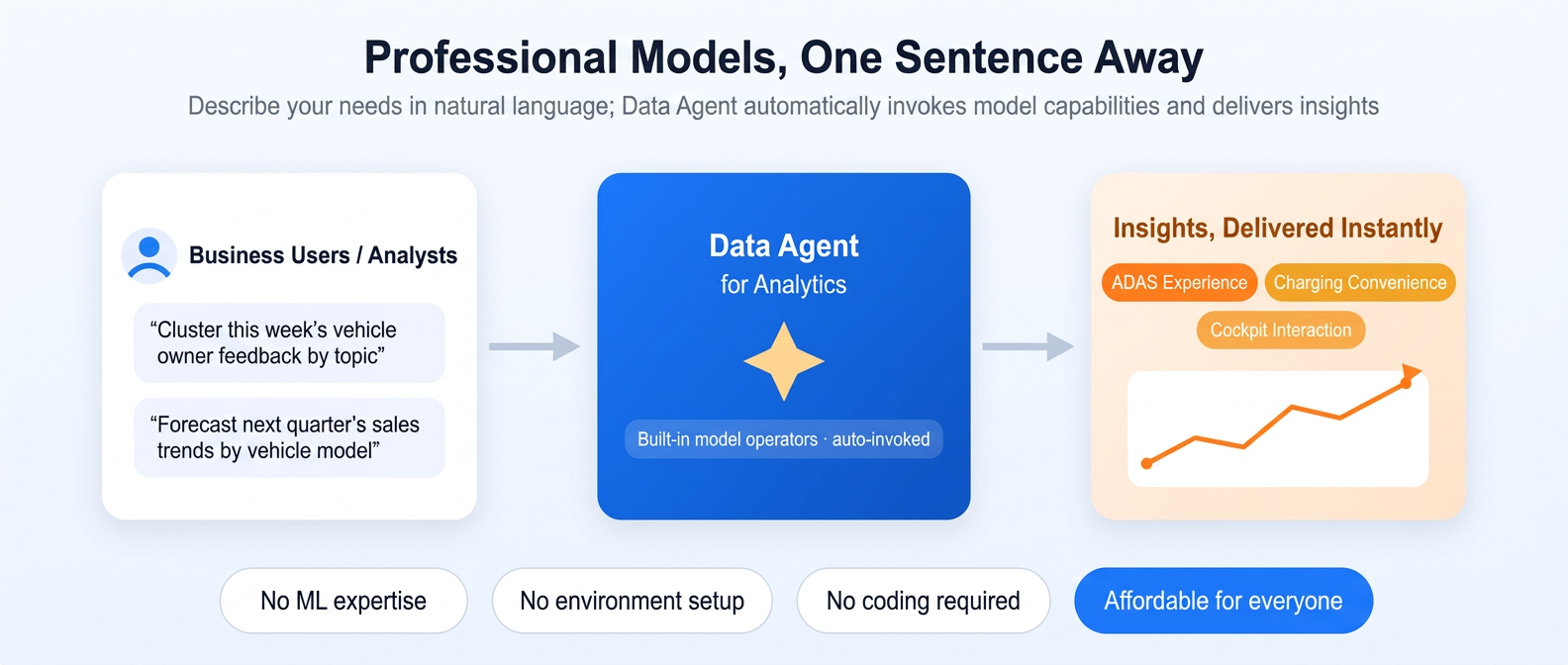
Data Agent for Analytics is the data analytics agent from Alibaba Cloud AIDBS — a natural-language-driven assistant for data analysis and insight.
It works in a straightforward way: you describe what you need, and the agent handles the whole chain — understanding the request, reading the data, breaking down the approach, invoking tools, producing results, and generating a report. You don't write SQL and you don't need Python. Just ask, "Show me last month's sales trend by region" or "Analyze why customers are churning," and the agent runs it end to end. It serves three roles:
• Business users use it to quickly generate reports on sales, user behavior, and more.
• Data analysts use it for exploratory analysis and data cleansing.
• Company leaders use it to get deep insight into key metrics.
For data sources, it connects seamlessly to RDS, PolarDB, AnalyticDB, MaxCompute, Hologres, and DMS managed instances, and also supports local CSV/Excel uploads — wherever your data lives, the analysis follows.
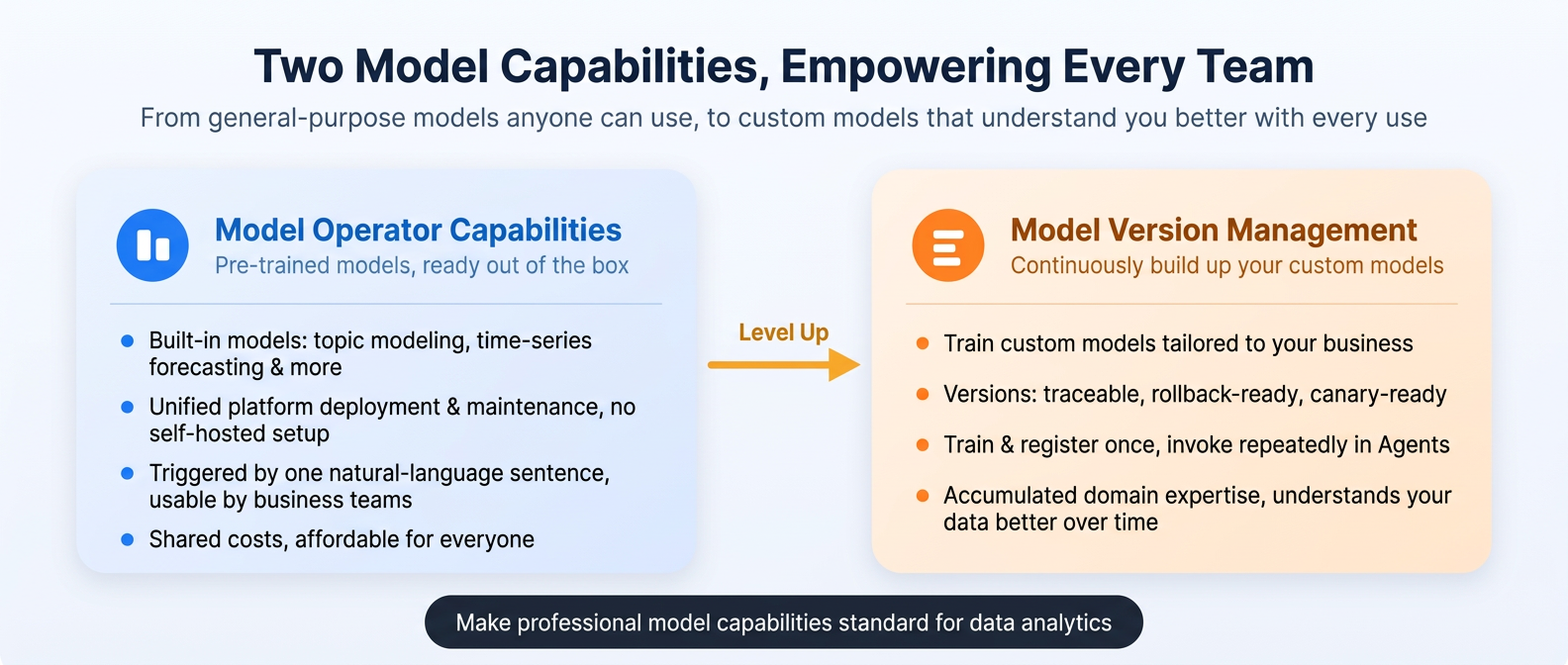
Once analysis moves beyond querying and viewing numbers into prediction and insight, SQL and basic statistics no longer suffice. So Data Agent distills advanced analytics into two built-in capabilities: a model operator service that puts general-purpose models within everyone's reach, and version management that lets enterprises build up models of their own. These two capabilities are also the most direct expression of AIDBS putting data and intelligence on one platform.
3. Model Operator Service: Specialized Models in One Sentence
Data Agent for Analytics turns advanced analytics such as topic modeling and time series forecasting into a model operator service built into the platform and ready out of the box. One sentence of plain language gets you analysis that used to require a specialist team.
Broadly speaking, Data Agent pairs large and small models: the LLM, strong at language understanding, interprets the request and explains the results, while the actual computation goes to specialized models such as BERTopic and TimesFM — each doing what it does best. That is the key difference from "making the LLM crunch the numbers": the results are both expert-grade and defensible.
In the past, every user's analysis session had to load its own copy of the model and take up its own slice of computing power. The more people used it, the higher the cost climbed, and idle models still tied up resources that could not be released. Over the long run, only a few large customers could afford the overhead of advanced analysis.
Now these models are delivered through one unified model operator service on the platform. You don't have to think about where a model is deployed or whether there is enough computing power — one sentence invokes it when needed, the platform spreads the cost, and everyone can afford it.
So what can this model operator service actually do?
• Topic modeling: automatically clusters massive volumes of unstructured text and identifies core topics and keywords, so user feedback insight, public opinion monitoring, and document classification no longer depend on people reading through entries one by one.
• Time series forecasting: projects future trends from historical data, works zero-shot, and covers scenarios such as sales forecasting, capacity planning, and anomaly detection.
Back to the carmaker we opened with. Automotive vertical platforms hold huge volumes of public owner reviews, and on top of those come social platforms and in-app suggestion boxes — easily thousands of comments at a time. The traditional approach is to put people on it, reading one comment after another and sorting them into categories: slow, and bound to miss things.
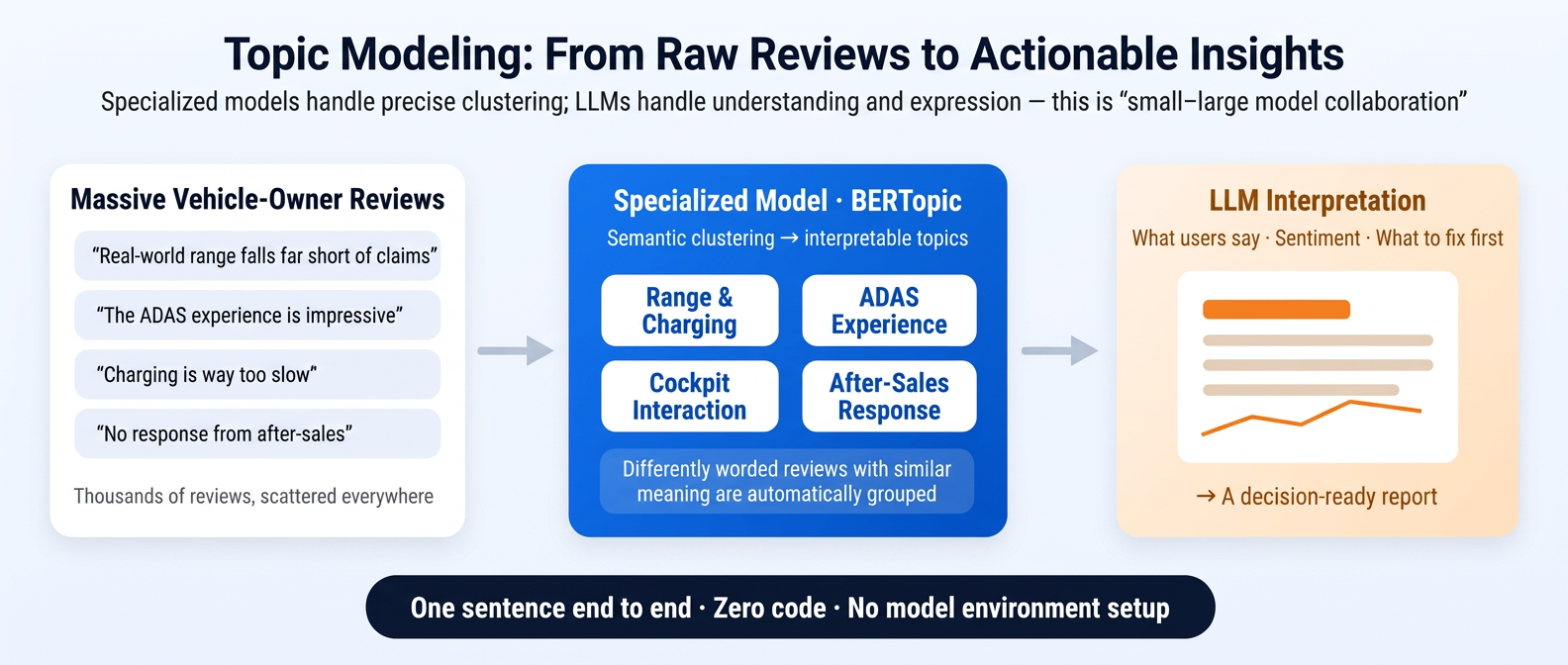
In Data Agent, it takes one sentence: "Show me what owners are mainly discussing and where the complaints cluster."
The topic modeling operator (BERTopic) first uses an embedding model to turn each review into a vector that captures its semantics, so reviews worded differently but meaning the same thing — "inflated range claims" and "it never hits the official mileage" — cluster together automatically. It then extracts representative keywords for each cluster, producing a set of semantically clear, explainable topics such as "range and charging," "assisted driving experience," "cockpit interaction," and "after-sales response." Scattered comments converge into a clear topic map.
The LLM then takes over. It works out what owners are actually saying under each topic, whether the sentiment is positive or negative, and what they are asking for, and writes it up in a report anyone can read: which topic dominates, which complaints are heating up, and what to fix first.
This is what pairing large and small models looks like in practice: the specialized vertical model handles precise clustering and distillation from massive text, and the LLM handles understanding and expression.
For the user, all of it comes down to one sentence — not a single line of code written, and no model environment touched.
In short, users get three solid gains:
• Truly no barrier to entry: no algorithm expertise and no code required — business users can run advanced analysis directly.
• Out of the box: the platform maintains and upgrades the capability centrally, so it's ready whenever you need it and results come faster.
• Secure isolation: each analysis runs in isolation, your data stays contained, and you can use the service with confidence.
4. Model Version Management: Building Your Own Models Over Time
The model operator service makes general-purpose capability available to everyone. But data differs by industry and by company: retail customer reviews and manufacturing quality-inspection tickets won't both get the best results from the same general-purpose model. What truly fits the business is usually a model the enterprise trains on its own data.
For this, Data Agent for Analytics brings in MLflow model version management, so the models customers train themselves can be governed properly and used reliably inside Data Agent.
Self-trained models used to scatter the moment training ended: versions strewn across different places with no telling new from old, reuse meaning rebuilding the environment from scratch, and regressions leaving no trail. Without a unified management mechanism, a hard-won model rarely becomes a durable asset.
Version management gives each of these problems an answer:
• Every training run is recorded automatically, with clear, searchable versions.
• Before a new model goes live, compare multiple versions and run canary validation, then roll out in full once it holds up.
• If live results disappoint, roll back to an earlier version with one click.
• Training results can be reused across the team again and again — register once, invoke anytime.
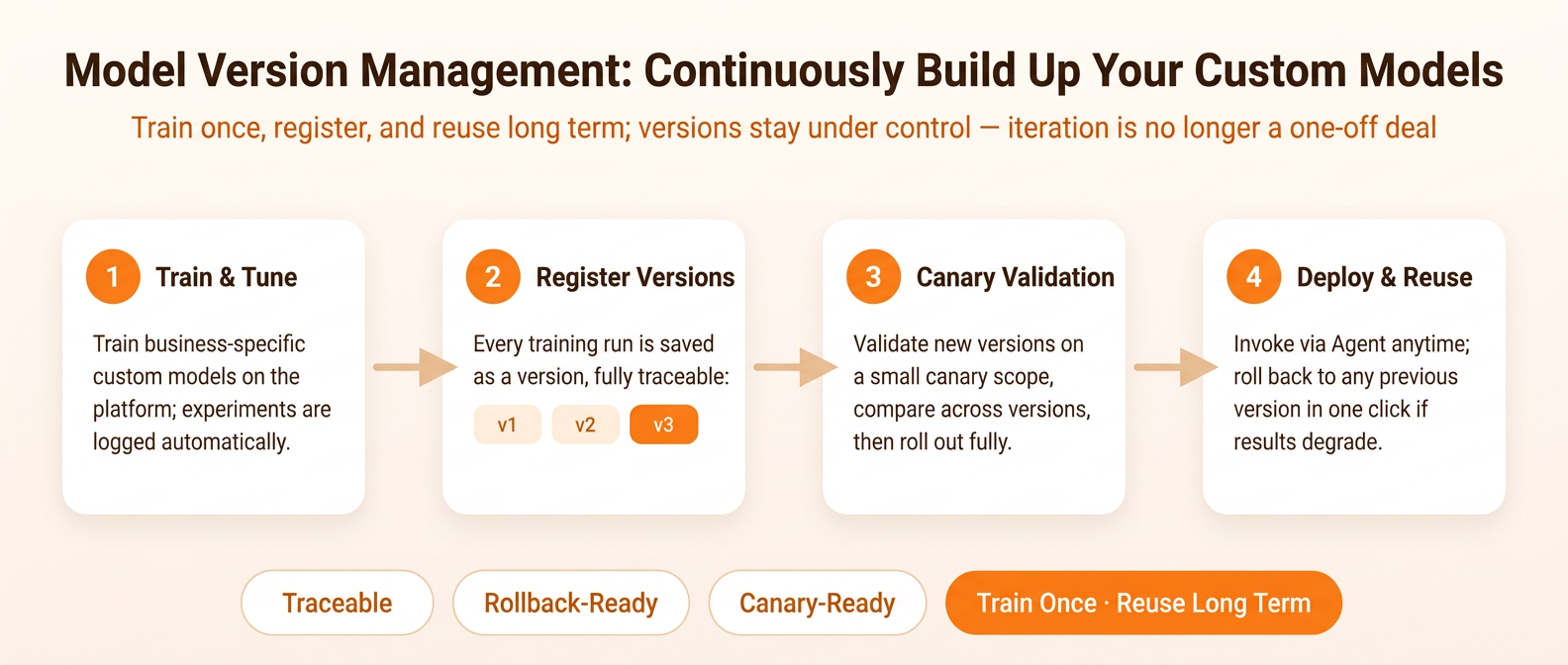
All told, enterprises gain three lasting benefits:
• Industry expertise accumulates. The team's understanding of the business is baked into the model, which knows your data better the more you use it.
• Versions can be traced, rolled back, and canary-tested, so model iteration is no longer a one-off deal.
• Train once, reuse for the long haul — every investment keeps paying back.
5. Making Specialized Models a Standard Part of Data Analytics
From the out-of-the-box model operator service to version management that builds up capabilities of your own, AIDBS Data Agent for Analytics is doing one thing: lowering the barrier to advanced data analytics and insight. Prediction and insight that once took a data scientist or an algorithm team now sit in the hands of every business user.
You don't need to know what a model depends on, where it runs, or whether computing power is sufficient. Want topic modeling? Run topic modeling. Want time series forecasting? Run time series forecasting. Want to use a model you trained yourself? Invoke it anytime.
One sentence, and advanced analysis is running.
This is what an AI-native database service is for: data and intelligence flowing naturally on one platform, analytics growing right alongside the data, within everyone's reach and everyone's budget.
Learn more about the product
🔗 https://www.alibabacloud.com/help/dms/data-agent-for-analytics
Read previous post:
Git for Your Database: PolarDB Lets Agents Experiment Safely
Read next post:

Comments
Related Products
-
 Qwen
Full-range, open-source, multimodal, and multi-functional
Learn More -
 Token Plan
Build more, spend less. One plan, every modality.
Learn More -
Alibaba Cloud Model Studio
A one-stop generative AI platform to build intelligent applications that understand your business, based on Qwen model series such as Qwen-Max and other popular models
Learn More -
 Hologres
A real-time data warehouse for serving and analytics which is compatible with PostgreSQL.
Learn More
More Posts by ApsaraDB
- From Cloud Native to Agentic Native: PolarDB for PostgreSQL Rebuilds the Data Foundation for AI Agents
- Git for Your Database: PolarDB Lets Agents Experiment Safely
- AI Coding Context Keeps Getting More Expensive — Tair Built a Capability for That, and We Want You to Test It
- With PostgreSQL Firmly in Place as the Data Foundation, What Else Do Agents Need to Truly Run?
- The 6 Components of RAG, Actually Just Need 1 Database
- PolarDB-X Zero: Get an AI-Friendly Database in 30 Seconds with a Single Command
- HiCache Across Multi‑Parallelism and Distributed Serving
- How CXL 2.0 Drives the Evolution of PolarDB's Software-Hardware Co-Designed Architecture
- CloudJump III: Optimizing Cloud Databases for Tiered Storage (SIGMOD 2026)