As developers in small to medium-sized teams (especially those under 20 people), agility is our greatest weapon. We need to validate ideas quickly, build Proofs of Concept (POCs), and iterate faster than the competition.
However, a common hurdle slows us down: Infrastructure friction.
When building a new POC, the conventional approach often involves spinning up a virtual machine (like an ECS instance), configuring security groups, installing runtime environments, setting up web servers (Nginx/Apache), and manually dealing with Docker files.
This process is time-consuming, prone to human error, and expensive. Why pay for a 24/7 ECS instance for a POC that your stakeholders only look at for 10 minutes a day?
In this post, I want to share my Point of View (POV) on a modern, cost-effective alternative. By combining GitHub Actions for CI/CD, Alibaba Cloud Container Registry (ACR) for image storage, and Function Compute (FC) for execution, we can eliminate infrastructure drag and focus entirely on code.
The "Conventional" Way: The Hidden Costs of Manual Deployment
Before we look at the solution, let’s visualize the problem.
In many small teams without a dedicated DevOps engineer, deploying a containerized application often looks like this:
The Conventional Workflow Diagram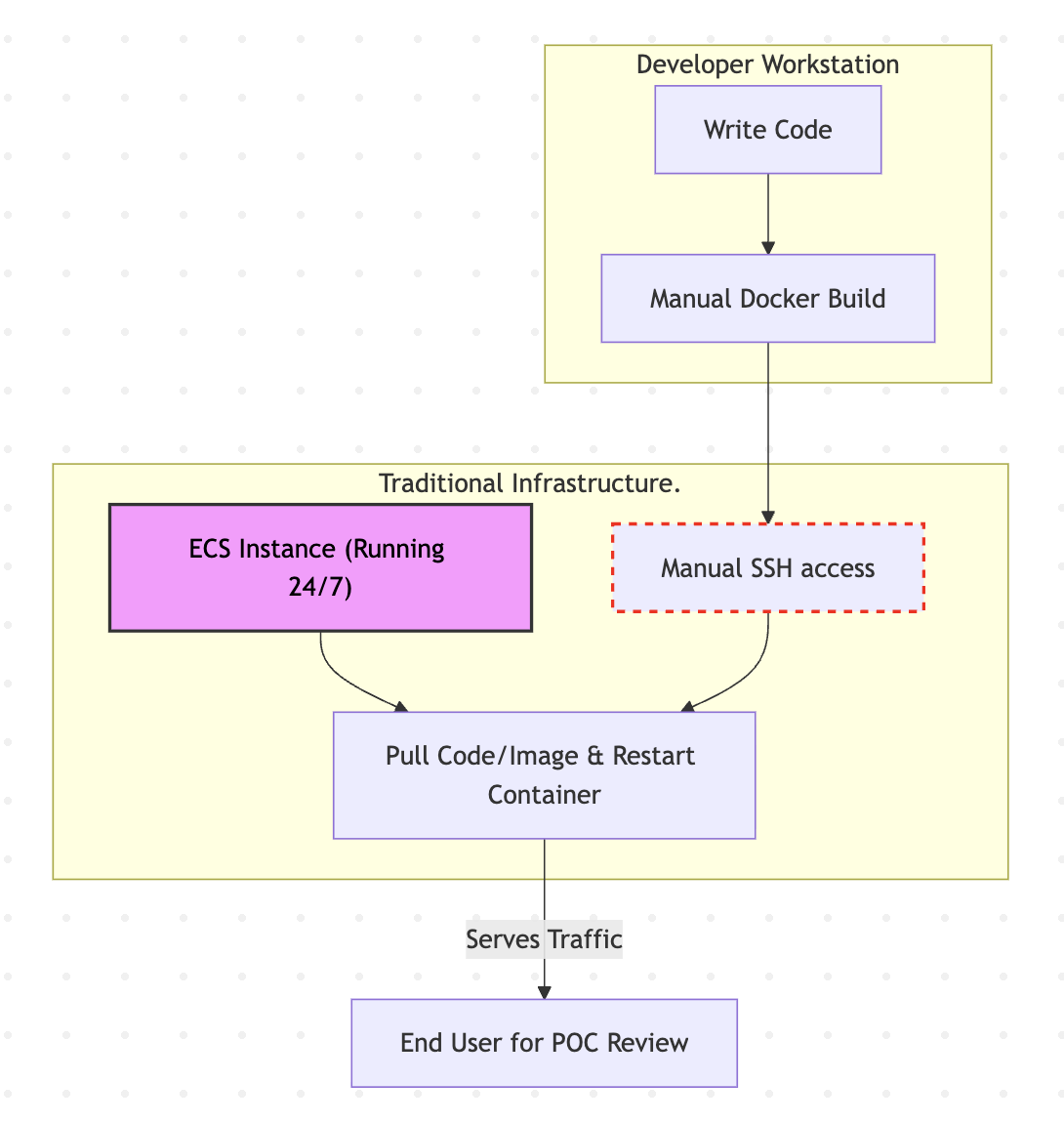
The pain points of this approach:
Idle Costs: You pay for the ECS instance 24 hours a day, even if development only happens for 8 hours.
Distraction: Developers spend time managing servers instead of writing features.
Bottlenecks: Deployment knowledge often sits with just one or two people, creating bottlenecks.
The Modern POV: Serverless CI/CD
My POV is that for POCs and early-stage development, we must move away from managing VMs entirely. We should leverage a fully automated CI/CD pipeline that utilizes serverless infrastructure.
The Proposed Stack:
-Source Control & CI Engine: GitHub (and GitHub Actions)
-Image Storage: Alibaba Cloud Container Registry (ACR) - Enterprise or Personal Edition
-Runtime Environment: Alibaba Cloud Function Compute (FC) - specifically using Custom Container runtimes.
The Automated Serverless Workflow Diagram
This proposed workflow is triggered automatically whenever a developer pushes code to GitHub. There are zero manual steps between saving code and seeing it live.
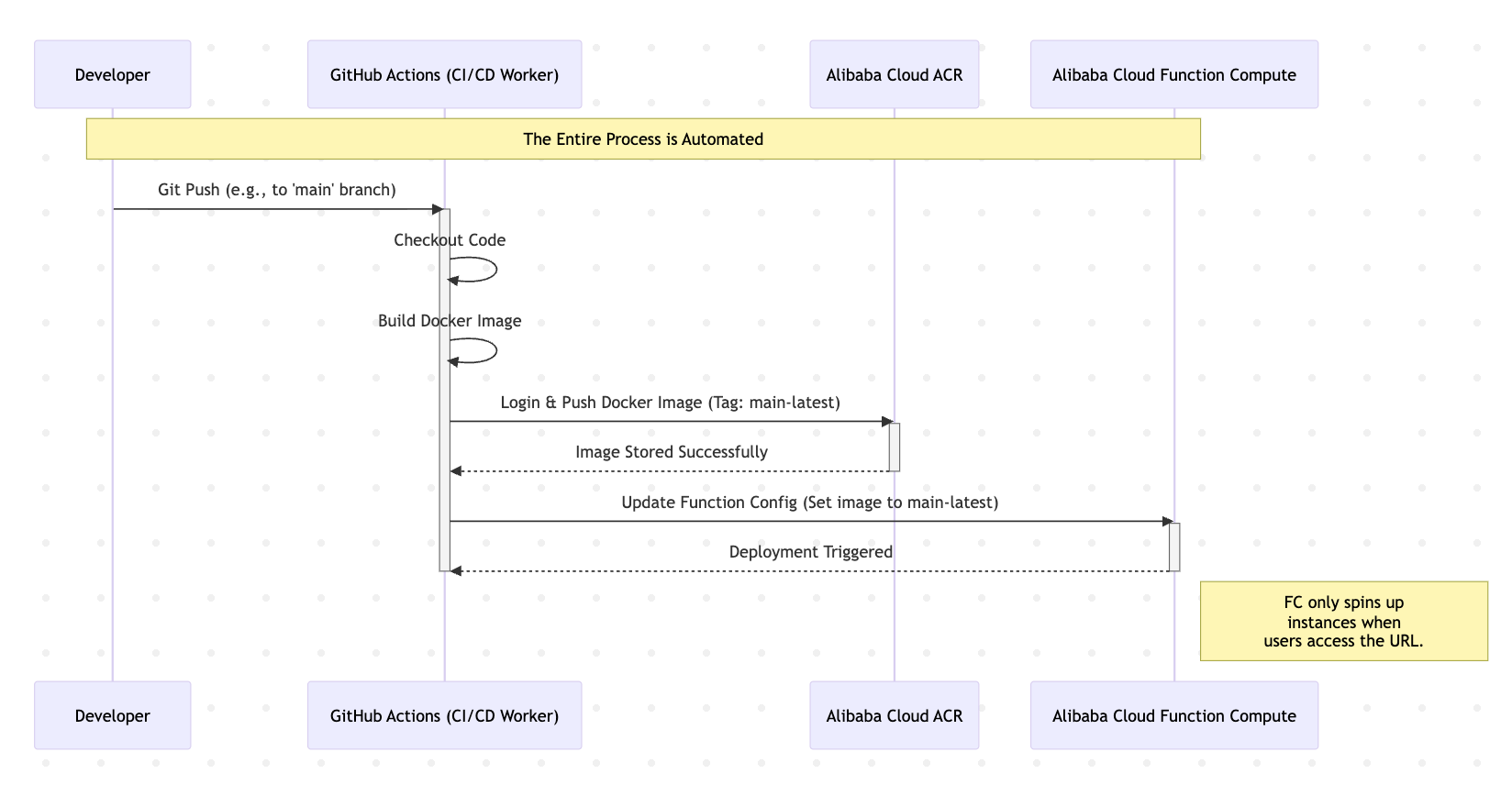
Why This Approach Wins for Small Teams
Adopting this flow offers significant advantages, particularly for teams of under 20 developers:
1. Drastic Cost Reduction During Development
This is the biggest win for a POC phase. With the conventional method, you pay for ECS compute capacity regardless of usage.
With Function Compute, you pay only for invocations and execution time. If nobody looks at your POC on the weekend, it costs you virtually nothing. This model is perfect for sporadic development usage patterns.
2. Saving Developer Time & Removing Bottlenecks
Automating the build-and-deploy cycle means developers no longer need to "context switch" from coding to "ops mode." They push code, wait a few minutes, and the changes are live. It democratizes deployment; anyone on the team can deploy simply by merging a Pull Request.
3. Long-Term Strategic Focus
While excellent for POCs, this isn't just a "hack." It sets a foundation for a mature DevOps culture. By automating early, the company saves huge operational costs in the long run. Staff can focus 100% on product development rather than wrestling with deployment scripts and server patching.
You can configure your workflow file (.github/workflows/deploy.yml) to behave differently based on the branch:
-Push to dev branch: Actions builds the image tagged :dev, pushes to ACR, and deploys it to a Function Compute service named my-app-dev.
-Push to main branch: Actions builds the image tagged :prod-v1.2, pushes to ACR, and deploys it to a Function Compute service named my-app-prod.
This gives you isolated development, staging, and production environments without needing three separate, expensive ECS clusters.
Conclusion
For Alibaba Cloud developers looking to maximize efficiency and minimize costs during the early stages of a project, continuing to rely on manual deployments to always-on virtual machines is a legacy habit we need to break.
By embracing CI/CD through GitHub Actions and the serverless power of Alibaba Cloud Function Compute and ACR, small teams can punch above their weight, delivering software faster and cheaper. Stop managing servers for your POCs—just ship code.
References:
Building Qwen-EcoLens: An AI-Powered Sustainable Nutrition Tracker on Alibaba Cloud

2 posts | 0 followers
FollowAlibaba Container Service - April 16, 2021
Farah Abdou - February 5, 2026
JJ Lim - September 17, 2021
Alibaba Container Service - September 19, 2024
Alibaba Cloud Serverless - December 17, 2020
Neel_Shah - October 27, 2025
2 posts | 0 followers
Follow DevOps Solution
Accelerate software development and delivery by integrating DevOps with the cloud
Learn More Alibaba Cloud Linux
Alibaba Cloud Linux is a free-to-use, native operating system that provides a stable, reliable, and high-performance environment for your applications.
Learn More Alibaba Cloud Flow
An enterprise-level continuous delivery tool.
Learn More Managed Service for Prometheus
Multi-source metrics are aggregated to monitor the status of your business and services in real time.
Learn MoreMore Posts by Matthew Chin CY

