This week, Alibaba unveiled cutting-edge AI advancements spanning enterprise security, data synthesis frameworks, and spatial intelligence. Highlights include the launch of Model Studio: Exclusive, a hybrid and private-cloud AI development platform for enterprises; WebShaper, a pioneering data synthesis method to train precision-focused research agents; and the upgraded Qwen-powered Amap travel agent, the world’s first AI-native navigation tool capable of processing complex travel queries. Together, these innovations underscore Alibaba’s drive to reshape industries through secure, scalable, and hyper-intelligent AI solutions.
Alibaba Cloud recently launched Model Studio: Exclusive, an exclusive version of its enterprise-grade AI development platform at its Indonesia AI Conference 2025. The platform is an ideal option for organizations that demand both innovation and high security.
Demand for private clouds is rising, especially in finance, healthcare and public services, as organizations prioritize security, compliance, AI, and customization.
Accordingly, Alibaba Cloud rolled out Model Studio: Exclusive, which is designed for hybrid and private cloud environments, helping businesses tap into the full potential of large language models (LLMs) and intelligent AI agents without ever risking the safety of their own infrastructure.
From fine-tuning foundational models to building industry-specific AI agents, the platform helps companies deploy tailored AI solutions in a secure environment. Key features include smart data parsing, extracting insights securely in high-compliance environments; automated data synthesis and intelligent quality assurance to streamline training workflows; cross-modality data processing to optimize post training. It also supports end-to-end task automation, where AI agents can break down complex tasks, plan next steps, and use various tools to complete tasks.
The scarcity of high-quality data poses a widespread challenge in training deep research agents. To enhance the training performance, Alibaba introduced WebShaper, a pioneering data synthesizing framework dedicated to overcoming the limitation.
Deep research agents are AI agents designed to autonomously gather, retrieve, and process information from various sources to answer questions or conduct research for users. Their performance relies heavily on the complexity and quality of the training data. Typical data synthesis methods follow an information-driven approach, which extract web data and create related questions and answers. This method could lead to inconsistencies between the extracted data, the questions and answers generated.
WebShaper provides a solution with a formalization-driven approach, which converts queries and information-seeking tasks into precise mathematical representations. It initiates data synthesis by constructing “seed” tasks, and then increases the complexity of these tasks multiple times using retrieval and validation tools based on the mathematical formalization.
With this new approach, WebShaper helps AI agents learn from a wider range of topics and task types, instead of just relying on the previously collected data. It also enables precise control over complexity and ensures semantic consistency, thereby reducing errors and increasing the training data quality. WebShaper overcomes the constraints of ambiguity of natural language, offering a data synthesis system that is controllable, explainable, and scalable.
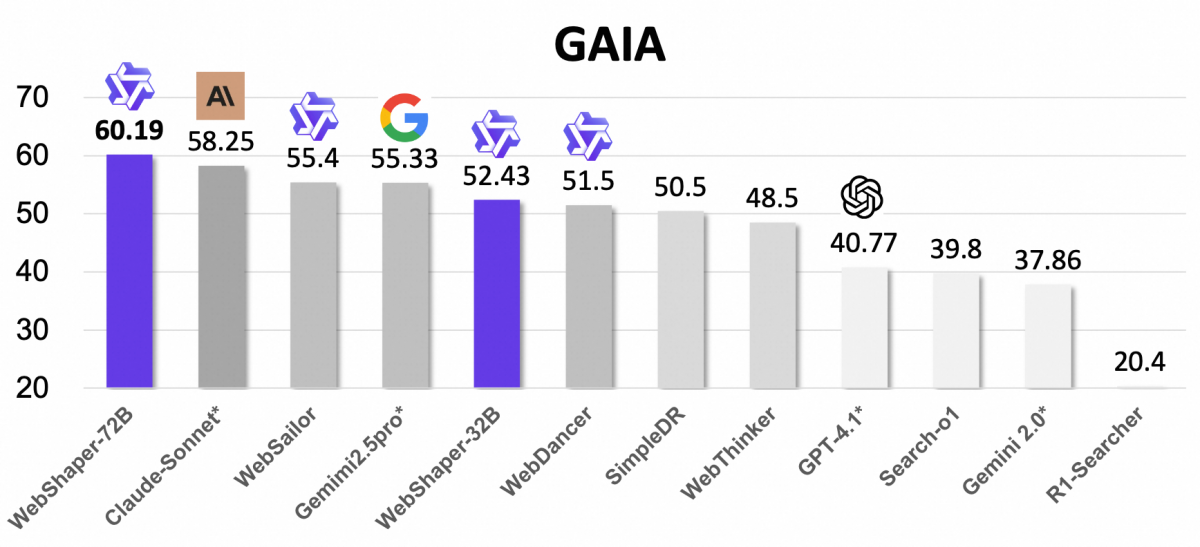
WebShaper-72B, trained on Qwen2.5-72B with data synthesized by WebShaper, has achieved state-of-the-art results on GAIA Text (60.19), a benchmark designed to evaluate general AI assistants on real-world tasks requiring reasoning, multimodal understanding, web browsing, and proficient tool usage. It has released a dataset comprising 500 question-answer pairs on HuggingFace and ModelScope. Additionally, a smaller model WebShaper-7B has been open-sourced for developers and researchers interested in further exploration in the information-seeking field.
Amap, China’s leading digital mapping and navigation platform, has deeply integrated Alibaba’s flagship foundational model Qwen, leveraging its cutting-edge multimodal and reasoning capabilities to launch the world’s first AI-native travel agent. The innovation in spatial intelligence enables users to create complex travel plans through natural voice commands.
Amap and Tongyi Lab, developer of Qwen models, have jointly built a seamless voice interaction system based on Qwen, covering wake-up, recognition, understanding and playback. The system also boasts a dual Automatic Speech Recognition (ASR) setup, ensuring high accuracy for both everyday language and Point of Interest (POI) information recognition.
At the heart of the system’s decision-making capabilities is a complex POI reasoning sub-agent, fine-tuned on the Qwen model. With users’ consents, this agent interprets and analyzes multidimensional inputs including geographical locations, participant requirements such as child-friendliness or pet allowances, time constraints, transportation preferences, and POI attributes like merchant ratings and operating hour, to generate tailored recommendations. For instance, a query such as “Find a Zhejiang cuisine restaurant near West Lake that offers children’s meals, has a rating above 4.5 out of 5, and is within 1 kilometer walking distance from a metro station,” can trigger precise suggestions and optimized routes.
The agent integrates proprietary map APIs, real-time weather queries, and live traffic tools, to provide dynamic guidance such as rerouting to avoid evening rush-hour congestion en route to airports.
With over 1 billion users, Amap is China’s top navigation application to date. Meanwhile, Alibaba’s Qwen AI models, with over 400 million downloads, stands as the world’s top open-source model on the Hugging Face platform.
AI in software development has emerged as one of the fastest-growing areas over the past year, evolving beyond simple code completion to become an integral part of the entire development lifecycle. Yet new challenges have emerged—and in some cases intensified—in the AI era. Software’s abstract nature complicates knowledge alignment and inheritance, contributing to human-AI collaboration friction. Moreover, most human-AI collaboration remains synchronous, requiring constant back-and-forth and hence, limiting AI’s efficiency.
Against this backdrop, Qoder, an agentic coding platform for global developers was introduced. Combining advanced context engineering and enhanced knowledge visibility, Qoder is packed with rich features to help accelerate developers’ productivity.
Powered by its proprietary Next-Edit-Suggestion (NES) model and enhanced context engineering, Qoder enables deep codebase searches and querying, multi-line edits, intelligent code suggestions and refactoring, and automated testing and validation, all accessible through natural language commands.
Qoder’s AI-native workflows enable developers to streamline their coding processes by integrating AI features into their development environment. It is available for Mac and Windows and supports over 200 programming languages such as Python and Java. Global developers can experience Qoder in public preview now for free.
This article was originally published on Alizila written by Crystal Liu , Claire Mo and Gabbie Fu.
Alibaba Cloud Launches New Edge Cloud Platform to Accelerate Digital Transformation in South Africa

1,360 posts | 484 followers
FollowAlibaba Clouder - August 9, 2018
Alibaba Cloud Community - July 28, 2025
Lana - April 14, 2023
Justin See - November 7, 2025
ApsaraDB - February 7, 2025
Alibaba Cloud Community - September 27, 2025
1,360 posts | 484 followers
Follow Container Compute Service (ACS)
A cloud computing service that provides container compute resources that comply with the container specifications of Kubernetes
Learn More
Container Service for Kubernetes
Alibaba Cloud Container Service for Kubernetes is a fully managed cloud container management service that supports native Kubernetes and integrates with other Alibaba Cloud products.
Learn More Tongyi Qianwen (Qwen)
Top-performance foundation models from Alibaba Cloud
Learn More Alibaba Cloud for Generative AI
Accelerate innovation with generative AI to create new business success
Learn MoreMore Posts by Alibaba Cloud Community

