| 16 | 900+ | 60%-70% |
| Systems | One-stop integrated reports | Store operation savings |
Founded in 1979, Youngor Group is a leading Chinese textile and apparel company. Starting with shirts, Youngor has gradually developed into a large-scale enterprise group encompassing high-end apparel brands, finance, real estate, textiles, and trade. It successfully listed on the Shanghai Stock Exchange in 1998. As of the end of 2022, Youngor Group's total assets reached 97.4 billion yuan, and its net assets reached 41.8 billion yuan, making it one of China's top 500 private enterprises.

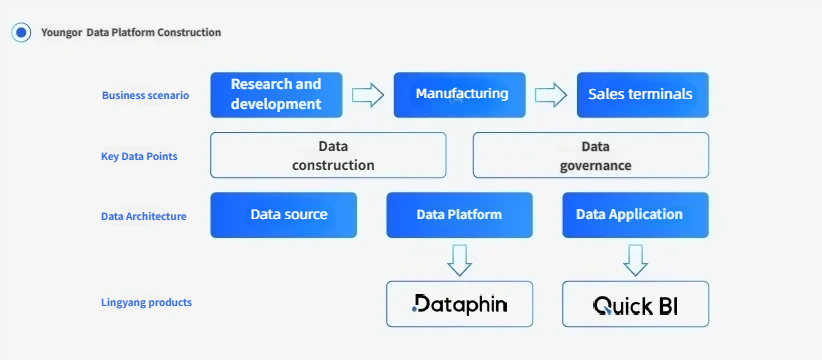
In 2018, Youngor proactively embraced the concept of a data platform. The data team aimed to use this platform to connect various business systems, from fabric R&D and manufacturing to smart marketing at sales terminals, and to provide decision-making support and improve efficiency through data construction and governance. However, building the data platform from scratch faced numerous challenges:
When Youngor launched its data middle platform construction project, it designed a three-layer data architecture consisting of data sources, middle platform, and applications. In this data architecture, Dataphin played an important role in the data middle platform layer.
At the data platform layer, Youngor integrated 16 systems, over 900 reports, and more than 400 sets of metrics through Dataphin. Dataphin's main advantages are threefold:
| Before | After |
| ● Data platform: Data retrieval is difficult, requiring specialized skills and a significant amount of time. | ● Integrates data from 16 systems and over 900 reports, simplifying the data acquisition process. |
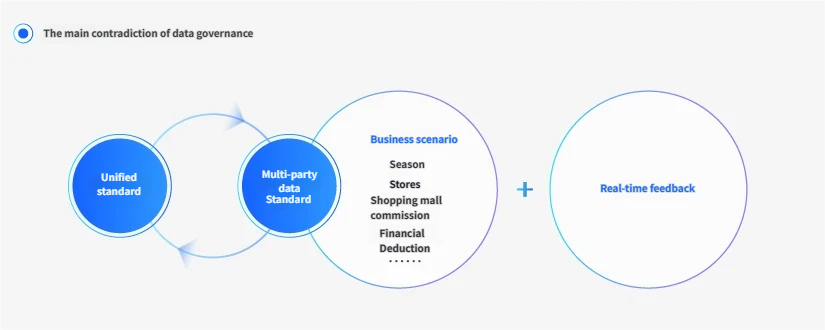
In the process of enterprise digital transformation, technology is often not the biggest challenge, but the lack of unified data standards and non-standard business processes can lead to data pollution, making it impossible to provide practical reference value for business decisions. The complexity of Youngor's business also exacerbates the complexity of data requirements and the difficulty of processing—even something as simple as "revenue amount" can result in data discrepancies of up to hundreds of thousands of yuan per day due to factors such as mall commissions and financial tax deductions, if the data standards of different channels are different.
There are two key aspects to this process: 1. Standardizing data metrics. 2. Clarifying the "boundaries of interests" by standardizing business processes—that is, clarifying who should do a task and to what extent.
When standardizing data metrics, the big data department identified key fields in each business process and provided detailed and clear data definitions based on business needs. For example, "season" is subdivided into stages such as "Spring 1," "Spring 2," and "Spring 3," while "store area" is updated in a timely manner according to renovation progress. Since the establishment of the data platform, data metrics have been iterated on average every month, ensuring that data feedback closely matches management requirements and business application needs.
| Before | After |
| ● Data details, detached from actual business application scenarios ● Business complexity leads to data complexity |
● Iterate in real time based on actual business scenarios ● Data feedback closely matches management needs and business application requirements. |
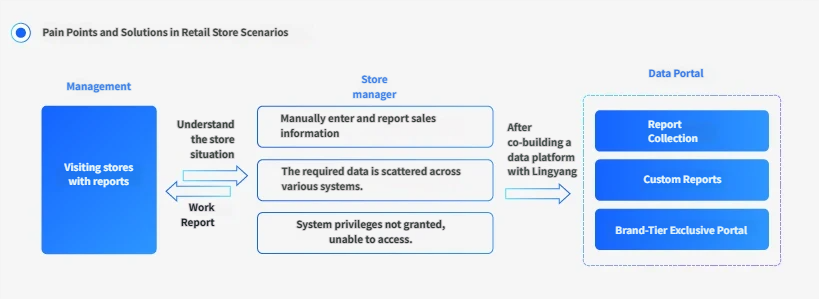
Taking the most common retail scenario as an example, in the past, when data made it difficult to see the whole picture, management often needed to bring a stack of reports to visit stores before making decisions in order to understand the true situation of each store, such as opening investment, decoration costs, and staff turnover. Meanwhile, store managers bore the pressure of performance targets while also needing to manage downwards and report upwards.
First, sales data needs to be manually entered and reported.
Second, the data required for reporting is scattered across various business systems (e.g., personnel data is collected in the HR system, and logistics data is collected in the logistics system).
Third, the required data is restricted by access permissions and cannot be accessed through the system.
After Youngor built its data platform, everyone from management to store sales staff had a more convenient way to access data. A panoramic data view centered on the store not only made it easier for management to understand store conditions but also reduced store managers' basic administrative work by 60%-70%. Its data portal offers three data perspectives:
| Before | After |
| ● The store manager's administrative work is trivial and heavy. ● Reliance on manual report generation leads to low decision-making efficiency. |
● A panoramic data perspective reduces store managers' daily administrative work by 60%-70%. ● The data platform provides real-time data support to assist store managers in their daily work. |
By building a data platform through Dataphin, Youngor has successfully integrated its data system across the entire value chain, from production to marketing. Now, management can have a real-time overview of operations, store managers are freed from tedious administrative tasks, and data has truly become a new engine supporting brand strategy and optimizing operational efficiency. This transformation demonstrates that when data and business resonate deeply, traditional apparel companies can also weave a completely new growth trajectory in the digital age.
Alibaba Cloud Empowers Global Enterprises with Expanded AI Services

1,364 posts | 487 followers
FollowAlibaba Cloud Community - June 30, 2025
digoal - May 28, 2019
digoal - January 19, 2021
Alibaba Cloud Community - January 9, 2026
ApsaraDB - March 23, 2026
digoal - September 27, 2022
1,364 posts | 487 followers
Follow Big Data Consulting for Data Technology Solution
Alibaba Cloud provides big data consulting services to help enterprises leverage advanced data technology.
Learn More Big Data Consulting Services for Retail Solution
Alibaba Cloud experts provide retailers with a lightweight and customized big data consulting service to help you assess your big data maturity and plan your big data journey.
Learn More Financial Services Solutions
Alibaba Cloud equips financial services providers with professional solutions with high scalability and high availability features.
Learn More Apsara Stack
Apsara Stack is a full-stack cloud solution created by Alibaba Cloud for medium- and large-size enterprise-class customers.
Learn MoreMore Posts by Alibaba Cloud Community

