In the Expenses and Costs console, you can view the billing details, utilization rate, and deduction discounts for your savings plans to evaluate their effectiveness, savings, and return on investment (ROI).
Choose a viewing method
Query savings plan bills in the following three ways for different scenarios:
Viewing method | Scenarios | Access link |
View detailed spending records of savings plan purchases for financial reconciliation. | ||
Evaluate the overall effectiveness and ROI of your savings plans. | ||
Analyze the detailed deduction status of your savings plans. |
Savings plan purchase bills
New console
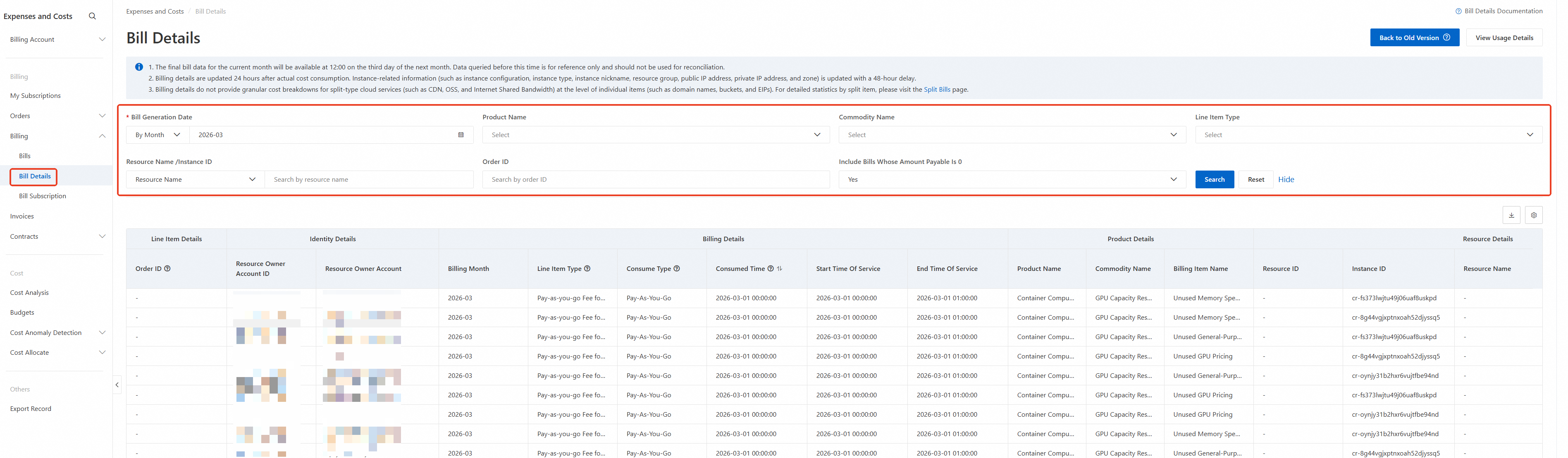
The Bill Details page displays purchase bills for savings plans, which you can then filter and export based on criteria such as Bill Generation Date, Resource Name, and Resource Name.
Log on to the Expenses and Costs console. In the left navigation pane, choose Billing > Bill Details.
On the Bill Details page, set Line Item Type to Savings Plan to filter the bills. By default, the billing details for the current month are displayed.
Set filter criteria such as Bill Generation Date and Resource Name /Instance ID, then click Search.
Legacy console
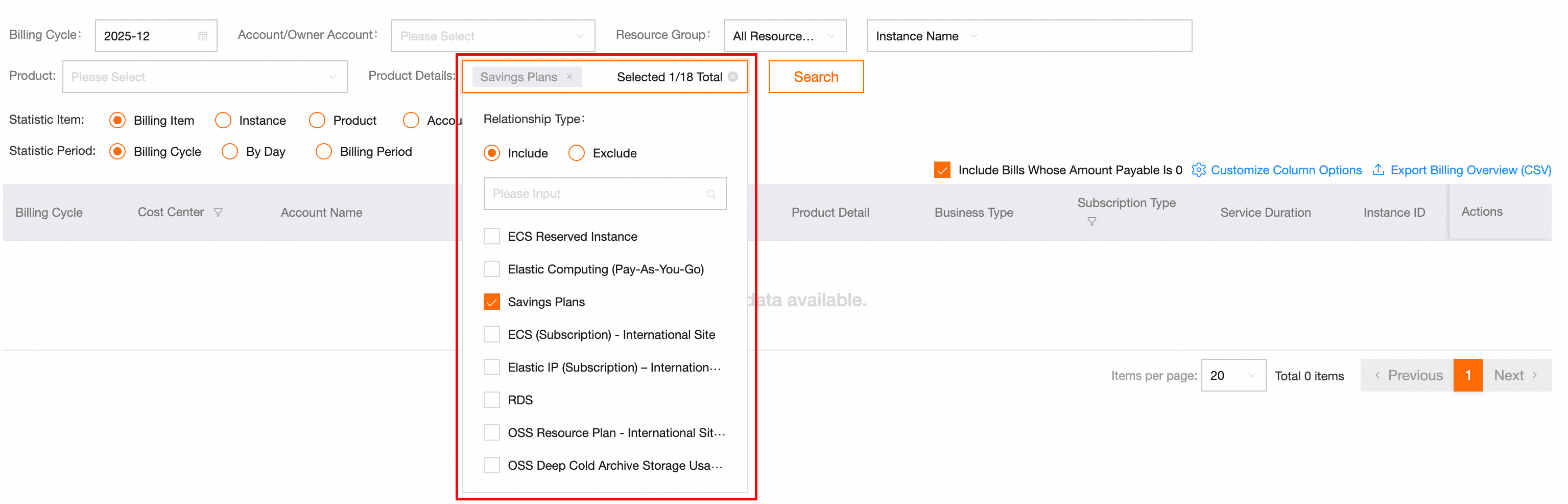
The Billing Details page displays the spending records for your savings plans. Filter and export them by criteria such as Billing Cycle and Resource Group.
Log on to the Expenses and Costs console. In the left navigation pane, choose Billing > Bill Details.
On the Bill Details page, set Product Details to Savings Plans and set Statistical Period to Details to filter the bills. By default, the billing details for the current month are displayed.
Set filter criteria such as Billing Cycle and Resource Group, then click Search.
For more information, see View and analyze bills.
If you log on with a main financial account, filter by account to view data for non-trusteeship and trusteeship linked accounts.
Savings plan usage overview
New console
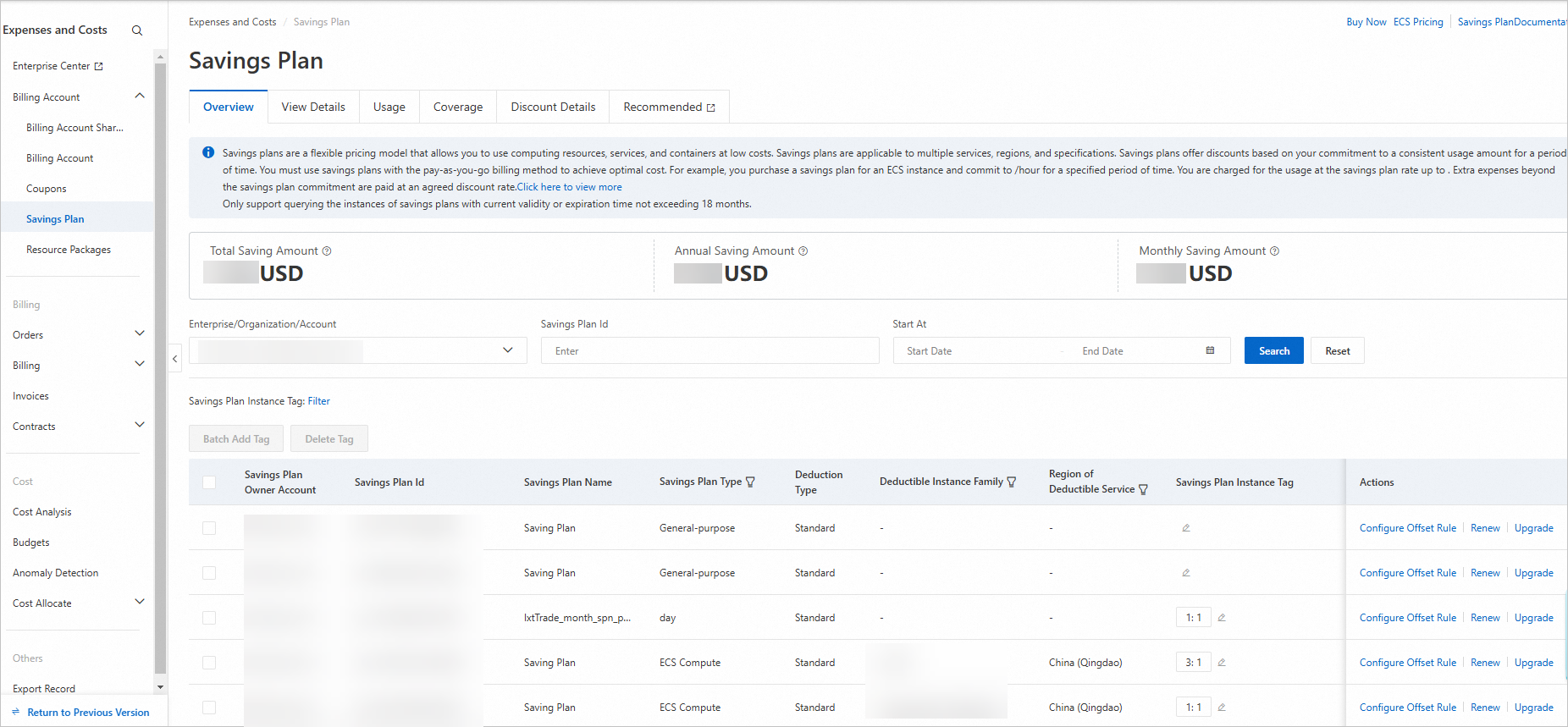
The savings plan overview page displays the cumulative savings, savings for the current year or month, the utilization rate, and the status of each savings plan instance. You can use this information to evaluate the ROI of your savings plans.
Log on to the Expenses and Costs console. In the left navigation pane, choose Account > Savings Plan.
On the Overview tab, set filter criteria such as Enterprise/Organization/Account, Savings Plan Instance ID, and Time Range, then click Search.
If your account has an overdue payment, the deduction behavior of a savings plan varies based on its payment option:
All Upfront savings plans: These plans continue to cover eligible pay-as-you-go resource bills even if the account has an overdue payment.
Partial Upfront or No Upfront savings plans: If the account has an overdue payment, these plans stop applying deductions starting from the next hour. The related resources are then billed at pay-as-you-go rates until the payment is cleared.
To prevent service interruptions or high bills due to overdue payments, ensure your payment method has a sufficient balance or credit limit.
Key fields
Field name | Description |
Commitment | The amount you commit to spend per period. This fee is charged regardless of whether deductions occur. Pay-as-you-go usage that exceeds this commitment is billed at the list price. |
Balance | For Elastic Edition: Total commitment - Used amount. For Standard Edition (monthly): Monthly commitment - Amount used this month. For Standard Edition (daily): Daily commitment - Amount used today. |
Status | Valid: Deductions are being applied normally. Stopped (overdue): Deductions are paused because the account has an overdue payment. Invalid: The savings plan has expired. |
Cumulative Savings | Cumulative savings = Standard pay-as-you-go cost - (Total savings plan amount + Actual payable amount). |
Utilization Rate | For Standard Edition: The month-to-date utilization rate. For Elastic Edition: The overall instance utilization rate. A higher utilization rate indicates better savings plan performance. |
Share Status | Indicates whether the savings plan instance is shared with other accounts. |
Legacy console
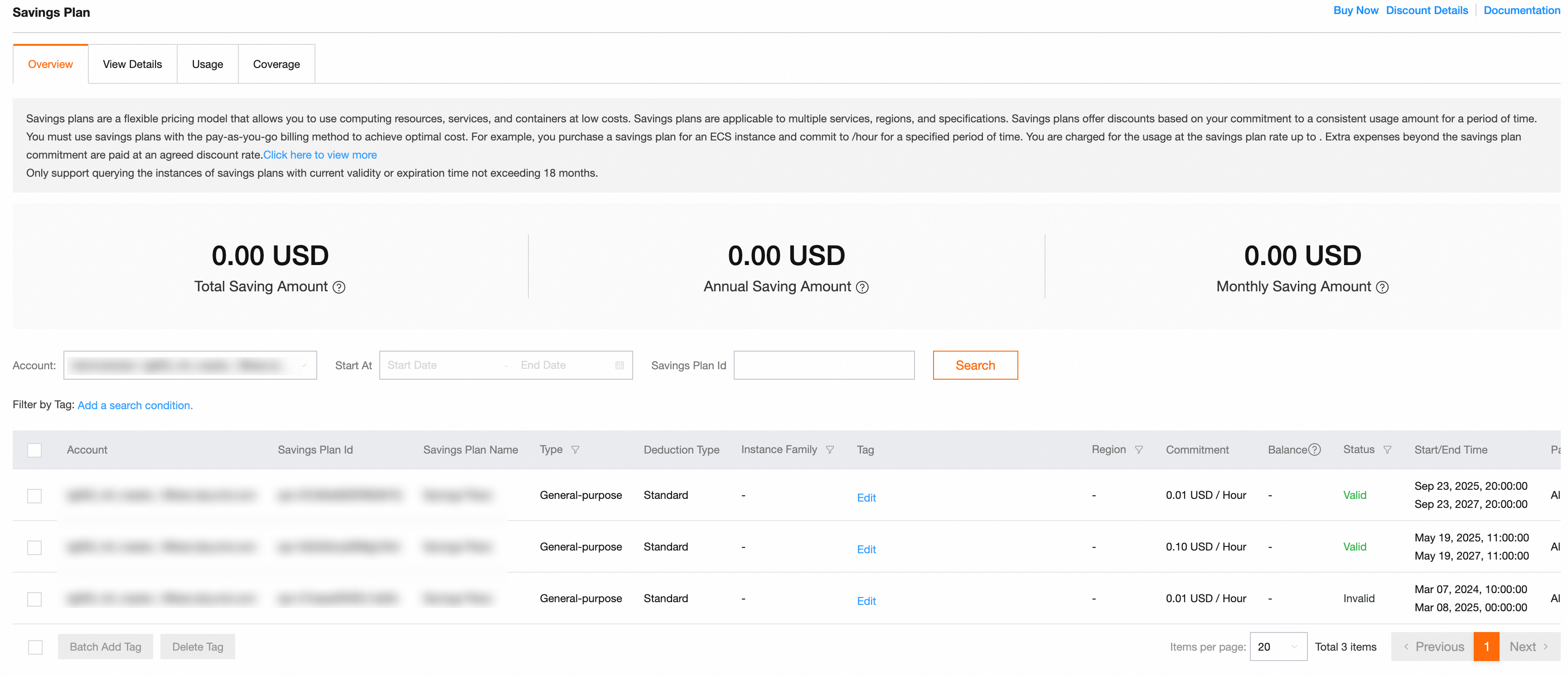
The savings plan overview page displays the cumulative savings, savings for the current year or month, the utilization rate, and the status of each savings plan instance. You can use this information to evaluate the ROI of your savings plans.
Log on to the Expenses and Costs console. In the navigation pane on the left, choose Savings Plan > Overview.
On the Overview tab, set filter criteria such as Account, Start At, and Savings Plan Id, then click Search.
If your account has an overdue payment, the deduction behavior of a savings plan varies based on its payment option:
All Upfront savings plans: These plans continue to cover eligible pay-as-you-go resource bills even if the account has an overdue payment.
Partial Upfront or No Upfront savings plans: If the account has an overdue payment, these plans stop applying deductions starting from the next hour. The related resources are then billed at pay-as-you-go rates until the payment is cleared.
To prevent service interruptions or high bills due to overdue payments, ensure your payment method has a sufficient balance or credit limit.
Key fields
Field name | Description |
Commitment | The amount you commit to spend per period. This fee is charged regardless of whether deductions occur. Pay-as-you-go usage that exceeds this commitment is billed at the list price. |
Balance | For Elastic Edition: Total commitment - Used amount. For Standard Edition (monthly): Monthly commitment - Amount used this month. For Standard Edition (daily): Daily commitment - Amount used today. |
Status | Valid: Deductions are being applied normally. Stopped (overdue): Deductions are paused because the account has an overdue payment. Invalid: The savings plan has expired. |
Cumulative Savings | Cumulative savings = Standard pay-as-you-go cost - (Total savings plan amount + Actual payable amount). |
Utilization Rate | For Standard Edition: The month-to-date utilization rate. For Elastic Edition: The overall instance utilization rate. A higher utilization rate indicates better savings plan performance. |
Share Status | Indicates whether the savings plan instance is shared with other accounts. |
Savings plan usage details
New console
The savings plan usage details page displays detailed deduction information for a specified savings plan, including Savings Plan Owner Account, Deduct Fee, Deduction Rate for Bills, Savings Plan Owner Account, and Deducted Instance ID.
Log on to the Expenses and Costs console.
In the navigation pane on the left, choose Billing Account > Savings Plan.
Click the View Details tab.
Set filter conditions, including Instance ID and Time Range, and click Search.
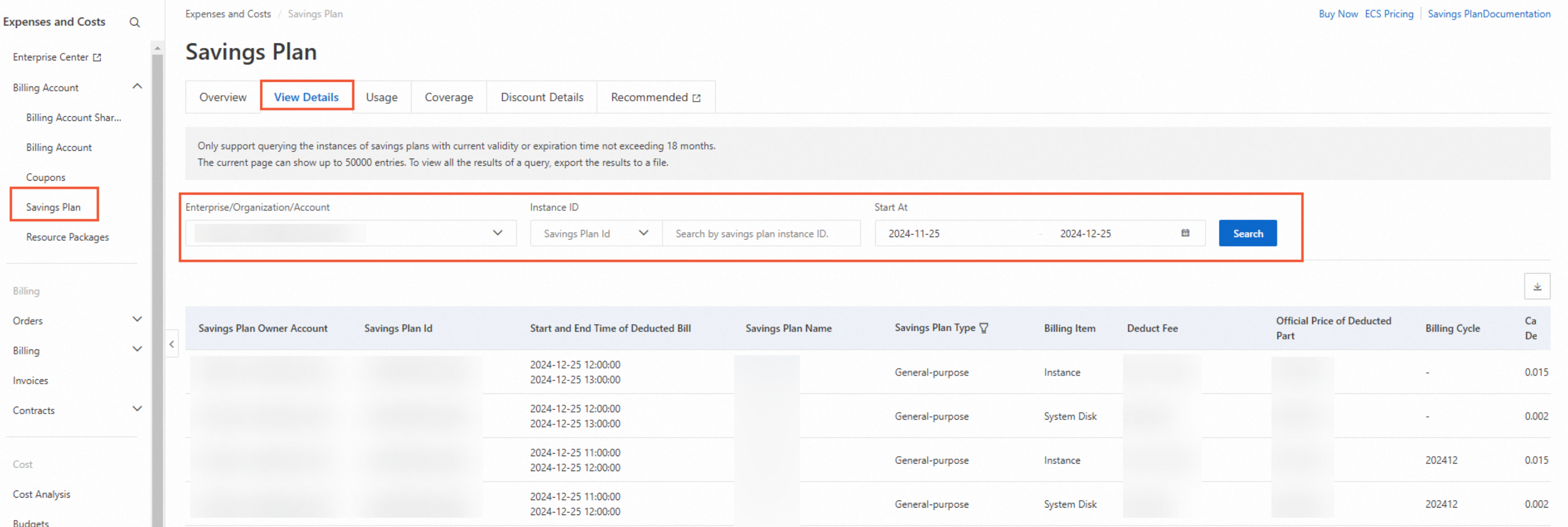
Key fields
Field name | Description |
Deduct Fee | The amount of the savings plan commitment used to cover the cloud resource fees. |
Catalogue Gross Amount of Deducted Bills | The total list price of the bill for the cloud resource fees covered by the savings plan. |
Deductible Discount | The discount rate applied by the savings plan to the cloud resource fees. The formula is: Deduction discount = Deduction amount / Total list price of the deducted portion. |
Deduction Rate for Bills | The bill offset rate is the percentage of a pay-as-you-go bill covered by a savings plan. The rate is calculated as follows: Bill Offset Rate = (Offset Amount / Corresponding Pay-as-you-go Discount) / List Price of the Offset Usage. |
Deducted Commodity | The pay-as-you-go product for the cloud resource fees covered by the savings plan. |
Deducted Instance ID | The ID of the cloud resource instance for the cloud resource fees covered by the savings plan. |
Legacy console
The savings plan usage details page displays the detailed deduction status for a specified savings plan, including Account, Deduction Amount, Bill Deduction Rate, Corresponding Deducted Product, and Deducted Instance.
Log on to the Expenses and Costs console.
In the navigation pane on the left, choose Savings Plan > Overview and Details.
Click the Usage Details tab.
Set filter criteria such as Account, Savings Plan Instance ID, and Start Time, and then click Search.
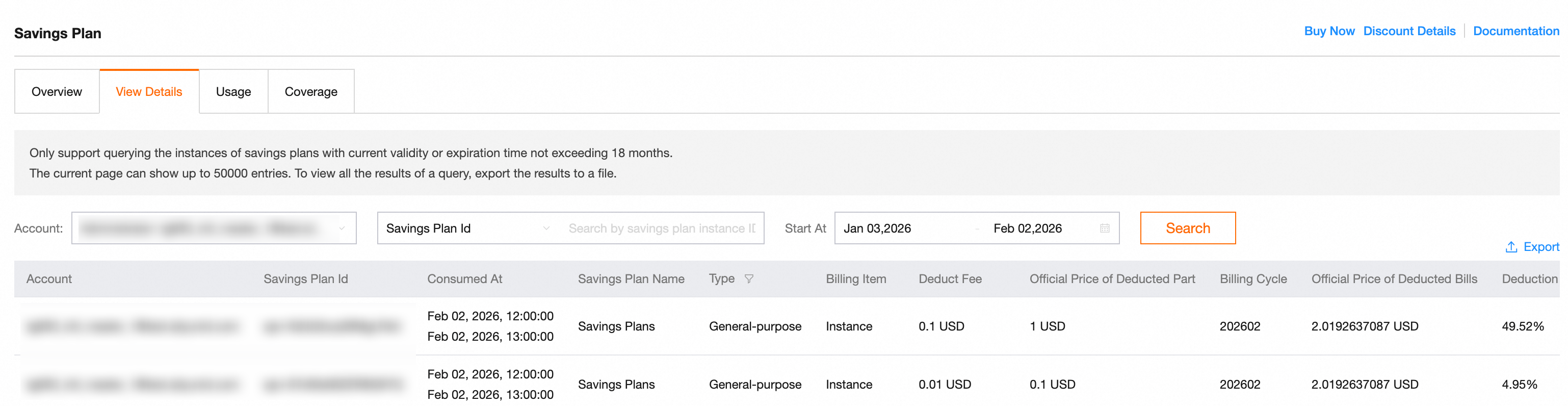
Key fields
Field name | Description |
Deduct Fee | The amount of the savings plan commitment used to cover the cloud resource fees. |
Official Price of Deducted Part | The total list price of the cloud resource fees that are covered by the savings plan. |
Discount | The discount rate applied by the savings plan to the cloud resource fees. The formula is: Deduction discount = Deduction amount / Total list price of the deducted portion. |
Deduction Rate for Bills | The percentage of a pay-as-you-go bill that is covered by the savings plan. The formula is: Bill deduction rate = (Deduction amount / Corresponding pay-as-you-go discount) / List price of the deducted bill. |
Deduction Product | The pay-as-you-go product for the cloud resource fees covered by the savings plan. |
Savings Plan Id | The ID of the purchased savings plan instance. |
FAQ
Why are there charges on my bill that were not covered by a savings plan?
Charges on your bill may not be covered by a savings plan for the following reasons:
Charges are not eligible for deduction: Fees for snapshots, Internet traffic, or disk capacity (except for specific plans) are not covered by savings plans. General-purpose savings plans only cover computing capacity costs for ECS and ECI.
Spending exceeds the commitment: Usage that exceeds the committed spending of the savings plan is billed at pay-as-you-go rates.
Account has an overdue payment: Partial Upfront and No Upfront savings plans pause deductions when the account has an overdue payment.
Why is the deduction amount small after I purchased a savings plan?
The deduction capacity of a savings plan is determined by its committed spending, not the upfront payment. Committed spending is the amount you commit to use per hour.
For example, consider a savings plan with a committed spend of USD 0.1 per hour that offers a rate at 40% of the pay-as-you-go price. The value of pay-as-you-go usage at list price that can be covered per hour is: USD 0.1 / 40% = USD 0.25. The maximum value of usage at list price that can be covered per day is: USD 0.25 × 24 = USD 6.
Before you purchase, use the savings plan calculator to select an appropriate committed spending amount based on your actual usage.
Can savings plans be extended?
No, they cannot. Savings plans automatically expire. To continue using a savings plan, you must purchase a new one before the current one expires.