All Products
Search
Document Center

Simple Log Service:Data structure of alert resource data

Last Updated:Jun 16, 2026

Each alert resource type, such as users, policies, and templates, has a defined data structure consisting of resources and records.

Introduction

Alert resource data includes users, user groups, on-call groups, webhook integrations, alert policies such as route consolidation, inhibition, and silence policies, action policies, content templates, and other custom resource data.

Note

Inhibition policies are not recommended.

Alert resource data is classified into two categories: resources and records. For example, a user is a resource, and the information about that user is a record.

Category

Property

Description

Resource

resource_name

The name that identifies the resource. For example, the resource name of a user is sls.common.user.

Record

id

The unique ID of the record. Data type: string.

tag

The tag of the record. Data type: string.

value

The complete value of the record. Data type: JSON string.

Structure of alert resource data

Resource type

resource_name field

record_id field

record_tag field

Example

Remarks

User

sls.common.user

user_id

user_name

{
    "user_id": "alex",
    "user_name": "Alex",
    "email": [
        "***@example.com"
    ],
    "country_code": "86",
    "phone": "133****3333",
    "enabled": true,
    "sms_enabled": true,
    "voice_enabled": true
}

None

User group

sls.common.user_group

user_group_id

user_group_name

{
    "user_group_id": "devops",
    "user_group_name": "DevOps Team",
    "enabled": true,
    "members": [
        "alex"
    ]
}

None

On-call group

sls.alert.oncall_group

oncall_id

oncall_name

{
    "oncall_id": "default_oncall",
    "oncall_name": "Default Oncall",
    "enabled": true,
    "overrides": [],
    "rotations": [
        {
            "targets": [
                {
                    "type": "user",
                    "target_id": "alex"
                },
                {
                    "type": "user_group",
                    "target_id": "devops"
                }
            ],
            "end_time": 0,
            "shift_day": "",
            "shift_time": "12:00",
            "shift_type": "day",
            "start_time": 1633017600,
            "shift_minute": 0,
            "end_time_type": "none",
            "shift_interval": 1,
            "shift_week_custom": null,
            "restriction_date_type": "workday",
            "restriction_time_type": "allday",
            "restriction_week_range": null,
            "restriction_time_custom_range": null
        }
    ],
    "calendar_id": "default_calendar"
}

This configuration is complex. We recommend that you use the console instead.

Webhook integration

sls.alert.action_webhook

id

name

{
    "id": "custom-webhook",
    "name": "Custom Webhook",
    "type": "custom",
    "url": "http://localhost:9099/data/webhook",
    "method": "POST",
    "headers": [
        {
            "key": "Content-Type",
            "value": "application/json"
        },
        {
            "key": "Foo",
            "value": "bar"
        }
    ]
}
{
    "id": "dingtalk",
    "name": "Dingtalk Webhook",
    "type": "dingtalk",
    "url": "https://oapi.dingtalk.com/robot/send?access_token=**********",
    "method": "POST",
    "secret": "SEC**********",
    "headers": []
}
  • Set type to the webhook type. Valid values:

    • dingtalk: DingTalk.

    • wechat: WeCom.

    • lark: Lark.

    • slack: Slack.

    • custom: custom webhook.

  • For all types except custom, set method to POST and headers to an empty array.

  • If you set type to dingtalk or lark, and set the security check method to signature verification in DingTalk or Lark, you must add the secret field.

    You can obtain the signature key from the bot management interface in DingTalk or Lark.

Alert policy

sls.alert.alert_policy

policy_id

policy_name

{
    "policy_id": "sls.builtin",
    "policy_name": "SLS Builtin Alert Policy",
    "parent_id": "sls.root",
    "is_default": false,
    "group_script": "fire(action_policy=\"sls.builtin\", group={\"project\": \"__a__\", \"uid\": alert.aliuid}, group_wait=\"5s\", group_interval=\"2m\", repeat_interval=\"2m\")\nstop()\nfire(action_policy=\"sls.builtin\", group={\"alert_id\": alert.alert_id}, group_wait=\"5s\", group_interval=\"10s\", repeat_interval=\"2m\")\nif alert.labels.name ~= \"^\\\\w+s$\":\n\tfire(action_policy=\"sls.builtin\", group={\"product\": \"xxs\"}, group_wait=\"5s\", group_interval=\"10s\", repeat_interval=\"2m\")\n\tstop()\nstop()\nfire(action_policy=\"sls.builtin\", group={\"label_name\": alert.labels.name}, group_wait=\"10s\", group_interval=\"10s\", repeat_interval=\"2m\")",
    "inhibit_script": "if alert.severity >= 8:\n    silence alert.severity < 6",
    "silence_script": ""
}
  • Set is_default to false.

  • group_script is the route consolidation policy.

  • inhibit_script is the inhibition policy.

  • silence_script is the silence policy.

  • If you configure these fields by using an SDK, group_script, inhibit_script, and silence_script contain only DSL script information without UI metadata. The console cannot render the corresponding graphical structure.

Action policy

sls.alert.action_policy

action_policy_id

action_policy_name

{
    "action_policy_id": "sls.builtin",
    "action_policy_name": "SLS Builtin Action Policy",
    "labels": {},
    "is_default": false,
    "primary_policy_script": "fire(type=\"webhook_integration\", integration_type=\"dingtalk\", webhook_id=\"dingtalk-test\", template_id=\"default-template\", period=\"any\")",
    "secondary_policy_script": "fire(type=\"voice\", users=[\"jizhi\"], groups=[\"group-jizhi\"], template_id=\"default-template\")",
    "escalation_start_enabled": false,
    "escalation_start_timeout": "10s",
    "escalation_inprogress_enabled": false,
    "escalation_inprogress_timeout": "10s",
    "escalation_enabled": false,
    "escalation_timeout": "4h0m0s"
}
  • Set is_default to false.

  • labels is a reserved parameter. Set it to a null object.

  • primary_policy_script is the primary action policy.

  • secondary_policy_script is the secondary action policy.

  • escalation_* fields control whether to enable the secondary action policy. For details, see the configuration items in the console.

  • If you configure these fields by using an SDK, primary_policy_script and secondary_policy_script contain only DSL script information without UI metadata. The console cannot render the corresponding graphical structure.

Content template

sls.alert.content_template

template_id

template_name

{
    "template_id": "default-template",
    "template_name": "Default Template",
    "is_default": false,
    "templates": {
        "fc": {
            "limit": 0,
            "locale": "zh-CN",
            "content": "",
            "send_type": "merged"
        },
        "sms": {
            "locale": "zh-CN",
            "content": ""
        },
        "lark": {
            "title": "Alerthub alert test ${alert_name}",
            "locale": "zh-CN",
            "content": ""
        },
        "email": {
            "locale": "zh-CN",
            "content": "",
            "subject": "SLS alert test-jizhi-test"
        },
        "slack": {
            "title": "Alerthub alert test ${alert_name}",
            "locale": "zh-CN",
            "content": ""
        },
        "voice": {
            "locale": "zh-CN",
            "content": ""
        },
        "wechat": {
            "title": "Alerthub alert test ${alert_name}",
            "locale": "zh-CN",
            "content": ""
        },
        "webhook": {
            "limit": 0,
            "locale": "zh-CN",
            "content": "",
            "send_type": "batch"
        },
        "dingtalk": {
            "title": "Alerthub alert test ${alert_name}",
            "locale": "zh-CN",
            "content": ""
        },
        "event_bridge": {
            "locale": "zh-CN",
            "content": "",
            "subject": "wkb-test"
        },
        "message_center": {
            "locale": "zh-CN",
            "content": ""
        }
    }
}
  • Set is_default to false.

  • templates contains the template configurations for each notification channel. If the content value for a channel is empty, the system's default template is used. For more information, see Default content templates.

  • The value of locale can be zh-CN or en-US.

  • For the webhook and fc channels, the value of send_type can be single or batch. single indicates that notifications are sent for each alert. batch indicates that alerts are merged and sent as a single notification.

Default calendar

sls.common.calendar

calendar_id

calendar_name

{
    "calendar_id": "default_calendar",
    "calendar_name": "Default Calendar",
    "timezone": "Asia/Shanghai",
    "workdays": [
        1,
        2,
        3,
        4,
        5
    ],
    "worktime": [
        {
            "end_time": "21:00",
            "start_time": "09:00"
        }
    ],
    "reset_days": [],
    "holiday_sync": "china"
}
  • The ID of the default calendar is fixed as default_calendar.

  • This configuration is complex. We recommend that you use the console instead.

DSL syntax description

The following sections show example DSL configurations for each policy type.

Important

DSL configuration is complex. We recommend that you configure policies in the console first, then inspect the network request payload.

Set a route consolidation policy

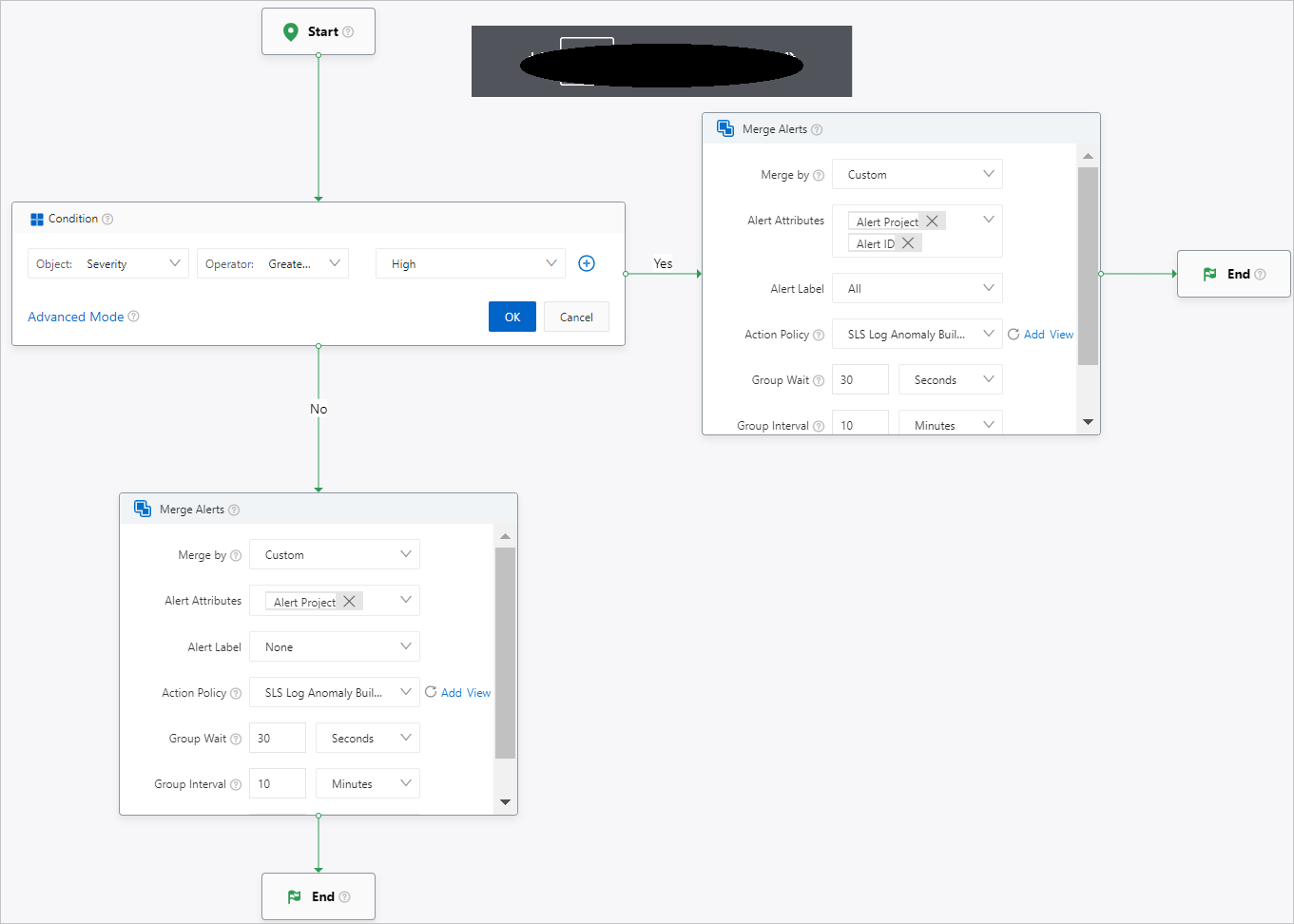
  • Console configuration告警策略

  • DSL configuration

    if alert.severity >= 8:
        fire(action_policy="sls.builtin", group={"alert.project": alert.project, "alert.alert_id": alert.alert_id}, group_by_all_labels=true, group_wait="15s", group_interval="5m", repeat_interval="1h")
        stop()
    fire(action_policy="sls.builtin", group={"alert.project": alert.project}, group_by_all_labels=false, group_wait="15s", group_interval="5m", repeat_interval="1h")

    The basic syntax is described as follows:

    • if alert.severity >= 8 is a condition node.

    • fire() is a route consolidation node.

      • action_policy is the action policy ID.

      • group is the consolidation baseline. The data type is dict.

      • group_by_all_labels specifies whether to consolidate alerts based on all labels. Valid values: true and false.

      • group_wait is the initial wait time.

      • group_interval is the wait time for changes.

      • repeat_interval is the repeat wait time.

    • stop() is the end node.

Set an inhibition policy

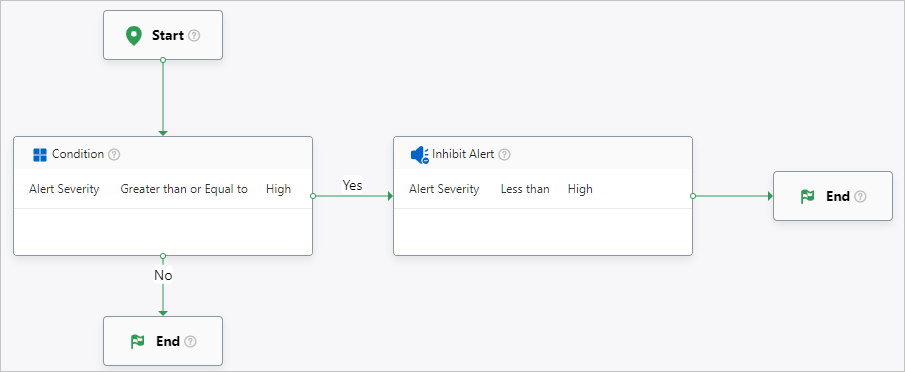
  • Console configuration告警策略

  • DSL configuration

    if alert.severity >= 8:
        silence alert.severity < 8
        stop()

    The basic syntax is described as follows:

    • if alert.severity >= 8 is a condition node.

    • silence alert.severity < 8 is an inhibition node.

    • stop() is the end node.

Set a silence policy

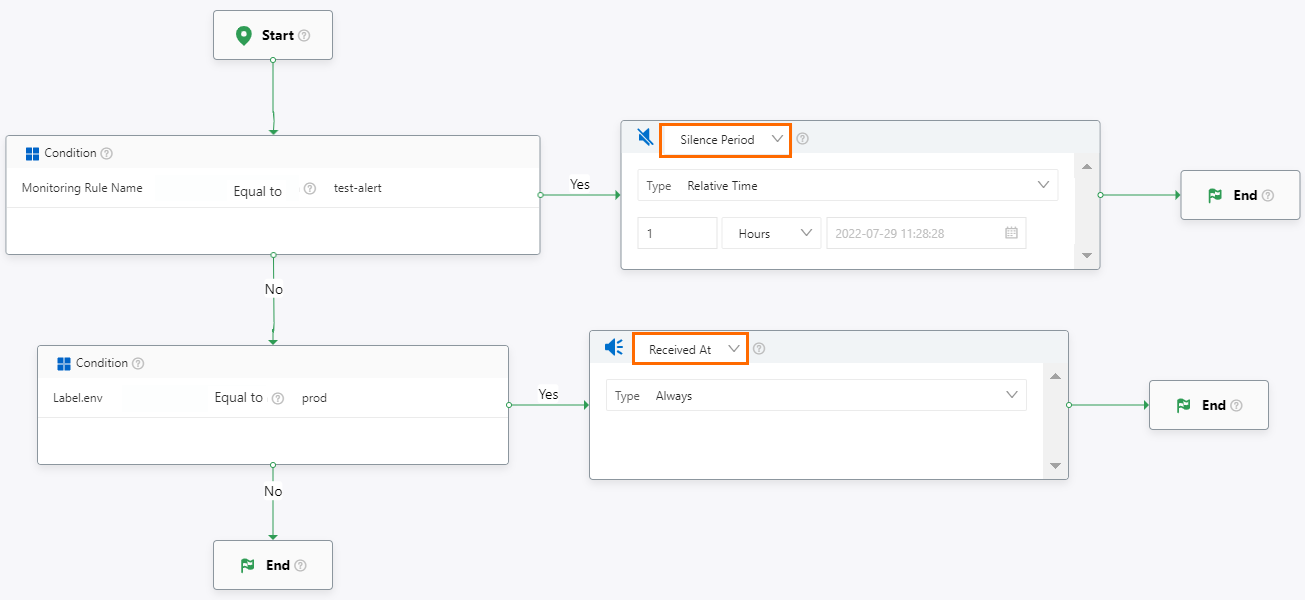
  • Console configuration告警策略

  • DSL configuration

    drop(end=1638189177) alert.alert_name == "test-alert"
    accept alert.labels.env == "prod"

    The basic syntax is described as follows:

    • drop indicates silence.

    • accept indicates that the alert is not silenced.

    • start and end specify a time range as a UNIX timestamp in seconds.

      • Specific time range: Set start and end.

      • Until a specific time: Set only end.

      • For a period of time: Set only end.

      • Indefinitely: Do not set start or end.

Set an action policy

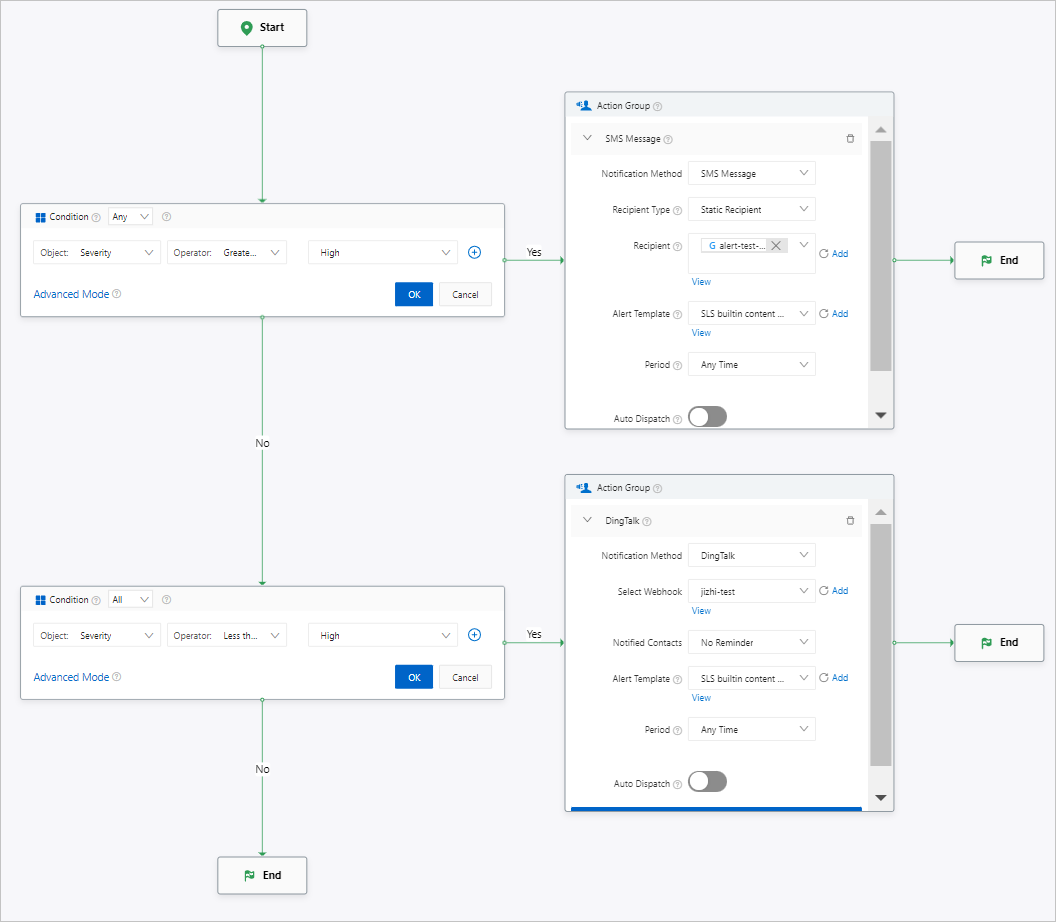
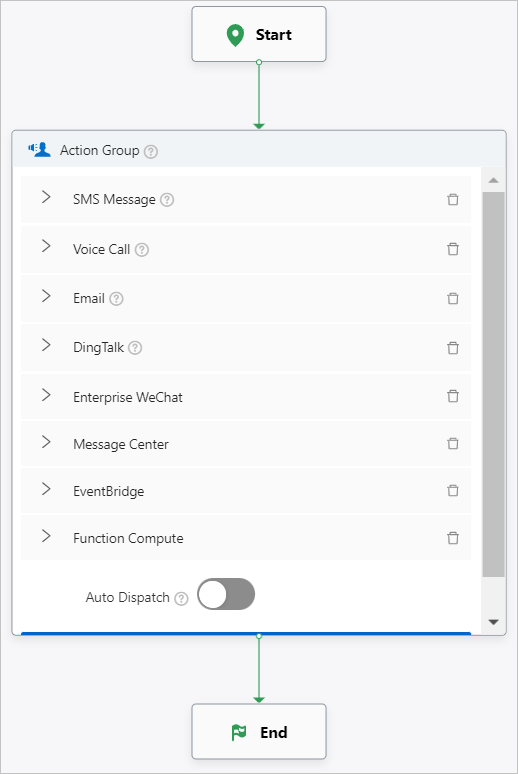
  • Console configuration行动策略

  • DSL configuration

    if alert.severity >= 8:
        fire(type="sms", users=[], groups=[], oncall_groups=["alert-test-oncall"], template_id="sls.builtin.cn", check_quota="true", period="any")
        stop()
    if alerts.severity < 8:
        fire(type="webhook_integration", integration_type="dingtalk", webhook_id="jizhi-test", template_id="sls.builtin.cn", period="any")
        stop()
    Important
    • if alert.xxx indicates that the condition is met if any alert matches.

    • if alerts.xxx indicates that the condition is met if all alerts match.

The following section provides configuration examples for each channel:

  • Console configuration行动策略

  • DSL configuration

    fire(type="sms", users=["jizhi"], groups=[], oncall_groups=[], template_id="sls.builtin.cn", check_quota="true", period="workday")
    fire(type="voice", users=[], groups=[], oncall_groups=["alert-test-oncall"], template_id="sls.builtin.cn", check_quota="true", period="worktime")
    fire(type="email", users=[], groups=["alert-test"], oncall_groups=[], template_id="sls.builtin.cn", check_quota="true", period="any")
    fire(type="webhook_integration", integration_type="dingtalk", webhook_id="jizhi-test", template_id="sls.builtin.cn", period="any")
    fire(type="webhook_integration", integration_type="wechat", webhook_id="wechat-test", template_id="sls.builtin.cn", period="any")
    fire(type="message_center", template_id="sls.builtin.cn", check_quota="true", period="any")
    fire(type="event_bridge", region="cn-hangzhou", bus_name="bus-demo", template_id="sls.builtin.cn", period="any")
    fire(type="fc", region="cn-shanghai", service="jizhi-test", qualifier="LATEST", function="sls-ops-1", template_id="sls.builtin.cn", period="any")
    fire(type="set_ticket_owner", choice="random", users=[], groups=[], oncall_groups=["alert-test-oncall"])

    The basic syntax is described as follows:

    Use fire() to set the notification channel. For more information, see Notification channels.