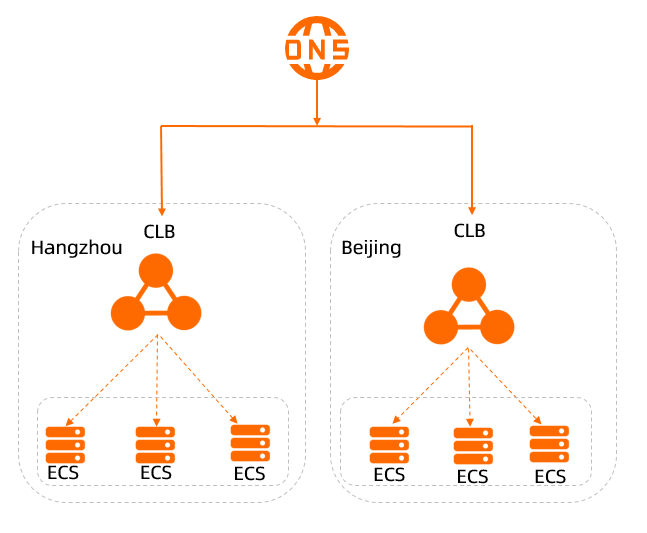
Classic Load Balancer (CLB) distributes inbound traffic across multiple backend Elastic Compute Service (ECS) instances, increasing application availability and protecting against server overload. The following scenarios describe common use cases.
Distribute workloads
CLB routes inbound traffic to backend ECS instances based on listening rules, preventing any single server from becoming overloaded. To keep all requests from a given client on the same backend ECS instance, enable session persistence.
Scale your applications
CLB acts as the traffic ingress point for your web servers and application servers. Add or remove backend ECS instances at any time to match changing traffic demands.
Eliminate single points of failure
CLB acts as the single point of contact for clients and distributes requests across multiple backend ECS instances. When an ECS instance malfunctions, CLB automatically isolates it and routes requests to the remaining healthy instances, keeping your application available.
Implement zone-disaster recovery
Deploy a CLB instance across multiple zones within the same region to protect your applications against zone-level failures. CLB supports cross-zone deployment in most regions.
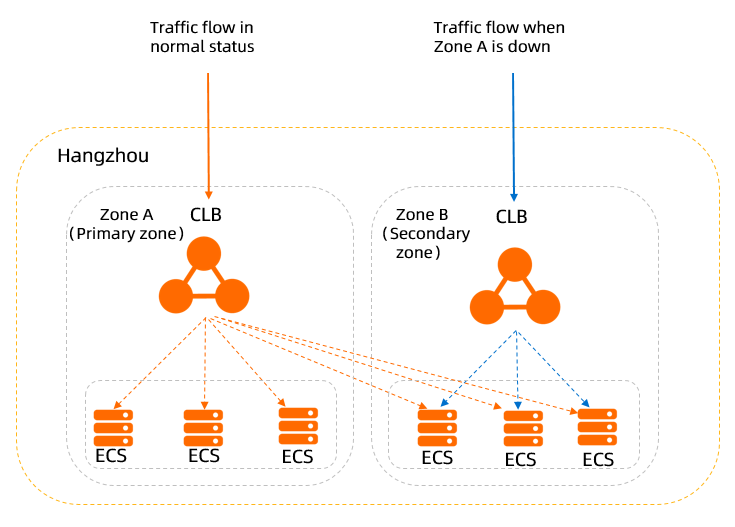
Under normal operation, CLB evenly distributes inbound traffic to ECS instances in both the primary zone (Zone A) and the secondary zone (Zone B). When the primary zone fails or has no healthy ECS instances, CLB automatically routes all traffic to the secondary zone within 30 seconds. When the primary zone recovers, CLB switches traffic back automatically.
Deploy at least one backend ECS instance in each zone to make full use of CLB's load balancing capabilities.
The following figure shows the recommended deployment: ECS instances in both zones receive traffic under normal conditions, and Zone B continues serving traffic if Zone A fails.
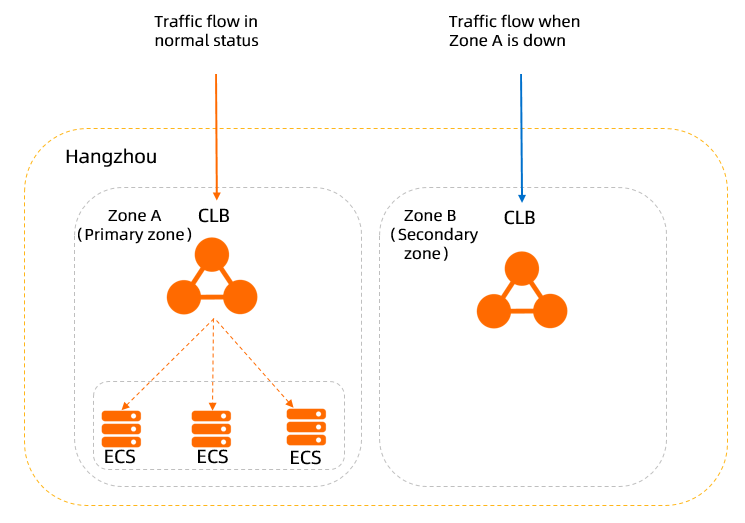
The following figure shows a single-zone deployment where all ECS instances are in the primary zone only. Under normal conditions, latency is lower because traffic stays within one zone. However, if Zone A fails, all ECS instances become unavailable and the service is interrupted.
Implement cross-region disaster recovery
Deploy CLB instances in different regions and add ECS instances from each region to the corresponding CLB instance. Use Alibaba Cloud DNS to resolve your domain names to the service addresses of CLB instances across regions, achieving global load balancing.
When a region becomes unavailable, stop DNS resolution for that region. Traffic is then redirected to CLB instances in other regions, and user access continues without interruption.