Anipop, a popular single-player game in China, frequently experiences traffic surges and high concurrency. To distribute traffic on demand, Anipop uses Application Load Balancer (ALB) to forward requests and elastically scale without manual capacity planning. This topic covers the pain points Anipop faced and the ALB solution architecture and benefits.
Pain points
During festivals and promotional events, Anipop experiences sharp traffic spikes. Its big data center analyzes game performance metrics and distributes traffic based on business requirements. However, because traffic volumes are difficult to predict in advance, engineers had to manually scale services during events based on region, time, and the number of connected devices.
IT O&M engineers often face the following challenges:
-
High O&M workload: Handling traffic surges, high concurrency, and high QPS requires managing multiple server groups for load balancing, which increases the O&M workload.
-
Manual intervention for critical services: During peak hours, O&M engineers must deploy two server groups and manually route requests by URL to protect critical services.
-
Limited Layer 7 routing capabilities: Some services require header-based routing, but limited Layer 7 capabilities force this logic to run on the server side.
Architecture
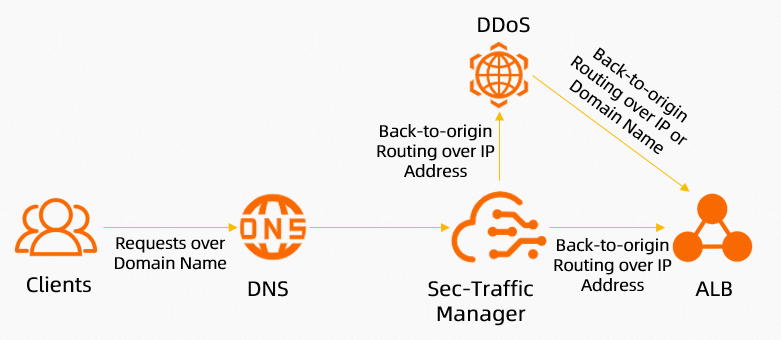
A single ALB instance can process up to one million Layer 7 queries per second and automatically scales with traffic. Anipop adopted ALB to improve traffic scheduling and handle surges and high concurrency without manual intervention. The following figure shows the solution architecture.
Benefits
-
High performance and high scalability: Each ALB instance can process up to one million queries per second, eliminating the need to estimate peak traffic. ALB automatically handles traffic surges based on business requirements.
-
Simplified O&M and reduced manpower: Anti-DDoS-scrubbed traffic routes directly to ALB. A single ALB instance replaces multiple load balancer instances, reducing O&M complexity.
-
Lower latency and better experience: URL-based forwarding rules on a server group route traffic by service priority, meeting customized traffic scheduling requirements.
-
Easy upgrades and future-proof design: ALB can serve as container Ingresses, enabling seamless upgrades to the latest containerization technologies.