Serverless App Engine (SAE) allows you to quickly migrate microservices applications to the cloud. You can configure flexible application start and stop settings to reduce resource and O&M costs. This topic describes how SAE helps Helian Health quickly migrate microservices applications to the cloud.
Background information
Zhejiang Helian Network Technology Co., Ltd. (hereinafter referred to as Helian Health) focuses on Internet healthcare and implements an integrated platform that can provide services for patients, doctors, and hospitals over the Internet. Helian Health has grown from an app provider into a one-stop hospital IoT application solution provider. Helian Health provides multiple apps for hospital Wi-Fi networks, patients, and medical personnel. The apps work together to provide household health management services.
Challenges
In the early stage of architecture optimization, Helian Health built the entire microservices architecture based on Elastic Compute Service (ECS). The following table describes the challenges faced by Helian Health when Helian Heath used the architecture. The table also describes the benefits of SAE.
Challenge | Benefit |
Low development iteration efficiency: The traditional development mode of Helian Health cannot support the rapid development of business. R&D engineers had to develop business and manage underlying components and perform O&M operations. The development efficiency was low. | SAE provides continuous integration or continuous delivery (CI/CD) capabilities. SAE can be integrated with Alibaba Cloud DevOps and Container Registry to provide Jenkins and on-premises integrated development environment (IDE) plug-ins. This helps you modify code and deploy applications to SAE in an efficient and quick manner. |
High system maintenance costs: Helian Health did not hire dedicated O&M engineers to maintain the complex system that is created based on open source microservices architectures and application performance management (APM) tools. As a result, the development and O&M costs are high. | SAE provides out-of-the-box application monitoring capabilities. You do not need to build a self-managed monitoring system. This significantly improves delivery efficiency. |
Low resource utilization: Helian Health had to retain a large number of subscription ECS instances based on business peaks. Helian Health is subject to obvious traffic fluctuations. In this case, the resource utilization during off-peak hours is low. The business of Helian Health rapidly changes. Once the business does not develop as expected, the purchased ECS instances may be idle for a long period of time. | SAE provides auto scaling policies to help you handle traffic fluctuations and ensure business stability. You can configure scheduled auto scaling policies and metric-based auto scaling policies. Metrics such as CPU utilization, memory usage, TCP connections, QPS, and RT are supported. SAE also supports one-click start and stop for development and test environments. This significantly improves resource utilization. You can configure health check probes to prevent online business from being affected during application release and scale processes. |
Low stability: The system scaling efficiency cannot be ensured during peak hours. Application release and restart may affect the stability of online business. | SAE supports features such as multi-zone deployment, health check, and backend automatic system inspection. You can contact SAE technical support throughout the entire process from development to O&M inspection. |
Solution
The following figure shows the solution that is used by Helian Health. 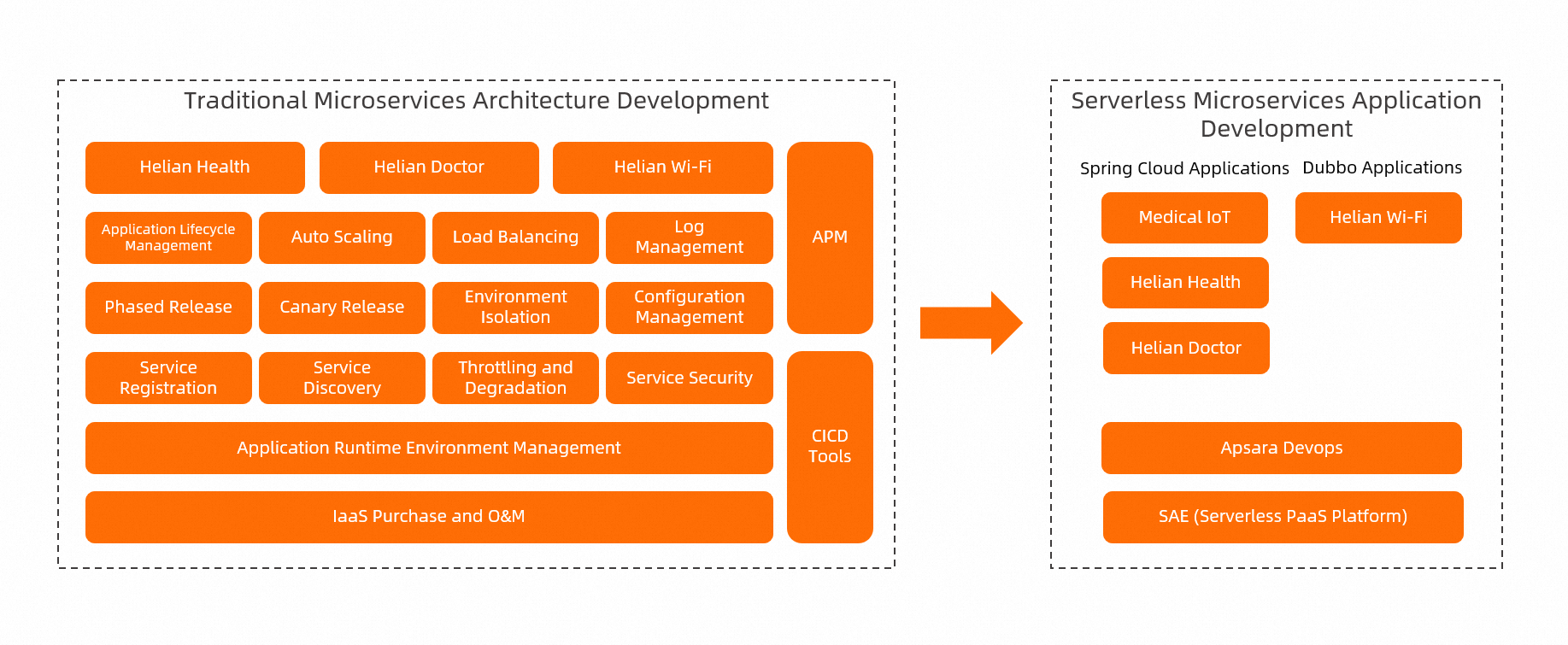
SAE is an application-oriented serverless PaaS. Helian Health does not need to manage or maintain the underlying infrastructure such as IaaS and Kubernetes clusters. This helps Helian Health reduce the learning costs of common microservices components, reduce O&M costs, improve the efficiency of development iteration and scaling, and reduce the costs of idle hardware. SAE helps Helian Health transform its development mode from traditional microservices architecture development to serverless microservices application development. Helian Health appropriately splits its business into multiple microservices applications and compresses the applications into code packages or images based on the Spring Cloud or Dubbo framework. Then, Helian Health deploys the applications to SAE. SAE provides the underlying O&M. Helian Health can use Alibaba Cloud DevOps to perform automatic deployment after Helian Health submits code.
Effect
Lower costs
SAE helps Helian Health reduce the costs of ECS instances that are required to construct applications based on a self-managed microservices architecture and APM tools. Helian Health does not need to install Server Guard agents on ECS instances. SAE supports auto scaling within seconds. This way, Helian Health can scale applications based on business requirements. SAE also provides the one-click start and stop feature for development and testing environments. This helps Helian Health significantly increase resource utilization.
Higher efficiency
SAE provides out-of-the-box microservices governance and application monitoring capabilities. Helian Health can quickly release new applications without the need to modify code. This helps Helian Health improve issue diagnostics efficiency and focus on business.
High scalability without affecting business
SAE allows Helian Health to configure multiple types of auto scaling policies, such as scheduled auto scaling policies and auto scaling policies that are triggered based on metrics such as CPU utilization and memory usage. Helian Health no longer needs to estimate resource capacity because SAE can perform auto scaling within seconds to ensure the SLA of business during peak hours. Helian Health can configure health check probes in SAE to perform automatic system inspection. This prevents business from being affected during application release and scale processes.
One-stop solution
SAE provides a one-stop cloud migration solution that automatically integrates Alibaba Cloud DevOps, Alibaba Cloud infrastructure services, such as Server Load Balancer (SLB), Simple Log Service, and CloudMonitor, and microservice peripheral services, such as Application Configuration Management (ACM), Application Real-Time Monitoring Service (ARMS), and Application High Availability Service (AHAS).