Tags let you organize and manage large numbers of ApsaraDB RDS for SQL Server instances. Each tag is a key-value pair attached to an instance—use the key to define a category (such as environment or team) and the value to specify the classification within that category (such as production or backend).
Limits
| Constraint | Detail |
|---|---|
| Tags per instance | Up to 20 |
| Tag key uniqueness | Each key must be unique per instance. A tag with a duplicate key overwrites the existing tag. |
| Batch operation limit | Up to 50 instances can be tagged in a single operation |
| Tag namespace scope | Regional. Instances in different regions do not share a tag namespace. |
| Tag deletion | When you remove a tag from an instance, ApsaraDB RDS deletes the tag if no other instance in the region uses it. |
Prerequisites
Before you begin, make sure you have:
An ApsaraDB RDS for SQL Server instance
The permissions to manage tags on RDS instances
Add a tag to an instance
Log on to the ApsaraDB RDS console. In the left-side navigation pane, click Instances. In the top navigation bar, select the region where your instance resides.
In the instance list, click the
 icon in the Tags column of the target instance. In the panel that appears, click Edit.
In the Configure Tags dialog box, set Tag Key and Tag Value, then click OK.
Add tags to multiple instances
Tag up to 50 instances at a time from the instance list.
Log on to the ApsaraDB RDS console. In the left-side navigation pane, click Instances. In the top navigation bar, select the region where your instances reside.
Select the instances you want to tag, then click Edit Tag below the instance list.
If Edit Tag is not visible, scroll to the bottom of the instance list.
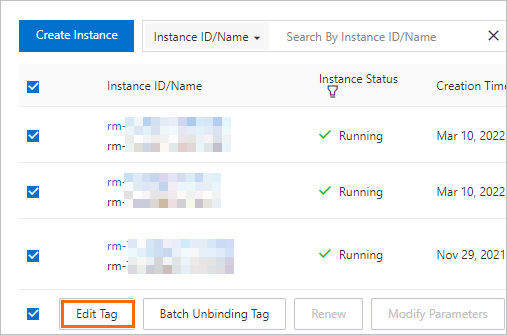
In the Configure Tags dialog box, set Tag Key and Tag Value, then click OK.
API reference
| Operation | Description |
|---|---|
| TagResources | Add tags to one or more ApsaraDB RDS instances. |