Quick BI lets you export dashboards, workbooks, and other reports as files for distribution, offline viewing, or archiving. Organization administrators configure allowed export types and channels on the export control page.
Access
On the Quick BI homepage, navigate to the export control page as shown below. This page contains Global settings, Basic settings, Standard export settings, and Self-service data retrieval settings.
Global Settings
Enable or disable resource exports and public link exports for the entire organization.

|
Parameter |
Description |
|
Allow export |
Controls whether users can export organization resources and self-service data retrieval files. Turning off this switch disables all exports and self-service data retrieval. |
|
Allow export from public links |
Controls exporting from public links for dashboards, workbooks, ad hoc analysis, and self-service data retrieval. Turning this off disables all public link exports. |
Basic Settings
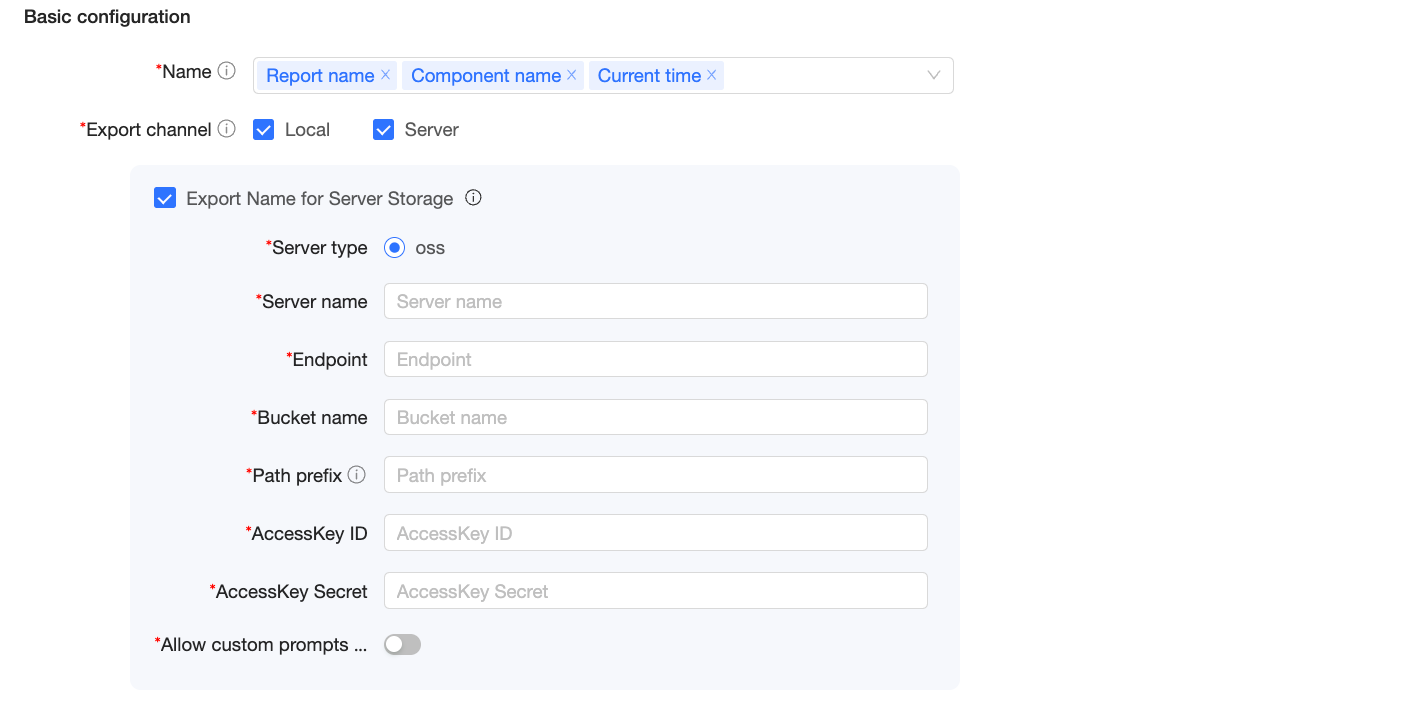
Customize the default file naming convention and set the export channel (local, server, or both).
|
Parameter |
Description |
|
|
Export file name |
Sets the default name for exported resources. Click the
|
|
|
Export channel |
Sets the export destination: local, server, or both.
|
|
|
Use export file name for server storage |
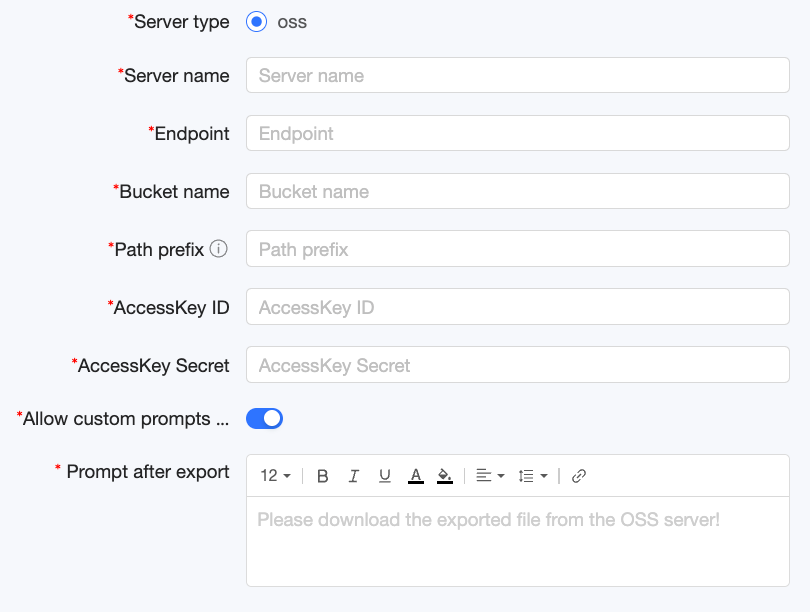
When server is selected as the export channel, applies the Export file name naming convention to server-stored files. When enabled, the naming rule is enforced and cannot be changed during export. The supported Server type is OSS. |
With Object Storage Service (OSS), exported reports are stored in a cloud bucket for internet-based access or integration with other cloud services. Configure the following parameters:
|
 icon to open the Field Expression Editor. Combine the following variables (separated by underscores) to build the file name: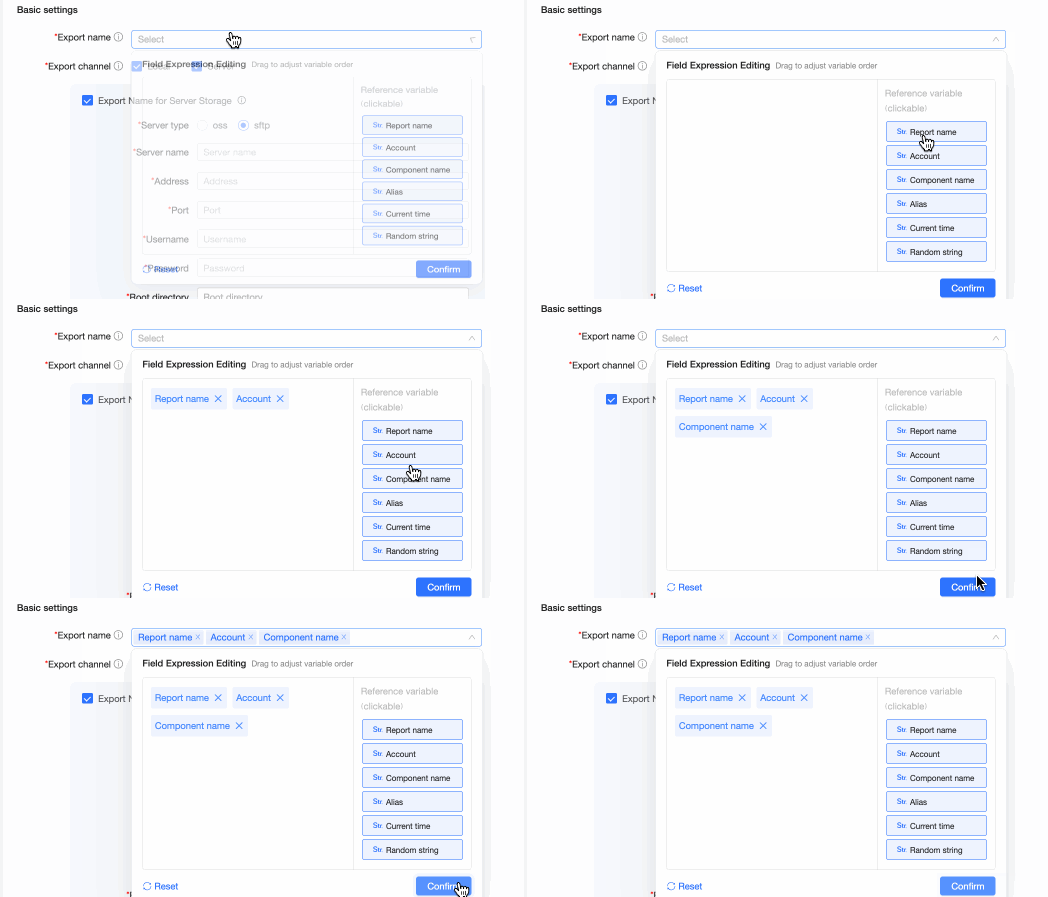
Standard Export Settings
Standard export lets you export data directly from the dashboard, suitable for datasets up to 10,000 rows.
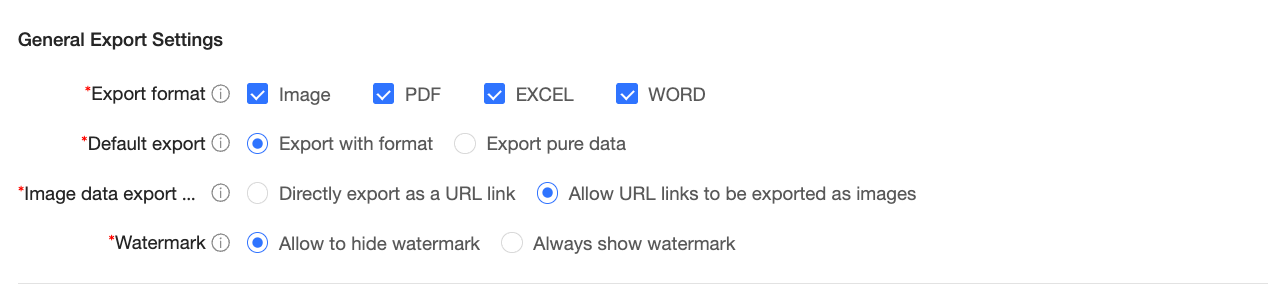
Configure export format, default export type, image data export method, and watermark settings to control export behavior.
-
If a crosstab contains more than 10,000 rows, you can export the large dataset by creating a self-service data retrieval task from the dashboard. This avoids reconfiguring fields on the self-service data retrieval page. For details, see Create a data retrieval task from a crosstab.
-
The standard export settings only apply to exports of up to 10,000 rows.
|
Parameter |
Description |
|
Export format |
File formats available for export: Image, PDF, Excel, and Word. Note
Only Xiao Q reports support export to Word format. |
|
Default export type |
When Excel is selected as an export format, specify whether exported files include formatting.
Note
|
|
Image data export method |
Available when Excel is selected with formatting enabled. Determines whether image fields are exported as embedded images in the Excel file.
Note
|
|
Watermark settings |
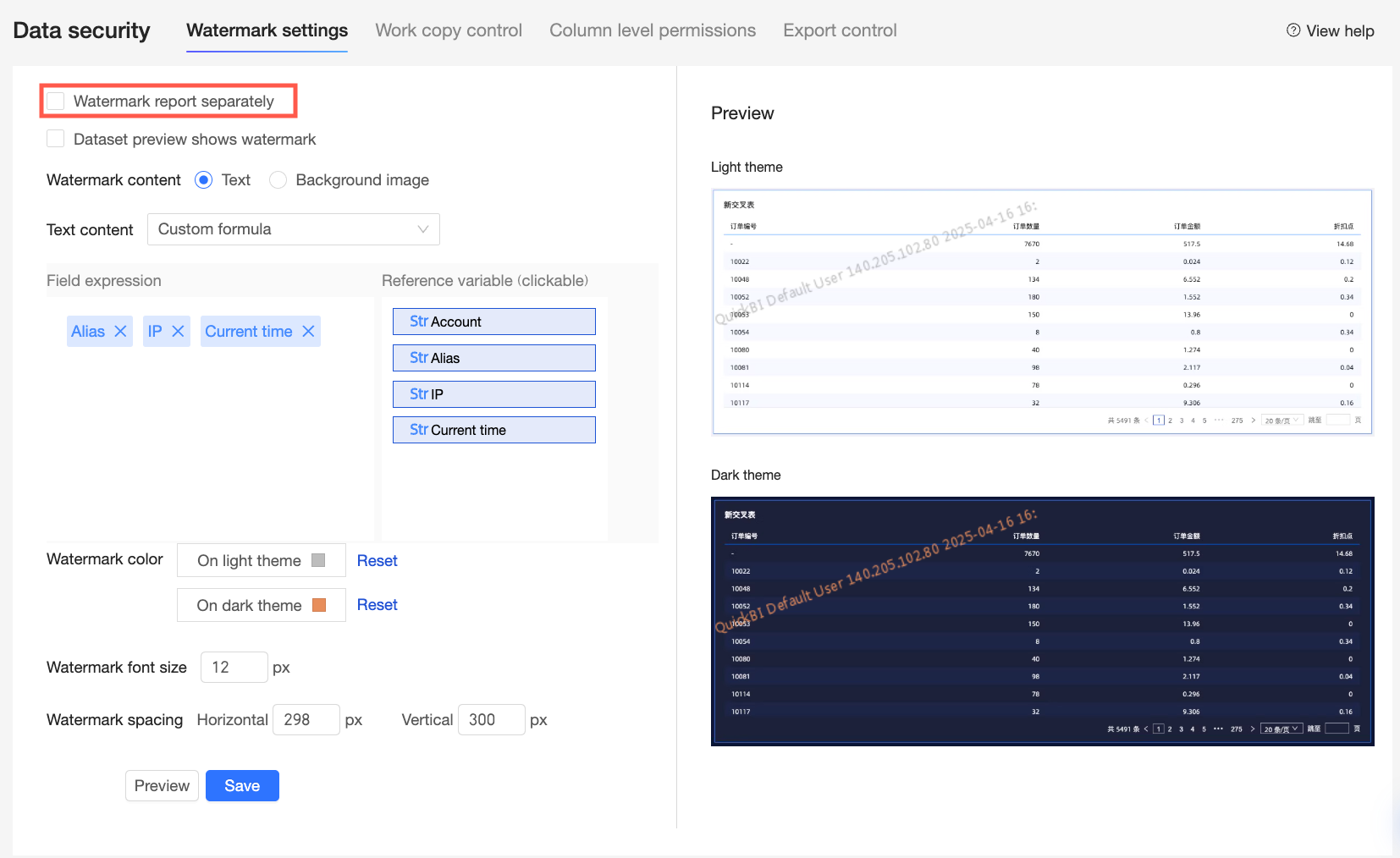
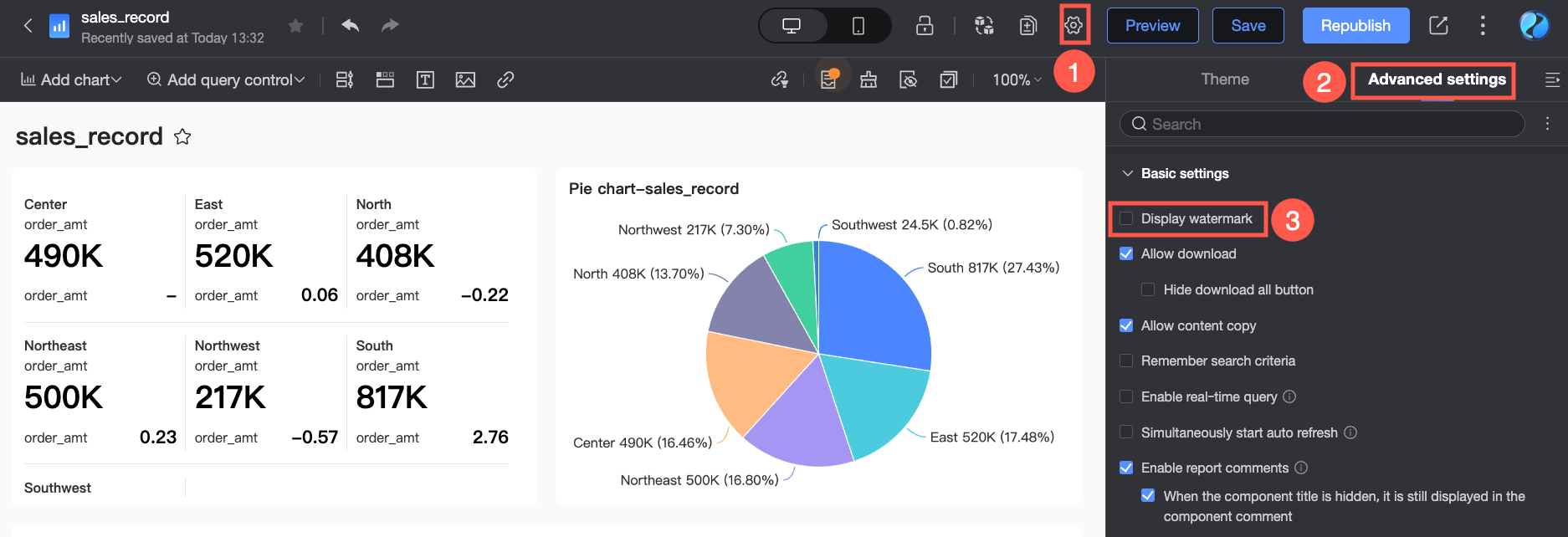
Controls whether users can hide watermarks. When the organizational watermark override is disabled, report creators cannot turn off Show watermark in the dashboard editor (Page Settings > Advanced > Basic Settings). |
Self-service Data Retrieval Settings
Self-service data retrieval handles large dataset exports containing millions of rows.

|
Parameter |
Description |
|
Self-service data retrieval file |
Sets the download limit for generated files. By default, files can be downloaded multiple times. Select Single use only to allow only one download, preventing unauthorized redistribution and reducing data leak risk. |
Related Operations
These settings apply organization-wide. Workspaces inherit them by default — if an export type is disabled here, it is also unavailable in workspace settings. You can still disable exports per workspace even when enabled at the organization level.
Configure workspace-level exports in Configure export control for a workspace.