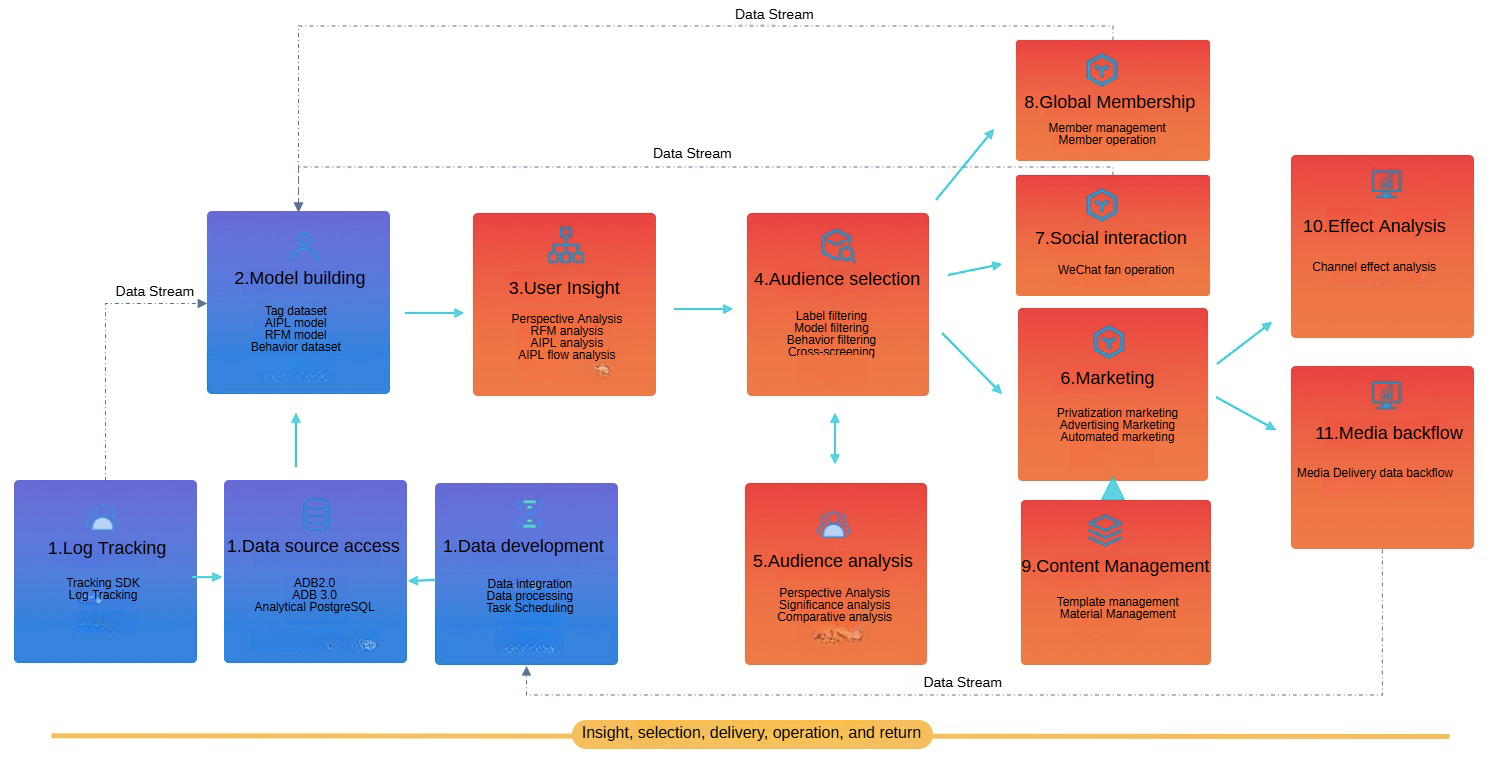
Quick Audience is an all-in-one consumer data platform that connects your marketing data, builds audience segments, and delivers targeted campaigns across channels—helping enterprise teams run more precise and efficient consumer operations.
Key concepts
Data source: Quick Audience uses an analytic database as the data source for analysis. All data to be analyzed or used for audience selection is stored in this database.
Dataset: A dataset is a mapping of a physical data table in Quick Audience. After you configure the field mappings for a physical table, you can save and generate a dataset. Quick Audience supports the following dataset types: user tag datasets, RFM models, Awareness-Interest-Purchase-Loyalty (AIPL) models, behavior datasets, and product tag datasets. Each type organizes and calculates data differently to serve specific analysis purposes. Datasets can be used directly for user analysis, ID push, audience filtering, and audience analysis—unlike raw data tables.
Audience: An audience is a collection of user IDs. Audiences can be generated through circle selection, manual upload, or the difference between existing audiences.
ID type: The type of identifier used to represent a user. For example, if a user is identified by a mobile phone number, the ID type is mobile phone number. Quick Audience supports the following ID types: OneID, UnionID, OpenID, mobile phone number, email address, Taobao ID, Taobao nickname, Alipay ID, Weibo ID, IMEI, IDFA, IMSI, OAID, and MAC address.
Benefits
With Quick Audience, you can:
Gain multi-dimensional marketing insights by connecting your marketing data and running flexible audience analysis across tags, models, and behaviors.
Reach consumers across channels—advertising platforms, social networks, e-commerce, and private domain apps—from a single platform.
Run marketing automation workflows that span multiple channels without manual handoffs.
Tap into the Ali economy multi-marketing platform to unlock multi-platform marketing capabilities.
Functions and features
-
User insight:
Data source configuration: Import and manage data sources. Supported types include AnalyticDB for MySQL 2.0, AnalyticDB for MySQL 3.0, and AnalyticDB for PostgreSQL.
Dataset management: Configure and manage user tag datasets, RFM models, AIPL models, behavior datasets, and product tag datasets. Set management permissions, usage permissions, and row-level permissions for individual users or user groups.
User analysis: Run crowd analysis, RFM analysis, AIPL user analysis, and AIPL flow analysis.
Audience filtering: Filter audiences by tags, models (RFM, AIPL), behaviors, and cross-dimensional criteria.
Audience management: Analyze, edit, download, update, and push audiences to destinations such as DataBank, Damodisk, and Kafka.
Audience analysis: Analyze audiences using tag insights, significance analysis, and RFM analysis.
Asset management: View tag popularity by category, statistical period, and dataset. Customize tags to match your business needs.
Marketing activities: Manage the full lifecycle of marketing activities from a unified campaign perspective.
Global marketing: Push consumer data to Alibaba Brand DataBank and Damodisk with one click to build global consumer data assets and improve omnichannel brand operations.
-
User marketing:
Marketing delivery: Deliver to targeted audiences and content across multiple channels, including privatization channels, advertising channels, and private domain placements.
Marketing automation: Use the built-in marketing automation engine and a library of marketing components to design custom workflows and execute campaigns automatically.
Media return: Return and analyze ad performance data—including display and click data from Tencent ad feeds and interest-based media delivery monitoring. Generate multi-dimensional report analysis and tags from ad behavior for downstream re-engagement.
Kanban: Manage and view custom reports through Quick BI authorization to gain insight into brand operation data.
Data collection: Collect and automatically process user behavior data from apps, then convert it into behavior datasets for re-engagement campaigns.
Social interaction: Operate WeChat official accounts across multiple brands and accounts. Run personalized campaigns for specific fan segments and manage enterprise private domain traffic.
Repurchase prediction
Product recommendation: Analyze relationships between users and products—and between products—using a training algorithm model based on past purchase behavior, to improve operational efficiency and brand repurchase performance.
Global Insight: Provide business teams—including product and operations staff—with global tags for user segmentation and analysis of existing users, supporting refined operational strategies.
Member Center: Configure member levels, member benefits, member tasks, and member marketing campaigns. Set rules for earning and redeeming points to improve member engagement and repurchase rates.
Intelligent shopping guide: The intelligent shopping guide enterprise micro version is a customer management system built for store shopping guides, deeply integrated with WeCom (Enterprise WeChat). Shopping guides access the system through a WeCom mini-program—no app download required. Daily operation reminders, shopping guide tasks, and coupon campaigns help stores better engage consumers.
Smart Retail: Support chain retailers in building brand online e-commerce capabilities, enabling online-offline synergy and complementary traffic distribution.
Global membership: Support user access from all channels, establish customer lifecycle management, identify and analyze consumer preferences, and apply data-driven precision marketing based on user interaction insights.