This page presents Online Transactional Processing (OLTP) benchmark results comparing PolarDB for PostgreSQL 16 with a comparable PostgreSQL 16 cloud-native database under identical hardware configurations. Across all seven Sysbench OLTP scenarios, PolarDB for PostgreSQL consistently delivers significantly higher throughput.
These results are most relevant if your workload involves high-concurrency OLTP — such as frequent inserts, indexed and non-indexed updates, or mixed read/write transactions — at 256 concurrent connections and with datasets in the hundreds of gigabytes.
Sysbench measures synthetic workloads. Use these numbers as directional guidance, and validate with your own schema and query patterns before making deployment decisions.
How it works
PolarDB for PostgreSQL's performance advantage in OLTP workloads comes from a layered set of architectural choices rather than isolated tuning.
At the hardware layer, PolarDB for PostgreSQL uses Optane persistent memory with a 3D XPoint storage medium, NVMe SSDs, and RoCE Remote Direct Memory Access (RDMA) networks. This combination pushes I/O bandwidth and network latency well beyond what conventional storage stacks deliver.
On top of that hardware, PolarDB implements a complete I/O and network protocol stack that runs entirely in user mode, bypassing kernel context-switch overhead. This design allows the hardware capabilities to translate into lower end-to-end latency.
For transaction management, PolarDB replaces native PostgreSQL's xid-based transaction tracking with Commit Sequence Number (CSN) — a monotonically increasing 64-bit integer. Under high concurrency, CSN eliminates the bottlenecks that xid wraparound and visibility checks introduce in standard PostgreSQL, which is why the write and mixed workload gains are especially pronounced.
Finally, pre-read, pre-extension, and rel_size_cache technologies reduce unnecessary I/O round trips during sequential access patterns, compounding the gains from the layers below.
Test environment and specifications
Both databases ran on equivalent hardware. The only intentional difference was the disk performance configuration.
| Description | PolarDB for PostgreSQL | Comparable PostgreSQL cloud-native database |
|---|---|---|
| Cores + Memory | 8 cores 64 GB | 8 cores 64 GB |
| Concurrency | 256 | 256 |
| PostgreSQL version | 16.10 | 16.10 |
| Disk performance level | PSL5 | Default configurations |
Both PolarDB for PostgreSQL 16 and the comparable PostgreSQL 16 cloud-native database use default kernel parameters.
For full details on how to replicate these tests, see Performance test method (OLTP).
Test workloads
The benchmark uses Sysbench with seven OLTP scenarios across three workload categories.
| Category | Scenario | What it tests |
|---|---|---|
| Write | oltp_insert |
Inserts rows into a table |
| Write | oltp_update_index |
Updates rows in an indexed table |
| Write | oltp_update_non_index |
Updates rows in a non-indexed table |
| Write | oltp_write_only |
Mixed inserts, updates, and deletes |
| Read | oltp_point_select |
Point queries |
| Read | oltp_read_only |
Point queries and range queries |
| Read/write | oltp_read_write |
Combined oltp_write_only and oltp_read_only |
Metric
Transactions per second (TPS): the number of transactions the database executes per second, counted by successful COMMITs.
Test data volume
| Parameter | Value |
|---|---|
| Number of tables | 8 |
| Number of rows | 64,000,000 |
| Total data volume | 128 GB |
Performance results
Write scenarios
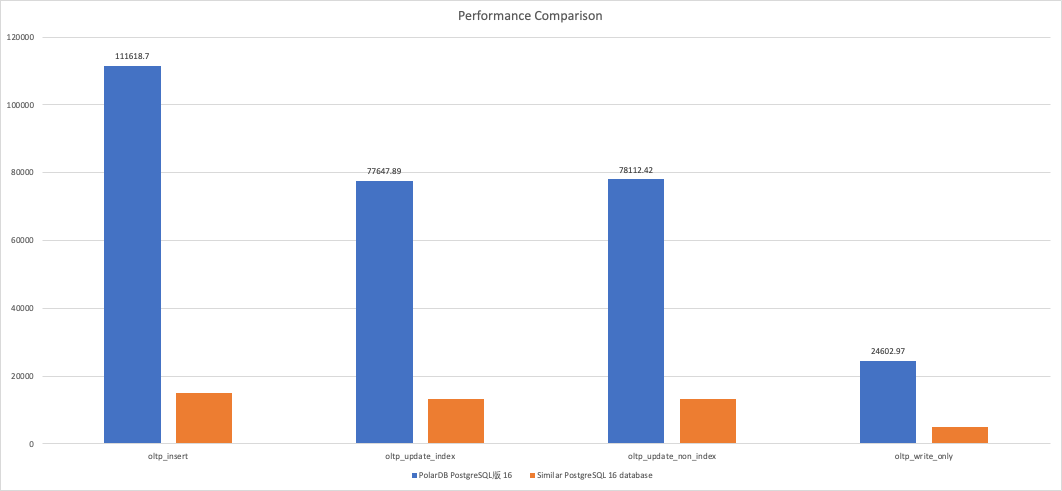
| Scenario | PolarDB for PostgreSQL 16 (TPS) | Comparable PostgreSQL 16 cloud-native database (TPS) |
|---|---|---|
oltp_insert |
111,618.70 | 15,064.65 |
oltp_update_index |
77,647.89 | 13,310.46 |
oltp_update_non_index |
78,112.42 | 13,297.03 |
oltp_write_only |
24,602.97 | 4,932.72 |
Read scenarios
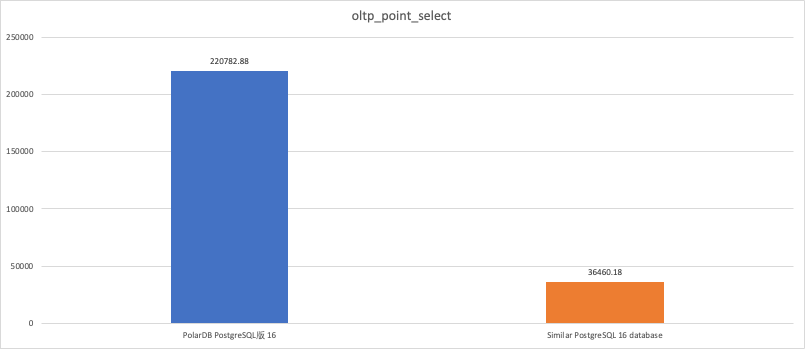
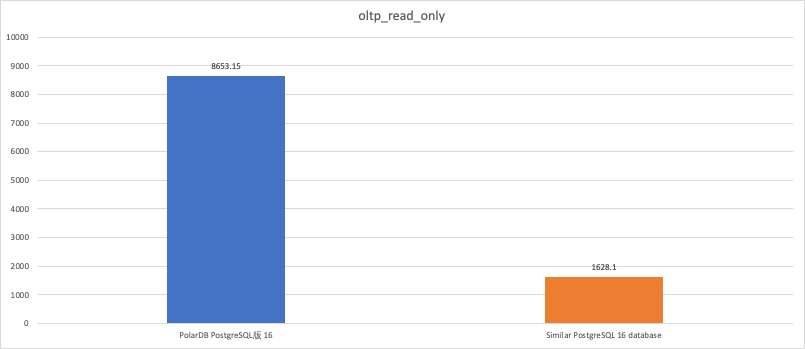
| Scenario | PolarDB for PostgreSQL 16 (TPS) | Comparable PostgreSQL 16 cloud-native database (TPS) |
|---|---|---|
oltp_point_select |
220,782.88 | 36,460.18 |
oltp_read_only |
8,653.15 | 1,628.10 |
Read/write mix scenario
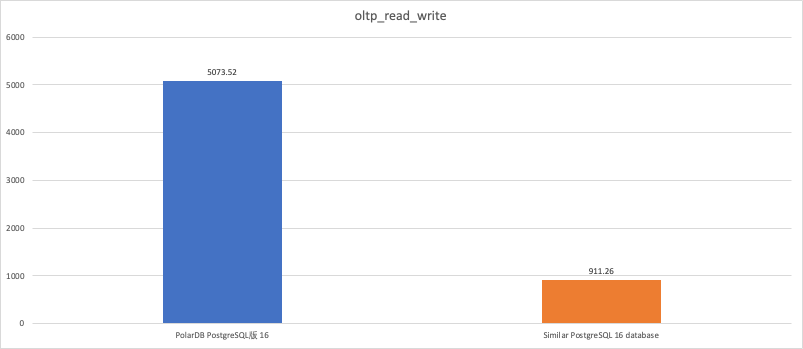
| Scenario | PolarDB for PostgreSQL 16 (TPS) | Comparable PostgreSQL 16 cloud-native database (TPS) |
|---|---|---|
oltp_read_write |
5,073.52 | 911.26 |
What's next
-
Performance test method (OLTP) — step-by-step instructions to run these tests in your own environment