PolarDB for PostgreSQL (Compatible with Oracle) uses PolarFileSystem (PFS) as its storage layer. PFS differs from standard file systems: it is optimized for large sequential reads but carries high overhead for small, frequent page extensions. To match these I/O characteristics, PolarDB introduces three optimizations—heap table read-ahead, heap table pre-extension, and index creation pre-extension—all enabled by default. Together, these features double or triple sequential scan and vacuum throughput, double data-loading throughput, and improve index creation speed by 30%.
Prerequisites
Before you begin, ensure that your cluster meets the following requirement:
PolarDB for PostgreSQL (Compatible with Oracle) 2.0, revision version 2.0.14.5.1.0 or later
To check your revision version, run:
SHOW polardb_version;Alternatively, check the version in the PolarDB console. If you need to upgrade, see Upgrade the version.
Overview
PostgreSQL reads and writes data in 8 KB pages. Standard file systems handle these small operations efficiently, but PFS has two constraints that make 8 KB operations expensive:
PFS incurs high metadata overhead per page extension.
PFS requires page extensions to be a multiple of 4 MB.
In PostgreSQL, the minimum size for page extension must be a multiple of 8 MB, which is not compatible with PFS and causes performance degradation when writing tables or creating indexes.
Reading data in 8 KB chunks is also inefficient on PFS, which performs best with large sequential reads.
The three features address these constraints:
| Feature | Addresses | Default parameter | Default value | Performance impact |
|---|---|---|---|---|
| Heap table read-ahead | Sequential scan, vacuum, index creation | polar_bulk_read_size | 128 KB | 2x–3x for vacuum and sequential scan; +18% for index creation |
| Heap table pre-extension | Data loading and frequent writes | polar_heap_bulk_extend_size | 4 MB | 2x for data loading |
| Index creation pre-extension | B-tree, GIN, GiST, SP-GiST, and Bloom index creation | polar_index_bulk_extend_size | 4 MB | +30% for index creation |
All three features are enabled by default. The default values are tuned to PFS and represent the performance ceiling—increasing them beyond these values produces no further improvement. Only disable a feature if you have a specific operational reason.
How it works
Heap table read-ahead
PostgreSQL normally loads pages into the buffer pool one 8 KB page at a time. On PFS, this small-read pattern is inefficient. When two or more pages need to be read, PolarDB batches them into a single 128 KB read, reducing the total number of I/O operations.
The process runs in four steps:
Allocate N buffers from the buffer pool.
Allocate a contiguous memory region of
N × page sizeusingpalloc, referred to asp.Read
N × page sizeof data from the heap table intopusing PFS.Copy the N pages from
pinto the N buffers.
Subsequent reads for those pages hit the buffer pool directly, eliminating further disk I/O.
The following diagram shows the data flow:

Heap table pre-extension
In standard PostgreSQL, extending a tablespace applies and extends 8 KB pages one by one. Even with batch extension, N pages still require N I/O operations. On PFS, where the minimum extension size is 4 MB, this results in excessive I/O overhead.
Heap table pre-extension resolves this by extending 4 MB at a time using PFS's bulk write interface. The process runs in three steps:
Allocate N buffers from the buffer pool without triggering any file system extension.
Extend the file by writing all-zero pages in a single batch using the PFS file write interface.
Initialize the pages one by one, identify available space, and end the pre-extension.
Index creation pre-extension
Index creation pre-extension follows the same approach as heap table pre-extension, but skips the buffer allocation step because indexes are built in the buffer pool before being flushed to disk.
The process runs in two steps:
Extend the file by writing all-zero pages in a single batch using the PFS file write interface.
Write the index pages built in the buffer pool to the file system.
Supported index types: B-tree, GIN, GiST, SP-GiST, and Bloom.
In older versions of PolarDB for PostgreSQL (Compatible with Oracle), index creation pre-extension supports only B-tree indexes.
Configure read-ahead and pre-extension
Heap table read-ahead
The polar_bulk_read_size parameter controls heap table read-ahead. The default value is 128 KB, which is the optimal value for PFS. Increasing beyond 128 KB produces no further improvement.
To disable heap table read-ahead:
ALTER SYSTEM SET polar_bulk_read_size = 0;
SELECT pg_reload_conf();
To re-enable heap table read-ahead at the default size:
ALTER SYSTEM SET polar_bulk_read_size = '128 KB';
SELECT pg_reload_conf();
To verify the current value:
SHOW polar_bulk_read_size;Heap table pre-extension
The polar_heap_bulk_extend_size parameter controls heap table pre-extension. The default value is 4 MB, which is the optimal value for PFS. Increasing beyond 4 MB produces no further improvement.
In older versions of PolarDB for PostgreSQL (Compatible with Oracle), the equivalent parameter is polar_bulk_extend_size.To disable heap table pre-extension:
ALTER SYSTEM SET polar_heap_bulk_extend_size = 0;
SELECT pg_reload_conf();
To re-enable heap table pre-extension at the default size:
ALTER SYSTEM SET polar_heap_bulk_extend_size = '4 MB';
SELECT pg_reload_conf();
To verify the current value:
SHOW polar_heap_bulk_extend_size;Index creation pre-extension
The polar_index_bulk_extend_size parameter controls index creation pre-extension. The default value is 4 MB, which is the optimal value for PFS. Increasing beyond 4 MB produces no further improvement.
In older versions of PolarDB for PostgreSQL (Compatible with Oracle), the equivalent parameter is polar_index_create_bulk_extend_size. Only B-tree indexes were supported in those versions.To disable index creation pre-extension:
ALTER SYSTEM SET polar_index_bulk_extend_size = 0;
SELECT pg_reload_conf();
To re-enable index creation pre-extension at the default size:
ALTER SYSTEM SET polar_index_bulk_extend_size = '4 MB';
SELECT pg_reload_conf();
To verify the current value:
SHOW polar_index_bulk_extend_size;Performance benchmarks
The following benchmarks were measured on a PolarDB for PostgreSQL (Compatible with Oracle) cluster running PostgreSQL 14, with 8 cores and 32 GB of memory, using a 400 GB pgbench dataset.
Heap table read-ahead
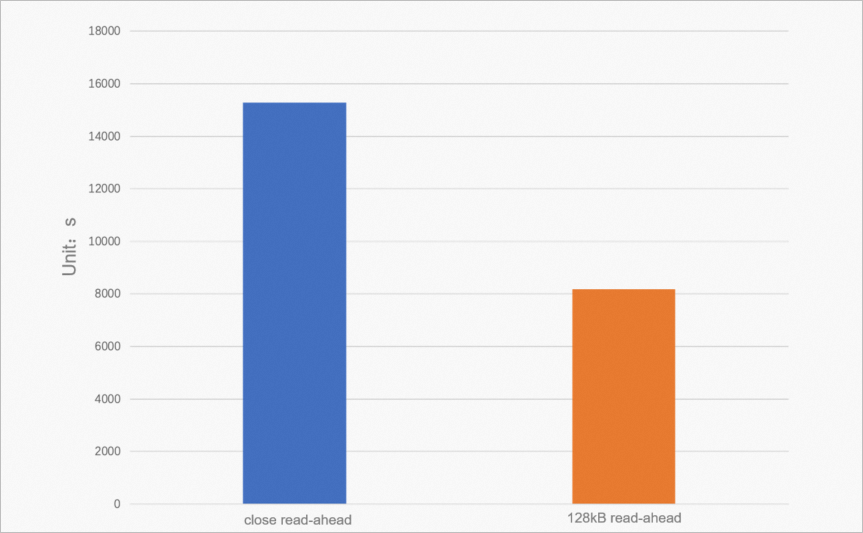
Performance comparison for vacuum on a 400 GB table:
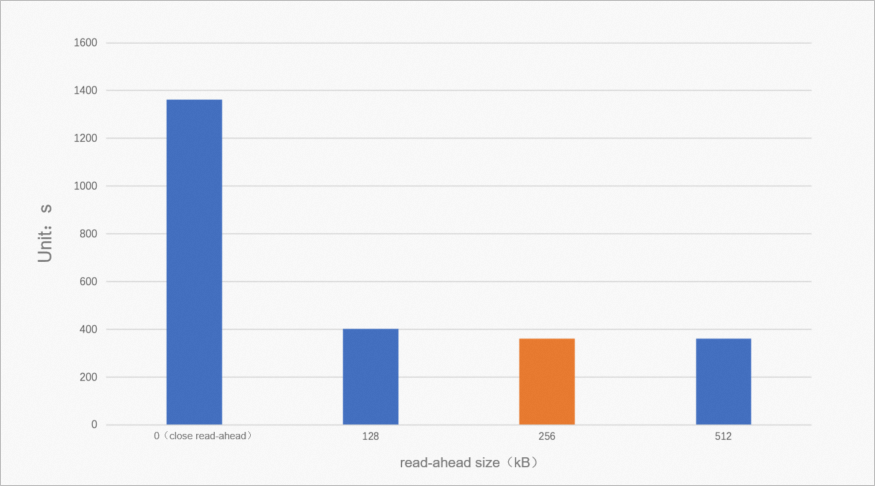
Performance comparison for sequential scan on a 400 GB table:
Conclusions:
Heap table read-ahead doubles or triples vacuum and sequential scan performance.
Increasing
polar_bulk_read_sizebeyond the default 128 KB produces no further improvement.
Heap table pre-extension
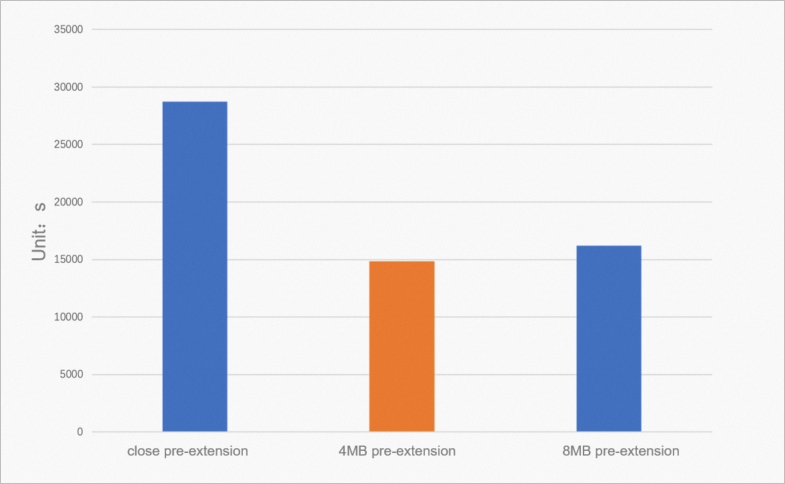
Performance comparison for data loading on a 400 GB table:
Conclusions:
Heap table pre-extension doubles data loading performance.
Increasing
polar_heap_bulk_extend_sizebeyond the default 4 MB produces no further improvement.
Index creation pre-extension
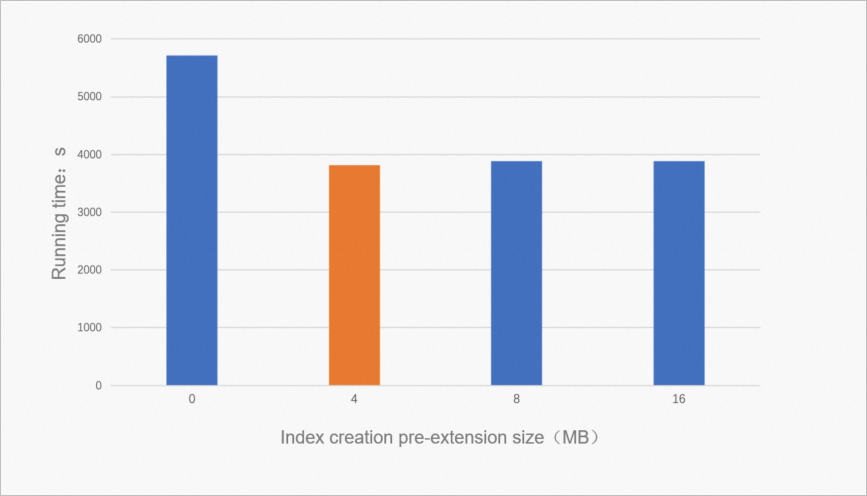
Performance comparison for creating indexes on a 400 GB table:
Conclusions:
Index creation pre-extension increases index creation performance by 30%.
Increasing
polar_index_bulk_extend_sizebeyond the default 4 MB produces no further improvement.