When two partitioned tables are joined, the query planner by default merges all partition data first and then applies the join condition — including partition pairs whose key ranges never overlap. Partition-wise join eliminates this overhead by splitting the join into independent, per-partition operations. Each partition from one table is joined only with the corresponding partition from the other table, skipping all combinations that can never produce matching rows.
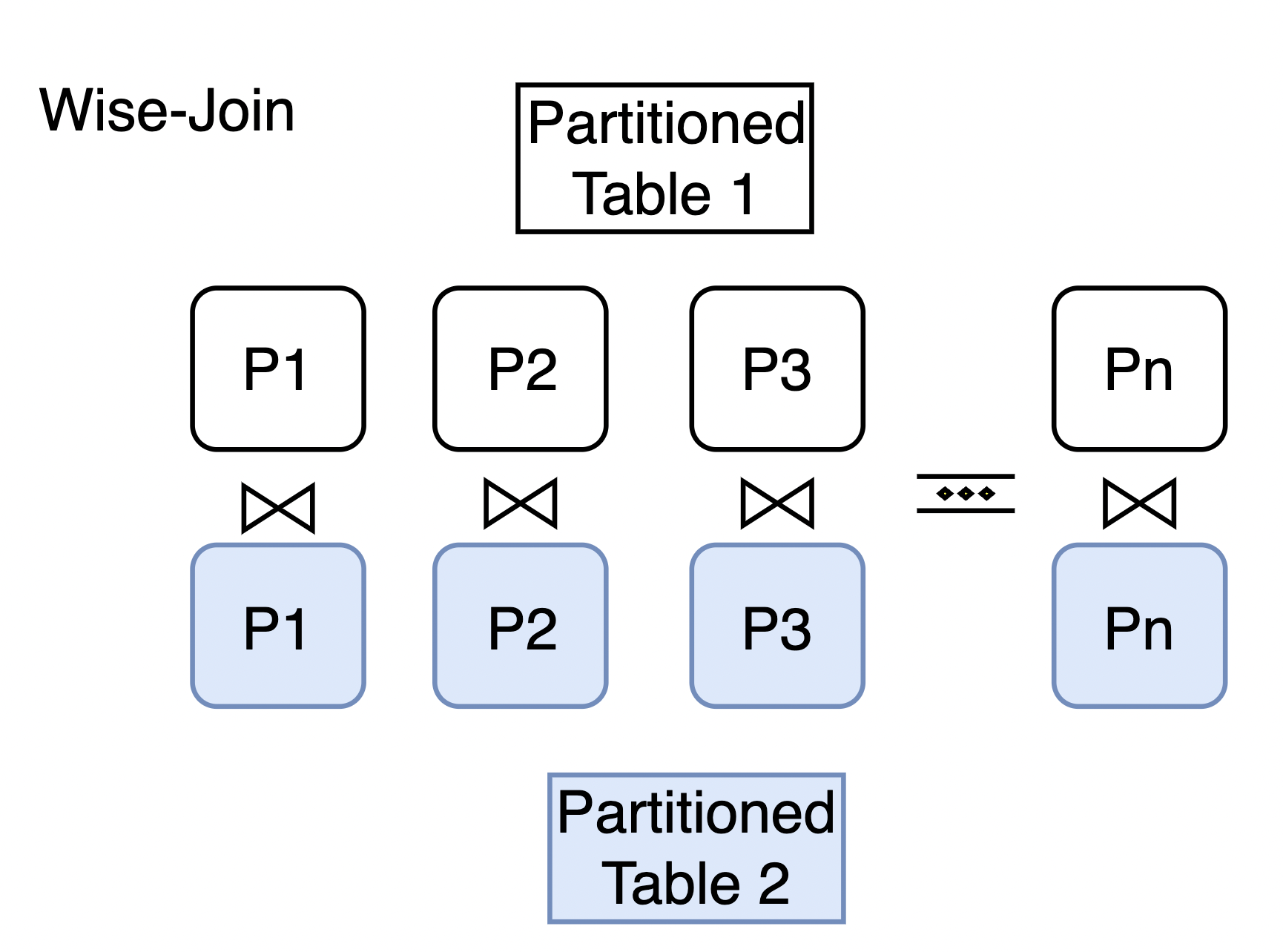
How it works
The query planner detects when two partitioned tables share the same partition key with compatible data types and a one-to-one partition mapping. Instead of a single large join across all partitions, the planner generates one join per matching partition pair. Partition combinations with non-overlapping key ranges are skipped entirely.
Without partition-wise join, the planner performs a single join over all partitions of both tables — including pairs that always produce empty results because their key ranges do not overlap.
Enable partition-wise join
Run the following statement to enable partition-wise join for the current session:
SET enable_partitionwise_join TO ON;Example: compare execution plans
The following example shows how partition-wise join changes the execution plan for a join between two range-partitioned tables.
Set up the tables
CREATE TABLE measurement (
    city_id   int not null,
    logdate   date not null,
    peaktemp  int,
    unitsales int
) PARTITION BY RANGE (logdate);

CREATE TABLE measurement_y2023q1 PARTITION OF measurement
    FOR VALUES FROM ('2023-01-01') TO ('2023-04-01');
CREATE TABLE measurement_y2023q2 PARTITION OF measurement
    FOR VALUES FROM ('2023-04-01') TO ('2023-07-01');
CREATE TABLE measurement_y2023q3 PARTITION OF measurement
    FOR VALUES FROM ('2023-07-01') TO ('2023-10-01');
CREATE TABLE measurement_y2023q4 PARTITION OF measurement
    FOR VALUES FROM ('2023-10-01') TO ('2024-04-01');

CREATE TABLE sales (
    dept_no  number,
    part_no  varchar2,
    country  varchar2(20),
    date     date,
    amount   number
) PARTITION BY RANGE (date);

CREATE TABLE sales_y2023q1 PARTITION OF sales
    FOR VALUES FROM ('2023-01-01') TO ('2023-04-01');
CREATE TABLE sales_y2023q2 PARTITION OF sales
    FOR VALUES FROM ('2023-04-01') TO ('2023-07-01');
CREATE TABLE sales_y2023q3 PARTITION OF sales
    FOR VALUES FROM ('2023-07-01') TO ('2023-10-01');
CREATE TABLE sales_y2023q4 PARTITION OF sales
    FOR VALUES FROM ('2023-10-01') TO ('2024-04-01');
Both measurement and sales have four quarterly partitions covering 2023. The join condition a.date = b.logdate maps to the partition key of each table, satisfying the requirements for partition-wise join.
Run EXPLAIN
EXPLAIN SELECT a.* FROM sales a JOIN measurement b ON a.date = b.logdate WHERE b.unitsales > 10;Without partition-wise join (default):
                                            QUERY PLAN
--------------------------------------------------------------------------------------------------
 Aggregate  (cost=871.75..871.76 rows=1 width=8)
   ->  Merge Join  (cost=448.58..812.79 rows=23587 width=32)
         Merge Cond: (a.date = b.logdate)
         ->  Sort  (cost=185.83..191.03 rows=2080 width=40)
               Sort Key: a.date
               ->  Append  (cost=0.00..71.20 rows=2080 width=40)
                     ->  Seq Scan on sales_y2023q1 a  (cost=0.00..15.20 rows=520 width=40)
                     ->  Seq Scan on sales_y2023q2 a_1  (cost=0.00..15.20 rows=520 width=40)
                     ->  Seq Scan on sales_y2023q3 a_2  (cost=0.00..15.20 rows=520 width=40)
                     ->  Seq Scan on sales_y2023q4 a_3  (cost=0.00..15.20 rows=520 width=40)
         ->  Sort  (cost=262.75..268.42 rows=2268 width=8)
               Sort Key: b.logdate
               ->  Append  (cost=0.00..136.34 rows=2268 width=8)
                     ->  Seq Scan on measurement_y2023q1 b  (cost=0.00..31.25 rows=567 width=8)
                           Filter: (unitsales > 10)
                     ->  Seq Scan on measurement_y2023q2 b_1  (cost=0.00..31.25 rows=567 width=8)
                           Filter: (unitsales > 10)
                     ->  Seq Scan on measurement_y2023q3 b_2  (cost=0.00..31.25 rows=567 width=8)
                           Filter: (unitsales > 10)
                     ->  Seq Scan on measurement_y2023q4 b_3  (cost=0.00..31.25 rows=567 width=8)
                           Filter: (unitsales > 10)
(21 rows)
The planner uses a single Merge Join across all four partitions from both tables. This includes pairs that always produce empty results — for example, sales_y2023q1 (Q1 data) joined with measurement_y2023q3 (Q3 data) can never match because the partition key ranges do not overlap.
Enable partition-wise join, then run the same query:
SET enable_partitionwise_join TO ON;With partition-wise join enabled:
                                       QUERY PLAN
----------------------------------------------------------------------------------------
 Append  (cost=21.70..453.33 rows=5896 width=128)
   ->  Hash Join  (cost=21.70..105.96 rows=1474 width=128)
         Hash Cond: (b.logdate = a.date)
         ->  Seq Scan on measurement_y2023q1 b  (cost=0.00..31.25 rows=567 width=8)
               Filter: (unitsales > 10)
         ->  Hash  (cost=15.20..15.20 rows=520 width=128)
               ->  Seq Scan on sales_y2023q1 a  (cost=0.00..15.20 rows=520 width=128)
   ->  Hash Join  (cost=21.70..105.96 rows=1474 width=128)
         Hash Cond: (b_1.logdate = a_1.date)
         ->  Seq Scan on measurement_y2023q2 b_1  (cost=0.00..31.25 rows=567 width=8)
               Filter: (unitsales > 10)
         ->  Hash  (cost=15.20..15.20 rows=520 width=128)
               ->  Seq Scan on sales_y2023q2 a_1  (cost=0.00..15.20 rows=520 width=128)
   ->  Hash Join  (cost=21.70..105.96 rows=1474 width=128)
         Hash Cond: (b_2.logdate = a_2.date)
         ->  Seq Scan on measurement_y2023q3 b_2  (cost=0.00..31.25 rows=567 width=8)
               Filter: (unitsales > 10)
         ->  Hash  (cost=15.20..15.20 rows=520 width=128)
               ->  Seq Scan on sales_y2023q3 a_2  (cost=0.00..15.20 rows=520 width=128)
   ->  Hash Join  (cost=21.70..105.96 rows=1474 width=128)
         Hash Cond: (b_3.logdate = a_3.date)
         ->  Seq Scan on measurement_y2023q4 b_3  (cost=0.00..31.25 rows=567 width=8)
               Filter: (unitsales > 10)
         ->  Hash  (cost=15.20..15.20 rows=520 width=128)
               ->  Seq Scan on sales_y2023q4 a_3  (cost=0.00..15.20 rows=520 width=128)
(25 rows)
The planner generates four independent Hash Joins — one per quarter. Each sales partition is joined only with the measurement partition covering the same date range (sales_y2023q1 with measurement_y2023q1, and so on). The estimated row count drops from 23,587 to 5,896, reflecting the elimination of cross-partition join overhead.