ST_AsMVT3D is an aggregate function that encodes rows containing 3D geometry into a Mapbox Vector Tile (MVT) binary. It returns a bytea value representing one MVT layer.
Syntax
bytea ST_AsMVT3D(anyelement set row)
bytea ST_AsMVT3D(anyelement row, text name)
bytea ST_AsMVT3D(anyelement row, text name, integer extent)
bytea ST_AsMVT3D(anyelement row, text name, integer extent, text geom_name)
bytea ST_AsMVT3D(anyelement row, text name, integer extent, text geom_name, text feature_id_name)
Parameters
| Parameter | Type | Description | Default |
|---|---|---|---|
row | anyelement | A row that contains at least one 3D geometry column. | — |
name | text | The name of the MVT layer. | Default |
extent | integer | The tile resolution in screen-space units. Valid values: 256–8192. | 4096 |
geom_name | text | The name of the geometry column in the row. | Name of the first geometry column |
feature_id_name | text | The name of the feature ID column. Set to NULL or a negative value to omit the feature ID. | — |
How it works
Generating a 3D MVT tile requires two functions in sequence:
ST_AsMVTGeom3D — clips 3D geometries to the tile boundary, transforms coordinates to tile space, and quantizes them. Call this first.
ST_AsMVT3D — takes the prepared rows and encodes them into the MVT binary format. Call this as the aggregate step.
A typical query follows this pattern:
WITH mvtgeom AS (
  SELECT ST_AsMVTGeom3D(geom, ST_TileEnvelope(z, x, y)) AS geom,
         name, category
  FROM   my_3d_features
  WHERE  geom && ST_TileEnvelope(z, x, y)
)
SELECT ST_AsMVT3D(mvtgeom.*)
FROM   mvtgeom;
To combine multiple layers into a single tile, use || or STRING_AGG:
SELECT ST_AsMVT3D(a.*) || ST_AsMVT3D(b.*) AS tile
FROM   layer_a a, layer_b b;
Z-axis encoding
ST_AsMVT3D extends the standard MVT specification with 3D support using the following encoding rules:
CommandID encoding: 3D geometries use
MoveTo3D(command ID 5) andLineTo3D(command ID 6) with interleavedXYZXYZ...coordinate sequences.Z-axis quantization formula:
encoded_z = 7 × (z + 450). The valid z range is –450 to 8848 (meters), covering sea floor to the summit of Mount Everest.
For the full specification, see vector-tile-spec.
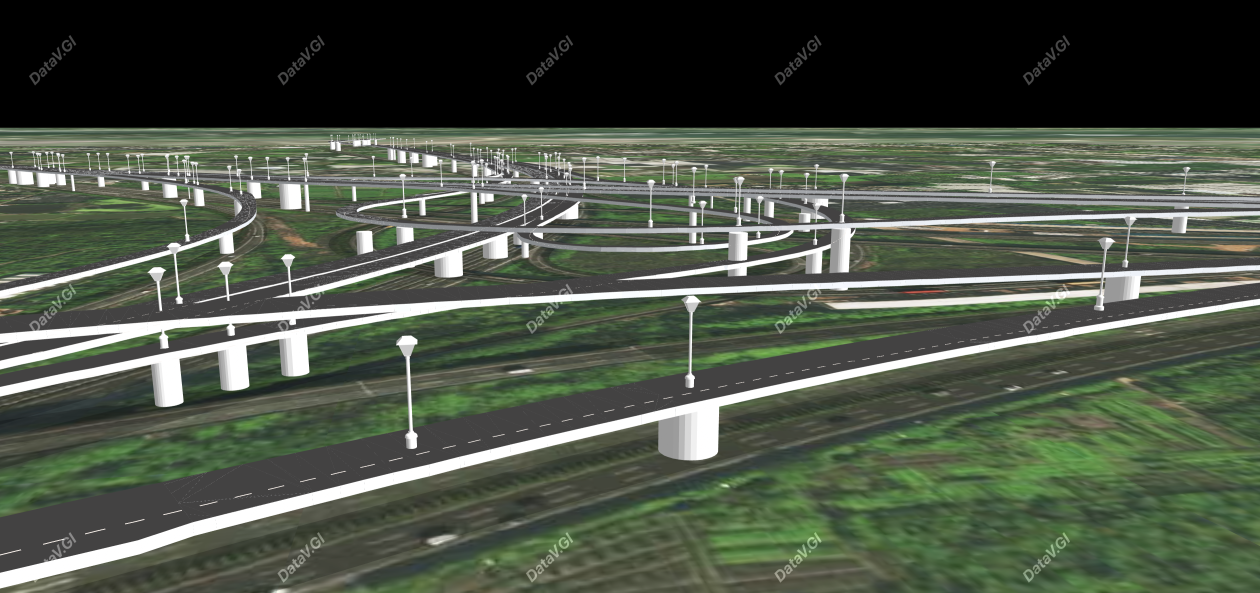
The following figure shows a large-scale 3D scenario rendered using 3D MVT tile technology.
Example
The following example converts a 3D MULTIPOLYGON in WGS 84 (SRID 4326) to tile coordinates, then encodes it as an MVT layer named buildings at zoom level 1, tile (0, 0).
WITH mvtgeom AS (
  SELECT ST_AsMVTGeom3D(
           ST_Transform(
             'SRID=4326;MULTIPOLYGON(((100 50 0,-100 50 1,-100 -50 2,100 -50 3,100 50 0)),
                                     ((0 0 0,1 0 1,2 2 2,0 0 0)))'::geometry,
             3857
           ),
           ST_TileEnvelope(1, 0, 0)
         ) AS geom,
         'main_building' AS name
)
SELECT ST_AsMVT3D(mvtgeom.*, 'buildings') FROM mvtgeom;
The function returns a bytea value containing the encoded MVT tile data.
See also
ST_AsMVTGeom3D — prepares 3D geometries for use with
ST_AsMVT3DST_TileEnvelope — generates a tile bounding box from zoom level and tile coordinates