PolarDB is built on a cloud native architecture. Traditional database engines store data files and processing logic on the same server — scaling one forces you to scale the other, and every read-only replica must maintain its own full copy of the data. PolarDB eliminates both constraints by decoupling compute from storage: database engine servers handle query processing while separate storage servers hold all data, and every compute node reads from a single shared data copy.
Figure 1. Product architecture 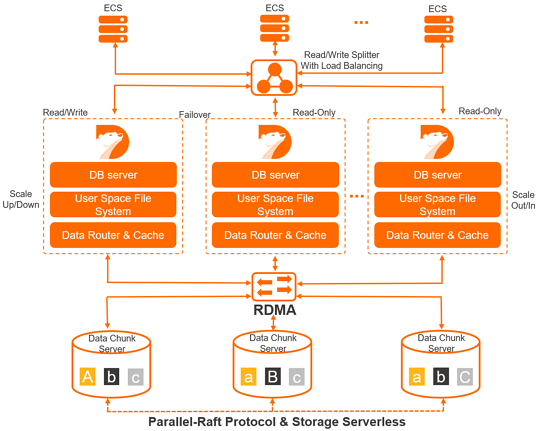
Cluster topology
A PolarDB cluster consists of one primary node and up to 15 read-only nodes. At least one read-only node is required for high availability.
| Node type | Role |
|---|---|
| Primary node | Handles all read and write requests |
| Read-only node | Handles read requests only |
PolarDB uses active-active failover between the primary node and read-only nodes. If the primary node fails, a read-only node can take over within a short period of time.
Compute and storage
PolarDB separates the database engine layer from the storage layer. Each layer has distinct responsibilities:
| Layer | Components | Responsibility |
|---|---|---|
| Compute | Primary node, read-only nodes (database engine servers) | Query processing, transaction management; stores metadata only |
| Storage | Storage nodes (database storage servers) | Holds all data files and redo logs; serves data to compute nodes over RDMA |
Replication between the primary node and read-only nodes transfers only redo log metadata rather than full data blocks, keeping replication delay minimal.
Read/write splitting
PolarDB clusters include read/write splitting by default. Cluster endpoints automatically route SQL requests across nodes based on load: write requests go to the primary node, and read requests are distributed across the primary node and read-only nodes. No application-side routing logic is required.
For more information, see Read/write splitting.
High-speed network connections
High-speed network connections are used between compute nodes and storage nodes. The Remote Direct Memory Access (RDMA) protocol transmits data between compute nodes and storage nodes, eliminating the bottlenecks of I/O performance.
Shared distributed storage
All compute nodes share one copy of data stored in a distributed file system. Because no compute node stores its own data copy, storage costs do not increase as you add read-only nodes.
Storage capacity scales online without downtime. The distributed file system is not bound by the capacity of a single database server and supports hundreds of terabytes of data.
Data reliability and consistency
Storage nodes maintain multiple data replicas. The Parallel-Raft protocol coordinates writes across replicas to ensure data consistency among replicas.