For tables with tens of millions of rows, COUNT(*) and full-index scans are expensive: MySQL ships each row up to the SQL layer before processing it, causing heavy CPU overhead and long query latency. Fast traverse eliminates this by pushing execution down to the InnoDB storage engine layer and traversing pages using the index the optimizer selects — not always the primary key.
Supported versions
Fast traverse requires PolarDB for MySQL 8.0, with one of the following revision versions:
8.0.1.1.5 or later
8.0.2.2.0 or later
To check your cluster version, see Query the engine version.
How it works
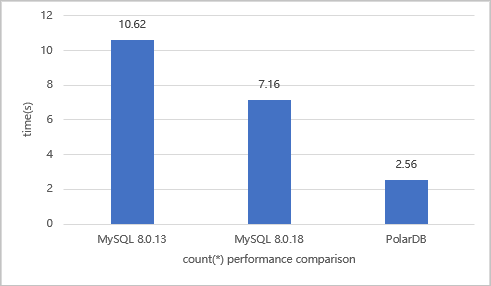
MySQL Community Edition 8.0.13 does not execute COUNT(*) in InnoDB at all, pushing every row to the SQL layer for counting. MySQL Community Edition 8.0.18 added page-level traversal in InnoDB, but always uses the primary key index regardless of what the optimizer selects.
Fast traverse removes both limitations:
Traverses InnoDB pages using the index the optimizer selects, not the primary key
Avoids the prolonged page locks and Multi-Version Concurrency Control (MVCC) version-restoration overhead that table lookups cause
Fast traverse is enabled by default on all supported PolarDB for MySQL clusters — no configuration required.
Verify that fast traverse is active
Run EXPLAIN on your query and inspect the output. In this example using the TPC-H lineitem table:
mysql> EXPLAIN SELECT COUNT(*) FROM lineitem\G
*************************** 1. row ***************************
           id: 1
  select_type: SIMPLE
        table: lineitem
   partitions: NULL
         type: index
possible_keys: NULL
          key: i_l_shipdate
      key_len: 4
          ref: NULL
         rows: 59440464
     filtered: 100.00
        Extra: Using index
Performance
The following results use TPC-H at scale factor 10, with innodb_parallel_read_threads set to 1. PolarDB clusters with fast traverse outperform MySQL Community Edition 8.0.13 and 8.0.18.
FAQ
What is the default value of innodb_parallel_read_threads in PolarDB for MySQL?
The default value is 0. To change it, see Configure cluster and node parameters.