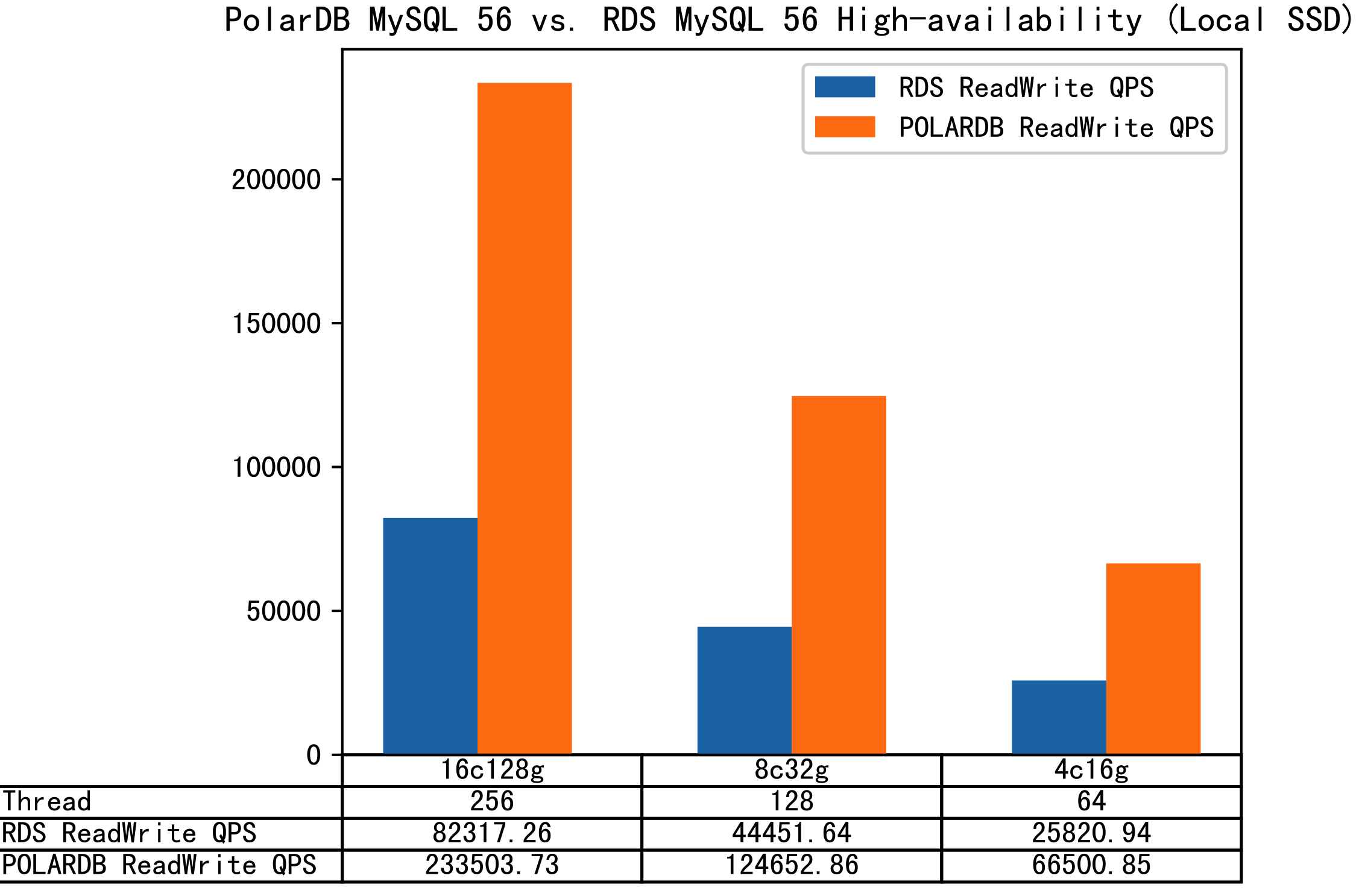
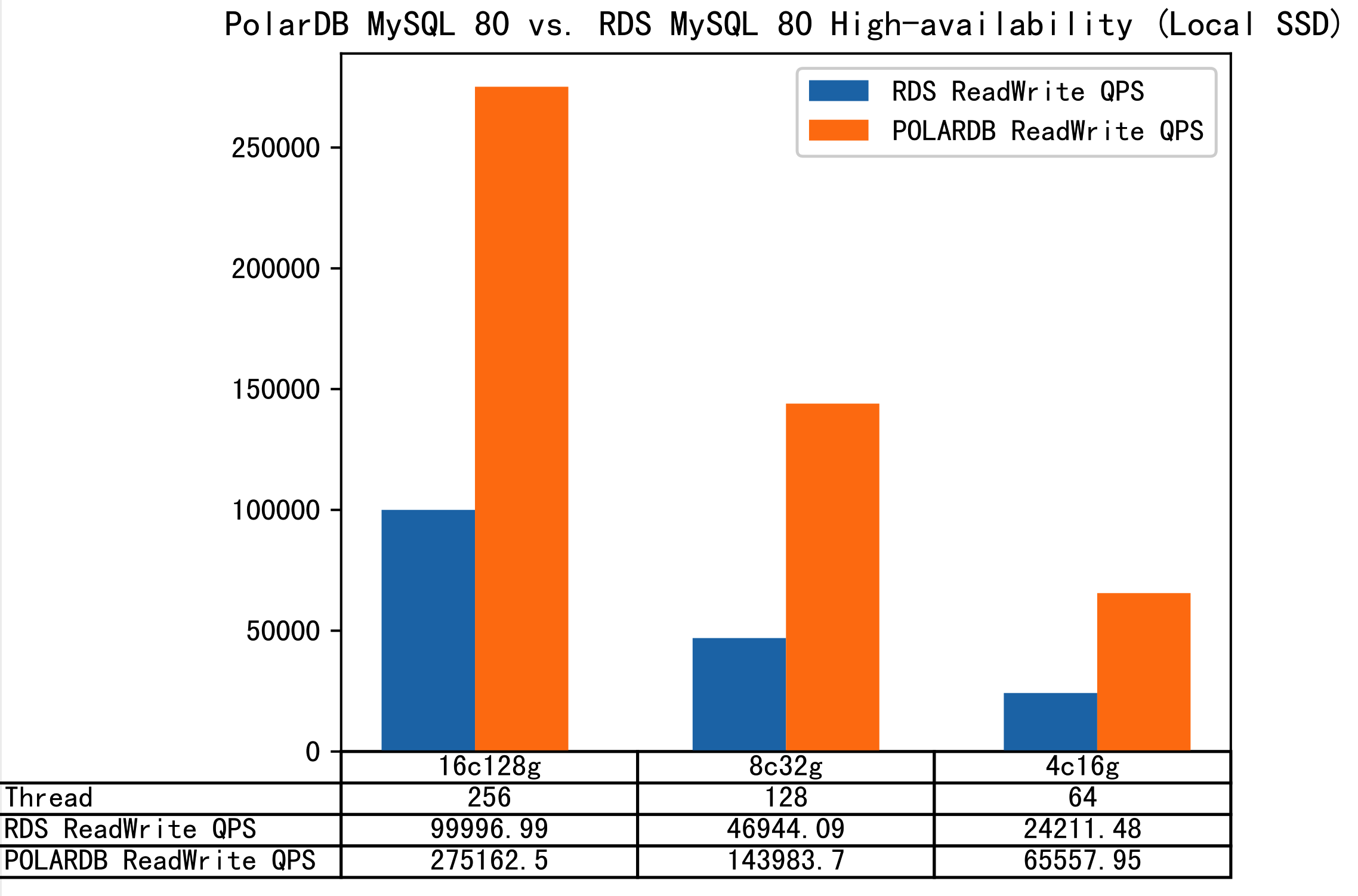
OLTP benchmark results for PolarDB for MySQL and ApsaraDB RDS for MySQL across multiple versions and instance specifications.
PolarDB for MySQL includes several performance optimizations over ApsaraDB RDS for MySQL:
-
Advanced hardware: Optane persistent memory (3D XPoint), NVMe SSDs, and RDMA over Converged Ethernet (RoCE) networking.
-
Full I/O and network protocol stack in user space for higher performance and lower latency.
-
Kernel-level optimizations for locks, I/O paths, and large-table handling in high-concurrency workloads.
Products used in this benchmark:
-
PolarDB for MySQL Cluster Edition clusters of different specifications.
-
ApsaraDB RDS for MySQL High-availability Edition dedicated instances with local SSD of different specifications.
Test methodology: OLTP performance test tools and methods.
Benchmarking guidelines
To ensure an accurate comparison:
-
Use identical instance specifications for both products.
-
Use the same database versions.
-
Use a simulated production workload or Sysbench to reflect real-world conditions.
-
When comparing read performance, do not use single SQL queries.
PolarDB for MySQL uses a compute-storage separation architecture, so a single query may show higher network latency than ApsaraDB RDS for MySQL. In production, cache hit rates typically exceed 99%—only the first read triggers disk I/O. Subsequent reads come from the buffer pool, delivering equivalent performance.
-
When comparing write performance, use a stress test rather than single SQL queries.
For a fair comparison, test a PolarDB for MySQL cluster (primary node + read-only node) against an ApsaraDB RDS for MySQL instance (primary + read-only with semi-synchronous replication). PolarDB for MySQL uses Quorum-based writes—a write succeeds only after data reaches a majority of replicas (at least two of three), ensuring data redundancy and strong consistency at the storage layer. Comparing against semi-synchronous replication rather than asynchronous provides a more meaningful benchmark.
PolarDB for MySQL 8.0.1 vs. ApsaraDB RDS for MySQL 8.0
PolarDB for MySQL 5.7 vs. ApsaraDB RDS for MySQL 5.7

PolarDB for MySQL 5.6 vs. ApsaraDB RDS for MySQL 5.6