After you instrument your application with SkyWalking and report distributed tracing data to Managed Service for OpenTelemetry, Managed Service for OpenTelemetry starts to monitor your application. You can then view a range of monitoring data, such as application topology, traces, failed transactions, slow transactions, and SQL analysis. This topic describes how to use the SkyWalking Python Agent to enable auto-instrumentation and report application data.
Prerequisites
-
You have downloaded the Python agent for Apache SkyWalking. We recommend that you use the latest version.
-
You have added the SkyWalking Python agent to your Python project.
-
New console
-
Log on to the Managed Service for OpenTelemetry console. In the left-side navigation pane, click Integration Center.
-
On the Integration Center page, click the SkyWalking card in the Open Source Frameworks section.
-
In the SkyWalking panel, click the Start Integration tab, and then select a region in which you want to report data.
NoteWhen you access a region for the first time, resources are automatically initialized there.
-
Configure the Connection Type parameter and copy an endpoint.
If your service is deployed on Alibaba Cloud and resides in the region that you selected, we recommend that you set this parameter to Alibaba Cloud VPC Network. Otherwise, set this parameter to Public Network.
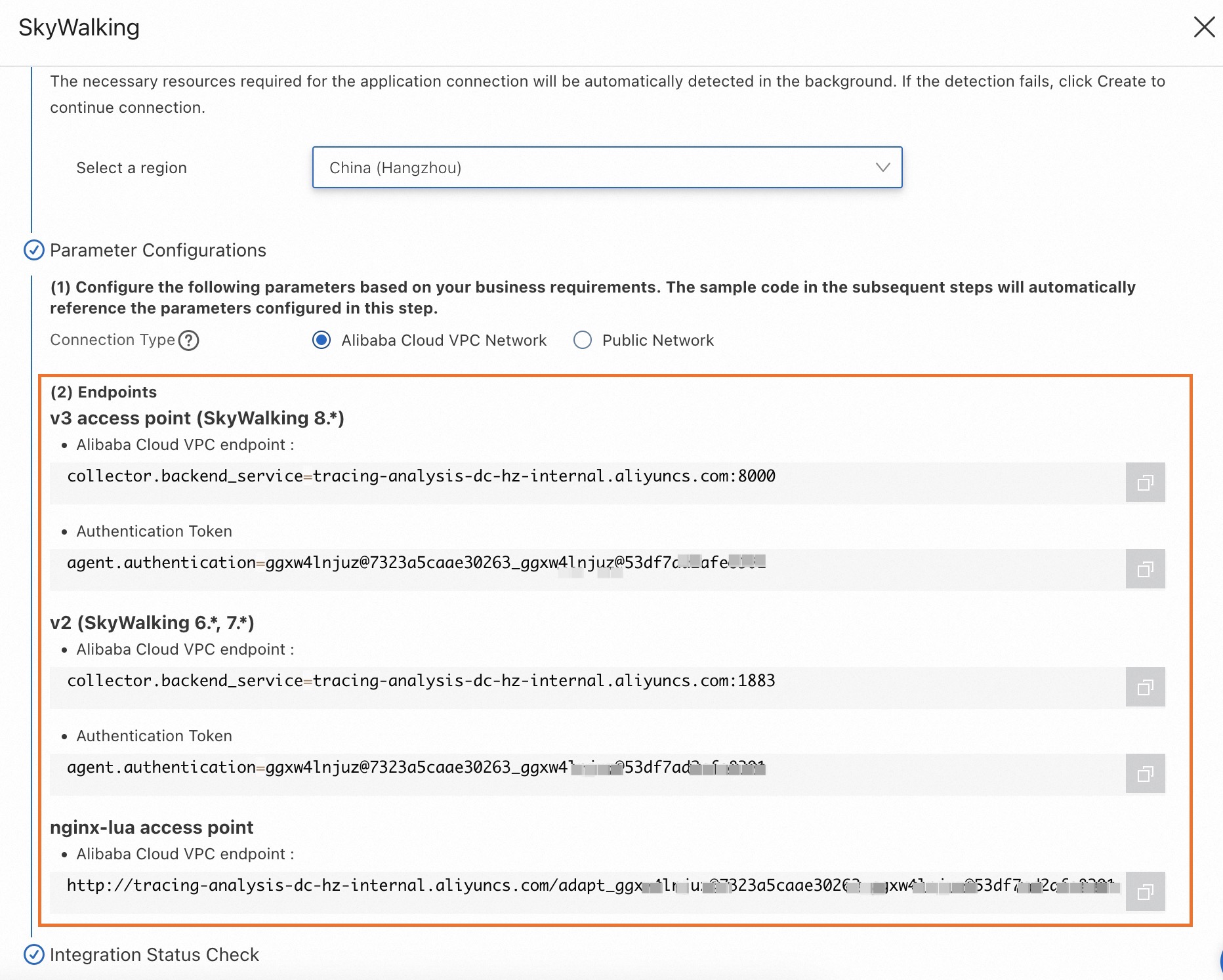
Old console
-
Log on to the Managed Service for OpenTelemetry console.
-
In the left-side navigation pane, click Cluster Configurations. On the page that appears, click the Access point information tab.
-
In the top navigation bar, select a region in which you want to report data. In the Cluster Information section, turn on Show Token.
-
Set the Client parameter to SkyWalking.
In the Related Information column of the table, copy an endpoint.
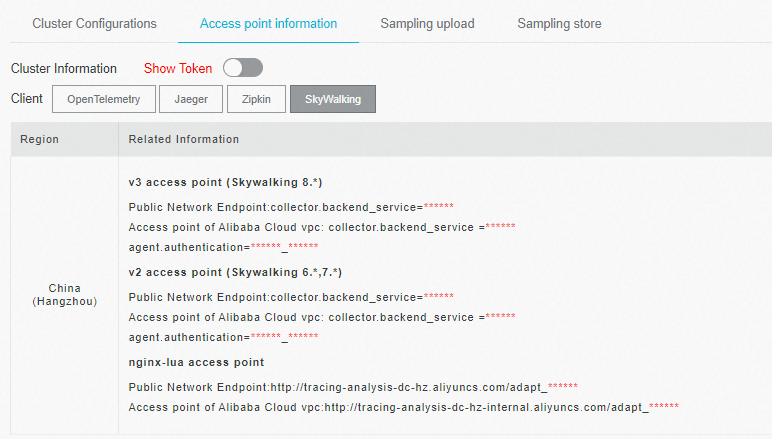 Note
NoteIf your application is deployed in an Alibaba Cloud production environment, use a VPC endpoint. Otherwise, use a public endpoint.
-
Background information
SkyWalking is a popular open source application performance monitoring (APM) tool for microservices, cloud-native, and container-based architectures, including Docker, Kubernetes, and Mesos. At its core, SkyWalking is a distributed tracing system.
skywalking-python is the official Python agent library for SkyWalking. You can integrate skywalking-python to monitor Python applications. It supports auto-instrumentation for many third-party libraries, such as Kafka, HTTP, AIOHTTP, Redis, and WebSockets.
Sample application
Sample application repository: SkyWalking Demo
This demo is a simple, Flask-based example that forwards requests and interacts with a MySQL database. The SkyWalking agent monitors the application and reports data.
Enable auto-instrumentation for a Python application
You can configure SkyWalking Python Agent parameters in your Python project files or as environment variables.
Configure parameters in code
Modify theconfig.init parameters in your Python project file. In the sample application, the corresponding files are proxy/TestProxy.py and controller/TestController.py.
from skywalking import config
config.init(ConfigurationName = ConfigurationValue)
Configure parameters as environment variables
Add the following content to your environment variable file and then restart your application for the changes to take effect.
export SW_AGENT_ConfigurationName=ConfigurationValueFor Docker container environments, you can configure environment variables under the environment option in the docker-compose.yaml file.
-
Configure the endpoint and token.
-
Import SkyWalking in your Python file.
from skywalking import agent, config -
Configure the endpoint and authentication token.
Replace
<endpoint>and<auth-token>with the endpoint and authentication token you obtained in the Prerequisites section.config.init(agent_collector_backend_services='<endpoint>', agent_authentication='<auth-token>')
-
-
Configure a service name as the application identifier.
config.init(agent_name='<service name>') -
Configure the data reporting protocol. The only supported protocol is gRPC.
### The only available reporting protocol is 'grpc'. config.init(agent_protocol='<protocol>') -
Configure other optional parameters as needed. For more information, see the Apache SkyWalking official documentation.
-
Restart the application.
FAQ
-
What do I do if the
Method not found: skywalking.v3.LogReportService/collecterror occurs when reporting data over gRPC?grpc._channel._InactiveRpcError: <_InactiveRpcError of RPC that terminated with: status = StatusCode.UNIMPLEMENTED details = "Method not found: skywalking.v3.LogReportService/collect" debug_error_string = "UNKNOWN:Error received from peer {grpc_message:"Method not found: skywalking.v3.LogReportService/collect", grpc_status:12, created_time:"2023-07-05T15:58:00"}" >Set
agent_log_reporter_activetoFalsein theconfig.initcall.config.init(agent_log_reporter_active=False) -
What do I do if the
Method not found: skywalking.v3.MeterReportService/collecterror occurs when reporting data over gRPC?grpc._channel._InactiveRpcError: <_InactiveRpcError of RPC that terminated with: status = StatusCode.UNIMPLEMENTED details = "Method not found: skywalking.v3.MeterReportService/collect" debug_error_string = "UNKNOWN:Error received from peer {grpc_message:"Method not found: skywalking.v3.MeterReportService/collect", grpc_status:12, created_time:"2023-07-05T16:00:00+08:00"}" >The console does not support
metricdata reporting. In theconfig.initcall, setagent_meter_reporter_activetoFalse.config.init(agent_meter_reporter_active=False)