When diagnosing latency spikes or tracking down errors across distributed services, you need a way to filter, aggregate, and inspect trace data efficiently. Trace Explorer combines real-time filtering with aggregation dimensions to help you pinpoint performance bottlenecks, identify error patterns, and understand request flows across your applications.
Prerequisites
Your application data is reported to Managed Service for OpenTelemetry. For setup instructions, see Integrate services or components.
Filter traces
Log on to the Managed Service for OpenTelemetry console. In the left-side navigation pane, click Applications.
On the Applications page, select a region in the top navigation bar and click the application name.
Click the Trace Explorer tab.
In the upper-right corner, specify the time range.
Add filter conditions using any of the following methods:
Quick Filter: Filter traces by status, duration, application name, span name, or host address. Selected conditions appear in the search bar.
Drop-down filter panel: Click the search bar to open the panel. Modify existing conditions or add custom ones.
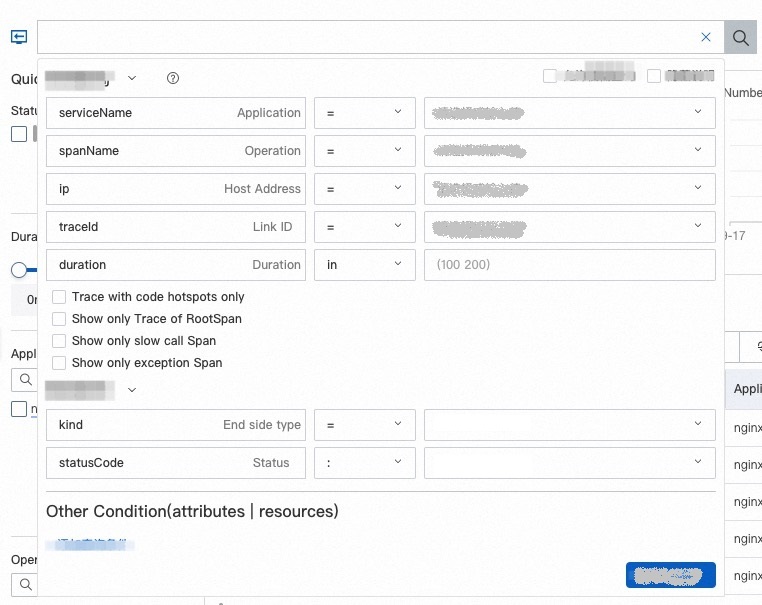
Query statement: Enter a query directly in the search bar. For syntax details, see Usage methods of Trace Explorer.
Save and reuse filter conditions
| Action | Steps |
|---|---|
| Save current filters as a view | Click the  icon to the right of the Aggregation Dimension drop-down list. icon to the right of the Aggregation Dimension drop-down list. |
| Load a saved view | Click Saved View and select the view. |
| Group results by dimension | Select an aggregation dimension from the drop-down list. |
View trace results
After you apply filters, the matched trace data appears on the Trace Explorer tab. Results include:
Column charts of span counts and HTTP errors
Time series curves of response time
A span list
Span list actions
| Action | How to |
|---|---|
| View trace details | Click Details in the Actions column. See Trace details. |
| View trace-related logs | Click Logs in the Actions column. |
| Show or hide columns | Click the  icon in the upper-right corner. icon in the upper-right corner. |
| Add attribute as a filter | Hover over a span and click the  icon to add the span's attribute values as a filter condition. icon to add the span's attribute values as a filter condition. |
Identify outliers with the scatter chart
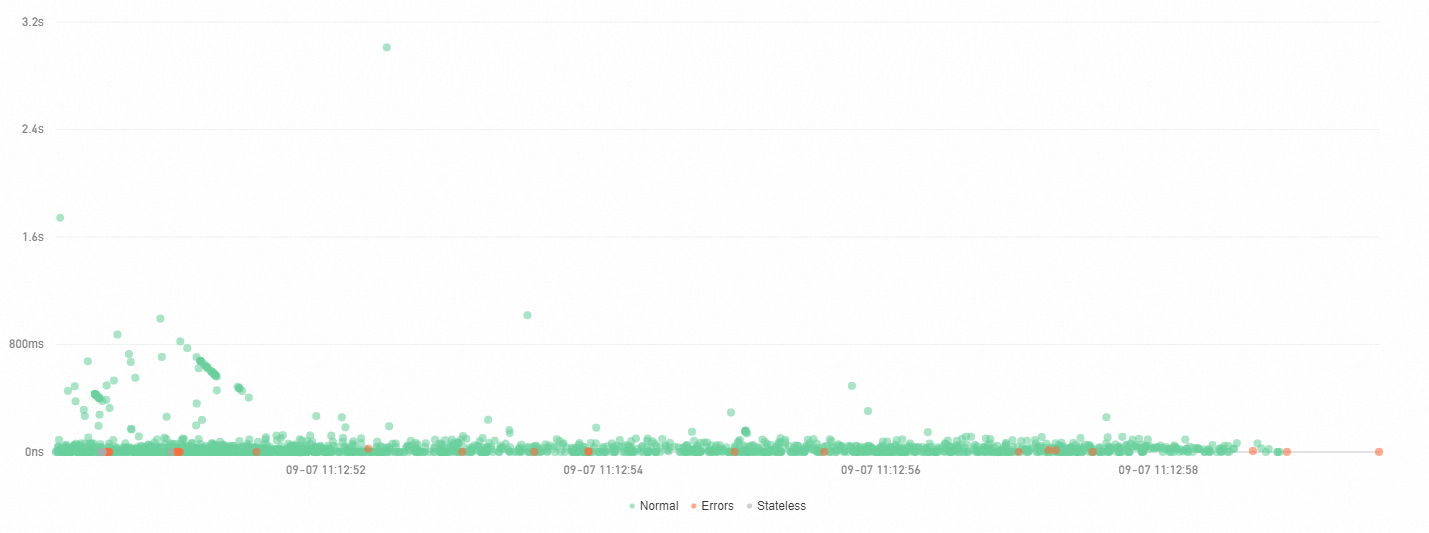
The Scatter plot tab plots each trace as a point, with time on the X axis and response time on the Y axis. This visualization helps you spot outlier traces with unusually high latency.
Hover over a point to view basic trace information.
Click a point to view the full call details.
Analyze traces with aggregation
Trace Explorer filters analyze individual spans. For analysis across complete distributed traces, use trace aggregation. It queries up to 5,000 distributed traces matching your conditions, retrieves all spans by trace ID, and aggregates the results while preserving trace integrity.
Aggregate queries run on full trace data. With multiple conditions, computation may take longer.
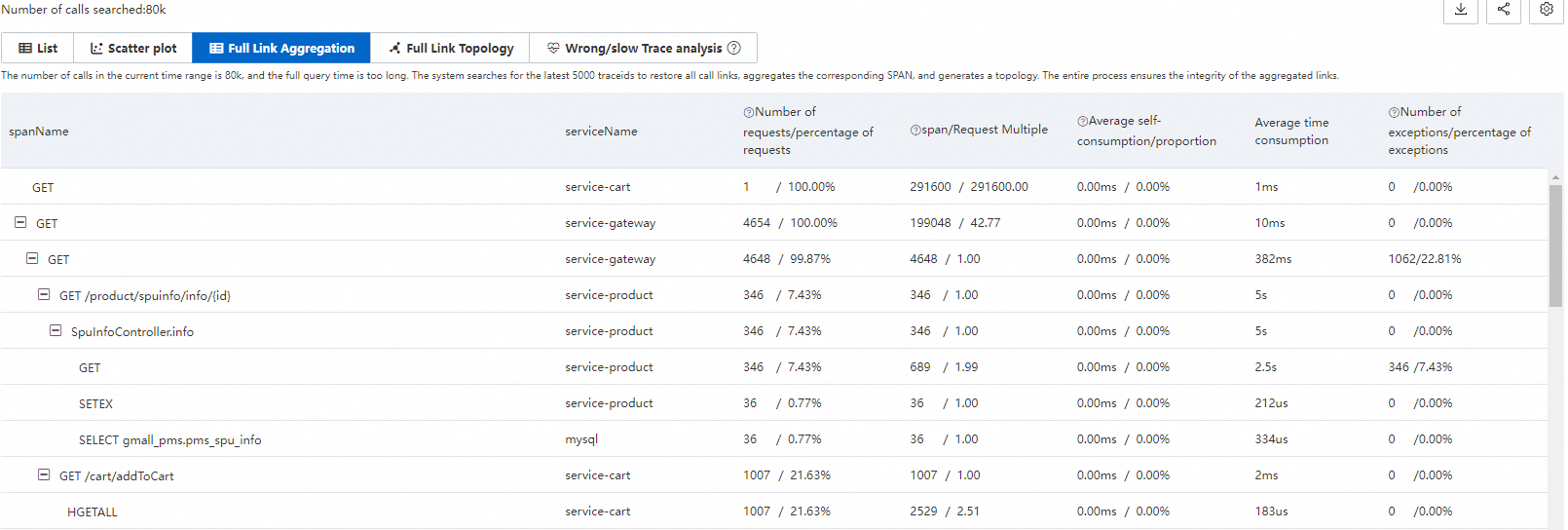
Aggregation parameters
| Parameter | Description |
|---|---|
| spanName | Name of the span. |
| serviceName | Application that produced the span. |
| Number of requests / percentage of requests | Ratio of requests that call this span to total requests. Formula: Requests calling this span / Total requests x 100%. |
| span / Request Multiple | Average number of times each request calls this span. Formula: Total span count / Request count. |
| Average self-consumption / proportion | Average self-time of the span, excluding time spent in child spans. Formula: Total span duration - Duration of all child spans. Important For asynchronous calls, self-time equals the total span duration. |
| Average Duration | Average duration of the span. |
| Number of exceptions / percentage of exceptions | Ratio of requests with exceptions to total requests. Formula: Requests with exceptions / Total requests. Important The number of requests with exceptions differs from the total number of exceptions. If the request multiple is greater than 1, a single request may contain multiple exceptions. |
Example: reading aggregation data
Span A calls Span B and Span C. The following table shows the aggregation results.
| spanName | serviceName | Requests / % | span / Multiple | Avg self / % | Avg Duration | Exceptions / % |
|---|---|---|---|---|---|---|
| A | demo | 10 / 100.00% | 10 / 1.00 | 5.00 ms / 25.00% | 20 ms | 2 / 20.00% |
| - B | demo | 4 / 40.00% | 8 / 2.00 | 16.00 ms / 100.00% | 16 ms | 2 / 50.00% |
| - C | demo | 1 / 10.00% | 1 / 1.00 | 4.00 ms / 100.00% | 4 ms | 1 / 100.00% |
Request distribution: All 10 requests call Span A (100%). Only 4 of those requests call Span B (40%), and only 1 calls Span C (10%). The remaining requests skip Span B and Span C due to conditional logic or exceptions.
Span multiplicity: Span A is called once per request (multiple = 1.00). Span B has 8 spans across 4 requests, so each request calls Span B twice on average (multiple = 2.00).
Self-time distribution: Span A's average self-time is 5.00 ms (25% of its 20 ms total duration), because the remaining 75% is spent in child spans B and C. Span B and Span C have self-time equal to their total duration (100%) because they have no child spans.
Exception distribution: Span A has 2 exceptions across 10 requests (20%). Span B has 2 exceptions across 4 requests (50%). Since each request calls Span B twice, the likely distribution is: 2 of the 4 requests encounter an exception on the first call, but the second call succeeds.
To view a specific trace, hover over the blue span name and click the recommended trace ID.
View trace topology
The Full Link Topology tab shows the service-to-service call topology of aggregated traces. Each node represents an application with its request count, error count, and response time.

Trace details
The trace detail view has four sections:

Section 1: Component tags
Tags group spans by call type, defined by the attributes.component.name field. Each tag shows the call type and span count. Click a tag to show or hide the related spans.
Section 2: Trace bar chart
The bar chart provides an overview of the entire trace and its span distribution.
| Element | Description |
|---|---|
| Bar | Each bar represents a span. Only spans whose duration exceeds 1% of the total trace duration are shown. |
| Color | Different colors distinguish different applications. For example, blue represents the opentelemetry-demo-adservice application. |
| Black line | Represents the span's self-time: the total span duration minus time spent in child spans. For example, if Span A takes 10 ms and its child Span B takes 8 ms, Span A's self-time is 2 ms. |
| Timeline | Shows the full time range of the trace. |
Section 3: Trace focus and filtering
Each row represents a span, arranged in a parent-child hierarchy. A number before each parent span indicates its child span count.
| Operation | Description |
|---|---|
| Collapse | Click the  icon to collapse or expand a span and its children. icon to collapse or expand a span and its children. |
| Focus | Select a span and click the  icon to display only that span and its downstream spans. icon to display only that span and its downstream spans. |
| Defocus | Click the  icon to restore the full trace view. icon to restore the full trace view. |
| Filter | Enter a span name, application name, or attribute in the search box to show the path from the matched span to the entry span. To clear the filter, delete the search text and click the Search icon. |
| Zoom in and out | Click the  icon to zoom in and hide the bar chart. Click the icon to zoom in and hide the bar chart. Click the  icon to restore the bar chart. icon to restore the bar chart. |
Section 4: Span details
The span details panel shows detailed information about the selected span, including related metrics, logs, and exceptions. It also supports custom interaction events.
| Tab | Description |
|---|---|
| Additional Information | Lists span attributes, resources, details, and events, grouped by type. For field descriptions, see Trace Explorer parameters. |
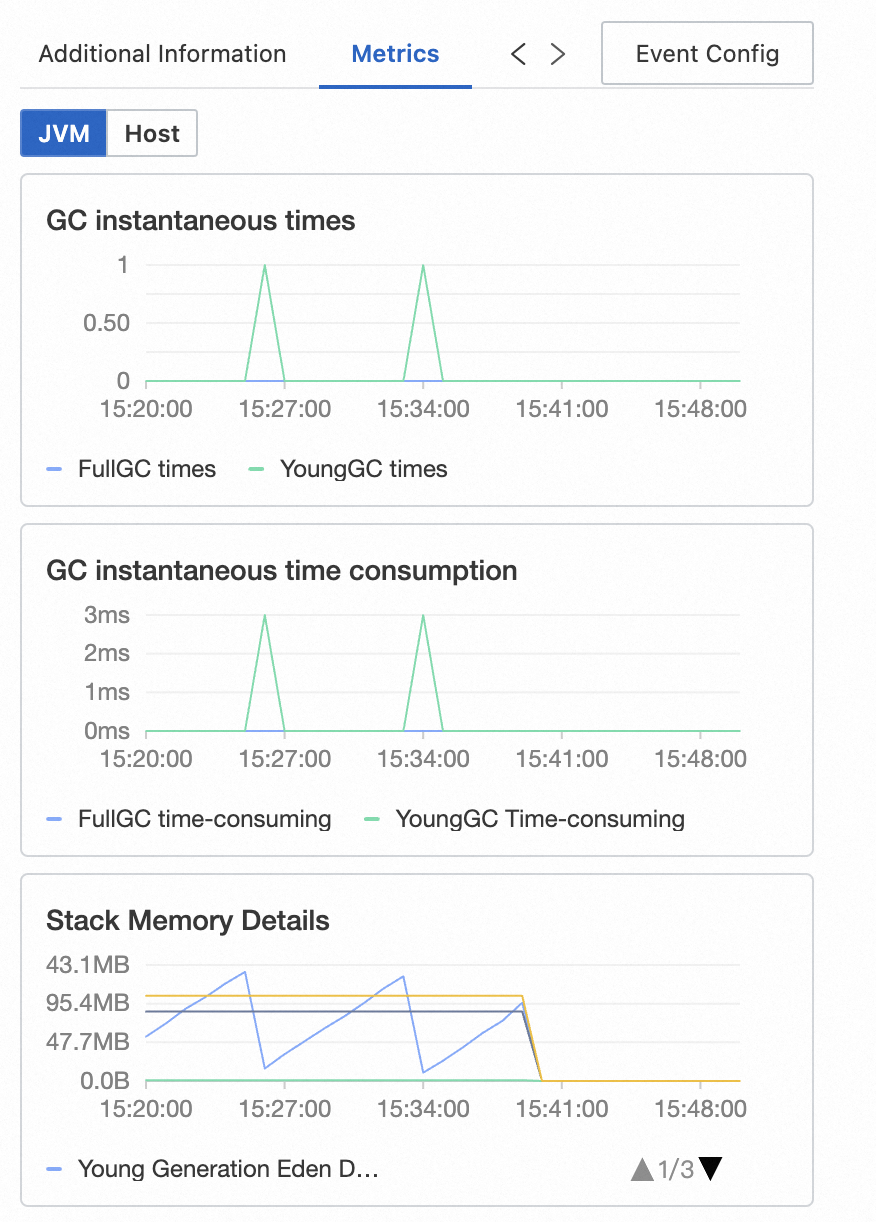
| Metrics | Shows metrics related to the span. For Java applications monitored by ARMS: JVM and host metrics. For traces reported by open source agents: RED Method metrics (rate, errors, duration). |
| Logs | Shows business logs related to the trace. If a Simple Log Service (SLS) Logstore is configured for the application, query business logs by trace ID in the Logstore. |
| Exceptions | Shows exception information recorded for the span, if any. |
| Event Config | Configure custom interaction events for one or more trace attributes. Use interaction events to query additional trace details or view related logs and metrics. For more information, see Configure a custom interaction event for a trace. |
What to do next
Set up alert rules to get notified when specific errors occur, so your Operations & Maintenance (O&M) team can respond quickly. For more information, see Create an alert rule.