Connect to the Qwen-TTS-Realtime real-time speech synthesis service over WebSocket. Covers the service endpoint, request headers, and interaction flow.
For model overview and selection guidance, see Real-time speech synthesis
The Qwen-TTS Realtime API uses the WebSocket protocol. Java and Python applications can use the DashScope SDK to skip WebSocket handling. Other languages can connect with a WebSocket library directly.
Service endpoint
Use the following URL. Set the model with the model query parameter:
Singapore
WebSocket URL: wss://dashscope-intl.aliyuncs.com/api-ws/v1/realtime?model=qwen3-tts-flash-realtime
China (Beijing)
WebSocket URL: wss://dashscope-intl.aliyuncs.com/api-ws/v1/realtime?model=qwen3-tts-flash-realtime
ImportantThe URL must use the wss:// protocol. Set the Authorization header (see Request headers) and specify the model using the model query parameter.
Request headers
Set the following request headers:
Parameter | Type | Required | Description |
|---|---|---|---|
Authorization | string | Yes | Format: |
user-agent | string | No | Client identifier for server-side source tracking. |
X-DashScope-WorkSpace | string | No | The Alibaba Cloud Model Studio workspace ID. |
ImportantAuthorization is verified during the WebSocket handshake. An invalid or missing API key causes the handshake to fail with HTTP 401/403.
Interaction flow
For detailed descriptions of client events and server events, see Client events and Server events.
The API supports two modes:
- ServerCommit mode: The server determines text segmentation and synthesis timing automatically.
- Commit mode: The client controls when to submit each text segment. Call
input_text_buffer.commitexplicitly to trigger synthesis.
Mode details
- In ServerCommit mode, call
input_text_buffer.appendto buffer text. The system determines synthesis timing automatically. - Calling
input_text_buffer.commitin ServerCommit mode synthesizes the current buffer immediately. The session then resumes ServerCommit mode. - In Commit mode,
input_text_buffer.appendalone does not trigger synthesis. Callinput_text_buffer.committo start synthesis.
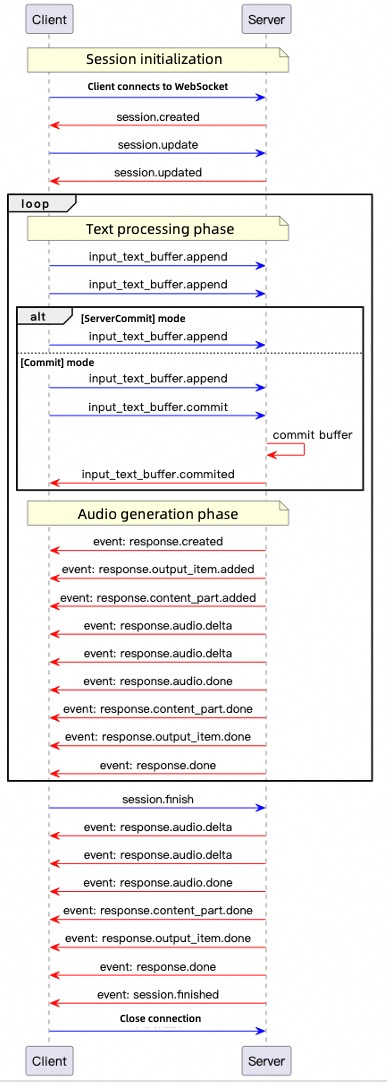
-
Connection: The client opens a WebSocket connection. The server returns
session.createdwhen ready. -
Session configuration: The client sends
session.updateto configure voice, format, and mode. -
Text input: The client sends
input_text_buffer.appendto add text to the buffer. -
Synthesis trigger:
- In ServerCommit mode, synthesis starts automatically. The client can call
input_text_buffer.committo force immediate synthesis. - In Commit mode, only
input_text_buffer.committriggers synthesis.
- In ServerCommit mode, synthesis starts automatically. The client can call
-
Audio generation: The server sends
response.created, then streams base64-encoded audio asresponse.audio.deltaevents untilresponse.audio.done. -
Session termination: The client sends
session.finishto release resources. The server returnssession.finishedand closes the connection.
After connection, the server returns this session.created event:
{
    "event_id": "event_xxx",
    "type": "session.created",
    "session": {
        "object": "realtime.session",
        "mode": "server_commit",
        "model": "qwen3-tts-flash-realtime",
        "voice": "Cherry",
        "response_format": "pcm",
        "sample_rate": 24000,
        "id": "sess_xxx"
    }
}
Code examples
The examples provide Python and Java clients and both commit modes. Set DASHSCOPE_API_KEY for the region used by the example endpoint. Python requires websockets and pyaudio; Java requires Java-WebSocket and Gson and uses Java Sound for playback. Each client event uses a unique UUID.
<dependencies>
    <dependency>
        <groupId>org.java-websocket</groupId>
        <artifactId>Java-WebSocket</artifactId>
        <version>1.5.3</version>
    </dependency>
    <dependency>
        <groupId>com.google.code.gson</groupId>
        <artifactId>gson</artifactId>
        <version>2.10.1</version>
    </dependency>
</dependencies>
pip install websockets pyaudio
-
Create the client
Java
Create a Java file named
TTSRealtimeClient.javaand copy the following code into the file:import com.google.gson.Gson; import com.google.gson.JsonObject; import org.java_websocket.client.WebSocketClient; import org.java_websocket.handshake.ServerHandshake; import java.net.URI; import java.util.Base64; import java.util.HashMap; import java.util.Map; import java.util.concurrent.CountDownLatch; import java.util.function.Consumer; /** * A client for interacting with the TTS Realtime API. * * This class provides methods for connecting to the TTS Realtime API, sending text data, retrieving audio output, and managing WebSocket connections. */ public class TTSRealtimeClient { public enum SessionMode { SERVER_COMMIT("server_commit"), COMMIT("commit"); private final String value; SessionMode(String value) { this.value = value; } public String getValue() { return value; } } /** * Audio callback interface */ public interface AudioCallback { void onAudio(byte[] audioData); } private final String baseUrl; private final String apiKey; private final String voice; private final SessionMode mode; private final String languageType; private final AudioCallback audioCallback; private final Gson gson = new Gson(); private WebSocketClient ws; private CountDownLatch responseDoneLatch; private CountDownLatch sessionFinishedLatch; public TTSRealtimeClient(String baseUrl, String apiKey, String voice, SessionMode mode, AudioCallback audioCallback, String languageType) { this.baseUrl = baseUrl; this.apiKey = apiKey; this.voice = voice; this.mode = mode; this.audioCallback = audioCallback; this.languageType = languageType; } public TTSRealtimeClient(String baseUrl, String apiKey, String voice, SessionMode mode, AudioCallback audioCallback) { this(baseUrl, apiKey, voice, mode, audioCallback, "Auto"); } /** * Establish a WebSocket connection to the TTS Realtime API. */ public void connect() throws Exception { Map<String, String> headers = new HashMap<>(); headers.put("Authorization", "Bearer " + apiKey); responseDoneLatch = new CountDownLatch(0); sessionFinishedLatch = new CountDownLatch(1); ws = new WebSocketClient(new URI(baseUrl), headers) { @Override public void onOpen(ServerHandshake handshake) { System.out.println("WebSocket connection established"); // Send default session configuration JsonObject session = new JsonObject(); session.addProperty("mode", mode.getValue()); session.addProperty("voice", TTSRealtimeClient.this.voice); session.addProperty("language_type", languageType); session.addProperty("response_format", "pcm"); session.addProperty("sample_rate", 24000); updateSession(session); } @Override public void onMessage(String message) { JsonObject event = gson.fromJson(message, JsonObject.class); String eventType = event.has("type") ? event.get("type").getAsString() : ""; if (!"response.audio.delta".equals(eventType)) { System.out.println("Received event: " + eventType); } switch (eventType) { case "error": System.err.println("Error: " + event.get("error")); break; case "session.created": System.out.println("Session created, ID: " + event.getAsJsonObject("session").get("id").getAsString()); break; case "session.updated": System.out.println("Session updated, ID: " + event.getAsJsonObject("session").get("id").getAsString()); break; case "input_text_buffer.committed": System.out.println("Text buffer committed, item ID: " + event.get("item_id")); break; case "input_text_buffer.cleared": System.out.println("Text buffer cleared"); break; case "response.created": System.out.println("Response created, ID: " + event.getAsJsonObject("response").get("id").getAsString()); responseDoneLatch = new CountDownLatch(1); break; case "response.output_item.added": System.out.println("Output item added, ID: " + event.getAsJsonObject("item").get("id").getAsString()); break; case "response.audio.delta": if (audioCallback != null) { byte[] audioBytes = Base64.getDecoder().decode( event.get("delta").getAsString()); audioCallback.onAudio(audioBytes); } break; case "response.audio.done": System.out.println("Audio generation completed"); break; case "response.done": System.out.println("Response completed"); responseDoneLatch.countDown(); break; case "session.finished": System.out.println("Session finished"); sessionFinishedLatch.countDown(); break; } } @Override public void onClose(int code, String reason, boolean remote) { System.out.println("Connection closed: " + reason); } @Override public void onError(Exception ex) { System.err.println("WebSocket error: " + ex.getMessage()); } }; ws.connectBlocking(); } /** * Send an event to the server. */ public void sendEvent(JsonObject event) { String eventId = "event_" + java.util.UUID.randomUUID().toString(); event.addProperty("event_id", eventId); System.out.println("Sending event: type=" + event.get("type").getAsString() + ", event_id=" + eventId); ws.send(gson.toJson(event)); } /** * Update the session configuration. */ public void updateSession(JsonObject config) { JsonObject event = new JsonObject(); event.addProperty("type", "session.update"); event.add("session", config); System.out.println("Updating session configuration: " + event); sendEvent(event); } /** * Send text data to the API. */ public void appendText(String text) { JsonObject event = new JsonObject(); event.addProperty("type", "input_text_buffer.append"); event.addProperty("text", text); sendEvent(event); } /** * Commit the text buffer to trigger processing. */ public void commitTextBuffer() { JsonObject event = new JsonObject(); event.addProperty("type", "input_text_buffer.commit"); sendEvent(event); } /** * Clear the text buffer. */ public void clearTextBuffer() { JsonObject event = new JsonObject(); event.addProperty("type", "input_text_buffer.clear"); sendEvent(event); } /** * End the session. */ public void finishSession() { JsonObject event = new JsonObject(); event.addProperty("type", "session.finish"); sendEvent(event); } /** * Wait for the response.done event. */ public void waitForResponseDone() throws InterruptedException { responseDoneLatch.await(); } /** * Wait for the session.finished event. */ public void waitForSessionFinished() throws InterruptedException { sessionFinishedLatch.await(); } /** * Close the WebSocket connection. */ public void close() { if (ws != null) { ws.close(); } } }Python
Create a Python file named
tts_realtime_client.pyand copy the following code into the file:# -- coding: utf-8 -- import asyncio import websockets import json import base64 import time import uuid from typing import Optional, Callable, Dict, Any from enum import Enum class SessionMode(Enum): SERVER_COMMIT = "server_commit" COMMIT = "commit" class TTSRealtimeClient: """ Client for interacting with the TTS Realtime API. This class provides methods for connecting to the TTS Realtime API, sending text data, receiving audio output, and managing WebSocket connections. Attributes: base_url (str): Base URL of the Realtime API. api_key (str): API Key for authentication. voice (str): Voice used for server-side speech synthesis. mode (SessionMode): Session mode, either server_commit or commit. audio_callback (Callable[[bytes], None]): Callback function for receiving audio data. language_type(str) Language for synthesized speech. Options: Chinese, English, German, Italian, Portuguese, Spanish, Japanese, Korean, French, Russian, Auto """ def __init__( self, base_url: str, api_key: str, voice: str = "Cherry", mode: SessionMode = SessionMode.SERVER_COMMIT, audio_callback: Optional[Callable[[bytes], None]] = None, language_type: str = "Auto"): self.base_url = base_url self.api_key = api_key self.voice = voice self.mode = mode self.ws = None self.audio_callback = audio_callback self.language_type = language_type # Current response state self._current_response_id = None self._current_item_id = None self._is_responding = False self._response_done_future = None async def connect(self) -> None: """Establish WebSocket connection with the TTS Realtime API.""" headers = { "Authorization": f"Bearer {self.api_key}" } self.ws = await websockets.connect(self.base_url, additional_headers=headers) # Set default session configuration await self.update_session({ "mode": self.mode.value, "voice": self.voice, "language_type": self.language_type, "response_format": "pcm", "sample_rate": 24000 }) async def send_event(self, event) -> None: """Send an event to the server.""" event['event_id'] = "event_" + uuid.uuid4().hex print(f"Sending event: type={event['type']}, event_id={event['event_id']}") await self.ws.send(json.dumps(event)) async def update_session(self, config: Dict[str, Any]) -> None: """Update session configuration.""" event = { "type": "session.update", "session": config } print("Updating session configuration: ", event) await self.send_event(event) async def append_text(self, text: str) -> None: """Send text data to the API.""" event = { "type": "input_text_buffer.append", "text": text } await self.send_event(event) async def commit_text_buffer(self) -> None: """Commit text buffer to trigger processing.""" event = { "type": "input_text_buffer.commit" } await self.send_event(event) async def clear_text_buffer(self) -> None: """Clear the text buffer.""" event = { "type": "input_text_buffer.clear" } await self.send_event(event) async def finish_session(self) -> None: """End the session.""" event = { "type": "session.finish" } await self.send_event(event) async def wait_for_response_done(self): """Wait for the response.done event""" if self._response_done_future: await self._response_done_future async def handle_messages(self) -> None: """Handle messages from the server.""" try: async for message in self.ws: event = json.loads(message) event_type = event.get("type") if event_type != "response.audio.delta": print(f"Received event: {event_type}") if event_type == "error": print("Error: ", event.get('error', {})) continue elif event_type == "session.created": print("Session created, ID: ", event.get('session', {}).get('id')) elif event_type == "session.updated": print("Session updated, ID: ", event.get('session', {}).get('id')) elif event_type == "input_text_buffer.committed": print("Text buffer committed, item ID: ", event.get('item_id')) elif event_type == "input_text_buffer.cleared": print("Text buffer cleared") elif event_type == "response.created": self._current_response_id = event.get("response", {}).get("id") self._is_responding = True # Create a new future to wait for response.done self._response_done_future = asyncio.Future() print("Response created, ID: ", self._current_response_id) elif event_type == "response.output_item.added": self._current_item_id = event.get("item", {}).get("id") print("Output item added, ID: ", self._current_item_id) # Handle audio delta elif event_type == "response.audio.delta" and self.audio_callback: audio_bytes = base64.b64decode(event.get("delta", "")) self.audio_callback(audio_bytes) elif event_type == "response.audio.done": print("Audio generation completed") elif event_type == "response.done": self._is_responding = False self._current_response_id = None self._current_item_id = None # Mark future as done if self._response_done_future and not self._response_done_future.done(): self._response_done_future.set_result(True) print("Response completed") elif event_type == "session.finished": print("Session finished") except websockets.exceptions.ConnectionClosed: print("Connection closed") except Exception as e: print("Error handling messages: ", str(e)) async def close(self) -> None: """Close the WebSocket connection.""" if self.ws: await self.ws.close() -
Select a speech synthesis mode
Realtime API supports two modes:
-
server_commit mode
The server handles text segmentation and synthesis timing automatically. The client only sends text. Suited for low-latency scenarios (such as GPS navigation).
-
commit mode
The client adds text to a buffer and explicitly triggers synthesis. Suited for scenarios that require precise sentence segmentation control (such as news broadcast).
server_commit mode
Java
In the same directory as
TTSRealtimeClient.java, create another Java file namedServerCommit.javaand copy the following code into the file:import javax.sound.sampled.*; import java.io.*; import java.util.ArrayList; import java.util.List; import java.util.concurrent.ConcurrentLinkedQueue; import java.util.concurrent.atomic.AtomicBoolean; public class ServerCommit { // The following is the configuration for the Singapore region. private static final String URL = "wss://dashscope-intl.aliyuncs.com/api-ws/v1/realtime?model=qwen3-tts-flash-realtime"; // The API Key differs between the Singapore and Beijing regions. Get your API Key: https://www.alibabacloud.com/help/model-studio/get-api-key // If you have not configured the environment variable, replace the next line with your Model Studio API Key: private static final String API_KEY = "sk-xxx"; private static final String API_KEY = System.getenv("DASHSCOPE_API_KEY"); private static final int SAMPLE_RATE = 24000; // Audio data cache private static final List<byte[]> audioChunks = new ArrayList<>(); // Real-time playback queue private static final ConcurrentLinkedQueue<byte[]> playbackQueue = new ConcurrentLinkedQueue<>(); private static final AtomicBoolean playing = new AtomicBoolean(true); public static void main(String[] args) throws Exception { if (API_KEY == null || API_KEY.isEmpty()) { throw new IllegalStateException("Please set the DASHSCOPE_API_KEY environment variable"); } // Initialize audio playback AudioFormat format = new AudioFormat(SAMPLE_RATE, 16, 1, true, false); DataLine.Info info = new DataLine.Info(SourceDataLine.class, format); SourceDataLine audioLine = (SourceDataLine) AudioSystem.getLine(info); audioLine.open(format); audioLine.start(); // Start the playback thread Thread playerThread = new Thread(() -> { while (playing.get() || !playbackQueue.isEmpty()) { byte[] chunk = playbackQueue.poll(); if (chunk != null) { audioLine.write(chunk, 0, chunk.length); } else { try { Thread.sleep(10); } catch (InterruptedException ignored) {} } } }); playerThread.start(); // Create the TTS client TTSRealtimeClient client = new TTSRealtimeClient( URL, API_KEY, "Cherry", TTSRealtimeClient.SessionMode.SERVER_COMMIT, audioData -> { playbackQueue.add(audioData); audioChunks.add(audioData); System.out.println("Received audio data: " + audioData.length + " bytes"); } ); client.connect(); // Send text fragments String[] textFragments = { "Alibaba Cloud's large language model platform, Model Studio, is an all-in-one platform for developing and building large language model applications.", "Both developers and business users can deeply participate in the design and development of large language model applications.", "You can develop a large language model application in five minutes using a simple interface,", "or train a dedicated model in a few hours, allowing you to focus more energy on application innovation." }; System.out.println("Starting to send text..."); for (String text : textFragments) { System.out.println("Sending fragment: " + text); client.appendText(text); Thread.sleep(100); } Thread.sleep(1000); client.finishSession(); // Wait for the response to complete client.waitForResponseDone(); client.waitForSessionFinished(); client.close(); // Wait for playback to complete playing.set(false); playerThread.join(); audioLine.drain(); audioLine.close(); // Save the audio file saveWav("output.wav"); System.out.println("Done"); } private static void saveWav(String filename) throws IOException { if (audioChunks.isEmpty()) { System.out.println("No audio data to save"); return; } ByteArrayOutputStream bos = new ByteArrayOutputStream(); for (byte[] chunk : audioChunks) { bos.write(chunk); } byte[] allAudio = bos.toByteArray(); AudioFormat format = new AudioFormat(SAMPLE_RATE, 16, 1, true, false); AudioInputStream ais = new AudioInputStream( new ByteArrayInputStream(allAudio), format, allAudio.length / 2); new File("outputs").mkdirs(); AudioSystem.write(ais, AudioFileFormat.Type.WAVE, new File("outputs/" + filename)); System.out.println("Audio saved to: outputs/" + filename); } }Compile and run
ServerCommit.javato hear the audio generated by Realtime API in real time.Python
In the same directory as
tts_realtime_client.py, create another Python file namedserver_commit.pyand copy the following code into the file:import os import asyncio import logging import wave from tts_realtime_client import TTSRealtimeClient, SessionMode import pyaudio # QwenTTS service configuration # The following is the configuration for the Singapore region. URL = "wss://dashscope-intl.aliyuncs.com/api-ws/v1/realtime?model=qwen3-tts-flash-realtime" # The API Key differs between the Singapore and Beijing regions. Get your API Key: https://www.alibabacloud.com/help/model-studio/get-api-key # If you have not configured the environment variable, replace the next line with your Model Studio API Key: API_KEY="sk-xxx" API_KEY = os.getenv("DASHSCOPE_API_KEY") if not API_KEY: raise ValueError("Please set DASHSCOPE_API_KEY environment variable") # Collect audio data _audio_chunks = [] # Real-time playback related _AUDIO_SAMPLE_RATE = 24000 _audio_pyaudio = pyaudio.PyAudio() _audio_stream = None # Will be opened at runtime def _audio_callback(audio_bytes: bytes): """TTSRealtimeClient audio callback: real-time playback and caching""" global _audio_stream if _audio_stream is not None: try: _audio_stream.write(audio_bytes) except Exception as exc: logging.error(f"PyAudio playback error: {exc}") _audio_chunks.append(audio_bytes) logging.info(f"Received audio chunk: {len(audio_bytes)} bytes") def _save_audio_to_file(filename: str = "output.wav", sample_rate: int = 24000) -> bool: """Save collected audio data as a WAV file""" if not _audio_chunks: logging.warning("No audio data to save") return False try: audio_data = b"".join(_audio_chunks) with wave.open(filename, 'wb') as wav_file: wav_file.setnchannels(1) # Mono wav_file.setsampwidth(2) # 16-bit wav_file.setframerate(sample_rate) wav_file.writeframes(audio_data) logging.info(f"Audio saved to: {filename}") return True except Exception as exc: logging.error(f"Failed to save audio: {exc}") return False async def _produce_text(client: TTSRealtimeClient): """Send text fragments to the server""" text_fragments = [ "Alibaba Cloud's large language model platform, Model Studio, is an all-in-one platform for developing and building large language model applications.", "Both developers and business users can deeply participate in the design and development of large language model applications.", "You can develop a large language model application in five minutes using a simple interface,", "or train a dedicated model in a few hours, allowing you to focus more energy on application innovation.", ] logging.info("Sending text fragments…") for text in text_fragments: logging.info(f"Sending fragment: {text}") await client.append_text(text) await asyncio.sleep(0.1) # Brief delay between fragments # Wait for the server to finish internal processing before ending the session await asyncio.sleep(1.0) await client.finish_session() async def _run_demo(): """Run the complete demo""" global _audio_stream # Open PyAudio output stream _audio_stream = _audio_pyaudio.open( format=pyaudio.paInt16, channels=1, rate=_AUDIO_SAMPLE_RATE, output=True, frames_per_buffer=1024 ) client = TTSRealtimeClient( base_url=URL, api_key=API_KEY, voice="Cherry", mode=SessionMode.SERVER_COMMIT, audio_callback=_audio_callback ) # Establish connection await client.connect() # Run message handling and text sending in parallel consumer_task = asyncio.create_task(client.handle_messages()) producer_task = asyncio.create_task(_produce_text(client)) await producer_task # Wait for text sending to complete # Wait for response.done await client.wait_for_response_done() # Close connection and cancel consumer task await client.close() consumer_task.cancel() # Close audio stream if _audio_stream is not None: _audio_stream.stop_stream() _audio_stream.close() _audio_pyaudio.terminate() # Save audio data os.makedirs("outputs", exist_ok=True) _save_audio_to_file(os.path.join("outputs", "qwen_tts_output.wav")) def main(): """Synchronous entry point""" logging.basicConfig( level=logging.INFO, format='%(asctime)s [%(levelname)s] %(message)s', datefmt='%Y-%m-%d %H:%M:%S' ) logging.info("Starting QwenTTS Realtime Client demo…") asyncio.run(_run_demo()) if __name__ == "__main__": main()Run
server_commit.pyto hear the audio generated by Realtime API in real time.commit mode
Java
In the same directory as
TTSRealtimeClient.java, create another Java file namedCommit.javaand copy the following code into the file:import javax.sound.sampled.*; import java.io.*; import java.util.ArrayList; import java.util.List; import java.util.Scanner; import java.util.concurrent.ConcurrentLinkedQueue; import java.util.concurrent.atomic.AtomicBoolean; public class Commit { // The following is the configuration for the Singapore region. private static final String URL = "wss://dashscope-intl.aliyuncs.com/api-ws/v1/realtime?model=qwen3-tts-flash-realtime"; // The API Key differs between the Singapore and Beijing regions. Get your API Key: https://www.alibabacloud.com/help/model-studio/get-api-key // If you have not configured the environment variable, replace the next line with your Model Studio API Key: private static final String API_KEY = "sk-xxx"; private static final String API_KEY = System.getenv("DASHSCOPE_API_KEY"); private static final int SAMPLE_RATE = 24000; private static final List<byte[]> audioChunks = new ArrayList<>(); private static final ConcurrentLinkedQueue<byte[]> playbackQueue = new ConcurrentLinkedQueue<>(); private static final AtomicBoolean playing = new AtomicBoolean(true); public static void main(String[] args) throws Exception { if (API_KEY == null || API_KEY.isEmpty()) { throw new IllegalStateException("Please set the DASHSCOPE_API_KEY environment variable"); } // Initialize audio playback AudioFormat format = new AudioFormat(SAMPLE_RATE, 16, 1, true, false); DataLine.Info info = new DataLine.Info(SourceDataLine.class, format); SourceDataLine audioLine = (SourceDataLine) AudioSystem.getLine(info); audioLine.open(format); audioLine.start(); // Start the playback thread Thread playerThread = new Thread(() -> { while (playing.get() || !playbackQueue.isEmpty()) { byte[] chunk = playbackQueue.poll(); if (chunk != null) { audioLine.write(chunk, 0, chunk.length); } else { try { Thread.sleep(10); } catch (InterruptedException ignored) {} } } }); playerThread.start(); // Create a TTS client (commit mode) TTSRealtimeClient client = new TTSRealtimeClient( URL, API_KEY, "Cherry", TTSRealtimeClient.SessionMode.COMMIT, audioData -> { playbackQueue.add(audioData); audioChunks.add(audioData); System.out.println("Received audio data: " + audioData.length + " bytes"); } ); client.connect(); // Interactive input System.out.println("Enter text (press Enter directly to send a commit event and end the session, press Ctrl+D to exit the program):"); Scanner scanner = new Scanner(System.in); while (true) { System.out.print("> "); if (!scanner.hasNextLine()) { client.finishSession(); break; } String userText = scanner.nextLine(); if (userText.isEmpty()) { // Empty input: commit the buffer and end the session System.out.println("Empty input, sending commit event and ending the session"); client.commitTextBuffer(); Thread.sleep(300); client.finishSession(); break; } else { System.out.println("Sending text: " + userText); client.appendText(userText); } } scanner.close(); // Wait for the response to complete client.waitForResponseDone(); client.waitForSessionFinished(); client.close(); // Wait for playback to complete playing.set(false); playerThread.join(); audioLine.drain(); audioLine.close(); // Save the audio file saveWav("output.wav"); System.out.println("Done"); } private static void saveWav(String filename) throws IOException { if (audioChunks.isEmpty()) { System.out.println("No audio data to save"); return; } ByteArrayOutputStream bos = new ByteArrayOutputStream(); for (byte[] chunk : audioChunks) { bos.write(chunk); } byte[] allAudio = bos.toByteArray(); AudioFormat format = new AudioFormat(SAMPLE_RATE, 16, 1, true, false); AudioInputStream ais = new AudioInputStream( new ByteArrayInputStream(allAudio), format, allAudio.length / 2); new File("outputs").mkdirs(); AudioSystem.write(ais, AudioFileFormat.Type.WAVE, new File("outputs/" + filename)); System.out.println("Audio saved to: outputs/" + filename); } }Compile and run
Commit.java. You can enter text to synthesize multiple times. Press Enter without entering text to hear the audio returned by Realtime API through the speaker.Python
In the same directory as
tts_realtime_client.py, create another Python file namedcommit.pyand copy the following code into the file:import os import asyncio import logging import wave from tts_realtime_client import TTSRealtimeClient, SessionMode import pyaudio # QwenTTS service configuration # The following is the configuration for the Singapore region. URL = "wss://dashscope-intl.aliyuncs.com/api-ws/v1/realtime?model=qwen3-tts-flash-realtime" # The API Key differs between the Singapore and Beijing regions. Get your API Key: https://www.alibabacloud.com/help/model-studio/get-api-key # If you have not configured the environment variable, replace the next line with your Model Studio API Key: API_KEY="sk-xxx" API_KEY = os.getenv("DASHSCOPE_API_KEY") if not API_KEY: raise ValueError("Please set DASHSCOPE_API_KEY environment variable") # Collect audio data _audio_chunks = [] _AUDIO_SAMPLE_RATE = 24000 _audio_pyaudio = pyaudio.PyAudio() _audio_stream = None def _audio_callback(audio_bytes: bytes): """TTSRealtimeClient audio callback: real-time playback and caching""" global _audio_stream if _audio_stream is not None: try: _audio_stream.write(audio_bytes) except Exception as exc: logging.error(f"PyAudio playback error: {exc}") _audio_chunks.append(audio_bytes) logging.info(f"Received audio chunk: {len(audio_bytes)} bytes") def _save_audio_to_file(filename: str = "output.wav", sample_rate: int = 24000) -> bool: """Save collected audio data as a WAV file""" if not _audio_chunks: logging.warning("No audio data to save") return False try: audio_data = b"".join(_audio_chunks) with wave.open(filename, 'wb') as wav_file: wav_file.setnchannels(1) # Mono wav_file.setsampwidth(2) # 16-bit wav_file.setframerate(sample_rate) wav_file.writeframes(audio_data) logging.info(f"Audio saved to: {filename}") return True except Exception as exc: logging.error(f"Failed to save audio: {exc}") return False async def _user_input_loop(client: TTSRealtimeClient): """Continuously get user input and send text. When user enters empty text, send a commit event and end the current session""" print("Enter text (press Enter directly to send a commit event and end the current session, press Ctrl+C or Ctrl+D to exit the program):") while True: try: user_text = input("> ") if not user_text: # User input is empty # Empty input is treated as end of a conversation: commit buffer -> end session -> break loop logging.info("Empty input, sending commit event and ending current session") await client.commit_text_buffer() # Wait briefly for the server to process the commit, preventing premature session end that could lose audio await asyncio.sleep(0.3) await client.finish_session() break # Exit user input loop directly, no need to press Enter again else: logging.info(f"Sending text: {user_text}") await client.append_text(user_text) except EOFError: # User pressed Ctrl+D break except KeyboardInterrupt: # User pressed Ctrl+C break # End session logging.info("Ending session...") async def _run_demo(): """Run the complete demo""" global _audio_stream # Open PyAudio output stream _audio_stream = _audio_pyaudio.open( format=pyaudio.paInt16, channels=1, rate=_AUDIO_SAMPLE_RATE, output=True, frames_per_buffer=1024 ) client = TTSRealtimeClient( base_url=URL, api_key=API_KEY, voice="Cherry", mode=SessionMode.COMMIT, # Changed to COMMIT mode audio_callback=_audio_callback ) # Establish connection await client.connect() # Run message handling and user input in parallel consumer_task = asyncio.create_task(client.handle_messages()) producer_task = asyncio.create_task(_user_input_loop(client)) await producer_task # Wait for user input to complete # Wait for response.done await client.wait_for_response_done() # Close connection and cancel consumer task await client.close() consumer_task.cancel() # Close audio stream if _audio_stream is not None: _audio_stream.stop_stream() _audio_stream.close() _audio_pyaudio.terminate() # Save audio data os.makedirs("outputs", exist_ok=True) _save_audio_to_file(os.path.join("outputs", "qwen_tts_output.wav")) def main(): logging.basicConfig( level=logging.INFO, format='%(asctime)s [%(levelname)s] %(message)s', datefmt='%Y-%m-%d %H:%M:%S' ) logging.info("Starting QwenTTS Realtime Client demo…") asyncio.run(_run_demo()) if __name__ == "__main__": main()Run
commit.py. You can enter text to synthesize multiple times. Press Enter without entering text to hear the audio returned by Realtime API through the speaker. -
server_commit mode